Salt spray testing, also known as salt fog testing, is the most widely used accelerated corrosion test for evaluating the protective performance of powder coatings on metal substrates. The test exposes coated panels to a continuous fog of 5% sodium chloride solution at 35°C inside a sealed chamber, creating a highly aggressive corrosive environment that accelerates the degradation mechanisms that would occur over years of natural exposure. The test is standardized under ASTM B117 (Standard Practice for Operating Salt Spray Apparatus) and ISO 9227 (Corrosion Tests in Artificial Atmospheres — Salt Spray Tests).
Technical
Powder Coating Salt Spray Testing Explained: ASTM B117, Evaluation Methods, and Real-World Correlation
Sundial Powder Coating·April 22, 2026·13 min
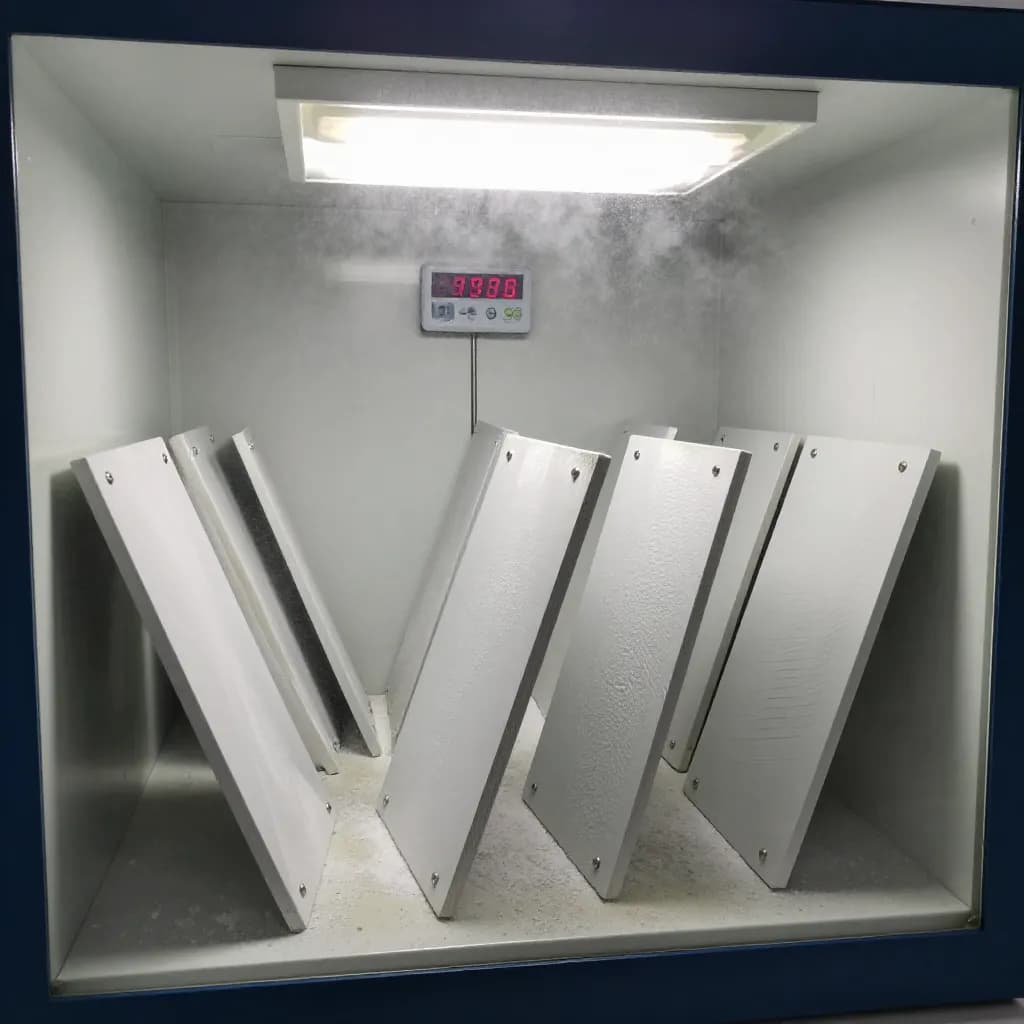
Salt spray testing evaluates the complete coating system — substrate, pretreatment, and powder coating working together — rather than any single component in isolation. A failure in any element of the system will be revealed by the test: inadequate pretreatment allows corrosion to initiate at the coating-substrate interface, insufficient film thickness permits moisture penetration, poor adhesion allows the coating to lift away from corroding metal, and coating porosity provides pathways for salt solution to reach the substrate.
Ready to Start Your Project?
From one-off customs to 15,000-part production runs — get precise pricing in 24 hours.
On This Page
What Salt Spray Testing Measures and Why It Matters
The test is used for multiple purposes: qualifying new coating systems and pretreatment processes, verifying ongoing production quality through periodic testing, comparing the performance of different coating systems, and meeting customer or specification requirements. Most industrial and architectural powder coating specifications include a minimum salt spray resistance requirement, typically expressed as a number of hours of exposure with defined maximum allowable degradation. Understanding what the test measures, how to evaluate results, and the limitations of the test is essential for coating engineers and quality managers.
Test Setup and Operating Parameters per ASTM B117
The salt spray test apparatus consists of a fog chamber (typically constructed from inert materials such as PVC or fiberglass-reinforced plastic), a salt solution reservoir, a compressed air supply with atomizing nozzles, a heating system, and a condensate collection system. The chamber must maintain specific environmental conditions throughout the test duration, and deviations from these conditions can invalidate the results.
The salt solution is prepared by dissolving 5 ± 1 parts by weight of sodium chloride in 95 parts of distilled or deionized water, producing a concentration of approximately 50 g/L. The salt must be of high purity — ASTM B117 specifies less than 0.3% total impurities on a dry basis, with specific limits on copper, nickel, and other metals that could affect corrosion behavior. The solution pH must be maintained between 6.5 and 7.2 when measured at 25°C, adjusted with dilute hydrochloric acid or sodium hydroxide as needed.
The chamber temperature is maintained at 35 ± 2°C, and the fog collection rate — measured using at least two collection funnels with a horizontal collection area of 80 cm² — must be 1.0-2.0 mL per hour per 80 cm². This collection rate ensures that the fog density is sufficient to maintain a continuous wet film on the test panels without excessive pooling. The compressed air supply must be filtered to remove oil and particulates, humidified to prevent evaporation of the salt solution in the nozzles, and regulated to produce a consistent fog density.
Test panels are positioned in the chamber at 15-30° from vertical, with the coated surface facing upward, to allow condensate to drain and prevent pooling. Panels must not contact each other or the chamber walls, and they should be arranged so that salt solution dripping from one panel does not fall on another. The chamber must not be opened during the test except for brief inspections, as opening disrupts the fog environment and can affect results.
Scribe Testing: Evaluating Corrosion at Damaged Areas
The most informative evaluation method for salt spray testing of powder coatings is the scribe test, which assesses the coating system's ability to resist corrosion spreading from a deliberate damage site. Before exposure, a straight-line scribe is cut through the coating to the bare metal substrate using a carbide-tipped scribing tool. The scribe simulates real-world damage such as scratches, stone chips, or handling damage that penetrates the coating and exposes the substrate to the corrosive environment.
After the specified exposure period, the panels are removed from the chamber, rinsed gently with clean water, and allowed to dry. The coating adjacent to the scribe is then evaluated for creep — the distance that corrosion and coating delamination have spread laterally from the scribe line. This is measured by applying adhesive tape over the scribe, pressing firmly, and removing the tape to pull away any coating that has lost adhesion due to underfilm corrosion. The maximum creep distance from the scribe edge is measured at multiple points along the scribe length, and the average or maximum value is reported.
Scribe creep is the primary performance metric for most powder coating specifications. Typical requirements include: maximum 2-3 mm creep for general industrial applications after 500-1000 hours, maximum 1-2 mm creep for automotive applications after 1000-1500 hours, and maximum 2-3 mm creep for architectural applications after 1000-2000 hours. The scribe creep value reflects the combined performance of the pretreatment (which determines how well the coating-substrate bond resists undermining by corrosion) and the coating (which determines how effectively it resists moisture penetration and maintains adhesion in the presence of corrosion products).
The scribe width and depth must be controlled for consistent results. ASTM D1654 specifies a scribe width of approximately 1 mm, penetrating completely through the coating to the substrate. A scribe that does not reach the substrate will produce artificially good results, while an excessively wide or deep scribe that damages the substrate beyond the coating interface may produce artificially poor results.
Evaluation Methods: Blistering, Rusting, and General Degradation
In addition to scribe creep, salt spray test panels are evaluated for several other degradation modes that provide information about different aspects of coating system performance. Blistering — the formation of dome-shaped elevations in the coating caused by osmotic pressure or corrosion product accumulation beneath the film — is evaluated per ASTM D714 using photographic reference standards. Blisters are classified by size (from 10, the smallest, to 0, the largest) and frequency (few, medium, medium dense, dense). Any blistering on unscribed areas indicates coating porosity, inadequate adhesion, or pretreatment failure.
Rusting on unscribed areas is evaluated per ASTM D610, which provides a numerical rating from 10 (no rust) to 0 (approximately 100% rusted). Rust on unscribed areas indicates that the coating has been penetrated by the salt solution, either through pinholes, holidays, or areas of insufficient film thickness. A rating of 9 or higher (less than 0.03% rusted) is typically required for acceptable performance.
Filament corrosion — thread-like corrosion tracks that propagate beneath the coating from initiation sites — is a specific failure mode associated with aluminum substrates, particularly when the pretreatment is inadequate. Filament corrosion is evaluated by measuring the maximum length of the filaments from the initiation point, with typical specifications requiring maximum filament lengths of 2-4 mm after the specified exposure period.
General appearance changes including discoloration, chalking, and loss of gloss are also noted, though these are more relevant to weathering tests than salt spray. Photographic documentation of the panels before and after exposure provides a permanent record of the test results and is essential for resolving disputes about evaluation ratings.
Salt Spray Hours vs Real-World Performance: The Correlation Problem
One of the most persistent misconceptions in the coatings industry is that salt spray hours can be directly converted to years of real-world service life. Statements such as '1000 hours of salt spray equals 10 years of outdoor exposure' are technically unfounded and can lead to seriously misleading performance expectations. The relationship between salt spray performance and real-world durability is complex, inconsistent, and depends heavily on the specific service environment.
The fundamental problem is that salt spray testing subjects the coating to a single, constant corrosive stress — continuous exposure to warm salt fog — while real-world environments involve a complex combination of stresses including UV radiation, temperature cycling, wet-dry cycling, atmospheric pollutants, mechanical damage, and biological growth. A coating system that performs well in salt spray may perform poorly in a UV-intensive environment, and vice versa. Salt spray testing does not evaluate UV resistance, chalking, color retention, or any of the degradation mechanisms driven by sunlight exposure.
Furthermore, the ranking of coating systems in salt spray testing does not always match their ranking in real-world performance. Studies comparing salt spray results with outdoor exposure data have shown cases where systems that performed well in salt spray failed prematurely in service, and systems with modest salt spray results provided excellent long-term outdoor performance. This is because the dominant corrosion mechanism in salt spray (continuous wet corrosion) may differ from the dominant mechanism in the service environment (cyclic corrosion, crevice corrosion, galvanic corrosion, or atmospheric corrosion).
Despite these limitations, salt spray testing remains valuable as a quality control tool for comparing coating systems under standardized conditions, verifying that production quality is consistent with qualification test results, and detecting gross failures in pretreatment or coating application. It should be used as one element of a comprehensive testing program that also includes accelerated weathering, cyclic corrosion testing, and ideally natural outdoor exposure.
Cyclic Corrosion Testing: A Better Alternative?
Cyclic corrosion tests address many of the limitations of continuous salt spray by alternating between different environmental conditions — salt spray, humidity, drying, and sometimes UV exposure — in a repeating cycle that more closely simulates real-world exposure patterns. The most widely used cyclic test standards include ASTM D5894 (alternating UV/condensation and salt fog), ASTM G85 (modified salt spray with acidified or dilute solutions), SAE J2334 (automotive cyclic corrosion), and ISO 11997 (cyclic corrosion testing of protective paint systems).
The wet-dry cycling in these tests is critical because it replicates the mechanism that drives most real-world atmospheric corrosion. During the wet phase, corrosive species penetrate the coating and initiate electrochemical corrosion at the metal surface. During the dry phase, the corrosion products concentrate and the osmotic pressure differential across the coating increases, promoting blister formation and coating delamination. This cycling mechanism is absent in continuous salt spray, which is one reason why salt spray results often fail to correlate with outdoor performance.
SAE J2334, developed by the automotive industry, is particularly well-regarded for its correlation with real-world vehicle corrosion. The test cycle consists of 6 hours of humidity at 50°C and 100% RH, followed by 15 minutes of salt application (0.5% NaCl, 0.1% CaCl₂, 0.075% NaHCO₃), followed by 17.75 hours of drying at 60°C and 50% RH. This 24-hour cycle is repeated for the specified test duration, typically 60-120 cycles for automotive applications. The multi-salt solution and the inclusion of calcium chloride better represent the road salt environment than the simple NaCl solution used in ASTM B117.
For powder coating applications where real-world correlation is important — particularly automotive, heavy equipment, and infrastructure — cyclic corrosion testing provides more meaningful performance data than continuous salt spray. However, continuous salt spray remains the most widely specified test due to its simplicity, lower equipment cost, and the extensive historical database of results that allows comparison with legacy coating systems.
Test Panel Preparation and Common Errors
The validity of salt spray test results depends critically on proper test panel preparation. Test panels should be representative of production conditions — prepared using the same substrate material, pretreatment process, powder formulation, application parameters, and cure schedule as production parts. Using specially prepared panels with optimized conditions that do not reflect actual production will produce results that overestimate the performance of the production coating system.
Substrate selection matters. ASTM B117 does not specify a particular substrate, but the choice affects results significantly. Cold-rolled steel (CRS) panels per ASTM A1008 are the most common substrate for general testing. The panel thickness should be sufficient to prevent warping during exposure — typically 0.8-1.0 mm for CRS. Panel edges should be coated or sealed with a protective tape or wax to prevent edge corrosion that can propagate under the coating and confound the evaluation of the coating system performance.
Common errors in test panel preparation include: using laboratory-grade substrates that are cleaner than production substrates; applying powder at thicknesses above the production range (thicker films always perform better in salt spray); curing at optimized conditions rather than production conditions; and scribing with inconsistent depth or width. Each of these errors biases the results in a favorable direction, creating a false sense of security about the coating system's actual production performance.
Panel identification and traceability are essential. Each panel should be permanently marked with the test identification number, substrate type, pretreatment, powder batch, film thickness, cure conditions, and scribe details. This information is needed to interpret the results and to trace any failures back to specific process conditions. Panels should be photographed before exposure, and the photographs should be included in the test report along with the post-exposure evaluation.
Interpreting Results and Making Specification Decisions
Interpreting salt spray test results requires understanding both the numerical ratings and their practical significance. A scribe creep of 2 mm after 1000 hours indicates that the coating system provides good barrier protection and that the pretreatment maintains adhesion in the presence of underfilm corrosion. A scribe creep of 8 mm after the same exposure indicates a significant weakness — likely in the pretreatment — that would result in premature failure in any corrosive service environment.
When setting salt spray requirements for a specification, consider the actual service environment and the consequences of failure. For interior applications with no corrosion exposure, salt spray testing may be unnecessary — adhesion and mechanical property testing may be sufficient. For mild exterior environments (rural, low humidity), 500 hours with maximum 3 mm scribe creep provides a reasonable quality assurance check. For moderate environments (urban, coastal proximity), 1000 hours with maximum 2 mm creep is appropriate. For severe environments (marine, industrial, road salt), 1500-2000 hours with maximum 2 mm creep, or cyclic corrosion testing, should be specified.
Avoid specifying salt spray hours based solely on what competitors claim or what sounds impressive. Excessively long test durations (3000+ hours) may not provide additional useful information and can take months to complete, delaying product qualification. Focus on the scribe creep and blister ratings rather than simply the number of hours survived, as a panel can survive many hours of exposure while showing unacceptable degradation.
For ongoing production quality control, periodic salt spray testing (monthly or quarterly) of panels prepared from production conditions provides assurance that the coating system performance has not degraded. Trending the scribe creep values over time can detect gradual deterioration in pretreatment quality or coating performance before it reaches the specification limit, enabling corrective action before non-conforming product is shipped.
Frequently Asked Questions
How many hours of salt spray testing does powder coating need to pass?
Requirements vary by application: 250-500 hours for general industrial, 500-1000 hours for moderate exterior exposure, 1000-1500 hours for automotive and heavy equipment, and 1000-2000 hours for architectural and marine applications. The scribe creep rating (typically maximum 2-3 mm) is more important than the number of hours alone.
Does 1000 hours of salt spray equal 10 years of outdoor life?
No. There is no reliable direct conversion between salt spray hours and years of outdoor service. Salt spray testing subjects coatings to continuous wet corrosion only, while real-world environments involve UV, temperature cycling, wet-dry cycling, and atmospheric pollutants. Salt spray is valuable for quality control and system comparison but should not be used to predict specific service life durations.
What is scribe creep and how is it measured?
Scribe creep is the distance that corrosion and coating delamination spread laterally from a deliberate scribe line cut through the coating before salt spray exposure. After exposure, adhesive tape is applied over the scribe and removed to pull away delaminated coating. The maximum lateral spread from the scribe edge is measured in millimeters at multiple points and reported as the average or maximum value.
Is cyclic corrosion testing better than salt spray?
Cyclic tests like SAE J2334 and ASTM D5894 generally provide better correlation with real-world performance because they alternate between wet, dry, and salt exposure phases, replicating the mechanisms that drive atmospheric corrosion. However, continuous salt spray (ASTM B117) remains widely specified due to its simplicity, lower cost, and extensive historical database for comparison.
What causes blistering in salt spray testing?
Blistering is caused by osmotic pressure or corrosion product accumulation beneath the coating film. It indicates coating porosity, inadequate adhesion, or pretreatment failure that allows salt solution to penetrate to the substrate. Blistering on unscribed areas is a more serious finding than scribe creep because it indicates a systemic weakness in the coating system rather than localized damage response.
Ready to Start Your Project?
From one-off customs to 15,000-part production runs — get precise pricing in 24 hours.