Powder reclaim — the collection and reuse of overspray powder that does not deposit on the workpiece during the first application pass — is one of the defining economic advantages of powder coating over liquid paint. While liquid paint overspray is largely wasted (captured by water wash or dry filters and disposed of as hazardous waste), powder overspray can be collected, sieved, and returned to the feed hopper for reapplication. This reclaim capability enables overall material utilization rates of 95-98%, compared to 30-70% for liquid spray painting, dramatically reducing raw material costs and waste generation.
Technical
Powder Coating Reclaim and Recycling Systems: Cyclones, Filters, Ratios, and Color Change
Sundial Powder Coating·April 22, 2026·13 min
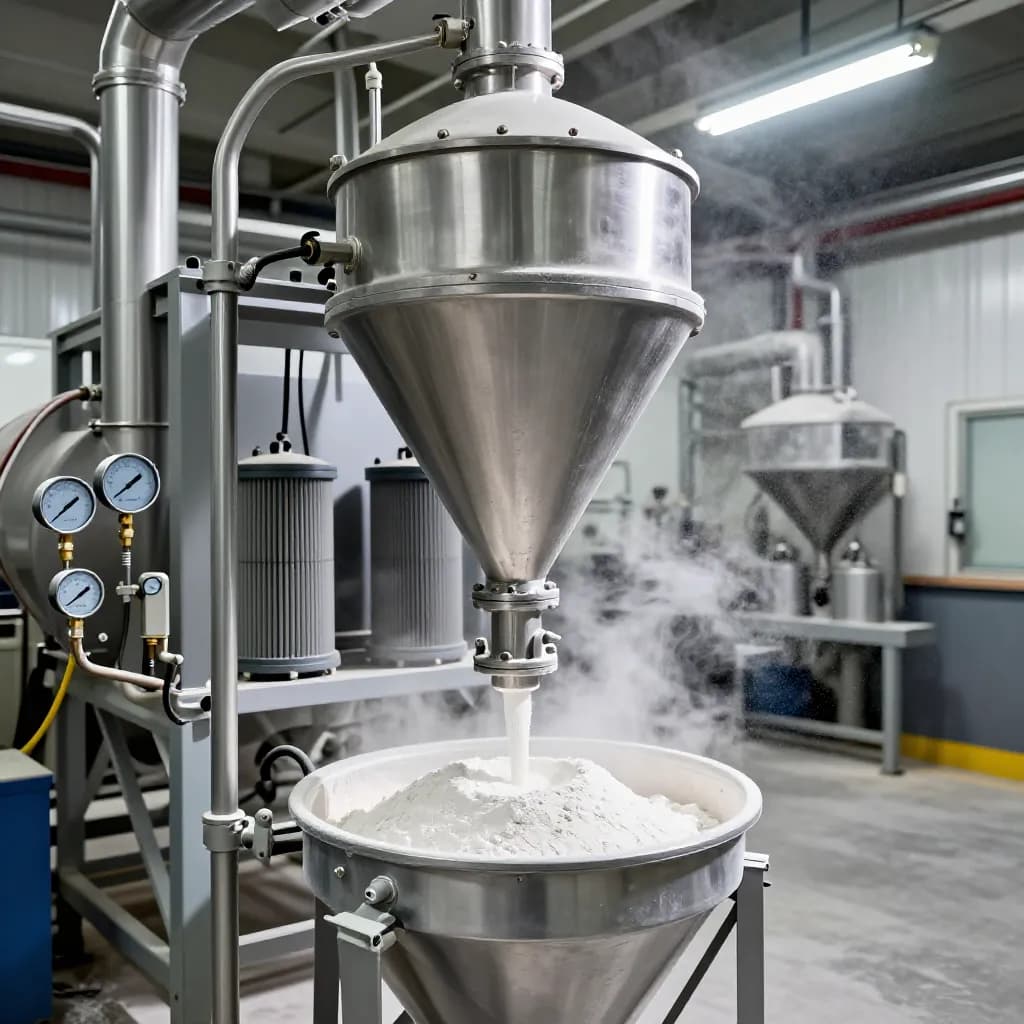
The reclaim system is an integral part of the powder coating booth, consisting of the collection mechanism (cyclone separator, cartridge filter, or both), the sieving system that removes contaminants and agglomerates, the transport mechanism that returns reclaimed powder to the feed hopper, and the blending system that mixes reclaim with virgin powder at the appropriate ratio. Each component must be properly designed, sized, and maintained to ensure that reclaimed powder meets the quality requirements for reapplication.
Ready to Start Your Project?
From one-off customs to 15,000-part production runs — get precise pricing in 24 hours.
On This Page
The Economics and Engineering of Powder Reclaim
The engineering challenge of reclaim is maintaining powder quality through multiple recirculation cycles. Each pass through the spray gun, booth, collection system, and sieve subjects the powder to mechanical stress, electrostatic charging and discharging, moisture exposure, and potential contamination. These stresses progressively alter the powder's physical properties — particularly particle size distribution, charge acceptance, and flow behavior — and can introduce contaminants that cause coating defects. Effective reclaim management requires understanding these degradation mechanisms and implementing controls to maintain powder quality within acceptable limits.
Cyclone Separators: High-Efficiency Powder Collection
Cyclone separators are the most common primary collection device in powder coating reclaim systems. They use centrifugal force to separate powder particles from the exhaust air stream — the powder-laden air enters the cyclone tangentially, creating a spinning vortex that throws heavier powder particles outward to the cyclone wall while clean air exits through the central vortex tube at the top. The separated powder falls to the bottom of the cyclone and is discharged through a rotary valve or flap valve into the reclaim transport system.
Cyclone collection efficiency depends on particle size, air velocity, cyclone geometry, and the density difference between the powder and the air. For standard powder coating particles (D50 30-40 μm), a well-designed cyclone achieves 90-95% collection efficiency by weight. However, efficiency drops sharply for fine particles — particles below 10 μm may have collection efficiencies of only 50-70%, and particles below 5 μm are largely uncollected. This size-dependent efficiency means that the reclaimed powder has a coarser PSD than the original overspray, because the finest particles pass through the cyclone and are captured by the downstream final filter.
Cyclone design parameters include the body diameter (typically 400-800 mm for powder coating applications), the inlet velocity (15-25 m/s), the cone angle, and the vortex finder diameter. Larger cyclones handle higher air volumes but have lower collection efficiency for fine particles. Smaller cyclones have higher efficiency but lower capacity. Multi-cyclone arrangements — using several smaller cyclones in parallel — can provide both high capacity and high efficiency.
The primary advantage of cyclone reclaim is speed of color change. Because the cyclone has smooth internal surfaces with minimal powder retention, it can be cleaned quickly — typically in 5-15 minutes — by blowing compressed air through the interior. This makes cyclone-based systems the preferred choice for operations that change colors frequently. The disadvantage is the lower collection efficiency for fine particles, which means that 5-10% of the overspray is lost to the final filter and cannot be reclaimed.
Cartridge Filter Systems: Maximum Recovery
Cartridge filter reclaim systems use pleated filter cartridges to capture powder from the booth exhaust air. The powder-laden air passes through the filter media, which captures particles on the outer surface while clean air passes through to the exhaust. Periodically, a reverse pulse of compressed air is directed through the cartridge from the clean side, dislodging the accumulated powder cake from the filter surface and dropping it into a collection hopper below.
Cartridge filters achieve collection efficiencies of 99.5-99.9% across all particle sizes, including the fine fraction that cyclones miss. This higher efficiency means that virtually all overspray is recovered for reuse, maximizing material utilization. The reclaimed powder from a cartridge system has a PSD that more closely matches the original overspray distribution, including the fine particles, which can be both an advantage (more complete recovery) and a disadvantage (higher fines content in the reclaim).
The main disadvantage of cartridge filter systems is the longer color change time. The pleated filter cartridges have a large surface area (typically 5-15 m² per cartridge, with 10-30 cartridges per booth) with deep pleats that trap powder in the folds. Cleaning the cartridges thoroughly enough to prevent cross-contamination during a color change requires extended blow-down cycles — typically 15-45 minutes — and even then, residual powder in the pleat roots may cause contamination of the next color. For operations that change colors frequently, this downtime is a significant productivity penalty.
Modern cartridge booth designs address the color change issue with features such as: quick-change cartridge modules that can be swapped out and cleaned offline; self-cleaning cartridges with enhanced pulse-jet systems; and booth designs that minimize powder accumulation on internal surfaces. Some systems use a hybrid approach — a cyclone for primary collection (providing fast color change) with a cartridge filter as the secondary collector (capturing the fines that pass through the cyclone). This combination provides both fast color change and high overall collection efficiency.
Virgin-to-Reclaim Ratios: Balancing Economy and Quality
The virgin-to-reclaim ratio — the proportion of fresh (virgin) powder to reclaimed (recycled) powder in the feed hopper — is the primary control for managing reclaim powder quality. As discussed in the particle size distribution article, reclaim powder undergoes a systematic PSD shift toward finer particles with each recirculation cycle, and it may also accumulate contaminants, moisture, and degraded particles. Blending reclaim with virgin powder dilutes these quality changes and maintains the blended powder within acceptable application parameters.
Typical virgin-to-reclaim ratios range from 60:40 to 80:20 (virgin:reclaim) for most production operations. The optimal ratio depends on several factors: the first-pass transfer efficiency (higher TE means less reclaim is generated per part), the sensitivity of the powder formulation to PSD changes, the quality requirements of the finished product, and the contamination level in the reclaim. Operations with high first-pass TE (60-70%) generate less reclaim and can operate at higher virgin ratios with minimal waste. Operations with low TE (40-50%) generate more reclaim and must use higher reclaim ratios to avoid excessive waste, but this increases the risk of quality problems.
Automatic ratio control systems use load cells or volumetric feeders to meter virgin and reclaim powder into the feed hopper at the specified ratio. The virgin powder is fed from a bulk container or box feeder, and the reclaim is fed from the reclaim hopper via a screw conveyor or pneumatic transport. The control system monitors the feed rates and adjusts them to maintain the target ratio. Manual ratio control — where the operator periodically adds virgin powder to the hopper based on visual assessment — is less precise and can result in ratio drift that affects coating quality.
For critical quality applications (automotive, architectural, appliance), tighter ratio control and lower reclaim percentages (20-30% reclaim) are recommended. For general industrial applications where surface finish requirements are less demanding, higher reclaim percentages (40-50%) may be acceptable. The key is to establish the maximum acceptable reclaim ratio through testing — coating panels at various ratios and evaluating surface finish, color, and film properties — and then maintaining the production ratio below this limit with appropriate monitoring.
Contamination Control in Reclaim Systems
Contamination in reclaim powder is a persistent quality concern because the reclaim system collects everything that enters the booth exhaust — not just overspray powder, but also dust, fibers, insects, rust particles from the conveyor, and any other airborne debris. Even small amounts of contamination can cause visible defects in the finished coating: dark specks from rust or dirt, craters from silicone or oil contamination, and color contamination from incomplete color changes.
Sieving is the primary contamination control measure. All reclaimed powder should pass through a vibrating sieve before returning to the feed hopper. The sieve mesh size is typically 150-200 μm (100-75 mesh), which removes agglomerates, debris, and cured powder particles while allowing normal-sized powder to pass through. Finer mesh sizes (100-120 μm) provide better contamination removal but may blind more quickly and require more frequent cleaning. The sieve should be inspected regularly for tears or holes in the mesh that would allow contaminants to pass through.
Booth cleanliness directly affects reclaim quality. Powder accumulation on booth walls, floor, and ceiling can fall into the reclaim stream as large agglomerates or contaminated clumps. Regular booth cleaning — daily for high-volume operations — prevents this accumulation. The booth interior should be smooth and free of ledges, brackets, or other features that trap powder. Booth lighting fixtures, air supply ducts, and gun mounts should be designed for easy cleaning.
Conveyor-related contamination is a common but often overlooked source. Rust and scale from the conveyor chain, paint flakes from hooks and carriers, and lubricant overspray from chain oilers can all enter the booth and contaminate the reclaim. Maintaining the conveyor in good condition, using appropriate hook cleaning procedures, and positioning chain lubrication points outside the booth area minimize this contamination source. For operations with persistent contamination problems, installing a pre-filter or magnetic separator in the reclaim line can remove ferrous particles before they reach the feed hopper.
Color Change Procedures: Speed vs Cleanliness
Color change is one of the most time-consuming and quality-critical operations in a powder coating facility. The goal is to remove all traces of the previous color from the booth, reclaim system, guns, hoses, and feed equipment before introducing the next color. Any residual powder from the previous color will contaminate the new color, causing visible specks or color shift that may result in rejected parts.
The color change procedure typically follows this sequence: stop spraying and allow the booth to clear; purge the guns and hoses with compressed air; remove and clean or replace the feed hopper; clean the booth interior (walls, floor, ceiling) with compressed air and/or vacuum; clean the reclaim system (cyclone blow-down, cartridge pulse cleaning, sieve cleaning); clean the gun exteriors and nozzles; install the new color hopper and connect to the guns; purge the guns to fill the hoses with new powder; and spray test panels to verify color purity before resuming production.
Color change time varies dramatically depending on the booth and reclaim system design. Quick-color-change booths with cyclone reclaim and smooth, non-stick interior surfaces can be changed in 10-20 minutes. Cartridge filter booths may require 30-60 minutes. Large booths with complex internal geometry and extensive ductwork can take 60-120 minutes. For operations that change colors frequently (10+ changes per shift), the color change time directly impacts productivity and is a major factor in booth selection and layout design.
Dedicated color systems — where each frequently used color has its own hopper, hoses, and guns that remain connected and ready to spray — can reduce color change time to 2-5 minutes by simply switching from one set of equipment to another. The booth and reclaim system still need cleaning, but the gun and feed system changeover is eliminated. This approach requires more equipment investment but can dramatically improve productivity for operations with a limited number of high-volume colors.
For operations running many colors with small batch sizes, the concept of color families can reduce contamination risk. Scheduling colors from light to dark within a production day means that any residual contamination from the previous color is less visible in the darker subsequent color. Starting the day with white or light colors and progressing to darker colors minimizes the visual impact of cross-contamination.
Reclaim System Maintenance and Troubleshooting
Regular maintenance of the reclaim system is essential for consistent powder quality and efficient operation. Neglected reclaim systems gradually degrade, producing contaminated or degraded powder that causes coating defects and reduces transfer efficiency.
Cyclone maintenance includes: inspecting the interior for powder buildup, particularly at the cone-to-cylinder junction and the discharge valve; checking the discharge valve for leaks that allow air infiltration and reduce collection efficiency; verifying the inlet velocity by measuring the pressure drop across the cyclone (a drop in pressure differential indicates reduced air flow or a blockage); and inspecting the vortex finder for damage or misalignment.
Cartridge filter maintenance includes: monitoring the pressure drop across the filter bank (increasing pressure drop indicates filter loading or blinding); inspecting cartridges for tears, holes, or collapsed pleats; verifying the pulse-jet cleaning system is functioning correctly (check air pressure, solenoid valve operation, and pulse timing); and replacing cartridges when they can no longer be cleaned to acceptable pressure drop levels. Cartridge life varies from 6 months to 3 years depending on the powder type, production volume, and cleaning frequency.
Sieve maintenance includes: inspecting the mesh for tears, holes, and blinding; checking the vibration motor for proper operation and amplitude; cleaning the mesh regularly to prevent blinding by fine particles or moisture-agglomerated powder; and replacing the mesh when it shows signs of wear or fatigue. A blinded sieve restricts powder flow and can cause the reclaim hopper to overflow, while a torn sieve allows contaminants to pass through to the feed hopper.
Common reclaim system problems and their causes include: inconsistent powder output (clogged reclaim transport line, inconsistent sieve throughput, or hopper bridging); contamination specks in the finished coating (torn sieve mesh, inadequate booth cleaning, or conveyor contamination); color contamination after color change (incomplete booth or cyclone cleaning, residual powder in hoses or dead spots); and excessive fines in the blended powder (reclaim ratio too high, cyclone efficiency degraded, or virgin powder PSD out of specification).
Advanced Reclaim Technologies and Zero-Waste Strategies
The powder coating industry continues to develop advanced reclaim technologies aimed at maximizing material utilization, reducing color change time, and improving reclaim powder quality. Several innovations are reshaping reclaim system design.
Self-cleaning booth designs use smooth, conductive interior surfaces (typically stainless steel or conductive plastic) combined with automated air-blow systems that clean the booth interior without manual intervention. These booths can complete a color change in 60-90 seconds for the booth cleaning step, with the remaining time consumed by gun and hose purging. Combined with dedicated color hopper systems, total color change times of 3-5 minutes are achievable.
Intelligent reclaim management systems use real-time monitoring of reclaim powder properties — including PSD (via inline laser diffraction), moisture content (via capacitive sensors), and contamination level (via optical particle counters) — to automatically adjust the virgin-to-reclaim ratio and flag quality deviations. These systems can detect a PSD shift or contamination event within minutes and adjust the process before defective parts are produced.
Powder conditioning systems address the degradation of reclaim powder by processing it through a controlled environment that removes moisture, breaks up agglomerates, and restores flow properties. These systems typically use a combination of gentle mechanical agitation, controlled heating (to 30-40°C), and dry air purging to recondition reclaim powder to near-virgin quality.
Zero-waste strategies aim to eliminate all powder waste from the coating operation. This requires maximizing first-pass transfer efficiency (through optimized gun settings and part orientation), maintaining reclaim quality through rigorous PSD and contamination control, and finding productive uses for any powder that cannot be reclaimed — such as using off-spec reclaim as a base for dark colors, or processing waste powder into filler material for non-critical applications. Some operations achieve true zero-powder-waste by combining high-efficiency application with comprehensive reclaim management and creative waste utilization.
Frequently Asked Questions
What is the difference between cyclone and cartridge filter reclaim?
Cyclone separators use centrifugal force to collect 90-95% of overspray with fast color change times (5-15 minutes) but miss fine particles below 10 μm. Cartridge filters capture 99.5-99.9% of all particle sizes but require longer color change times (15-45 minutes) due to powder trapped in filter pleats. Many systems use both — a cyclone for primary collection and cartridge filters for final cleanup.
What virgin-to-reclaim ratio should I use?
Typical ratios range from 60:40 to 80:20 (virgin:reclaim). Critical quality applications (automotive, architectural) should use 70:30 to 80:20. General industrial applications may accept 60:40 to 50:50. The optimal ratio depends on first-pass transfer efficiency, powder formulation sensitivity, and quality requirements. Establish the maximum acceptable ratio through testing and maintain production below this limit.
How do you prevent color contamination during color changes?
Follow a systematic procedure: purge guns and hoses, clean the booth interior with compressed air and/or vacuum, clean the reclaim system (cyclone blow-down or cartridge pulse cleaning), clean sieves, install new color equipment, and spray test panels before production. Schedule colors light-to-dark to minimize visible contamination. Use dedicated color hoppers and hoses for high-volume colors.
Why does reclaim powder cause surface finish problems?
Reclaim powder undergoes progressive PSD shift toward finer particles, accumulates moisture, and may contain contaminants from the booth environment. Excessive fines cause poor fluidization and inconsistent spray patterns. Contamination causes specks and craters. Managing the virgin-to-reclaim ratio, regular PSD monitoring, proper sieving, and booth cleanliness prevent these problems.
How often should reclaim system components be maintained?
Sieves should be inspected daily and mesh replaced when worn or torn. Cyclones should be inspected weekly for buildup and discharge valve function. Cartridge filters should have pressure drop monitored continuously and cartridges inspected monthly. Booth cleaning should be performed daily for high-volume operations. Comprehensive system maintenance should be scheduled quarterly.
Ready to Start Your Project?
From one-off customs to 15,000-part production runs — get precise pricing in 24 hours.