Racking — the method of holding and supporting parts during the powder coating process — is one of the most underappreciated factors in coating quality. The way a part is hung, supported, and oriented as it moves through pretreatment, application, and curing directly affects coating coverage, film thickness uniformity, appearance, and the location and visibility of contact marks. Poor racking can turn a well-formulated powder and a well-maintained coating line into a source of defects and customer complaints.
Technical
Powder Coating Racking and Hanging Techniques: Rack Design, Ground Paths, and Custom Fixtures
Sundial Powder Coating·April 22, 2026·13 min
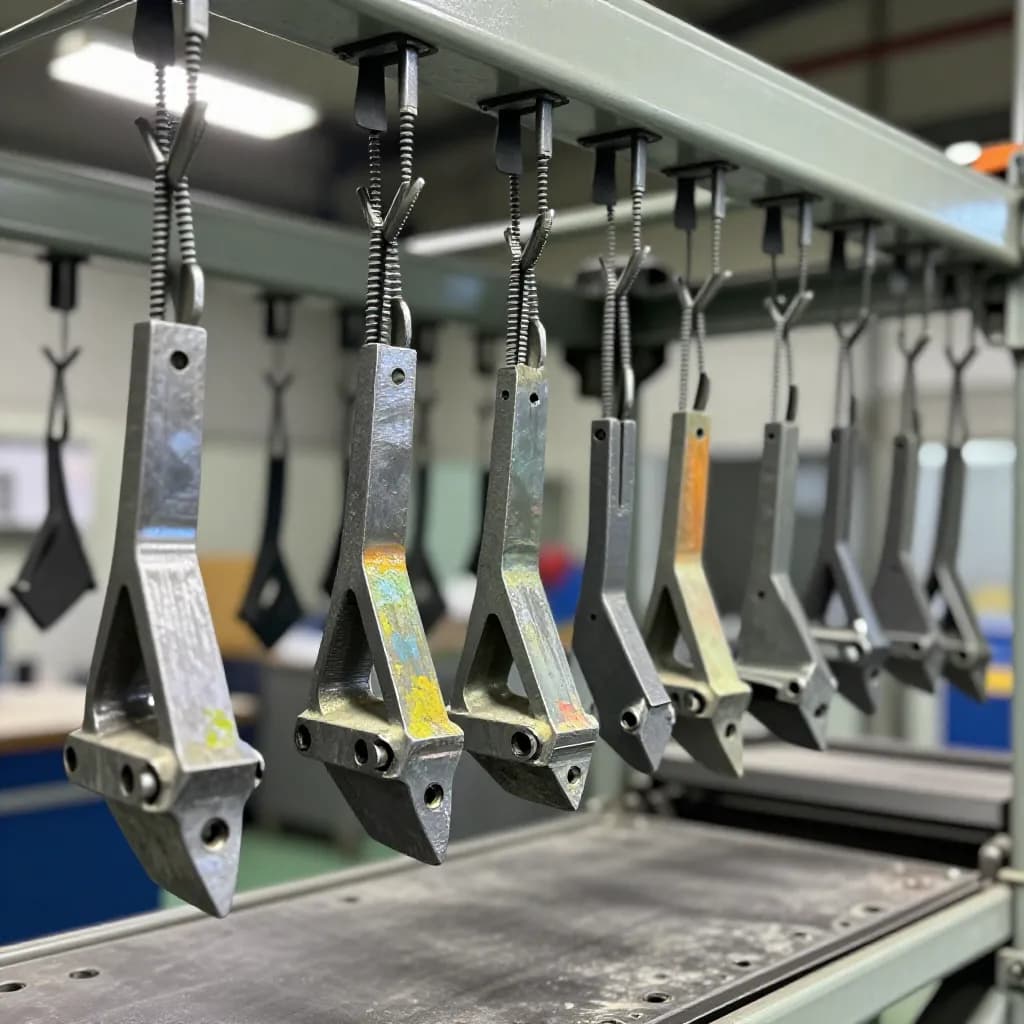
The racking system must accomplish several things simultaneously. It must hold the part securely through all process stages — including the pretreatment wash, where water pressure can dislodge loosely held parts, and the cure oven, where thermal expansion can shift part positions. It must provide a reliable electrical ground path from the part to the conveyor or rack frame, because electrostatic powder application depends on the part being at ground potential to attract charged powder particles. It must orient the part to maximize coating access to all surfaces while minimizing Faraday cage effects in recessed areas. And it must do all of this while leaving the smallest possible contact marks on the finished surface.
Ready to Start Your Project?
From one-off customs to 15,000-part production runs — get precise pricing in 24 hours.
On This Page
Why Racking Is Critical to Coating Quality
These requirements often conflict with each other. A secure hold requires firm contact, but firm contact creates larger, more visible marks. Maximum coating access may require an orientation that makes the part less stable on the rack. Optimal part density for throughput may compromise access for the spray guns. Resolving these trade-offs is the art and science of racking, and experienced coaters invest significant time and creativity in developing racking solutions that balance all requirements.
Contact Points and Mark Management
Every point where a rack, hook, or fixture touches the part creates a contact mark — a small area where the coating is absent or disturbed. These marks are an inherent consequence of the racking process and cannot be completely eliminated, but they can be managed through thoughtful rack design and strategic placement.
The goal is to locate contact points on non-visible or non-critical surfaces wherever possible. For a cabinet door, hang it from the top edge where the hinge will cover the mark. For a bracket, support it at a mounting hole that will be covered by a bolt head. For a tube or pipe, grip it at the end that will be inserted into a fitting. When contact marks must fall on visible surfaces, minimize their size by using the smallest practical contact area — a sharp hook point creates a smaller mark than a flat support surface.
The number of contact points should be the minimum needed for secure support and adequate grounding. Each additional contact point is another mark on the finished part. However, too few contact points can result in parts falling off the rack (a safety hazard and a quality disaster) or inadequate grounding (causing poor powder attraction and thin, uneven coating). The balance depends on part weight, geometry, and the forces experienced during processing — particularly the water pressure in pretreatment spray washers and the air movement in the spray booth.
Contact mark touch-up is sometimes necessary for parts where marks fall on visible surfaces. Touch-up is typically performed with color-matched liquid paint applied by brush or aerosol after the powder coating is cured. While touch-up paint does not match the durability of the original powder coating, it provides acceptable cosmetic coverage for small contact marks. For applications where touch-up is unacceptable, the racking solution must be designed to place all contact points on hidden surfaces — a constraint that may limit part density and increase coating cost.
Ground Path Design and Electrical Considerations
Electrostatic powder application depends on a reliable electrical ground path from the part being coated, through the rack or fixture, to the conveyor or booth ground. If this ground path is interrupted or has high resistance, the electrostatic attraction that holds powder on the part is weakened, resulting in poor powder deposition, uneven coverage, and thin films. Ground path quality is one of the most common root causes of coating defects, and it deserves careful attention in rack design.
The ground path must be metal-to-metal contact at every connection point: from the part to the hook or fixture, from the hook to the rack frame, and from the rack frame to the conveyor or booth ground. Powder coating build-up on racks and hooks progressively insulates these contact points, degrading the ground path over time. This is why racks must be stripped of accumulated coating regularly — typically after every 5 to 15 uses, depending on the coating thickness and the sensitivity of the application to ground path quality.
Rack stripping is performed by burning off the accumulated powder in a burn-off oven (typically at 400 to 500°C), by chemical stripping in a hot caustic or solvent bath, or by media blasting. Each method has trade-offs: burn-off is fast but can weaken rack metal over repeated cycles; chemical stripping is gentler but slower and generates chemical waste; media blasting is effective but labor-intensive. Many operations use a combination — burn-off for routine stripping with periodic chemical or mechanical cleaning to remove residues that burn-off leaves behind.
For parts with complex geometries or multiple isolated sections, the rack design must ensure that every section of the part has a ground path. A part with an isolated tab or flange that is not in electrical contact with the main body will not attract powder to that section, creating a bare spot that is only discovered after curing.
Part Density and Throughput Optimization
Part density — the number of parts per rack or per linear meter of conveyor — directly affects throughput and coating cost. Higher density means more parts processed per oven cycle or per hour of conveyor operation, reducing the per-part cost of energy, labor, and overhead. However, increasing density beyond the optimal point compromises coating quality by restricting spray gun access, creating Faraday cage effects between closely spaced parts, and causing parts to shield each other from the powder spray.
The optimal part spacing depends on part geometry, the spray gun configuration, and the quality requirements. Flat parts like panels and brackets can be spaced relatively closely — as little as 50 to 100 mm apart — because the spray guns can access the surfaces without obstruction. Three-dimensional parts like housings, frames, and complex assemblies require more spacing to allow the spray pattern to reach all surfaces, including interior corners and recessed areas. A general guideline is to maintain at least 100 to 150 mm clearance between parts for standard geometries, increasing to 200 mm or more for complex shapes.
Rack layout should be planned systematically rather than ad hoc. Create a rack loading diagram that shows the optimal position for each part type, the hook or fixture location, and the minimum spacing. Train loading personnel to follow the diagram consistently. Inconsistent loading — parts too close together in some areas, too far apart in others — wastes capacity and creates quality variation.
For continuous lines, part density is also constrained by the conveyor hook spacing, which is fixed during line installation. If the standard hook spacing does not match the optimal part spacing for a particular product, adapter fixtures that hold multiple parts per hook position can improve density without modifying the conveyor.
Custom Fixtures for Complex Parts
Standard hooks and clips work well for simple parts — flat panels, brackets, tubes, and small components — but complex parts often require custom fixtures designed specifically for their geometry. Custom fixtures ensure secure holding, optimal orientation, reliable grounding, and consistent contact mark placement across production runs.
Custom fixture design starts with understanding the part geometry, the critical surfaces (where coating quality and appearance are most important), the non-critical surfaces (where contact marks can be tolerated), and the process forces the fixture must withstand. The fixture designer — often a skilled rack builder within the coating operation — creates a holding device that grips the part at non-critical locations, orients it for maximum spray access to critical surfaces, and provides a robust ground path.
Common custom fixture types include cradles that support parts from below, clamps that grip parts at edges or flanges, mandrels that insert into holes or bores, and multi-part trees that hold several small parts on a single fixture. Materials are typically mild steel wire or rod, bent and welded to shape. Stainless steel is used for fixtures that will be chemically stripped, as it resists the stripping chemicals better than mild steel.
The investment in custom fixtures pays for itself through improved quality, reduced rework, and faster loading times. A well-designed fixture allows loading personnel to place parts quickly and consistently, eliminating the trial-and-error of finding a workable hanging position for each part. For high-volume production of a specific part, the fixture cost is amortized over thousands of parts and becomes negligible on a per-part basis. For job shops coating diverse parts in small quantities, a library of adjustable, multi-purpose fixtures provides flexibility without the cost of dedicated fixtures for every part type.
Racking for Automatic Spray Systems
Automatic spray systems — reciprocators and robots — impose additional requirements on racking that manual spray operations do not. Automatic guns follow programmed paths and spray patterns optimized for a specific part position and orientation on the rack. If parts are not positioned consistently, the automatic program will apply powder to the wrong locations, resulting in uneven coverage, excessive build-up in some areas, and thin spots in others.
For reciprocating gun systems, parts should be arranged in a consistent vertical pattern that matches the reciprocator stroke. All parts should be at the same distance from the guns, at the same height range, and with the same orientation. The reciprocator program is set for a specific part arrangement, and any deviation from that arrangement degrades coating uniformity. This means that rack loading must be precise and repeatable — a requirement that favors dedicated fixtures with defined part positions over ad hoc hook hanging.
Robotic spray systems offer more flexibility because the robot can be programmed to follow the contours of individual parts, adjusting its path, speed, and spray parameters for each part position on the rack. However, this flexibility requires that the robot knows exactly where each part is located. Part position repeatability on the rack is still essential — the robot program assumes parts are in specific positions, and misplaced parts will receive incorrect spray coverage.
Part recognition systems using vision cameras or laser scanners are emerging technologies that allow automatic spray systems to detect actual part positions and adjust their programs in real time. These systems reduce the sensitivity to racking precision and can accommodate some variation in part placement, but they add cost and complexity to the spray system. For most operations, investing in consistent, repeatable racking is more practical and cost-effective than relying on adaptive spray technology to compensate for inconsistent racking.
Racking for Special Applications
Certain applications impose unique racking challenges that require specialized solutions beyond standard hooks and fixtures.
Large, heavy parts — structural steel members, heavy equipment frames, large architectural panels — require racks and conveyors rated for the load. Standard light-duty conveyor systems may not support the weight, and standard hooks may bend or break. Heavy-duty racking uses thicker wire or rod, reinforced hook designs, and load-rated conveyor carriers. The oven and pretreatment systems must also be sized to accommodate the physical dimensions of large parts.
Small, lightweight parts — fasteners, clips, small brackets, electronic components — present the opposite challenge. These parts are too small or too light to hang individually on standard hooks. Solutions include racking multiple parts on a single fixture (tree racking), placing parts on coated wire mesh trays that allow powder to reach all surfaces, or using magnetic fixtures that hold ferrous parts without mechanical clips. The challenge with small parts is achieving adequate coverage on all surfaces while maintaining reasonable throughput.
Parts requiring coating on internal surfaces — tubes, pipes, hollow sections, and enclosed housings — need racking that allows the spray gun to access the interior. This may require specific orientations (open end facing the gun), internal spray lances that insert into the part, or tribo-charging guns that can reach into Faraday cage areas more effectively than corona guns. Internal coating is one of the most challenging aspects of powder coating, and the racking solution is a critical enabler.
Heat-sensitive assemblies — parts with press-fit bearings, adhesive bonds, or electronic components that cannot withstand full cure temperature — may require partial masking and careful racking to minimize heat exposure to sensitive areas while ensuring adequate cure of the coated surfaces.
Frequently Asked Questions
Why do powder coated parts have small uncoated marks?
These are contact marks where the rack, hook, or fixture touched the part during coating. Every part must be held by something during the process, and the contact points prevent powder from reaching those spots. Good racking design places contact marks on non-visible or non-critical surfaces to minimize their impact.
How often should powder coating racks be stripped?
Racks should be stripped of accumulated coating every 5-15 uses, depending on coating thickness and quality requirements. Accumulated powder insulates the ground path, degrading electrostatic attraction and causing poor powder deposition. Stripping methods include burn-off ovens, chemical baths, and media blasting.
What is a ground path in powder coating?
The ground path is the electrical connection from the part being coated, through the rack and conveyor, to earth ground. Electrostatic powder application requires the part to be at ground potential so charged powder particles are attracted to it. A poor ground path results in weak powder attraction, uneven coverage, and thin films.
How close together can parts be hung for powder coating?
Optimal spacing depends on part geometry and spray configuration. Flat parts can be spaced 50-100 mm apart. Three-dimensional parts typically need 100-200 mm or more clearance to allow spray access to all surfaces. Too-close spacing creates shielding effects and Faraday cage problems that cause uneven coating.
Do I need custom fixtures for powder coating?
Standard hooks work for simple parts, but complex geometries benefit significantly from custom fixtures that ensure consistent positioning, reliable grounding, and strategic contact mark placement. Custom fixtures improve quality, reduce rework, and speed up loading. The investment is easily justified for parts coated in volume.
Ready to Start Your Project?
From one-off customs to 15,000-part production runs — get precise pricing in 24 hours.