Quality control in powder coating is not a single inspection at the end of the line — it is a systematic program of checks, measurements, and controls that spans the entire process from incoming materials to final shipment. A comprehensive QC system catches problems at the earliest possible stage, when corrective action is least costly, and provides documented evidence that every part shipped meets the specified requirements.
Technical
Powder Coating Quality Control and Inspection: Instruments, Acceptance Criteria, and SPC
Sundial Powder Coating·April 22, 2026·14 min
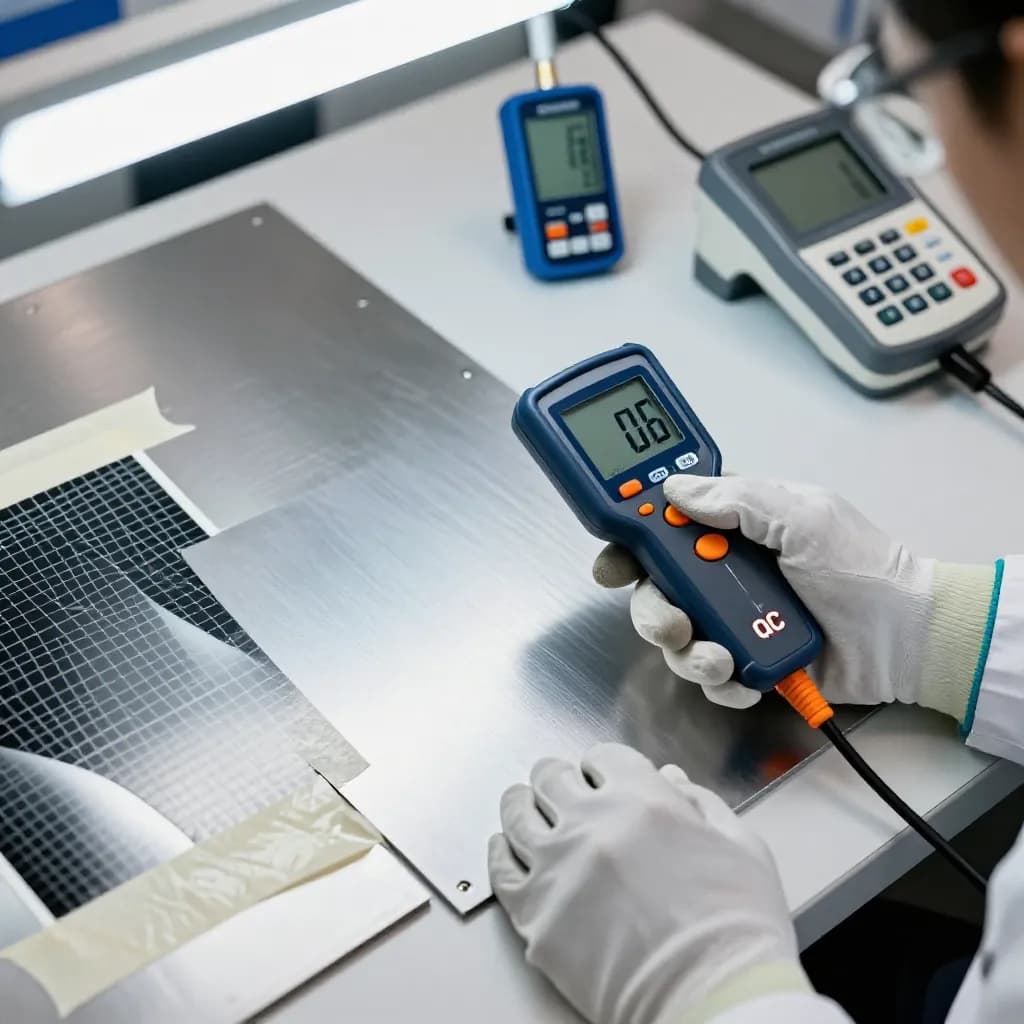
The quality control system should be structured around three phases: incoming inspection (verifying that raw materials and substrates meet specifications before they enter the process), in-process control (monitoring critical process parameters during production to ensure they remain within established limits), and final inspection (verifying that finished parts meet all appearance, dimensional, and performance requirements before shipment).
Ready to Start Your Project?
From one-off customs to 15,000-part production runs — get precise pricing in 24 hours.
On This Page
Building a Comprehensive Quality Control System
The foundation of the QC system is documentation — written procedures that define what is inspected, how it is measured, what the acceptance criteria are, how often inspections are performed, and what actions are taken when results are out of specification. This documentation serves multiple purposes: it ensures consistency regardless of which operator performs the inspection, it provides traceability for customer complaints and warranty claims, it satisfies the requirements of quality management standards such as ISO 9001, and it supports continuous improvement by providing data for trend analysis and root cause investigation.
Incoming Inspection: Substrates and Powder Materials
Incoming inspection verifies that substrates and powder coating materials meet their specifications before entering the production process. Catching a defective substrate or out-of-spec powder batch at the receiving dock is far less costly than discovering the problem after coating, curing, and inspection.
Substrate inspection should verify: material type and grade (confirmed by mill certificates or material test reports); surface condition (free from excessive rust, scale, oil, or mechanical damage); dimensional accuracy (critical dimensions within tolerance); and weld quality (for fabricated assemblies). For aluminum substrates, the alloy and temper should be verified against the purchase order. For galvanized steel, the zinc coating weight should be confirmed. A visual inspection of each incoming lot, supplemented by dimensional checks on a sample basis, is the minimum requirement.
Powder coating incoming inspection should include: verification of the product identification (manufacturer, product code, batch number, color) against the purchase order; visual comparison of the powder color against the approved reference standard under controlled lighting; instrumental color measurement using a spectrophotometer, with Delta E calculated against the reference; particle size distribution measurement (by laser diffraction or sieve analysis) to verify the PSD is within specification; and gel time measurement (by hot plate or DSC) to verify the reactivity is within the expected range.
For critical applications, incoming powder inspection may also include: application of test panels using the production spray equipment and cure schedule, followed by film thickness measurement, gloss measurement, adhesion testing, and visual appearance evaluation. This application test verifies that the powder performs correctly under actual production conditions, catching any issues that laboratory measurements alone might miss. Incoming inspection results should be recorded and linked to the batch number for traceability throughout the production process.
In-Process Quality Checks: Pretreatment Through Cure
In-process quality checks monitor critical process parameters at each stage of the coating operation, providing real-time assurance that the process is operating within established control limits. These checks are performed by production operators as part of their standard work routine, with results recorded on process control sheets or entered into electronic data collection systems.
Pretreatment checks include: bath temperature (measured with a calibrated thermometer or RTD probe), chemical concentration (measured by titration at specified intervals), pH (measured with a calibrated pH meter), rinse water conductivity (measured with a conductivity meter), and conversion coating weight (measured by gravimetric method or XRF on test coupons processed with the production parts). Water break testing on cleaned parts verifies that organic contaminants have been removed. These checks should be performed at least twice per shift during production, with additional checks after bath replenishment or process interruptions.
Application checks include: film thickness measurement on the first parts of each production run and at regular intervals thereafter (typically every 30-60 minutes or every 50-100 parts); visual inspection of the deposited powder layer for uniformity, coverage, and defects; gun voltage and current verification against the process standard; and powder output rate verification. Film thickness should be measured at a minimum of 3-5 points per part, including the thinnest expected area and the thickest expected area.
Cure checks include: oven temperature verification against the setpoint (using the oven controller display and periodic independent thermocouple verification); oven temperature profiling at specified intervals (weekly minimum, plus whenever part geometry or line speed changes); and cured film property testing including MEK solvent rub test for cure verification, pencil hardness, and adhesion testing. The MEK rub test should be performed on the first parts of each production run and at regular intervals to confirm that the cure schedule is producing fully crosslinked films.
Final Inspection: Appearance, Dimensions, and Performance
Final inspection is the last quality gate before parts are released for shipment. It verifies that every part meets all specified requirements for appearance, film properties, and dimensional accuracy. The scope and intensity of final inspection depend on the criticality of the application and the customer's quality requirements.
Visual appearance inspection evaluates: color consistency (compared to the approved reference standard under controlled lighting); surface finish quality (freedom from defects including orange peel, pinholes, craters, runs, sags, inclusions, and contamination); gloss level (verified by glossmeter measurement at 60° angle per ASTM D523); and masking quality (all masked areas properly protected, all masking materials removed, clean masking edges). Visual inspection should be performed under standardized lighting conditions — a minimum of 500 lux illuminance with D65 or equivalent daylight-balanced lighting — at a viewing distance of 30-50 cm.
Film property measurements include: dry film thickness at specified measurement points (using calibrated magnetic or eddy current gauges); adhesion testing per ASTM D3359 (cross-hatch) on a sample basis; hardness testing per ASTM D3363 (pencil hardness) on a sample basis; and cure verification by MEK rub test on a sample basis. The sampling frequency depends on the production volume and the process capability — a capable, stable process may require only 1-2% sampling, while a less capable process may require 100% measurement of critical parameters.
Dimensional inspection verifies that the coating thickness has not caused the part to exceed dimensional tolerances. For precision components with tight tolerances (±0.05 mm or less), the coating thickness must be accounted for in the dimensional specification. Critical dimensions should be measured after coating to confirm compliance.
All final inspection results should be documented on an inspection report or certificate of conformance that accompanies the shipment. The report should include: part identification, quantity, powder batch number, film thickness measurements, adhesion test results, gloss readings, color measurement data, and a statement of conformance to the applicable specification. This documentation provides traceability and evidence of quality for the customer's records.
Quality Control Instruments and Their Calibration
A powder coating quality control laboratory requires a specific set of instruments, each of which must be properly calibrated and maintained to provide accurate, reliable measurements. The core instrument set includes:
Coating thickness gauge — magnetic induction and/or eddy current type, with accuracy of ±1-3% or ±1-2.5 μm. Calibration is performed using certified thickness standards (calibration foils) traceable to national standards. Calibration should be verified at the start of each shift and after any impact or suspected damage to the probe.
Glossmeter — 60° measurement angle per ASTM D523, with additional 20° and 85° angles for high-gloss and low-gloss surfaces respectively. Calibration is performed using certified gloss standards. Verification should be performed daily.
Spectrophotometer — sphere geometry (d/8°) or 45°/0° geometry, with inter-instrument agreement of Delta E ≤ 0.3. Calibration is performed using certified white and black tiles. Verification should be performed at the start of each shift.
Adhesion test kit — multi-blade cutting tool with sharp blades at the correct spacing, specified pressure-sensitive tape, and magnifying glass for evaluation. Blade sharpness should be verified regularly by examining the cut quality on a test panel.
Pencil hardness test kit — set of calibrated pencils from 6B to 6H per ASTM D3363, with a pencil hardness tester that applies consistent force and angle. Pencils should be sharpened to a flat, cylindrical tip before each test.
MEK solvent and cotton swabs for the solvent rub test per ASTM D5402. Fresh MEK should be used (not recycled or contaminated solvent), and the cotton swab should be saturated but not dripping.
All instruments should be included in a calibration management program that tracks calibration dates, calibration results, and next-due dates. Calibration intervals should be based on the instrument manufacturer's recommendations and the instrument's usage frequency — typically 6-12 months for laboratory instruments and 3-6 months for production floor instruments that are subject to more wear and environmental exposure.
Statistical Process Control: Data-Driven Quality Management
Statistical process control (SPC) transforms quality control from a reactive inspection activity into a proactive process management tool. By collecting and analyzing process data in real time, SPC detects trends and shifts in process performance before they result in non-conforming product, enabling corrective action while the process is still producing acceptable parts.
The key SPC tools for powder coating are control charts and process capability analysis. Control charts plot measured values (film thickness, gloss, color, cure parameters) over time, with statistically calculated control limits that represent the natural variation of the process. Points within the control limits indicate a stable, predictable process. Points outside the control limits, or patterns such as runs, trends, or cycles, indicate that an assignable cause has changed the process and investigation is needed.
X-bar and R charts are used for variables data (film thickness, gloss, Delta E) when multiple measurements are taken per sample group. Individual and moving range (I-MR) charts are used when only one measurement per sample is practical. For attribute data (pass/fail visual inspection results), p-charts or np-charts track the proportion or number of defective parts per sample.
Process capability indices Cp and Cpk quantify the relationship between the process variation and the specification limits. Cp measures the potential capability (the ratio of the specification width to the process spread), while Cpk measures the actual capability (accounting for any offset of the process mean from the specification center). A Cpk of 1.0 means the process just fits within the specification; 1.33 provides a comfortable margin; and 1.67 or higher indicates an excellent process with very low risk of non-conformance.
For powder coating, the most valuable SPC applications are: film thickness control (tracking average and range at defined measurement points), color consistency (tracking Delta E of production parts against the reference standard), gloss consistency (tracking 60° gloss readings), and cure verification (tracking MEK rub test results or oven profile data). Implementing SPC on these key parameters provides early warning of process drift and supports data-driven decision-making for process adjustments.
Defect Classification and Response Protocols
A structured defect classification system ensures consistent evaluation of coating quality and appropriate response to different types and severities of defects. Defects should be classified by type (what the defect is), severity (how bad it is), and location (where on the part it occurs), with defined response actions for each classification.
Defect types in powder coating include: surface texture defects (orange peel, roughness, waviness); surface contamination defects (inclusions, specks, fisheyes, craters); film integrity defects (pinholes, holidays, thin spots, bare areas); application defects (runs, sags, drips, overspray); cure defects (under-cure, over-cure, yellowing); and handling defects (scratches, chips, dents, fingerprints). Each type has different root causes and corrective actions.
Severity classification typically uses a three-level system: critical defects that render the part non-functional or unsafe (bare areas on corrosion-critical surfaces, coating on mating surfaces that should be bare); major defects that are clearly visible and affect the part's appearance or performance (large inclusions, significant color deviation, adhesion failure); and minor defects that are barely visible or do not affect function (slight orange peel within specification, minor gloss variation, small isolated specks).
Response protocols define the action taken for each severity level: critical defects require immediate production stop, segregation of affected parts, root cause investigation, and corrective action before production resumes; major defects require segregation of affected parts, notification of the quality supervisor, and investigation of the root cause; minor defects are documented and monitored for trends but do not require production interruption unless the frequency exceeds a defined threshold.
A defect tracking system — whether a simple spreadsheet or a dedicated quality management software — records every defect found during inspection, including the defect type, severity, location, quantity affected, root cause (when determined), and corrective action taken. This data supports Pareto analysis to identify the most frequent and costly defect types, trend analysis to detect emerging problems, and continuous improvement initiatives to reduce overall defect rates.
Quality Standards and Certification Requirements
Powder coating operations serving specific market segments must comply with industry quality standards that define minimum requirements for process control, testing, and documentation. Understanding these standards is essential for meeting customer expectations and maintaining certification.
ISO 9001 is the foundational quality management system standard applicable to all manufacturing operations. It requires documented procedures, process control, calibrated instruments, trained personnel, internal audits, and management review. ISO 9001 certification is a baseline expectation for most commercial powder coating operations.
Qualicoat is the European quality label for powder-coated architectural aluminum. It specifies detailed requirements for pretreatment (minimum conversion coating weight, rinse quality), application (film thickness ranges, uniformity), cure (oven profiling, MEK testing), and finished product testing (adhesion, hardness, impact, boiling water, Machu, accelerated weathering, natural weathering). Qualicoat-licensed applicators are audited annually by independent inspectors who verify compliance with all requirements.
GSB International provides quality certification for coated aluminum and steel, with Standard, Premium, and Master tiers. Each tier has progressively more demanding requirements for weathering resistance, mechanical properties, and chemical resistance. GSB certification requires initial type testing of the coating system plus ongoing production quality monitoring.
AAMA (American Architectural Manufacturers Association) specifications — 2603, 2604, and 2605 — define performance requirements for architectural coatings in North America. While AAMA does not certify applicators directly, many specifications require that coatings meet AAMA performance requirements, and applicators must demonstrate compliance through testing.
Automotive quality standards including IATF 16949 (the automotive quality management system standard) and CQI-12 (Special Process: Coating System Assessment) impose additional requirements for process control, statistical methods, error-proofing, and traceability that go beyond general ISO 9001 requirements. Automotive coating operations must demonstrate process capability (Cpk ≥ 1.33 or higher) for critical parameters and maintain detailed production records for every batch.
Frequently Asked Questions
What are the essential quality control instruments for powder coating?
The core set includes: coating thickness gauge (magnetic/eddy current), glossmeter (60° angle per ASTM D523), spectrophotometer for color measurement, adhesion test kit (cross-hatch cutter and tape per ASTM D3359), pencil hardness test set (ASTM D3363), and MEK solvent for cure verification (ASTM D5402). All instruments must be calibrated and included in a calibration management program.
How often should film thickness be measured during production?
Measure the first parts of each production run, then at regular intervals — typically every 30-60 minutes or every 50-100 parts. Measure at minimum 3-5 points per part including the thinnest and thickest expected areas. For SPC programs, measure defined points on a sample of parts per the established sampling plan.
What is a good Cpk value for powder coating film thickness?
A Cpk of 1.33 or higher indicates a capable process with low risk of non-conformance. Automotive applications typically require Cpk ≥ 1.33 or ≥ 1.67 for critical parameters. A Cpk of 1.0 means the process just fits within specification with no margin. Values below 1.0 indicate the process is not capable of consistently meeting the specification.
What quality certifications are important for powder coating?
ISO 9001 is the baseline quality management standard. Qualicoat and GSB International certify architectural coating quality in Europe. AAMA specifications define performance requirements in North America. IATF 16949 and CQI-12 are required for automotive coating operations. The relevant certifications depend on the market segments served.
How should coating defects be classified and tracked?
Use a three-level severity system: critical (non-functional/unsafe), major (clearly visible/affects performance), and minor (barely visible/no functional impact). Define response protocols for each level — critical requires production stop and investigation; major requires segregation and investigation; minor requires documentation and trend monitoring. Track all defects in a database for Pareto and trend analysis.
Ready to Start Your Project?
From one-off customs to 15,000-part production runs — get precise pricing in 24 hours.