The powder coating process transforms raw metal parts into durable, beautifully finished products through a carefully controlled sequence of steps. While the basic concept is straightforward — apply dry powder to a metal surface and bake it to form a hard coating — achieving consistent, high-quality results requires precision at every stage. Each step in the process builds upon the previous one, and a failure at any point can compromise the quality and durability of the final finish.
Technical
The Powder Coating Process: A Step-by-Step Guide
Sundial Powder Coating·April 20, 2026·11 min
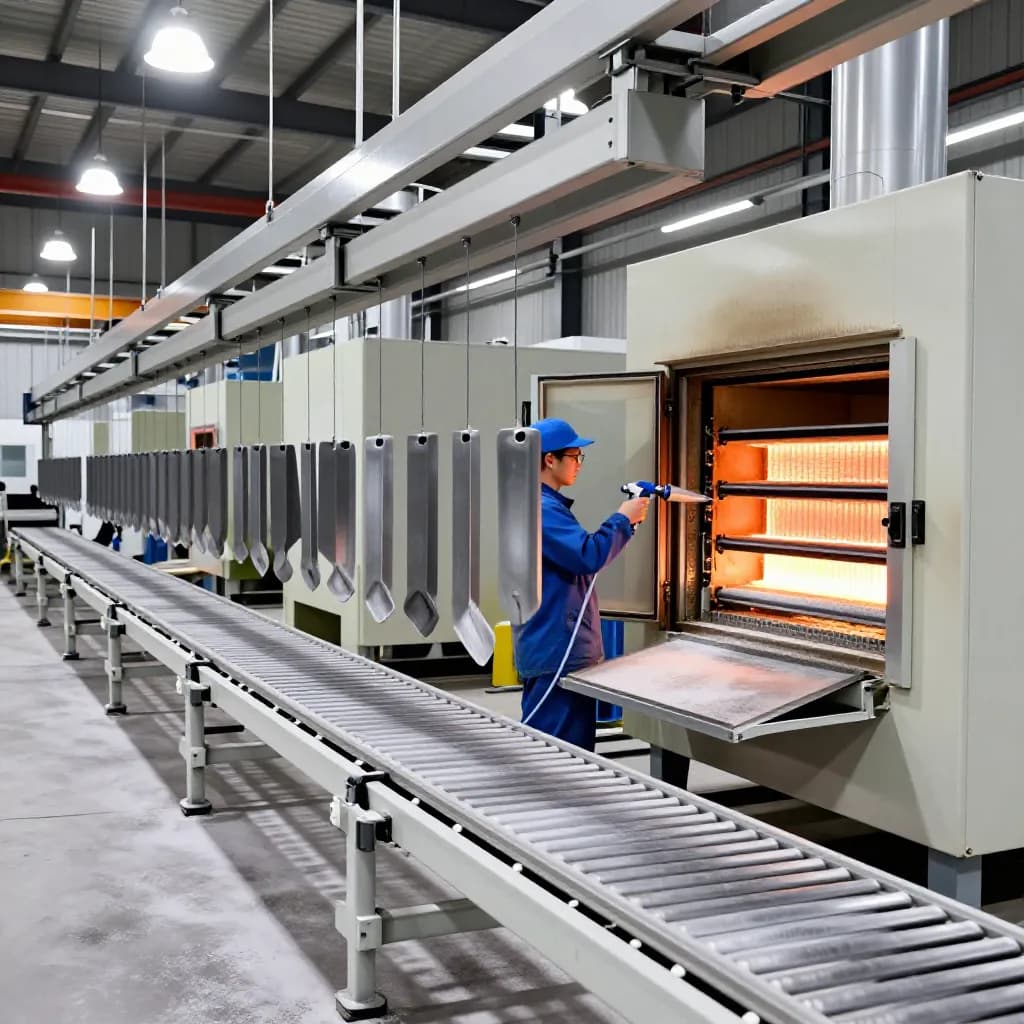
A typical powder coating line consists of a pretreatment system, a dry-off oven, a powder application booth with electrostatic spray equipment and a powder recovery system, a curing oven, and a cooling and inspection area. Parts are hung on hooks or placed on racks attached to an overhead conveyor that moves them through each stage of the process at a controlled speed. The entire cycle from loading to unloading typically takes 45 minutes to two hours depending on the line configuration, part size, and coating specification.
Ready to Start Your Project?
From one-off customs to 15,000-part production runs — get precise pricing in 24 hours.
On This Page
Overview of the Powder Coating Process
Modern powder coating facilities range from small batch operations processing a few hundred parts per day to large automated lines capable of coating thousands of square meters per hour. Regardless of scale, the fundamental process steps remain the same. Understanding each step in detail helps specifiers, quality managers, and end users appreciate the factors that influence coating quality and make informed decisions about coating specifications and supplier selection.
Step 1: Surface Preparation and Pretreatment
Surface preparation is universally recognized as the most critical step in the powder coating process. The long-term adhesion, corrosion resistance, and appearance of the finished coating depend more on the quality of surface preparation than on any other single factor. The goal is to create a surface that is chemically clean, free of contaminants, and optimally conditioned for coating adhesion.
For aluminum substrates, the pretreatment process typically begins with an alkaline or acidic cleaning stage that removes oils, greases, and other organic contaminants from the manufacturing process. This is followed by thorough rinsing with clean water to remove cleaning chemical residues. An acid etch or deoxidizing stage then removes the natural oxide layer and surface impurities, creating a fresh, chemically active surface. After additional rinsing, a conversion coating is applied — traditionally chromate-based, but increasingly using chromate-free alternatives such as titanium or zirconium-based systems that deposit a thin, amorphous oxide layer on the aluminum surface.
For steel substrates, the process may include additional steps such as mechanical descaling or shot blasting to remove mill scale and heavy rust, followed by chemical cleaning and phosphating. Zinc phosphate conversion coatings are the standard for steel in demanding applications, providing excellent adhesion promotion and corrosion inhibition. Iron phosphate is a more economical alternative suitable for less demanding environments. The quality of the pretreatment is verified through regular testing of chemical bath concentrations, coating weights, and adhesion performance on test panels. Quality standards like Qualicoat and GSB specify detailed requirements for pretreatment processes and their monitoring.
Step 2: Drying
After pretreatment, the parts must be thoroughly dried before entering the powder application booth. Any residual moisture on the surface will interfere with the electrostatic charging and adhesion of the powder particles, and moisture trapped beneath the powder film will turn to steam during curing, causing blistering, pinholes, and other defects. The dry-off oven is therefore a critical transition stage between pretreatment and powder application.
The dry-off oven typically operates at temperatures between 100 and 150 degrees Celsius, with parts passing through for 5 to 15 minutes depending on their mass and geometry. The oven must be designed to ensure that all surfaces of the part — including recesses, channels, and enclosed areas where water can collect — reach a temperature sufficient to evaporate all moisture. Convection ovens with high air circulation are most common, though infrared heating elements may be used to supplement convection heating for parts with complex geometries.
Proper drying is especially important for parts with complex shapes, welded joints, or hollow sections where water can become trapped. If moisture is not completely removed, it will cause defects that may not become apparent until the curing stage or even after the finished product is in service. Some coating lines incorporate a blow-off station before the dry-off oven, using compressed air to remove standing water from recesses and joints, reducing the drying time required and improving the consistency of the drying process.
Step 3: Powder Application
Powder application is the stage where the dry coating material is deposited onto the prepared substrate. The dominant application method is electrostatic spray, which uses specialized spray guns to impart an electrical charge to the powder particles as they exit the gun nozzle. The most common charging method is corona charging, where the powder passes through a high-voltage electric field (typically 60 to 100 kilovolts) at the gun tip, acquiring a negative charge. The charged particles are propelled toward the grounded workpiece by a combination of electrostatic attraction and the airflow from the gun.
Triboelectric charging is an alternative method where the powder acquires a positive charge through friction as it passes through a specially designed gun barrel, typically made of PTFE. Tribo guns produce a softer, more uniform spray pattern with less tendency for the Faraday cage effect — the phenomenon where charged particles are repelled from recessed areas and inside corners, leading to thin or uncoated spots. Tribo charging is often preferred for parts with complex geometries, though it generally provides lower deposition rates than corona charging.
The powder application booth is designed to contain the overspray and recover unused powder for recycling. Booth walls may be constructed from powder-coated steel, polypropylene, or other non-conductive materials that minimize powder adhesion. A recovery system — either cyclone-based or cartridge filter-based — collects overspray powder and returns it to the feed hopper for reuse. Efficient recovery systems can reclaim 95 to 99 percent of overspray, making powder coating one of the most material-efficient coating processes available. Application parameters including gun voltage, current, powder flow rate, gun-to-part distance, and gun movement pattern must be carefully optimized for each part geometry to achieve uniform coverage and the specified film thickness.
Step 4: Curing
Curing is the stage where the applied powder is transformed from a loose layer of dry particles into a continuous, cross-linked coating film. The coated parts enter a curing oven where they are heated to a specific temperature for a defined period, causing the powder particles to melt, flow together, and undergo a chemical cross-linking reaction. The curing schedule — the combination of temperature and time — is critical to achieving the specified mechanical, chemical, and aesthetic properties of the finished coating.
Standard thermoset powder coatings typically require a metal temperature of 180 to 200 degrees Celsius maintained for 10 to 20 minutes. It is important to note that the specified cure temperature refers to the metal temperature of the part, not the oven air temperature. The oven air temperature must be set higher than the target metal temperature to account for heat transfer losses and the time required for the part to reach temperature. Heavy or thick-walled parts take longer to heat through than thin sheet metal components, so the conveyor speed or oven dwell time must be adjusted accordingly.
During curing, the powder goes through several distinct phases. First, the powder particles melt and begin to flow together, forming a continuous liquid film. As the temperature continues to rise, the cross-linking reaction initiates, and the liquid film begins to gel and harden. The cross-linking reaction must proceed to completion to achieve the full mechanical and chemical resistance properties of the coating. Under-curing results in a coating that is softer, less chemically resistant, and more susceptible to weathering. Over-curing can cause yellowing, embrittlement, and reduced gloss. Low-temperature cure powder coatings are available that cure at metal temperatures as low as 140 to 160 degrees Celsius, offering energy savings of 15 to 25 percent compared to standard formulations.
Step 5: Quality Inspection
Quality inspection is the final step before the coated parts are released for assembly, packaging, or shipment. A comprehensive inspection program verifies that the coating meets all specified requirements for thickness, adhesion, appearance, and performance. The rigor of the inspection program should be proportional to the criticality of the application, with architectural and safety-critical components requiring the most thorough evaluation.
Film thickness is measured using a non-destructive magnetic or eddy current gauge, depending on the substrate material. Multiple measurements are taken across each part to verify that the coating thickness falls within the specified range — typically 60 to 120 microns for a single coat, with a minimum of 60 microns for architectural applications. Adhesion is tested using the cross-cut test (ISO 2409) or the pull-off test (ISO 4624), where a grid pattern is cut through the coating and adhesive tape is applied and removed to evaluate whether the coating lifts from the substrate.
Gloss is measured using a gloss meter at a 60-degree angle and compared to the specified gloss range. Color is evaluated visually under standardized lighting conditions and may be measured instrumentally using a spectrophotometer, with results expressed as Delta E values relative to the approved standard. Surface appearance is inspected visually for defects such as orange peel, pinholes, craters, inclusions, runs, sags, and color inconsistencies. Hardness testing (pencil hardness or Buchholz indentation), impact resistance testing (reverse and direct impact), and bend testing (conical mandrel or T-bend) may also be performed to verify the mechanical properties of the cured film. All test results are recorded and retained as part of the quality documentation for the production batch.
Troubleshooting Common Powder Coating Defects
Even in well-managed powder coating operations, defects can occasionally occur. Understanding the common defect types and their root causes enables rapid diagnosis and correction. Orange peel — a textured surface resembling the skin of an orange — is one of the most common defects. It is typically caused by insufficient powder flow during curing, which can result from too-low oven temperature, too-short cure time, excessive film thickness, or powder that has been stored improperly and lost its flow characteristics. Adjusting the cure schedule, reducing film thickness, or using fresh powder usually resolves the issue.
Pinholes are small holes in the cured coating surface caused by gas escaping through the film during curing. Common causes include moisture on the substrate (from inadequate drying), outgassing from the substrate material (particularly common with cast metals and galvanized steel), or contamination of the powder with moisture or foreign particles. Ensuring thorough drying, using outgassing-resistant powder formulations for problematic substrates, and maintaining clean powder handling equipment are the primary preventive measures.
Poor coverage in recessed areas and inside corners is often caused by the Faraday cage effect, where the electrostatic field lines concentrate on edges and protruding features while bypassing recessed areas. Solutions include reducing the gun voltage, increasing the gun-to-part distance, using tribo charging guns, or applying a manual touch-up pass to recessed areas. Color variation between parts or between batches can result from inconsistent film thickness, variations in cure temperature or time, contamination of the powder with a different color, or differences between powder batches. Maintaining consistent application parameters, verifying oven temperature profiles, implementing rigorous color change procedures, and using powder from the same production batch for critical projects are essential practices for achieving uniform color across a production run.
Frequently Asked Questions
How long does the powder coating process take?
The total process time from loading to unloading typically ranges from 45 minutes to 2 hours, depending on the line configuration and part size. Pretreatment takes 15-30 minutes, drying takes 5-15 minutes, powder application takes 5-15 minutes per part, and curing takes 15-30 minutes including heat-up time. Batch operations may take longer due to manual handling between stages.
What temperature is needed to cure powder coating?
Standard thermoset powder coatings require a metal temperature of 180-200 degrees Celsius maintained for 10-20 minutes. Low-temperature cure formulations are available that cure at 140-160 degrees Celsius, offering energy savings. The oven air temperature must be set higher than the target metal temperature to account for heat transfer, and heavy parts require longer to reach the cure temperature throughout.
Can powder coating be applied to cold metal?
Yes, powder is applied to parts at room temperature. The electrostatic charge holds the powder on the surface until the part enters the curing oven. Some specialized processes preheat the substrate before application to achieve thicker films or to coat non-metallic substrates, but standard electrostatic application is performed at ambient temperature.
What causes orange peel in powder coating?
Orange peel texture is caused by insufficient flow of the powder during the melt phase of curing. Common causes include oven temperature too low, cure time too short, excessive film thickness that prevents proper flow, degraded powder that has lost its flow properties, or powder formulation with inherently limited flow characteristics. Optimizing the cure schedule and maintaining proper film thickness are the primary solutions.
How is powder coating thickness measured?
Powder coating thickness is measured non-destructively using electronic gauges. Magnetic induction gauges are used on steel substrates, while eddy current gauges are used on non-ferrous metals like aluminum. The gauge is placed on the coated surface and instantly displays the film thickness in microns. Multiple measurements are taken across each part to verify uniform coverage and compliance with the specified thickness range.
Ready to Start Your Project?
From one-off customs to 15,000-part production runs — get precise pricing in 24 hours.