The powder feed system is responsible for delivering a consistent, controlled flow of powder from the bulk supply to the spray guns. While spray guns and booth design receive more attention, the feed system is equally critical to coating quality — inconsistent powder delivery causes film thickness variation, appearance defects, and wasted material regardless of how well the guns and booth are performing.
Technical
Powder Coating Powder Feed Systems: Hoppers, Box Feed, Venturi, and Dense Phase Technology
Sundial Powder Coating·April 23, 2026·14 min
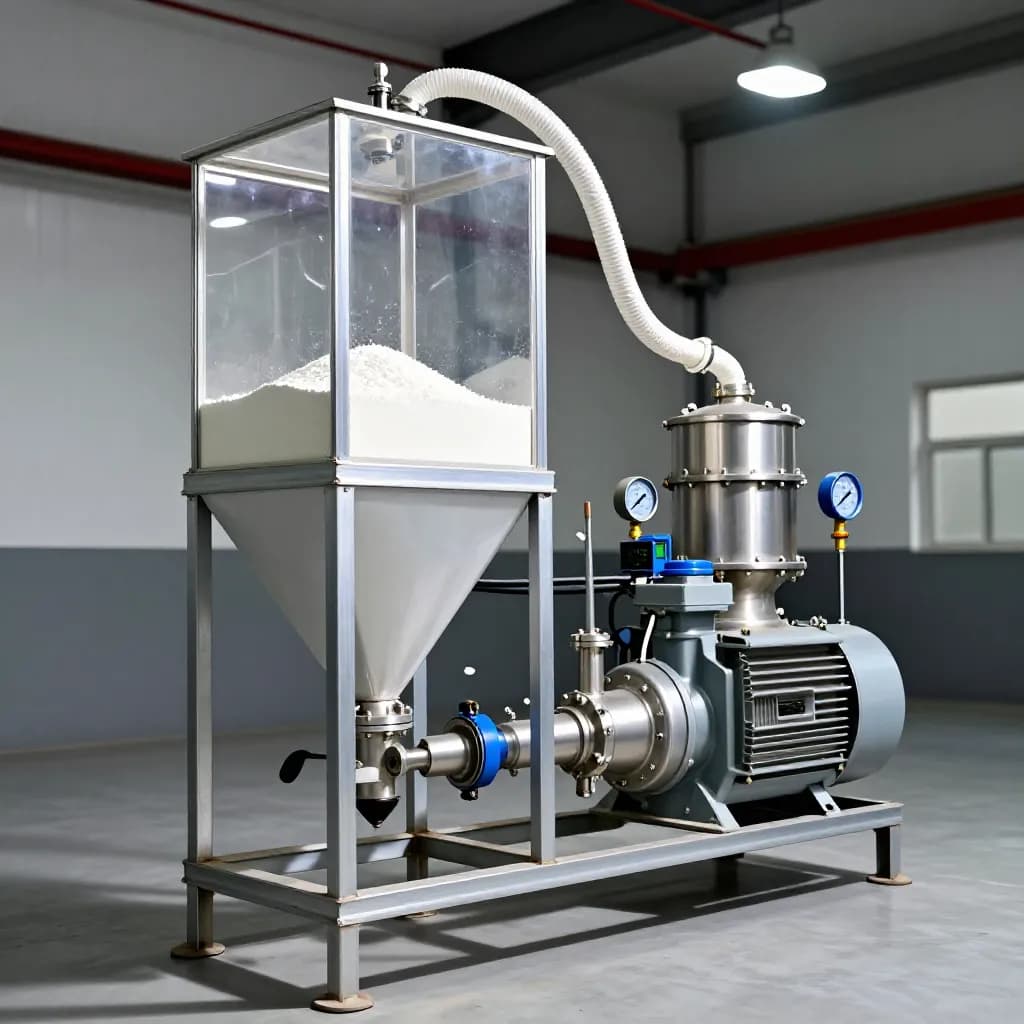
A powder feed system consists of three primary components: the powder supply container (hopper, box feeder, or bulk supply), the fluidization system that conditions the powder for transport, and the pump that moves the powder through the delivery hose to the spray gun. Each component must be properly designed, sized, and maintained to deliver the consistent flow rates that automatic and manual spray systems require.
Ready to Start Your Project?
From one-off customs to 15,000-part production runs — get precise pricing in 24 hours.
On This Page
Powder Feed Systems: The Link Between Powder and Gun
The two fundamental pump technologies used in powder coating — venturi (ejector) pumps and dense phase pumps — represent different engineering approaches to powder transport. Venturi pumps have been the industry standard for decades, offering simplicity and low cost. Dense phase pumps are a newer technology that provides more consistent flow, gentler powder handling, and faster color changes. Understanding the operating principles, advantages, and limitations of each technology is essential for selecting the right feed system for the application.
Fluidization: Conditioning Powder for Transport
Fluidization is the process of suspending powder particles in a stream of air to create a fluid-like state that allows the powder to flow freely and be picked up consistently by the pump. Without proper fluidization, powder remains in a packed, static state that resists flow and produces erratic, pulsing delivery to the spray guns.
Fluidization is achieved by passing low-pressure air (typically 0.3–1.0 bar) through a porous membrane at the bottom of the powder container. The air permeates upward through the powder bed, separating the particles and reducing inter-particle friction. When the air velocity exceeds the minimum fluidization velocity — which depends on particle size, density, and shape — the powder bed expands and begins to behave like a fluid, with a clearly defined surface that can be poured and pumped.
The quality of fluidization depends on several factors. Air quality is paramount — the fluidizing air must be clean, dry, and oil-free (the same quality required for spray guns). Moisture in the fluidizing air causes powder to clump and resist fluidization. The porous membrane must be uniformly permeable across its entire area — blocked or damaged areas create dead zones where powder remains packed. Powder condition affects fluidization — fresh, properly stored powder fluidizes readily, while aged, moisture-contaminated, or mechanically degraded powder may resist fluidization and require higher air pressure or mechanical agitation to achieve a fluid state.
Fluidization level is monitored visually (the powder surface should appear to gently boil) and by the consistency of the powder flow rate at the gun. Excessive fluidization — too much air — creates a turbulent, erupting bed that produces inconsistent pickup and surging flow. Insufficient fluidization leaves packed powder that the pump cannot pick up consistently.
Hopper Feed Systems and Box Feed Units
Hopper feed systems use a dedicated container — the hopper — that holds a working quantity of powder (typically 20–50 kg) in a fluidized state for pickup by the pump. The hopper is filled from bulk containers (boxes, bags, or bulk supply systems) and provides a controlled, consistent powder supply to one or more spray guns. Hoppers are available in round and rectangular configurations, with round hoppers providing more uniform fluidization due to the absence of corners where powder can pack.
Hopper design features that affect performance include the fluidization membrane area (larger area provides more uniform fluidization), the hopper geometry (conical or tapered bottoms promote powder flow toward the pickup point), the powder level sensor (ultrasonic or capacitive sensors that trigger automatic refill), and the vibration system (external vibrators that break up powder bridges and promote flow in the lower hopper section). Hopper material should be non-stick and electrically conductive — stainless steel or conductive polyethylene are common choices.
Box feed systems eliminate the hopper entirely by placing the fluidization membrane and pump pickup directly into the original powder shipping container (typically a 20–25 kg cardboard box with a polyethylene liner). The box feed unit consists of a fluidization plate that is inserted into the bottom of the box, a pump pickup tube, and a lid that seals the box to contain the fluidized powder. Box feed systems offer the fastest possible color change — simply remove the current box and insert a new one with a different color. There is no hopper to clean, no powder to transfer, and no risk of cross-contamination. The trade-off is smaller powder capacity (limited to the box size), less uniform fluidization (the rectangular box shape creates corner dead zones), and the need to manage empty boxes and liners.
Venturi Pump Technology: Principles and Performance
Venturi pumps (also called ejector pumps or suction pumps) are the traditional powder transport technology, using the Venturi effect to create suction that draws powder from the fluidized bed and propels it through the delivery hose to the spray gun. Compressed air is forced through a narrow venturi throat, creating a low-pressure zone that draws powder into the air stream. The powder-air mixture then travels through the delivery hose at velocities of 15–25 m/s.
Venturi pumps are simple, reliable, and inexpensive. They have no moving parts, require minimal maintenance, and can be easily replaced if worn. The powder flow rate is controlled by adjusting the compressed air pressure to the venturi (which controls the suction force) and a supplemental air supply that dilutes the powder-air mixture to the desired concentration. Typical flow rates range from 50 to 400 g/min per pump.
However, venturi pumps have inherent limitations that affect coating consistency. The powder-air mixture is highly dilute — typically 2–5% powder by volume — meaning that large volumes of air are delivered to the gun along with the powder. This transport air contributes to the total air volume at the gun tip, affecting spray pattern and deposition. Flow rate consistency is affected by hose length, hose routing (bends and vertical rises increase resistance), powder level in the hopper (lower levels reduce suction efficiency), and wear of the venturi throat and pickup tube. Over time, venturi throat wear increases the throat diameter, reducing suction efficiency and flow rate — a gradual degradation that can go unnoticed until coating quality is affected.
Venturi pumps also retain powder in the delivery hose after shutdown, requiring a purge cycle to clear the hose before color changes. The long hose length (typically 3–8 meters) and the powder packed in the hose represent a significant volume that must be purged, contributing to longer color change times.
Dense Phase Pump Technology: Principles and Advantages
Dense phase pumps represent a fundamental advancement in powder transport technology, moving powder in concentrated slugs rather than the dilute suspension used by venturi pumps. The operating principle uses alternating pressure and vacuum cycles in a small chamber to draw in a slug of powder, then push it through the delivery hose using a pulse of compressed air. The powder concentration in the hose is much higher than in venturi systems — typically 20–40% by volume — and the transport velocity is lower (3–8 m/s vs. 15–25 m/s for venturi).
The advantages of dense phase transport are significant. Flow rate consistency is dramatically improved because the pump delivers discrete, metered doses of powder rather than relying on continuous suction from a variable-condition fluidized bed. Flow rate variation is typically ±2–5% for dense phase pumps compared to ±10–20% for venturi pumps. This consistency translates directly into tighter film thickness control and reduced powder waste.
The lower transport velocity reduces powder degradation during transport. Venturi pumps accelerate powder to high velocities that cause particle attrition (breaking) and impact fusion (particles welding together) as they collide with hose walls and bends. Dense phase transport is gentler, preserving the original particle size distribution and producing better surface finish quality, particularly with metallic and textured powders that are sensitive to particle damage.
Color change speed is another major advantage. The shorter powder slug in the hose and the positive-displacement pumping action allow the hose to be purged completely in 5–15 seconds, compared to 30–60 seconds for venturi systems. Combined with quick-change booth design, dense phase pumps enable total color change times of 3–5 minutes. The reduced air volume delivered to the gun also provides more precise spray pattern control and better penetration into Faraday cage geometries.
Powder Delivery Hose Selection and Routing
The delivery hose connecting the pump to the spray gun is a critical but often overlooked component of the feed system. Hose material, diameter, length, and routing all affect powder flow consistency, color change speed, and maintenance requirements.
Hose material must be smooth, non-stick, and antistatic. Standard powder delivery hoses are made of polyurethane, polyethylene, or PTFE-lined materials with a conductive inner surface that dissipates electrostatic charge buildup. Charge buildup on the hose interior attracts powder particles, creating deposits that restrict flow and contaminate subsequent colors. Conductive hoses with surface resistance below 10⁶ ohms per meter prevent this accumulation.
Hose diameter is typically 8–12 mm internal diameter for venturi systems and 6–10 mm for dense phase systems. Larger diameters reduce pressure drop and allow higher flow rates but increase the powder volume retained in the hose (affecting color change time) and reduce transport velocity (potentially allowing powder to settle in horizontal runs). The optimal diameter balances flow capacity against color change speed and transport reliability.
Hose length should be minimized — every additional meter of hose increases pressure drop, reduces flow consistency, and adds to the powder volume that must be purged during color changes. Typical hose lengths are 3–6 meters for automatic systems and 4–8 meters for manual systems. Hose routing should avoid sharp bends (minimum bend radius of 200 mm), vertical rises (which require additional transport energy), and contact with hot surfaces (which can soften the hose and create restrictions). Hoses should be supported at regular intervals to prevent sagging and kinking, and replaced when the interior surface shows wear, scoring, or powder buildup that cannot be cleaned.
Flow Rate Calibration, Monitoring, and Troubleshooting
Consistent powder flow rate is the foundation of consistent coating quality. Flow rate calibration should be performed at system startup, after any component change (pump, hose, gun, or nozzle), and at regular intervals during production — typically daily for high-quality applications.
The standard calibration method is a timed collection test: the gun is triggered into a collection container for a measured time period (typically 30–60 seconds), and the collected powder is weighed. The flow rate in grams per minute is calculated from the weight and time. Each gun in an automatic system should be calibrated individually, and the results compared to verify that all guns are delivering within ±5% of the target flow rate. Significant variation between guns indicates pump wear, hose restrictions, or fluidization problems that must be corrected.
In-line flow monitoring systems are available that measure powder flow rate continuously during production using various sensing technologies — capacitive, microwave, or optical sensors mounted in the delivery hose or at the gun inlet. These systems provide real-time feedback to the spray controller, enabling closed-loop flow rate control that automatically adjusts pump parameters to maintain the target flow rate as conditions change. Closed-loop flow control can reduce film thickness variation by 30–50% compared to open-loop operation.
Common flow rate problems and their causes include: surging or pulsing flow (poor fluidization, low powder level, moisture in fluidizing air), gradually declining flow rate (venturi throat wear, hose restriction, clogged pickup tube), sudden flow stoppage (hose kink, blocked nozzle, empty hopper), and inconsistent flow between guns (unequal hose lengths, different pump wear states, uneven fluidization). Systematic troubleshooting should check each component in sequence — fluidization quality, powder level, pump condition, hose condition, and gun/nozzle condition — to identify and correct the root cause.
Frequently Asked Questions
What is the difference between venturi and dense phase powder pumps?
Venturi pumps use suction to transport powder in a dilute air stream (2–5% concentration) at high velocity (15–25 m/s). Dense phase pumps use pressure pulses to move concentrated powder slugs (20–40% concentration) at low velocity (3–8 m/s). Dense phase provides better flow consistency (±2–5% vs. ±10–20%), gentler powder handling, and faster color changes.
Why is fluidization important for powder feed systems?
Fluidization suspends powder particles in air to create a fluid-like state that allows consistent pump pickup. Without proper fluidization, powder remains packed and resists flow, causing erratic delivery, pulsing, and film thickness variation. Clean, dry, oil-free air through a uniform porous membrane is essential.
How often should powder flow rate be calibrated?
Flow rate should be calibrated at system startup, after any component change, and at regular intervals — typically daily for high-quality applications. Each gun should be calibrated individually using a timed collection test, with all guns delivering within ±5% of the target flow rate.
What are the advantages of box feed systems?
Box feed systems place the fluidization plate and pump pickup directly in the powder shipping box, eliminating the hopper. This enables the fastest possible color changes — simply swap boxes. There is no hopper to clean and no cross-contamination risk. The trade-off is smaller capacity and less uniform fluidization.
What causes surging or pulsing powder flow?
Surging flow is typically caused by poor fluidization (insufficient or uneven air distribution), low powder level in the hopper, moisture in the fluidizing air causing powder clumping, or a damaged fluidization membrane. Check air quality, powder level, and membrane condition to resolve the issue.
Ready to Start Your Project?
From one-off customs to 15,000-part production runs — get precise pricing in 24 hours.