Pigments are far more than colorants in powder coatings — they are functional components that influence opacity, weathering durability, heat resistance, chemical stability, and even the mechanical properties of the cured film. The selection of pigments for a powder coating formulation requires balancing color requirements with performance demands, processing constraints, and regulatory compliance. A pigment that provides the desired color but fails under UV exposure, discolors at cure temperature, or bleeds into adjacent coating layers is worse than useless — it creates a product that fails in service.
Technical
Pigment Technology in Powder Coatings: Organic, Inorganic, and Special Effect Pigments
Sundial Powder Coating·April 22, 2026·14 min
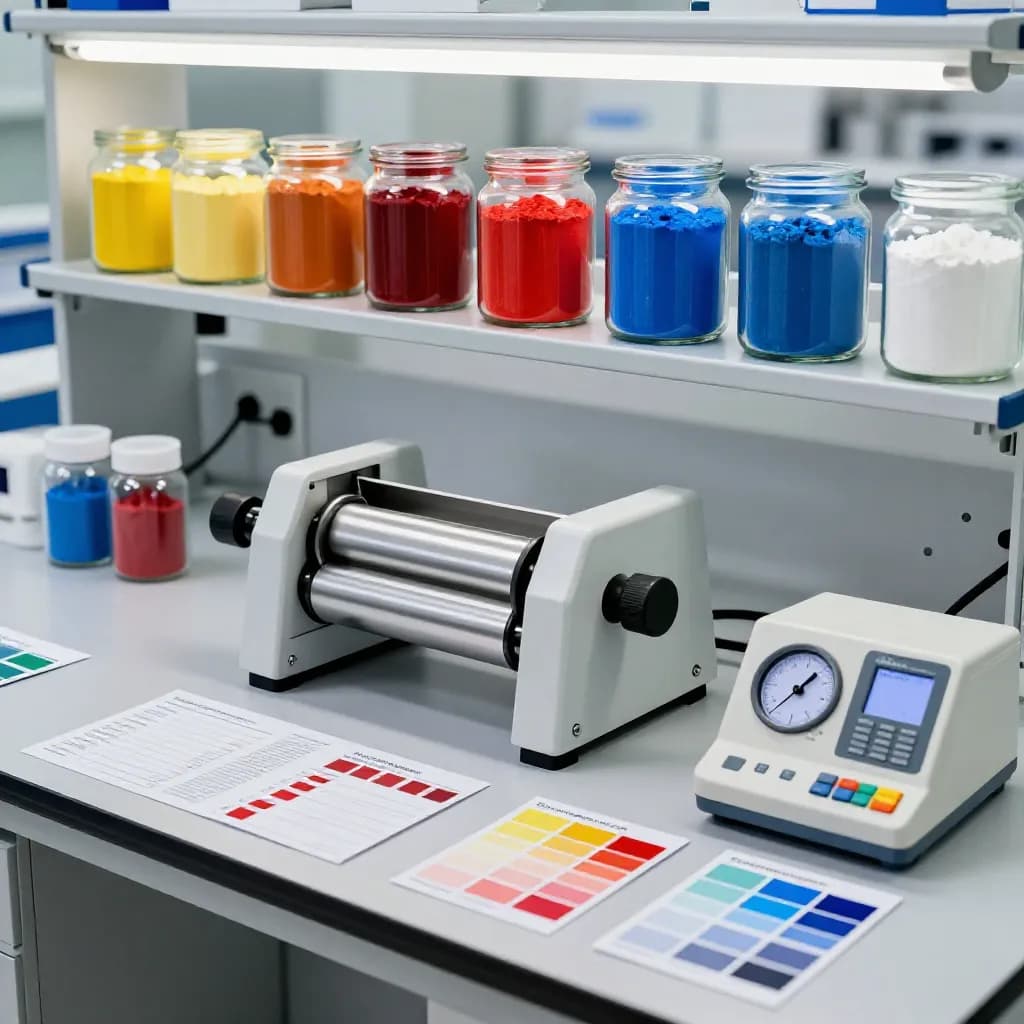
Pigments in powder coatings face unique challenges compared to liquid paint pigments. The extrusion process used to manufacture powder coatings subjects pigments to high shear forces and temperatures of 80-120°C, which can damage sensitive pigments or alter their color. The cure process exposes pigments to temperatures of 160-200°C for 10-30 minutes, requiring heat stability that exceeds the demands of many air-dry or low-bake liquid coatings. And the absence of solvent in powder coatings means that pigment wetting and dispersion must be achieved entirely through the melt-mixing process, without the benefit of solvent-based wetting agents.
Ready to Start Your Project?
From one-off customs to 15,000-part production runs — get precise pricing in 24 hours.
On This Page
The Role of Pigments in Powder Coating Performance
Pigment volume concentration (PVC) — the volume fraction of pigment in the dried coating film — is a critical formulation parameter that affects opacity, gloss, mechanical properties, and weathering performance. Below the critical PVC (CPVC), the pigment particles are fully wetted and encapsulated by the resin binder, and the coating film is continuous and non-porous. Above the CPVC, there is insufficient binder to fill the spaces between pigment particles, creating porosity that reduces barrier properties, mechanical strength, and weathering resistance. Most powder coatings are formulated well below the CPVC to ensure optimal film integrity.
The powder coating industry uses hundreds of different pigments spanning the full color spectrum, from simple iron oxides and titanium dioxide to complex organic chromophores and engineered effect pigments. Understanding the properties, capabilities, and limitations of the major pigment classes is essential for effective formulation design.
Inorganic Pigments: Workhorses of the Industry
Inorganic pigments form the backbone of powder coating color technology, providing the opacity, heat stability, and weathering resistance needed for demanding exterior applications. These mineral-based pigments are composed of metal oxides, mixed metal oxides, and other inorganic compounds that are inherently stable against UV radiation, heat, and chemical attack.
Titanium dioxide (TiO2) is the most important pigment in the powder coating industry, used in virtually every white and light-colored formulation. Rutile-grade TiO2 provides exceptional opacity (hiding power) due to its high refractive index (2.73), excellent whiteness, and outstanding UV stability. Surface-treated grades with alumina and silica coatings provide enhanced weathering resistance and improved dispersibility. TiO2 loading in white powder coatings typically ranges from 20-35% by weight, depending on the required opacity and the film thickness.
Iron oxide pigments — red (Fe2O3), yellow (FeOOH), and black (Fe3O4) — provide earth tones with excellent heat stability, lightfastness, and chemical resistance. Synthetic iron oxides offer more consistent color and particle size than natural grades and are preferred for powder coating applications. Iron oxide pigments are among the most cost-effective colorants available and are widely used in architectural, industrial, and automotive primer formulations.
Mixed metal oxide (MMO) pigments — also known as complex inorganic color pigments (CICPs) — provide a range of colors including yellows, oranges, browns, greens, and blues with exceptional heat stability and weathering resistance. These pigments are based on crystal structures (spinel, rutile, corundum) doped with transition metal ions that provide color. Cobalt blue (CoAl2O4), chromium green (Cr2O3), and bismuth vanadate yellow (BiVO4) are examples of MMO pigments widely used in exterior-durable powder coatings.
Carbon black provides deep black color with excellent opacity, UV absorption, and heat stability. In powder coatings, carbon black also functions as a UV stabilizer by absorbing UV radiation that would otherwise degrade the polymer binder. However, carbon black can be difficult to disperse in powder coating formulations due to its extremely fine particle size and high surface area, and inadequate dispersion leads to specks, reduced gloss, and inconsistent color.
Organic Pigments: Bright Colors and Their Limitations
Organic pigments provide the bright, saturated colors — vivid reds, oranges, yellows, greens, and violets — that inorganic pigments cannot achieve. These carbon-based chromophores offer high tinting strength (color intensity per unit weight), enabling lower pigment loadings and more transparent formulations. However, organic pigments generally have lower heat stability, weatherfastness, and chemical resistance than inorganic pigments, and their selection for powder coating applications requires careful evaluation of these limitations.
Heat stability is the first screening criterion for organic pigments in powder coatings. The pigment must survive both the extrusion process (80-120°C with high shear) and the cure process (160-200°C for 10-30 minutes) without color change, decomposition, or sublimation. Many organic pigments that perform well in liquid coatings are unsuitable for powder coatings because they cannot withstand the thermal exposure. Pigment manufacturers provide heat stability ratings (typically on a 1-5 scale) that indicate the maximum temperature a pigment can tolerate without significant color change.
Weatherfastness — resistance to color change under UV exposure — varies enormously among organic pigment classes. High-performance organic pigments such as quinacridones (reds and violets), diketopyrrolopyrroles (DPP, reds and oranges), phthalocyanines (blues and greens), and perylenes (reds and maroons) provide excellent weatherfastness suitable for exterior architectural applications. Lower-performance classes such as monoazo yellows, diarylide yellows, and naphthol reds have limited weatherfastness and are restricted to interior applications or short-term exterior use.
Bleeding and migration are concerns with certain organic pigments, particularly in multi-coat systems. Some organic pigments are partially soluble in the coating resin at cure temperature and can migrate from one coating layer to another, causing color contamination. This is most problematic when a strongly colored basecoat is overcoated with a light-colored or clear topcoat — migrating pigment from the basecoat can discolor the topcoat. Pigment selection for multi-coat systems must account for migration resistance in addition to color, heat stability, and weatherfastness.
The cost of high-performance organic pigments is significantly higher than inorganic alternatives, reflecting the complex synthesis and purification processes required to produce these materials. Quinacridone and DPP pigments, for example, can cost 5-20 times more per kilogram than iron oxide pigments. This cost differential drives formulation strategies that use organic pigments at the minimum loading needed for color development, often in combination with inorganic pigments that provide opacity and reduce the overall pigment cost.
Weatherfastness Testing and Pigment Selection for Exterior Use
Selecting pigments for exterior-durable powder coatings requires systematic evaluation of weatherfastness using standardized accelerated and natural exposure testing. The consequences of selecting pigments with inadequate weatherfastness are severe — color fading, chalking, and appearance degradation that can occur within months of installation, leading to warranty claims, recoating costs, and reputational damage.
Accelerated weathering tests using xenon arc (ISO 16474-2, ASTM G155) or fluorescent UV (ISO 16474-3, ASTM G154) exposure provide the primary screening tool for pigment weatherfastness evaluation. These tests expose coated panels to controlled cycles of UV radiation, moisture, and temperature that simulate the degradation mechanisms of natural outdoor exposure in an accelerated timeframe. Color change (Delta E) and gloss retention are measured at regular intervals to track the degradation kinetics.
Natural weathering exposure — particularly in South Florida (subtropical, high UV, high humidity) and Arizona (desert, extreme UV, high temperature) — provides the definitive validation of pigment weatherfastness. AAMA 2604 requires 5 years of South Florida exposure, and AAMA 2605 requires 10 years. Qualicoat Class 2 requires performance equivalent to 3 years of Florida exposure, and Class 3 requires performance equivalent to 10 years. These extended exposure requirements effectively mandate the use of high-performance pigments in exterior architectural formulations.
Pigment manufacturers provide Blue Wool Scale (BWS) ratings that indicate the lightfastness of pigments on a scale of 1 (very poor) to 8 (excellent). For exterior powder coating applications, pigments with BWS ratings of 7 or 8 are generally required. For interior applications, BWS ratings of 5-6 may be acceptable depending on the expected light exposure.
The interaction between pigment and resin chemistry affects weatherfastness. A pigment that performs well in one resin system may perform differently in another due to differences in UV absorption, radical scavenging, and photocatalytic activity. TiO2, for example, can act as a photocatalyst that accelerates binder degradation if not properly surface-treated. Formulation-specific weathering tests — not just pigment-level data — are essential for validating the weatherfastness of complete coating systems.
Metallic and Special Effect Pigments
Metallic and special effect pigments add visual depth, sparkle, and dynamic color effects to powder coatings, enabling decorative finishes that go far beyond what solid-color pigments can achieve. These effect pigments are based on thin, platelet-shaped particles that reflect, refract, and interfere with light to create angle-dependent color and brightness effects.
Aluminum flake pigments are the most widely used metallic effect pigments in powder coatings. These thin aluminum platelets (typically 1-50 microns in diameter and 0.1-1 micron thick) reflect light like tiny mirrors, creating the characteristic metallic sparkle. The visual effect depends on the flake size, shape, and orientation within the coating film. Coarser flakes produce a more sparkly, glittery appearance, while finer flakes produce a smoother, more uniform metallic sheen.
The incorporation of metallic pigments into powder coatings presents unique challenges. Unlike conventional pigments that are dispersed throughout the resin matrix during extrusion, metallic flakes are too fragile to survive the high-shear extrusion process without being broken and deformed, which destroys their reflective properties. Instead, metallic pigments are added to the finished powder by a bonding process — the flakes are mixed with the powder particles and attached to their surfaces using a small amount of heat or adhesive. This bonding process must achieve secure attachment of the flakes to the powder particles to prevent separation during application and reclaim, while avoiding damage to the flake geometry.
Perl effect pigments (pearlescent pigments) are based on thin platelets of mica, alumina, or synthetic substrates coated with metal oxide layers (typically TiO2 or Fe2O3). These multi-layer structures create interference colors — colors that change with viewing angle as the optical path length through the metal oxide layer varies. Pearl pigments can produce subtle color shifts (white pearl, silver pearl) or dramatic color-flip effects (blue-to-purple, green-to-gold) depending on the metal oxide layer thickness and composition.
Other special effect pigments used in powder coatings include glass flake pigments for barrier enhancement and decorative effects, holographic pigments for rainbow effects, thermochromic pigments that change color with temperature, and photochromic pigments that change color with UV exposure. These specialty pigments enable unique decorative effects but typically require careful formulation and application optimization to achieve consistent results.
Pigment Dispersion and Processing in Powder Manufacturing
Achieving adequate pigment dispersion during powder coating manufacturing is essential for color consistency, opacity, gloss, and mechanical properties. Unlike liquid coatings where pigments are dispersed using high-speed dissolvers, bead mills, or three-roll mills in a liquid medium, powder coating pigments must be dispersed in a molten polymer matrix during the extrusion process — a fundamentally different and more challenging dispersion environment.
The twin-screw extruder used in powder coating manufacturing provides the shear forces and residence time needed to break up pigment agglomerates and distribute pigment particles uniformly throughout the resin matrix. The extrusion process involves feeding the premixed dry ingredients (resin, crosslinker, pigments, additives, and fillers) into the extruder, where they are melted, mixed, and sheared as they pass through the barrel. The extrudate emerges as a thin sheet or ribbon that is cooled, broken into chips, and ground to the final powder particle size.
Pigment wetting — the displacement of air from the pigment particle surface and its replacement by resin — is the first step in dispersion and is driven by the surface energy difference between the pigment and the resin. Pigments with high surface energy (most inorganic pigments) are readily wetted by the molten resin, while pigments with surface treatments or organic coatings may require wetting agents to achieve complete surface coverage. Inadequate wetting results in air entrapment at the pigment-resin interface, which can cause pinholes, reduced gloss, and poor color development.
The degree of pigment dispersion achieved during extrusion depends on the shear rate, residence time, melt viscosity, and pigment characteristics. Hard-to-disperse pigments — particularly carbon black, organic pigments with strong inter-particle attraction, and fine-particle inorganic pigments — may require multiple extrusion passes, higher shear screw configurations, or the use of pigment concentrates (masterbatches) to achieve adequate dispersion.
Color consistency between production batches depends on maintaining consistent pigment dispersion, which in turn requires consistent extrusion parameters (temperature, screw speed, feed rate) and consistent raw material properties (pigment particle size, surface treatment, resin melt viscosity). Statistical process control of color measurements (Lab* values) on production samples provides the quality assurance framework for detecting and correcting color drift before it results in out-of-specification product.
Regulatory and Safety Considerations for Powder Coating Pigments
The regulatory landscape for pigments in powder coatings has evolved significantly, with restrictions on heavy metals, classification requirements for hazardous substances, and food-contact regulations all influencing pigment selection and formulation practice.
Heavy metal restrictions have eliminated or restricted several historically important pigment classes. Lead chromate pigments (chrome yellow, chrome orange, molybdate orange) — once the standard for bright yellow and orange colors — are now restricted or banned in many jurisdictions due to the toxicity of lead and hexavalent chromium. Cadmium pigments (cadmium yellow, cadmium red) are similarly restricted. These restrictions have driven the adoption of alternative pigments such as bismuth vanadate (for yellows), DPP (for reds and oranges), and mixed metal oxides (for a range of colors).
The European REACH regulation requires registration and evaluation of chemical substances, including pigments, and has led to restrictions on several pigment types. Cobalt-containing pigments face scrutiny due to the classification of certain cobalt compounds as carcinogenic, though cobalt aluminate blue (the most widely used cobalt pigment in powder coatings) is currently considered a substance of low concern due to its extreme chemical stability and insolubility.
For food-contact applications, pigments must comply with FDA 21 CFR 178.3297 (colorants for polymers) in the United States and Regulation (EC) No 1935/2004 in Europe. These regulations restrict the types of pigments that can be used in coatings that contact food and set limits on the migration of pigment components into food. Only pigments that have been evaluated and approved for food contact can be used in these applications.
Occupational health considerations apply to pigment handling during powder coating manufacturing. Fine pigment powders can be inhaled during weighing, premixing, and extruder feeding operations, and appropriate dust control measures and personal protective equipment are required. Pigments classified as hazardous substances under GHS/CLP require additional handling precautions, labeling, and safety data sheet documentation.
The trend toward more sustainable and environmentally responsible pigments is driving research into bio-based colorants, recycled pigments, and pigments manufactured using lower-energy processes. While these developments are still largely in the research phase for powder coating applications, they reflect the broader industry movement toward reduced environmental impact across the entire coating supply chain.
Frequently Asked Questions
What is the difference between organic and inorganic pigments?
Inorganic pigments are mineral-based (metal oxides, mixed metal oxides) offering excellent heat stability, weatherfastness, and opacity but limited color brightness. Organic pigments are carbon-based chromophores providing vivid, saturated colors with high tinting strength but generally lower heat stability and weatherfastness. Most exterior powder coatings use combinations of both types.
Why can't all liquid paint pigments be used in powder coatings?
Powder coating pigments must survive extrusion temperatures of 80-120°C with high shear and cure temperatures of 160-200°C for 10-30 minutes. Many pigments suitable for air-dry or low-bake liquid coatings cannot withstand these thermal exposures without color change, decomposition, or sublimation.
How are metallic pigments added to powder coatings?
Metallic flakes are too fragile to survive the high-shear extrusion process, so they are added after grinding by a bonding process. The flakes are mixed with finished powder particles and attached to their surfaces using controlled heat or adhesive. This bonding must be secure enough to prevent separation during application and reclaim.
What Blue Wool Scale rating is needed for exterior use?
For exterior powder coating applications, pigments with Blue Wool Scale ratings of 7 or 8 are generally required to ensure adequate lightfastness over the expected service life. For interior applications, ratings of 5-6 may be acceptable depending on light exposure conditions.
Are lead and cadmium pigments still used in powder coatings?
Lead chromate and cadmium pigments are restricted or banned in most jurisdictions due to heavy metal toxicity concerns. They have been replaced by alternatives such as bismuth vanadate (yellows), DPP (reds and oranges), and mixed metal oxide pigments. Some legacy formulations may still contain these pigments in less regulated markets.
Ready to Start Your Project?
From one-off customs to 15,000-part production runs — get precise pricing in 24 hours.