Phosphate conversion coatings have been the dominant pretreatment technology for powder coating on steel substrates for over 70 years. These coatings are formed by a controlled chemical reaction between a phosphoric acid-based solution and the metal substrate surface, producing a thin, insoluble layer of metal phosphate crystals that is chemically bonded to the substrate. This conversion coating serves as the critical interface between the bare metal and the powder coating, providing three essential functions: enhanced adhesion through chemical bonding and mechanical interlocking, corrosion inhibition by creating a barrier that slows electrochemical reactions, and a uniform surface chemistry that promotes consistent powder coating wetting and flow during cure.
Technical
Powder Coating Phosphate Conversion Coatings: Iron Phosphate vs. Zinc Phosphate Technology
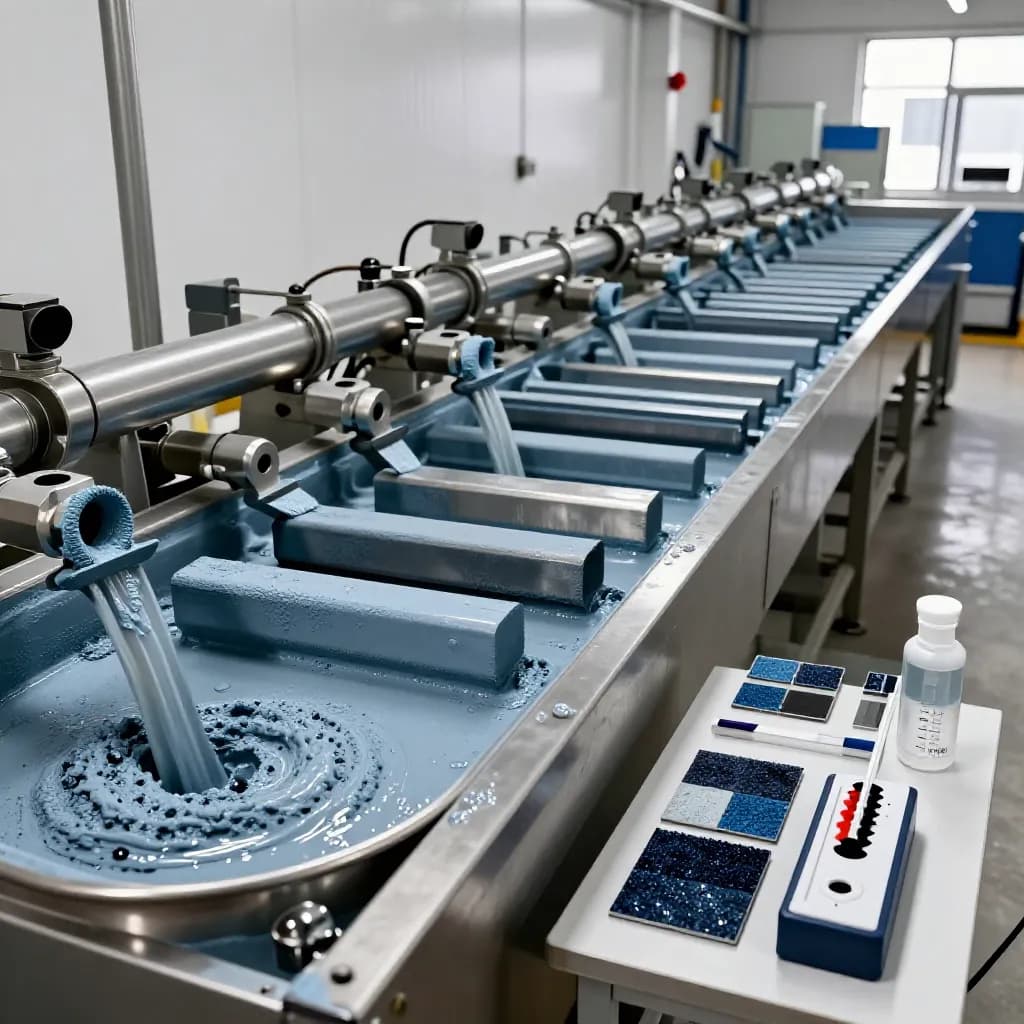
The two primary phosphate conversion coating types used in powder coating are iron phosphate and zinc phosphate. While both are based on phosphoric acid chemistry, they differ fundamentally in their formation mechanism, crystal structure, coating weight, corrosion resistance, and process complexity. Iron phosphate produces a thin, amorphous coating through a simple process that is well-suited to general industrial applications. Zinc phosphate produces a thicker, crystalline coating through a more complex process that delivers superior corrosion resistance for demanding automotive, appliance, and architectural applications.
Ready to Start Your Project?
From one-off customs to 15,000-part production runs — get precise pricing in 24 hours.
On This Page
Phosphate Conversion Coatings: The Foundation of Coating Adhesion
The choice between iron phosphate and zinc phosphate is driven by the performance requirements of the finished product, the substrate material, the production volume, and the environmental and waste treatment capabilities of the facility. Understanding the chemistry, process control, and performance characteristics of each system is essential for selecting the right pretreatment for the application.
Iron Phosphate: Chemistry and Formation Mechanism
Iron phosphate conversion coatings are formed when a mildly acidic solution containing phosphoric acid, oxidizing agents, and surfactants reacts with the steel substrate surface. The reaction dissolves a small amount of iron from the substrate surface, which then reacts with the phosphate ions in solution to precipitate as an amorphous iron phosphate layer (vivianite, Fe₃(PO₄)₂) on the surface. The reaction is self-limiting — as the coating forms, it insulates the substrate from the solution, slowing and eventually stopping the reaction.
Iron phosphate baths operate at pH 4.0–5.5 and temperatures of 35–60°C, with contact times of 30–120 seconds for spray application or 2–5 minutes for immersion. The bath chemistry is relatively simple, containing phosphoric acid as the primary reactant, an oxidizing accelerator (typically sodium nitrite or hydrogen peroxide) that promotes coating formation, and surfactants that improve wetting and cleaning action. Many iron phosphate products are formulated as cleaner-coaters — combined cleaning and conversion coating solutions that perform both functions in a single stage.
The resulting iron phosphate coating is amorphous (non-crystalline), appearing as a blue, gold, or iridescent film on the steel surface. Coating weight is typically 0.3–1.0 g/m², measured by dissolving the coating in chromic acid solution and weighing the panel before and after per ASTM B680. The thin, amorphous nature of iron phosphate provides moderate adhesion enhancement and corrosion inhibition — sufficient for indoor applications and products with moderate service life requirements, but insufficient for demanding exterior or automotive applications where zinc phosphate is specified.
Zinc Phosphate: Chemistry and Crystal Structure
Zinc phosphate conversion coatings are formed through a more complex chemical process that produces a thick, crystalline coating with significantly greater corrosion resistance than iron phosphate. The zinc phosphate bath contains phosphoric acid, zinc ions (from zinc oxide or zinc phosphate), an accelerator (typically sodium nitrite, nickel, or manganese compounds), and various modifiers that control crystal size and morphology.
The formation mechanism involves three simultaneous reactions: acid attack on the steel surface (dissolving iron and generating hydrogen), precipitation of zinc phosphate crystals (hopeite, Zn₃(PO₄)₂·4H₂O) on the surface, and incorporation of iron from the dissolved substrate into the crystal structure (forming phosphophyllite, Zn₂Fe(PO₄)₂·4H₂O). The ratio of hopeite to phosphophyllite in the coating affects its performance — higher phosphophyllite content generally indicates better coating quality and adhesion.
Zinc phosphate baths operate at pH 2.8–3.5 and temperatures of 35–60°C, with contact times of 60–180 seconds for spray or 3–10 minutes for immersion. The resulting coating is visibly crystalline under magnification, with crystal sizes ranging from 2 to 15 microns depending on the bath chemistry and process conditions. Coating weight is typically 1.5–4.0 g/m² — 3 to 10 times heavier than iron phosphate. This thicker, crystalline coating provides superior corrosion resistance because the interlocking crystal structure creates a more effective barrier and provides greater surface area for mechanical interlocking with the powder coating. Zinc phosphate is the standard pretreatment for automotive body panels, appliance housings, and any application requiring salt spray resistance exceeding 500 hours per ASTM B117.
Crystal Size, Morphology, and Refinement
The crystal size and morphology of zinc phosphate coatings significantly affect their performance as a powder coating substrate. Smaller, more uniform crystals produce a denser, more continuous coating with better corrosion resistance and more consistent powder coating adhesion. Larger, irregular crystals create a more porous coating with gaps between crystals that can allow corrosion to initiate at the substrate surface.
Crystal size is controlled primarily by the use of grain refiners — chemical additives applied to the substrate surface before the zinc phosphate stage. The most common grain refiner is titanium-based colloidal activator (titanium phosphate), applied as a dilute rinse (0.1–0.5 g/L) at ambient temperature for 15–60 seconds. The titanium colloid deposits on the substrate surface and provides nucleation sites for zinc phosphate crystal growth. With more nucleation sites, more crystals initiate simultaneously, resulting in smaller individual crystals that form a denser, more uniform coating.
Without grain refinement, zinc phosphate crystals typically grow to 10–15 microns in size with irregular, columnar morphology. With proper grain refinement, crystal size is reduced to 2–5 microns with a more compact, equiaxed morphology. The difference in coating quality is dramatic — grain-refined coatings provide 2–3 times better salt spray resistance than non-refined coatings of the same weight. Crystal morphology is assessed by scanning electron microscopy (SEM) during process development and periodically during production to verify that the grain refiner is functioning correctly. The grain refiner bath must be maintained within its specified concentration range and replaced when its activity declines, typically every 1–4 weeks depending on production volume.
Coating Weight Measurement and Quality Testing
Coating weight is the primary quality metric for phosphate conversion coatings and must be measured regularly to verify that the pretreatment process is producing coatings within specification. The standard method is gravimetric — dissolving the conversion coating from a test panel in a stripping solution and calculating the coating weight from the mass difference.
For iron phosphate, the stripping solution is typically 5% chromic acid (CrO₃) at 70°C for 5–10 minutes, per ASTM B680. The test panel is weighed before stripping, immersed in the stripping solution until the coating is completely dissolved, rinsed, dried, and reweighed. The coating weight in g/m² is calculated from the mass loss divided by the panel area. Target coating weights for iron phosphate are 0.3–1.0 g/m², with the optimal range depending on the specific product and powder coating system.
For zinc phosphate, the same gravimetric method is used with a stripping solution of 5% chromic acid containing 0.2% silver nitrate (to prevent attack on the steel substrate). Target coating weights are 1.5–4.0 g/m² for spray application and 2.0–5.0 g/m² for immersion. Coating weights below the minimum indicate insufficient reaction (low bath concentration, low temperature, short contact time, or poor surface activation), while weights above the maximum suggest excessive reaction that can produce a powdery, poorly adherent coating.
Beyond coating weight, additional quality tests include adhesion testing of the powder-coated panel per ASTM D3359 (cross-cut tape test) or ASTM D4541 (pull-off test), salt spray resistance per ASTM B117, humidity resistance per ASTM D2247, and cyclic corrosion testing per SAE J2334 or GMW 14872 for automotive applications. These performance tests validate that the conversion coating, in combination with the powder coating, meets the end-use requirements.
Process Control and Bath Maintenance
Maintaining consistent phosphate conversion coating quality requires disciplined process control of bath chemistry, temperature, contact time, and rinse quality. Each parameter has a direct effect on coating weight, crystal structure, and performance, and deviations must be detected and corrected promptly.
Iron phosphate bath control involves monitoring total acid (TA) and free acid (FA) by titration, pH by meter, temperature by thermometer or RTD, and coating weight on test panels. The TA/FA ratio indicates the balance between the phosphating reaction and the cleaning action — a rising FA indicates acid buildup that can attack the substrate excessively, while a falling FA indicates chemical depletion. Chemical additions are made based on titration results, typically every 4–8 hours during production.
Zinc phosphate bath control is more complex, requiring monitoring of total acid, free acid, zinc content, accelerator concentration (nitrite or nickel), iron content (from dissolved substrate), and sludge generation. The free acid to total acid ratio (FA/TA) is a critical control parameter — values outside the 1:7 to 1:12 range indicate bath imbalance that affects coating quality. Iron buildup in the bath (from substrate dissolution) must be monitored and controlled, as excessive iron displaces zinc in the coating and reduces corrosion resistance. Sludge — insoluble iron phosphate precipitate — accumulates in the bath and must be removed by settling, filtration, or centrifugation to prevent nozzle clogging and coating defects.
Bath life for iron phosphate systems is typically 6–12 months with proper maintenance. Zinc phosphate baths can operate for years with continuous monitoring and chemical adjustment, though periodic partial dumps and recharges may be needed to control iron and sludge accumulation.
Performance Comparison and Application Selection
The performance difference between iron phosphate and zinc phosphate conversion coatings is substantial and well-documented. In standardized salt spray testing per ASTM B117, powder-coated steel panels with iron phosphate pretreatment typically achieve 250–500 hours before coating failure (blistering or scribe creep exceeding the acceptance criterion). The same powder coating system over zinc phosphate pretreatment typically achieves 750–1,500 hours — a 2–3 times improvement in corrosion resistance.
This performance gap is driven by the fundamental differences in coating structure. The thicker, crystalline zinc phosphate coating provides a more effective barrier against moisture and ion transport to the substrate surface. The interlocking crystal structure creates a tortuous path that slows the diffusion of corrosive species. And the higher coating weight provides more sacrificial material that must be consumed before the substrate is exposed.
Application selection guidelines are straightforward. Iron phosphate is appropriate for indoor products, general industrial equipment, furniture, shelving, and applications where moderate corrosion resistance (250–500 hours salt spray) is acceptable. Zinc phosphate is required for automotive components, outdoor equipment, architectural products, appliances, and any application where high corrosion resistance (750+ hours salt spray) is specified. The additional process complexity and waste treatment requirements of zinc phosphate are justified by the significant performance improvement.
It is worth noting that newer pretreatment technologies — particularly zirconium-based and silane-based systems — are increasingly competitive with zinc phosphate in corrosion performance while offering simpler process control, lower sludge generation, and better environmental profiles. These alternatives are discussed in separate articles and should be evaluated alongside traditional phosphate systems when specifying pretreatment for new installations.
Frequently Asked Questions
What is the difference between iron phosphate and zinc phosphate?
Iron phosphate produces a thin (0.3–1.0 g/m²), amorphous coating through a simple process, providing moderate corrosion resistance (250–500 hours salt spray). Zinc phosphate produces a thicker (1.5–4.0 g/m²), crystalline coating through a more complex process, providing 2–3 times better corrosion resistance (750–1,500 hours salt spray).
How is phosphate coating weight measured?
Coating weight is measured gravimetrically per ASTM B680 by dissolving the coating from a test panel in 5% chromic acid solution and calculating the weight from the mass difference. The result is expressed in grams per square meter (g/m²). This test should be performed at least once per shift.
What is grain refinement in zinc phosphate?
Grain refinement uses a titanium-based colloidal activator applied before the zinc phosphate stage to provide nucleation sites for crystal growth. This produces smaller (2–5 micron), denser crystals instead of larger (10–15 micron), irregular crystals, improving corrosion resistance by 2–3 times.
Why does sludge form in zinc phosphate baths?
Sludge forms when iron dissolved from the steel substrate reacts with phosphate ions to form insoluble iron phosphate precipitate. This sludge must be continuously removed by settling, filtration, or centrifugation to prevent nozzle clogging and coating defects. Sludge generation is inherent to the zinc phosphate process.
When should zinc phosphate be specified over iron phosphate?
Zinc phosphate should be specified when the application requires salt spray resistance exceeding 500 hours per ASTM B117 — automotive components, outdoor equipment, architectural products, and appliances. Iron phosphate is sufficient for indoor products and general industrial applications with moderate corrosion resistance requirements.
Ready to Start Your Project?
From one-off customs to 15,000-part production runs — get precise pricing in 24 hours.