Particle size distribution (PSD) is one of the most influential physical properties of a powder coating, affecting virtually every aspect of the coating process: fluidization behavior in the hopper, transport through feed hoses, electrostatic charging efficiency, deposition pattern and transfer efficiency, film thickness uniformity, surface finish quality, and reclaim system performance. A powder with the wrong PSD — too coarse, too fine, or too broadly distributed — will cause persistent application problems regardless of how well the spray equipment and process parameters are optimized.
Technical
Powder Coating Particle Size Distribution: D50, Measurement Methods, and Impact on Finish Quality
Sundial Powder Coating·April 22, 2026·13 min
Powder coating particles are produced by grinding (milling) solidified extrudate chips in an impact mill, typically an ACM (air classifying mill) that simultaneously grinds and classifies the particles. The grinding process produces a distribution of particle sizes rather than a single uniform size, and the shape of this distribution is controlled by the mill operating parameters: rotor speed, air flow rate, classifier speed, and feed rate. The resulting PSD is characterized by statistical descriptors that define the central tendency and spread of the distribution.
Ready to Start Your Project?
From one-off customs to 15,000-part production runs — get precise pricing in 24 hours.
On This Page
Why Particle Size Distribution Matters in Powder Coating
The target PSD for most powder coatings is a median particle size (D50) of 30-45 μm, with a distribution spanning approximately 10-100 μm. This range represents a compromise between competing requirements: finer particles produce smoother finishes and better penetration into recessed areas, but are harder to fluidize and transport; coarser particles fluidize and spray more easily, but produce rougher finishes and poorer coverage in tight geometries. Understanding the PSD descriptors, measurement methods, and the practical impact of PSD on coating performance is essential for powder manufacturers, coating applicators, and quality engineers.
PSD Descriptors: D10, D50, D90, and Span
Particle size distributions are described using percentile values that indicate the particle diameter below which a given percentage of the total particle volume falls. The three most commonly reported values are D10, D50, and D90.
D50 is the median particle size — 50% of the total particle volume consists of particles smaller than D50, and 50% consists of particles larger. For standard powder coatings, D50 typically ranges from 30-45 μm. A D50 of 33-38 μm is considered optimal for most spray applications, providing a good balance of application behavior and finish quality. Powders with D50 below 25 μm are classified as ultra-fine and require special handling; powders with D50 above 50 μm are considered coarse and produce rougher finishes.
D10 is the 10th percentile — 10% of the particle volume is smaller than D10. For standard powders, D10 is typically 10-18 μm. The D10 value indicates the fines content of the powder. A low D10 (below 10 μm) indicates a high proportion of very fine particles that can cause fluidization problems, poor charging, and Faraday cage effects.
D90 is the 90th percentile — 90% of the particle volume is smaller than D90. For standard powders, D90 is typically 65-90 μm. The D90 value indicates the coarse fraction. A high D90 (above 100 μm) indicates the presence of large particles that can cause spitting from the gun, rough surface texture, and poor leveling.
Span is a dimensionless measure of distribution width, calculated as (D90 - D10) / D50. A typical production powder has a span of 1.3-1.8. Narrower distributions (span below 1.3) produce more uniform films and smoother finishes but are more expensive to produce because tighter classification rejects more material. Wider distributions (span above 2.0) indicate poor grinding control and typically result in inconsistent application behavior and surface finish.
Measurement Methods: Laser Diffraction and Sieve Analysis
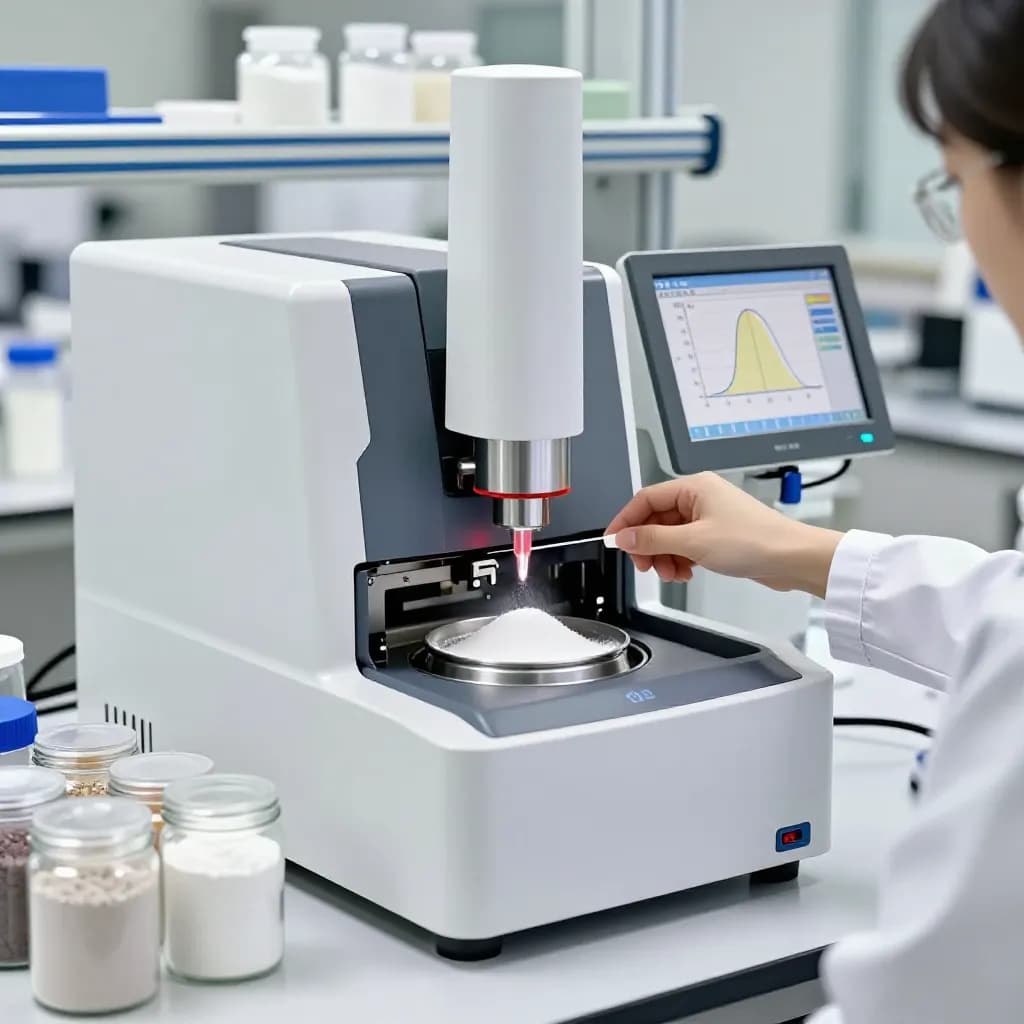
Laser diffraction is the standard method for measuring powder coating PSD in both manufacturing and quality control laboratories. The technique works by passing a dispersed stream of powder particles through a laser beam and measuring the angular distribution of the scattered light. Larger particles scatter light at smaller angles, while smaller particles scatter at larger angles. A mathematical model (typically Mie theory or Fraunhofer approximation) converts the scattering pattern into a particle size distribution.
Modern laser diffraction instruments measure the complete PSD in 10-30 seconds with high repeatability (typically ±1-2% on D50). The measurement can be performed in dry dispersion mode (powder dispersed in an air stream) or wet dispersion mode (powder dispersed in a liquid). Dry dispersion is more commonly used for powder coatings because it avoids the need for a dispersing liquid and more closely represents the powder's behavior in the actual application process. However, dry dispersion requires careful control of the dispersing air pressure to break up agglomerates without fracturing individual particles.
Sieve analysis is an older, simpler method that measures the weight fraction of powder retained on a series of sieves with progressively finer mesh openings. Standard sieve sizes for powder coating analysis include 150 μm (100 mesh), 106 μm (140 mesh), 75 μm (200 mesh), 45 μm (325 mesh), and sometimes 32 μm (450 mesh). The powder is placed on the top sieve of a nested stack and agitated mechanically or ultrasonically for a specified time. The weight retained on each sieve is recorded and used to construct a cumulative distribution.
Sieve analysis is less precise than laser diffraction and cannot resolve the fine end of the distribution below approximately 25-32 μm, but it provides a direct physical measurement that is easy to understand and does not require expensive instrumentation. Many powder coating operations use sieve analysis for incoming quality checks — particularly the percentage passing 45 μm (which correlates with fines content) and the percentage retained on 106 μm (which indicates coarse particles). Laser diffraction is preferred for detailed PSD characterization and for process control in powder manufacturing.
Impact of PSD on Fluidization and Transport
Fluidization — the process of suspending powder particles in an upward air stream to create a fluid-like bed — is the first step in the powder delivery chain and is critically dependent on PSD. The fluidized bed in the powder hopper must be uniform and stable, providing consistent powder density to the pickup tube that feeds the spray gun. Poor fluidization results in surging, pulsating, or inconsistent powder output that causes film thickness variation and surface finish defects.
Particle size directly affects fluidization behavior through its influence on the balance between gravitational, aerodynamic, and interparticle cohesive forces. Particles in the 20-80 μm range (Geldart Group A) fluidize smoothly and expand uniformly when air is introduced. Particles below approximately 15-20 μm (Geldart Group C) are dominated by interparticle cohesive forces (van der Waals, electrostatic, and moisture bridging) that cause them to agglomerate and resist fluidization. These fine particles form channels and rat-holes in the fluidized bed rather than suspending uniformly, leading to inconsistent powder pickup and delivery.
As the fines content of a powder increases — whether from initial grinding or from accumulation of reclaim — fluidization quality degrades progressively. When the fraction below 10 μm exceeds approximately 15-20% of the total volume, fluidization problems become noticeable: the bed becomes sluggish, powder output fluctuates, and the spray pattern becomes inconsistent. At fines content above 25-30%, the powder may become essentially unsprayable without mechanical agitation or fluidization aids.
Powder transport through feed hoses is also affected by PSD. Fine particles have higher surface-area-to-volume ratios and generate more friction against the hose walls, increasing the pressure drop and reducing the effective transport velocity. This can cause powder buildup in hoses, particularly at bends and fittings, leading to intermittent slugs of powder that produce thick spots on the coated part. Dense phase transport systems are less sensitive to PSD variations than venturi systems because they use lower air velocities and positive-pressure pumping that is less affected by powder flow characteristics.
Impact of PSD on Electrostatic Charging and Deposition
Particle size affects electrostatic charging efficiency because the charge-to-mass ratio of a particle depends on its surface area relative to its volume. Smaller particles have higher surface-area-to-volume ratios and therefore acquire higher charge-to-mass ratios during corona or tribo charging. This means that fine particles are more strongly influenced by the electrostatic field and tend to deposit preferentially on the nearest grounded surface, while coarser particles have more momentum and can penetrate further into recessed areas.
In corona charging, the charge acquired by a particle is approximately proportional to its surface area (diameter squared), while its mass is proportional to its volume (diameter cubed). The charge-to-mass ratio therefore scales inversely with particle diameter — a 10 μm particle has roughly 5 times the charge-to-mass ratio of a 50 μm particle. This differential charging creates a size-dependent deposition pattern: fine particles deposit quickly on the front face of the part, while coarser particles travel further and deposit on sides and recessed areas.
This size-dependent behavior has practical implications for coating uniformity. A powder with a broad PSD (high span) will produce a less uniform film than a powder with a narrow PSD because the different size fractions deposit at different rates and in different locations. The fine fraction builds up quickly on the front face, potentially causing back-ionization, while the coarse fraction provides coverage on sides and recesses. A narrower PSD produces more uniform deposition because all particles have similar charge-to-mass ratios and similar deposition behavior.
Transfer efficiency — the percentage of sprayed powder that deposits on the part — is also PSD-dependent. Very fine particles (below 10 μm) tend to follow air currents rather than electrostatic field lines and may be carried past the part without depositing. Very coarse particles (above 80 μm) may have insufficient charge-to-mass ratio to be attracted to the part and fall out of the spray pattern due to gravity. The optimal transfer efficiency is achieved with a PSD centered in the 25-50 μm range, where particles have sufficient charge for electrostatic attraction and sufficient mass for stable trajectory.
Reclaim Powder: PSD Shifts and Management Strategies
Reclaim powder — overspray collected from the spray booth by cyclone separators or cartridge filters and returned to the feed hopper — undergoes a systematic PSD shift toward finer particle sizes with each recirculation cycle. This shift occurs because larger particles have higher transfer efficiency and are preferentially deposited on the part during the first pass, while smaller particles remain airborne and are captured by the reclaim system. After multiple recirculation cycles, the reclaim powder becomes progressively finer than the original virgin powder.
The magnitude of the PSD shift depends on the transfer efficiency of the application process. At 50% first-pass transfer efficiency (typical for many production operations), the reclaim powder has a D50 approximately 5-10 μm finer than the virgin powder after the first cycle. After multiple cycles of recirculation, the reclaim D50 can drop to 20-25 μm with a significantly higher fines content (particles below 10 μm increasing from 5-8% to 15-25% of the total volume).
Managing the virgin-to-reclaim ratio is the primary tool for controlling PSD in production. Most operations blend reclaim with virgin powder at ratios of 70:30 to 80:20 (virgin:reclaim), which maintains the blended PSD close to the virgin specification. Higher reclaim ratios (50:50 or more) shift the blended PSD toward finer sizes, potentially causing fluidization problems, inconsistent spray patterns, and surface finish changes. The optimal ratio depends on the specific powder formulation, the application equipment, and the quality requirements of the finished product.
Regular PSD monitoring of both virgin and reclaim powder is essential for maintaining consistent coating quality. Measuring the reclaim PSD weekly (or more frequently for high-volume operations) and adjusting the blend ratio based on the results prevents the gradual accumulation of fines that can degrade application performance. Some operations periodically purge the reclaim system and start fresh with virgin powder to reset the PSD, particularly when changing colors or when reclaim quality has degraded beyond acceptable limits.
Ultra-Fine Powders: Applications and Challenges
Ultra-fine powder coatings with D50 values of 15-25 μm are used for specialty applications requiring exceptionally smooth finishes, thin films, or enhanced penetration into fine features. Applications include automotive clearcoats, thin-film decorative coatings on small components, and coatings for electronic assemblies where film thickness must be precisely controlled at 25-40 μm.
The primary advantage of ultra-fine powders is surface finish quality. The smaller particles pack more uniformly on the substrate surface before melting, and the thinner initial deposit requires less flow to achieve a smooth, leveled film. Ultra-fine powders can achieve wave-scan values and distinctness-of-image ratings approaching liquid paint quality, making them attractive for applications where appearance is the primary specification.
However, ultra-fine powders present significant handling and application challenges. Fluidization is difficult due to the strong interparticle cohesive forces in fine powders — specialized fluidization techniques including mechanical agitation, vibration, and pulsed air may be required. Electrostatic charging is less efficient because the high charge-to-mass ratio of fine particles causes rapid back-ionization, limiting the achievable film thickness. Powder transport through hoses is prone to buildup and blockage. Reclaim is problematic because the already-fine particles become even finer after recirculation.
To address these challenges, ultra-fine powders are often formulated with flow additives (fumed silica or alumina at 0.1-0.5% by weight) that coat the particle surfaces and reduce interparticle cohesion. Application typically uses tribo charging (which produces lower charge levels than corona) or specialized low-charge corona settings. Dense phase transport systems are preferred over venturi systems for more consistent delivery. Despite these measures, ultra-fine powders remain more difficult to process than standard-grade powders and are typically reserved for applications where the finish quality benefits justify the additional processing complexity.
PSD Specification and Quality Control in Practice
Establishing and maintaining PSD specifications requires collaboration between the powder manufacturer and the coating applicator. The powder manufacturer controls PSD through grinding parameters and publishes the target PSD on the product data sheet — typically specifying D50 and either D10/D90 or the percentage passing specific sieve sizes. The coating applicator should verify incoming powder PSD against these specifications and monitor the blended (virgin plus reclaim) PSD during production.
A practical PSD specification for a standard production powder might read: D50 = 35 ± 5 μm, D10 ≥ 12 μm, D90 ≤ 80 μm, percentage below 10 μm ≤ 10% by volume. These limits ensure that the powder will fluidize properly, charge efficiently, and produce an acceptable surface finish. Tighter specifications may be needed for applications with demanding finish requirements.
Incoming inspection of virgin powder should include PSD measurement (by laser diffraction or sieve analysis) on a sample from each batch or delivery. Results should be compared against the specification and trended over time to detect gradual shifts in the manufacturer's grinding process. If PSD is out of specification, the powder should be quarantined and the manufacturer contacted before use — applying out-of-spec powder will likely cause production problems that are more costly than the delay of obtaining replacement material.
In-process PSD monitoring of the blended powder in the feed hopper provides real-time information about the condition of the powder being sprayed. A simple sieve test — measuring the percentage passing 45 μm — can be performed in minutes and provides a useful indicator of fines accumulation. If the fines content exceeds the established limit, the reclaim ratio should be reduced or the reclaim purged. For operations with laser diffraction instruments, full PSD measurement of hopper samples at regular intervals provides more detailed information for process control and troubleshooting.
Frequently Asked Questions
What is the ideal particle size for powder coating?
The optimal median particle size (D50) for most spray applications is 33-38 μm, with a distribution spanning approximately 10-100 μm. This range provides good fluidization, efficient electrostatic charging, acceptable transfer efficiency, and smooth surface finish. Ultra-fine powders (D50 15-25 μm) produce smoother finishes but are harder to process.
How does reclaim powder affect particle size distribution?
Reclaim powder is systematically finer than virgin powder because larger particles deposit preferentially on parts while smaller particles remain airborne and are collected by the reclaim system. After multiple recirculation cycles, reclaim D50 can drop 5-15 μm below virgin D50, with fines content increasing from 5-8% to 15-25%. Managing the virgin-to-reclaim ratio (typically 70:30 to 80:20) controls the blended PSD.
What causes poor fluidization in powder coating hoppers?
Poor fluidization is most commonly caused by excessive fines content — particles below 10 μm exceeding 15-20% of total volume. Fine particles are dominated by interparticle cohesive forces that cause agglomeration and channeling rather than uniform suspension. Other causes include moisture absorption, inadequate fluidization air pressure, and clogged fluidization membranes.
How is particle size distribution measured?
Laser diffraction is the standard method, measuring the angular scattering pattern of a laser beam passing through dispersed particles to calculate the complete PSD in 10-30 seconds. Sieve analysis is a simpler alternative that measures weight fractions retained on standard mesh sieves. Laser diffraction provides more detailed data, while sieve analysis is useful for quick incoming quality checks.
Does particle size affect surface finish quality?
Yes, significantly. Finer particles produce smoother finishes because they pack more uniformly before melting and require less flow to level. A tighter PSD (lower span value) also improves finish uniformity. However, excessively fine particles cause fluidization and charging problems. The optimal balance for smooth finishes is D50 of 30-35 μm with span below 1.3.
Ready to Start Your Project?
From one-off customs to 15,000-part production runs — get precise pricing in 24 hours.