Parking structures and garages are among the most chemically and mechanically aggressive environments in the built environment, yet their surface finishes are often specified with less care than those of the buildings they serve. Vehicle exhaust emissions, road salt and de-icing chemicals carried on tires, oil and fuel drips, tire marks, and regular vehicle impact create conditions that rapidly degrade inadequate surface finishes. The consequences of coating failure in parking structures extend beyond aesthetics — corroded structural steel, deteriorated safety barriers, and illegible wayfinding systems create safety hazards and liability risks.
Architecture
Powder Coating for Parking Structures and Garages: Vehicle Impact, Chemical Exposure, and Wayfinding
Sundial Powder Coating·April 22, 2026·11 min
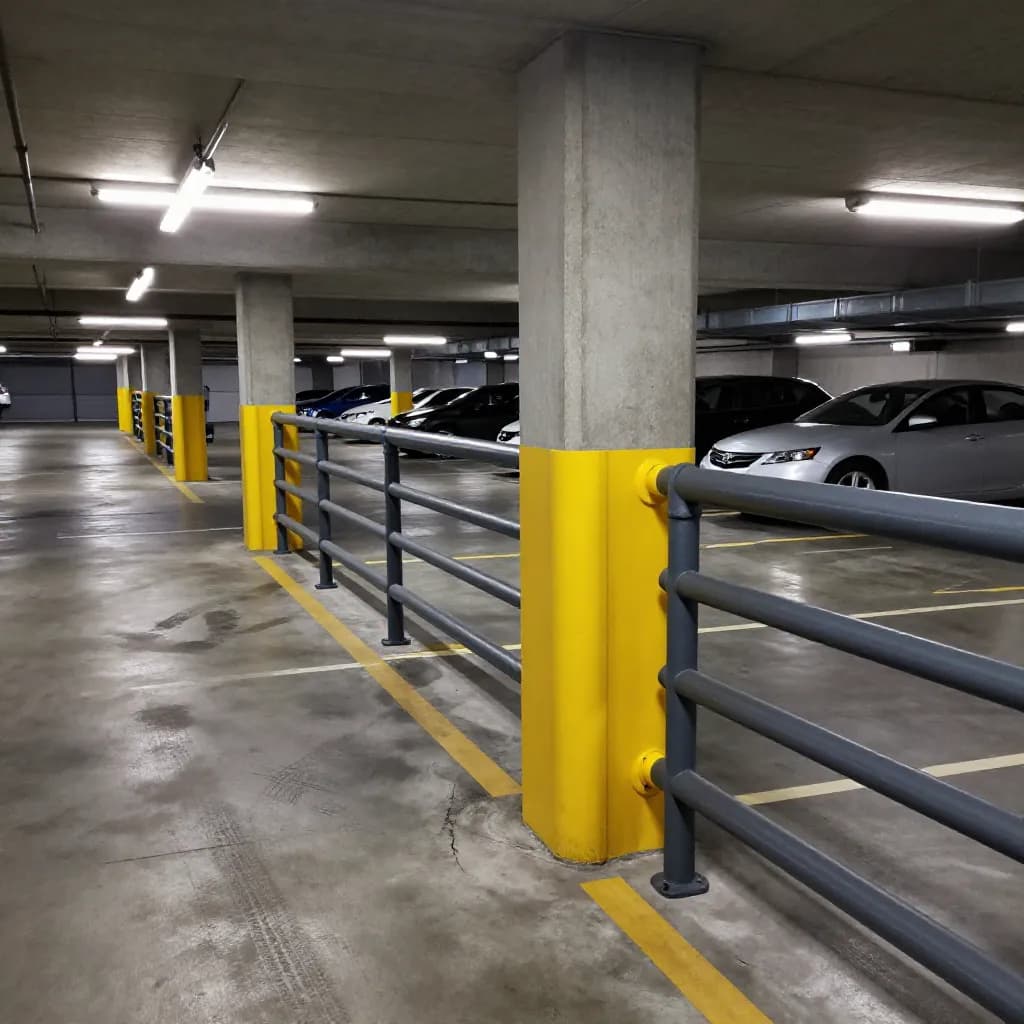
Powder coating addresses the unique demands of parking environments with a combination of chemical resistance, mechanical durability, and design flexibility that liquid paint cannot match. The 60-120 micron film thickness provides a robust barrier against the chemical cocktail of automotive fluids and road chemicals, while the thermoset polymer matrix resists softening and degradation from petroleum products that would dissolve many liquid paint systems.
Ready to Start Your Project?
From one-off customs to 15,000-part production runs — get precise pricing in 24 hours.
On This Page
Parking Structures: Aggressive Environments Hidden in Plain Sight
From structural steel columns and beams to safety barriers, wayfinding signage, lighting fixtures, and ventilation grilles, powder-coated metalwork in parking structures delivers the long-term performance needed to maintain safety, functionality, and appearance in this demanding environment. The zero VOC characteristic is particularly relevant for enclosed and semi-enclosed parking structures where air quality is already compromised by vehicle emissions.
Vehicle Impact Resistance and Safety Barriers
Vehicle impact is an unavoidable reality in parking structures. Despite speed limits and traffic management measures, low-speed collisions with columns, barriers, and wall surfaces occur regularly. The surface finish on impact-prone elements must absorb these events without catastrophic failure — maintaining both its protective function and a reasonable appearance after minor impacts.
Powder coating's thermoset polymer film provides superior impact resistance compared to liquid paint. The cross-linked molecular structure absorbs impact energy through elastic deformation rather than brittle fracture, meaning that minor impacts dent the substrate without cracking or delaminating the coating. This contrasts with liquid paint films, which tend to chip and flake on impact, exposing the substrate to corrosion and creating an unsightly appearance that signals neglect.
Safety barriers — including vehicle restraint systems, pedestrian protection barriers, and column guards — are the primary impact-absorbing elements in parking structures. These barriers must comply with structural performance standards such as EN 1991-1-1 (vehicle barrier loads) and maintain their protective function after impact events. Powder coating on safety barriers maintains its adhesion and integrity through impact deformation, continuing to provide corrosion protection even on deformed sections. This is critical for barriers in aggressive environments where exposed steel would corrode rapidly.
Column protectors and corner guards are high-frequency impact zones that benefit particularly from powder coating's durability. These elements absorb daily contact from vehicle doors, bumpers, and mirrors, and the coating must resist the scratching and scuffing that results. The hard powder film maintains its surface quality through this regular contact, while liquid paint on column protectors typically shows visible damage within months of installation, requiring frequent touch-up that is both costly and aesthetically unsatisfactory.
Chemical Resistance: Automotive Fluids and De-Icing Agents
The chemical environment in parking structures is uniquely aggressive. Engine oil, transmission fluid, brake fluid, coolant, battery acid, windshield washer fluid, and fuel are all potential contaminants. In cold climates, road salt and de-icing chemicals — including sodium chloride, calcium chloride, and magnesium chloride — are carried into the structure on vehicle tires and undercarriages, creating a highly corrosive environment that persists throughout the winter season and beyond.
Powder coating's fully cross-linked thermoset film provides excellent resistance to this chemical environment. The dense, non-porous coating prevents penetration by automotive fluids that would soften or dissolve many liquid paint systems. Testing to EN ISO 2812 confirms resistance to specific automotive chemicals, and the 60-120 micron film thickness provides a substantial barrier that maintains its integrity even under prolonged chemical contact.
De-icing chemical resistance is particularly critical for parking structures in cold climates. Chloride-laden water from melting snow and ice pools on floor surfaces and splashes onto structural elements, creating conditions that accelerate corrosion of unprotected or poorly protected steel. Powder coating combined with appropriate pretreatment — including zinc-rich primers or hot-dip galvanizing for the most aggressive exposures — provides the multi-layer protection needed to resist chloride-induced corrosion over the structure's design life.
Tire marks and rubber deposits are a persistent aesthetic issue in parking structures. The smooth, hard surface of powder coating resists rubber adhesion more effectively than softer liquid paint films, and tire marks can be removed with standard cleaning agents without damaging the underlying finish. This ease of cleaning helps maintain the appearance of parking structure surfaces, supporting the perception of safety and quality that encourages use of the facility.
Wayfinding Systems and Safety Color Coding
Effective wayfinding is essential for the safe and efficient operation of parking structures. Drivers must navigate between levels, locate available spaces, find pedestrian exits, and return to their vehicles — often in environments with limited natural light and complex spatial layouts. Color-coded wayfinding systems are the primary navigational tool, and the durability and visibility of these color systems directly influence user experience and safety.
Powder coating provides the color precision and long-term durability that parking wayfinding demands. Level identification colors, directional arrows, pedestrian route markings, and emergency exit identification all rely on consistent, clearly visible colors that maintain their appearance despite the aggressive parking environment. Powder coating's superior color retention — maintaining Delta E values below 5 after years of exposure — ensures that wayfinding colors remain clearly distinguishable throughout the structure's service life.
Safety colors defined by ISO 3864 must be applied to specific elements including fire equipment locations, emergency exits, height restriction barriers, and hazard zones. These colors must be immediately recognizable and must not fade or become ambiguous over time. Powder coating's UV-stable polyester chemistry maintains safety color accuracy even in areas exposed to natural light, while the 60-120 micron film resists the abrasion and chemical exposure that would degrade liquid-painted safety markings.
For modern parking structures incorporating digital wayfinding and space guidance systems, the powder-coated metalwork that houses sensors, displays, and lighting must integrate seamlessly with the technology infrastructure. The ability to specify exact colors and finishes for equipment housings ensures visual consistency between the architectural and technological elements of the wayfinding system, creating a coherent user experience.
Lighting Fixtures and Electrical Infrastructure
Lighting is critical for safety and security in parking structures, and the metalwork that supports lighting systems — fixture housings, mounting brackets, cable trays, and distribution boards — must maintain its integrity in the aggressive parking environment. Corroded or degraded lighting infrastructure compromises both illumination quality and electrical safety, creating liability risks for the structure operator.
Powder-coated lighting fixture housings resist the corrosion that is endemic in parking structures. The 60-120 micron film provides a continuous barrier against moisture, vehicle emissions, and de-icing chemicals, protecting the electrical enclosure and maintaining the fixture's IP rating throughout its service life. The smooth, non-porous powder surface also resists dirt accumulation, maintaining the reflective efficiency of the fixture housing and supporting consistent illumination levels between cleaning cycles.
Cable tray systems in parking structures route power and data cables throughout the facility, often in locations exposed to vehicle emissions, moisture, and occasional impact. Powder-coated steel cable trays provide the corrosion resistance needed for this environment, with the coating maintaining its protective function for 20-25 years — matching the expected service life of the electrical infrastructure. The smooth powder film also facilitates cable installation and removal during maintenance, reducing friction compared to rough or corroded surfaces.
Emergency lighting and fire alarm systems require particular attention to coating durability. These life-safety systems must function reliably under all conditions, and corrosion of their metalwork housings and mounting systems can compromise both their structural security and their electrical integrity. Powder coating's long-term corrosion protection ensures that emergency systems remain securely mounted and electrically sound throughout their service life, supporting compliance with fire safety regulations and reducing the frequency of replacement due to corrosion-related failure.
Ventilation Grilles and Air Quality Management
Ventilation is essential in enclosed and semi-enclosed parking structures to manage vehicle emissions and maintain air quality within safe limits. The ventilation grilles, louvre systems, and ductwork that manage airflow represent significant metalwork areas that must resist the corrosive effects of vehicle exhaust while maintaining their aerodynamic performance.
Powder-coated aluminum and steel ventilation grilles provide the corrosion resistance needed for parking structure air management systems. The coating resists degradation from carbon monoxide, nitrogen oxides, sulfur compounds, and particulate matter in vehicle exhaust, maintaining both its protective function and the aerodynamic profile of the grille blades. The smooth powder surface does not accumulate soot and particulate as readily as rougher liquid paint surfaces, maintaining airflow efficiency between cleaning cycles.
For naturally ventilated parking structures, the external louvre systems that provide weather protection while allowing air circulation are fully exposed to the elements. Powder coating certified to Qualicoat Class 2 or AAMA 2605 provides the weather resistance needed for these exposed elements, maintaining appearance and corrosion protection for 20-25 years. The ability to color-match ventilation grilles to the building's facade ensures architectural integration, avoiding the utilitarian appearance that can result from unfinished or poorly finished ventilation openings.
Jet fan systems — increasingly used in modern parking structures for smoke control and ventilation — include powder-coated housings and mounting brackets that must resist the vibration, heat, and corrosive atmosphere of the parking environment. The thermoset powder film maintains its adhesion under the vibration loads generated by fan operation, and its heat resistance ensures that the coating does not degrade from the elevated temperatures in the fan discharge zone.
Lifecycle Economics and Asset Management
Parking structures are long-life assets with design lives of 40-60 years, and the lifecycle cost of surface finishes is a significant component of the total cost of ownership. The aggressive environment means that coating maintenance is more frequent and more costly than in most building types, making the specification of durable finishes a critical economic decision.
Powder coating's 20-25 year service life between recoating cycles delivers substantial lifecycle cost savings compared to liquid paint's 8-12 year cycle. For a multi-story parking structure with thousands of square meters of coated metalwork, each avoided recoating event saves significant direct costs — materials, labor, access equipment, and traffic management during the work — plus the indirect costs of reduced parking capacity and revenue loss during maintenance periods.
The predictability of powder coating's performance supports effective asset management planning. Building owners can schedule recoating interventions years in advance, budgeting accurately and coordinating with other planned maintenance activities. This contrasts with liquid paint systems, where less predictable degradation can lead to emergency maintenance requirements that disrupt operations and incur premium costs.
For parking structure operators considering the total cost of ownership, the calculation is straightforward. The 95-98% material efficiency of powder application reduces initial coating costs per square meter. The 20-25 year service life reduces recoating frequency by 50-60% compared to liquid paint. The superior chemical and mechanical resistance reduces the frequency of localized repairs. And the zero VOC characteristic eliminates the ventilation and air quality management costs associated with liquid painting in enclosed parking environments. Collectively, these advantages make powder coating the most economically rational finishing specification for parking structure metalwork.
Frequently Asked Questions
How does powder coating resist vehicle impact in parking garages?
Powder coating's cross-linked thermoset film absorbs impact through elastic deformation rather than brittle fracture. Minor impacts dent the substrate without cracking or delaminating the coating, maintaining corrosion protection on deformed sections — unlike liquid paint which chips and flakes on impact.
Can powder coating withstand road salt and de-icing chemicals?
Yes. The dense, non-porous 60-120 micron film resists chloride penetration. Combined with zinc-rich primers or hot-dip galvanizing, powder coating provides multi-layer protection against chloride-induced corrosion in cold-climate parking structures throughout the structure's design life.
How long do wayfinding colors last in powder-coated parking structures?
Powder coating maintains wayfinding and safety colors within Delta E values below 5 for the full 20-25 year service life. UV-stable polyester chemistry preserves color accuracy even in areas exposed to natural light, ensuring level identification and safety markings remain clearly visible.
Is powder coating suitable for parking structure ventilation systems?
Yes. Powder-coated ventilation grilles resist degradation from vehicle exhaust compounds and maintain aerodynamic performance. The smooth surface resists soot accumulation, and Qualicoat Class 2 certified coatings provide 20-25 years of weather resistance on external louvre systems.
What lifecycle cost savings does powder coating provide for parking structures?
Powder coating reduces recoating frequency by 50-60% compared to liquid paint, with 20-25 year versus 8-12 year service life. Combined with 95-98% material efficiency and reduced localized repair frequency, powder coating delivers the lowest total cost of ownership for parking structure metalwork.
Ready to Start Your Project?
From one-off customs to 15,000-part production runs — get precise pricing in 24 hours.