Bollards and barriers are ubiquitous elements of the urban landscape, serving functions that range from simple pedestrian guidance to high-security vehicle attack mitigation. The powder coating on these products must satisfy two often-competing demands: providing robust protection against the mechanical and environmental stresses of outdoor installation, and delivering the aesthetic quality expected of visible urban furniture that contributes to the character of public spaces.
Architecture
Powder Coating for Bollards and Barriers: Impact Resistance, Security, Decorative, and Heritage Applications
Sundial Powder Coating·April 23, 2026·12 min
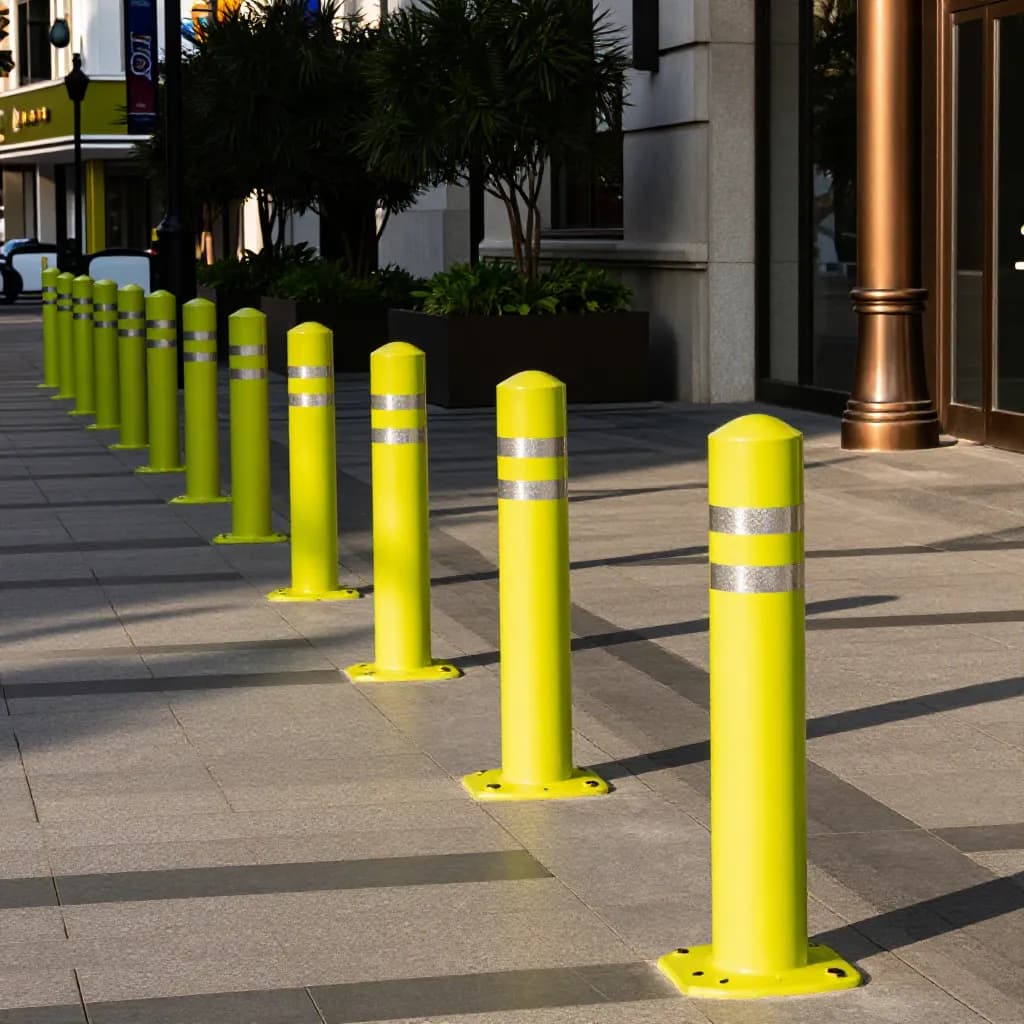
The bollard market encompasses a remarkable diversity of products. Simple steel pipe bollards protect storefronts from vehicle intrusion. Decorative cast iron bollards define pedestrian zones in historic districts. High-security crash-rated bollards protect government buildings and public gathering spaces from vehicle-borne attacks. Retractable and removable bollards manage access to restricted areas. Flexible delineator bollards guide traffic without creating rigid obstacles. Each product type has different substrate materials, performance requirements, and aesthetic expectations that affect the powder coating specification.
Ready to Start Your Project?
From one-off customs to 15,000-part production runs — get precise pricing in 24 hours.
On This Page
Bollards and Barriers: Coating for Protection and Aesthetics
Powder coating is the dominant finishing technology for bollards and barriers because it provides the thick, tough, chemically resistant film needed for ground-level outdoor installations. Bollards face the most aggressive combination of environmental stresses in the urban furniture category — vehicle contact, de-icing salt splash, dog urine, cleaning chemicals, UV radiation, and the general mechanical abuse of street-level installation. The powder coating must resist all of these simultaneously while maintaining the specified color and finish.
The security bollard segment has grown significantly in response to the increasing threat of vehicle attacks on public spaces. These high-security products are engineered to stop vehicles traveling at high speed, and the coating must survive the extreme deformation that occurs during a vehicle impact event. While the coating's primary function is corrosion protection and aesthetics rather than structural performance, a coating that cracks and delaminates during impact exposes the deformed steel to rapid corrosion, compromising the bollard's ability to be inspected and potentially reused after an impact event.
Impact Resistance for Vehicle Contact Zones
Bollards are designed to be hit. Whether the contact is a low-speed parking lot bump or a high-speed security impact, the powder coating must accommodate the resulting deformation without catastrophic failure. The coating's response to impact directly affects the bollard's post-impact corrosion resistance and its visual condition after the event.
Low-speed vehicle contact — parking lot bumps, delivery truck nudges, and slow-speed collisions — is the most common impact scenario for commercial and decorative bollards. These impacts typically produce minor dents and surface deformation without compromising the bollard's structural integrity. The powder coating must flex with the deforming steel without cracking or delaminating, maintaining the corrosion barrier at the impact site. Flexible polyester formulations with elongation of 3 millimeters or more on a conical mandrel test and direct impact resistance of 160 inch-pounds or more provide the flexibility needed to survive low-speed impacts.
High-speed security impacts are an entirely different magnitude of deformation. Crash-rated bollards tested to PAS 68, IWA 14-1, or ASTM F2656 standards are designed to stop vehicles traveling at 30-80 kilometers per hour, and the bollard may deform significantly during the impact event — bending, crushing, or shearing depending on the bollard design and impact severity. The powder coating in the impact zone will be stretched far beyond its normal elongation capacity and will crack and delaminate in the immediate impact area. However, the coating on the non-impacted portions of the bollard should remain intact, continuing to provide corrosion protection and visual identification.
Post-impact coating condition is a consideration for bollard maintenance and reuse. Some crash-rated bollard systems are designed for single-use — the bollard is replaced after an impact event. Others are designed for inspection and potential reuse if the deformation is within acceptable limits. For reusable bollards, the coating condition after impact provides visual evidence of the deformation severity and helps inspectors assess whether the bollard can remain in service. A coating that peels away from the entire bollard after a localized impact makes inspection more difficult and accelerates corrosion of the exposed steel.
The base plate and foundation connection area of impact-rated bollards experiences extreme stress during vehicle impact, and the coating at this critical junction must be robust. Enhanced film thickness of 100-150 microns at the base plate, combined with flexible formulation and excellent adhesion from zinc phosphate pretreatment, provides the best chance of coating survival at the base during impact events.
Security Bollard Coating Specifications
Security bollards protecting government buildings, embassies, transit stations, and public gathering spaces have coating requirements that go beyond standard urban furniture specifications. The coating must support the bollard's security function while meeting the aesthetic standards of high-profile installations.
Visual deterrence is a legitimate security function of bollard coating. Bollards that are clearly visible and identifiable as security barriers communicate that the protected space is defended, potentially deterring attack planning. High-visibility colors, reflective elements, and distinctive finishes help identify security bollards and distinguish them from decorative street furniture. However, many security installations prefer bollards that blend with the surrounding urban design, providing protection without creating a fortress-like atmosphere.
The coating must not interfere with the bollard's structural performance. For steel bollards filled with concrete, the coating on the interior steel surface must be compatible with concrete contact and must not create a bond-breaking layer between the steel shell and the concrete fill. Some security bollard manufacturers specify bare interior surfaces to ensure full steel-to-concrete bond, while others use epoxy-based interior coatings that are compatible with concrete adhesion.
Retractable and removable security bollards have additional coating requirements related to their mechanical operation. The bollard sleeve — the below-grade housing that the bollard retracts into — must be coated with a formulation that resists the abrasion of the bollard sliding in and out, the moisture and debris that accumulate in the sleeve, and the alkaline environment of concrete contact. The bollard shaft surface that contacts the sleeve during retraction must be coated with a hard, smooth finish that minimizes friction and resists the abrasion of repeated cycling.
Anti-climb coatings are specified on some security bollards to prevent unauthorized persons from using the bollard as a climbing aid to access restricted areas. These coatings use a smooth, low-friction surface that provides minimal grip for hands and feet. The anti-climb property is achieved through the same low surface energy chemistry used in anti-graffiti coatings, providing a dual benefit of climb resistance and graffiti resistance.
Corrosion protection for security bollards must be specified for the full design life of the security installation, which may be 25-50 years. The duplex galvanizing-plus-powder-coating system provides the most robust long-term protection, with the galvanizing providing cathodic protection at any coating defect and the powder coating protecting the zinc layer from atmospheric consumption. For below-grade bollard components, supplementary protection such as bituminous wrapping or epoxy coating provides additional moisture barrier in the soil and concrete environment.
Decorative and Heritage Bollard Finishes
Decorative bollards serve as urban design elements that define spaces, guide pedestrians, and contribute to the aesthetic character of streetscapes, plazas, and parks. The powder coating on decorative bollards must deliver the visual quality expected of architectural street furniture while providing the durability needed for ground-level outdoor installation.
Heritage bollard designs — reproductions of Victorian, Edwardian, Georgian, and other historical styles — require finishes that evoke the materials and patinas of their historical originals. Traditional cast iron bollards were painted in dark colors — black, dark green, and dark blue — that have become the standard heritage palette. Powder coating replicates these traditional colors with modern durability, providing the historical appearance with 10-20 times the service life of traditional oil-based paint.
Antique and patina effects on heritage bollards are achieved through multi-coat powder coating techniques. A dark base coat — typically black or dark brown — is applied first, followed by a lighter metallic or textured topcoat applied in a controlled pattern that simulates natural weathering. The topcoat is applied more heavily on raised ornamental details and more lightly in recesses, creating the light-and-shadow effect of genuine aged metal. Bronze, copper, and verdigris effects are all achievable through this technique.
Contemporary decorative bollards use the full range of powder coating colors and finishes to complement modern architectural settings. Brushed stainless steel effects, high-gloss primary colors, matte neutrals, and metallic finishes are all specified for contemporary bollard designs. The finish selection should complement the surrounding architecture and landscape materials — a bollard in a granite plaza might use a dark gray finish that echoes the stone, while a bollard in a colorful playground might use a bright, playful color.
Illuminated bollards — incorporating LED lighting for path marking, wayfinding, or decorative effect — require coating that is compatible with the lighting elements. The coating must not block or distort light transmission through translucent panels or lenses, and the coating color should complement the light color for a cohesive nighttime appearance. Reflective or metallic coatings can enhance the lighting effect by reflecting light from the LED elements.
Custom bollard designs for specific projects — corporate campuses, cultural institutions, and signature public spaces — may require unique colors, textures, or graphic elements. Powder coating supports these custom requirements through color matching, texture formulation, and multi-coat techniques. For projects requiring graphic elements such as logos or patterns, the powder coating provides a durable base surface for applied graphics protected by a clear topcoat.
Retractable Bollard Coating Challenges
Retractable bollards — which lower into a below-grade sleeve to allow vehicle access and raise to block access — present unique coating challenges related to their mechanical operation. The coating must survive the repeated cycling of raising and lowering, the abrasive contact between the bollard shaft and the sleeve, and the harsh below-grade environment of the sleeve housing.
The bollard shaft surface that slides within the sleeve is the most demanding coating zone. Each raise-and-lower cycle creates sliding contact between the shaft coating and the sleeve interior, generating abrasion that gradually wears the coating. A retractable bollard may cycle 10-50 times per day in an active access control application, accumulating thousands of cycles per year. The shaft coating must resist this abrasion while maintaining a smooth surface that does not increase the friction force required for operation.
Hard, smooth powder coatings with pencil hardness of 3H or higher and low coefficient of friction provide the best shaft coating performance. Some manufacturers specify nylon or PTFE-modified powder coatings that incorporate solid lubricant particles in the coating matrix, reducing friction and wear simultaneously. These self-lubricating coatings extend the maintenance interval between lubrication services and reduce the operating force required for manual retractable bollards.
The below-grade sleeve accumulates water, debris, and de-icing salt that create an aggressive corrosion environment. The sleeve interior coating must resist immersion in standing water, alkaline concrete contact, and the chemical cocktail of urban runoff. Epoxy powder coatings provide the best combination of water immersion resistance and chemical resistance for sleeve interiors. The sleeve should also incorporate drainage provisions to minimize standing water accumulation.
The transition zone where the bollard shaft emerges from the ground is the most visible and most vulnerable area. This zone is exposed to maximum salt splash, water pooling, and mechanical contact from the sleeve collar. Enhanced coating protection at this transition — increased film thickness, supplementary sealant, or stainless steel collar inserts — prevents the premature coating failure that commonly occurs at ground level on retractable bollards.
Automatic retractable bollards with hydraulic or electric actuation have additional coating considerations. Hydraulic fluid contact on the shaft and sleeve interior requires oil-resistant coating formulations. Electrical connections and sensor mounting points must be masked during coating to maintain functionality. The coating must not interfere with position sensors, limit switches, or other control system components that manage the bollard's automatic operation.
Ground-Level Durability and Environmental Resistance
Bollards are installed at ground level where they face the most aggressive environmental conditions in the urban landscape. The combination of de-icing salt, standing water, dog urine, vehicle exhaust, cleaning chemicals, and mechanical abuse creates a corrosion environment that exceeds what most urban furniture experiences.
De-icing salt concentration at ground level is significantly higher than at elevated positions. Salt-laden water from road spray, snowmelt, and sidewalk de-icing concentrates around bollard bases, creating a persistently corrosive environment during winter months. The lower 30 centimeters of a bollard may be exposed to salt concentrations 5-10 times higher than the upper sections. The coating specification for the base zone should reflect this increased exposure — either through enhanced film thickness, dual-coat systems with epoxy primer, or specification of higher salt spray resistance requirements for the base section.
Dog urine is a significant and often underestimated corrosion threat to bollards. The uric acid and salts in dog urine create a localized acidic environment that attacks both the coating and the underlying zinc galvanizing. Bollards in areas with high dog traffic — parks, sidewalks, and residential streets — show accelerated base corrosion compared to bollards in vehicle-only areas. Acid-resistant coating formulations and increased film thickness on the lower section help resist this exposure, but regular cleaning to remove urine deposits is also important for long-term coating preservation.
Standing water at the bollard base creates a persistent wet environment that accelerates corrosion at any coating defect. Proper installation with drainage provisions — gravel backfill, weep holes in the foundation, and sloped grade away from the bollard — minimizes water accumulation. The coating specification should assume some water pooling will occur and specify immersion-resistant formulations for the base section.
Mechanical damage at ground level results from lawn mower contact, snow plow strikes, street sweeper brushes, and pedestrian foot traffic. The coating must resist these chronic low-level impacts without chipping or cracking. Impact resistance of 120 inch-pounds or more is recommended for the base section, with enhanced film thickness of 100-120 microns providing additional impact absorption.
UV exposure on bollards is less severe than on elevated structures because surrounding buildings, vehicles, and vegetation provide partial shading. However, bollards in open plazas and parking lots receive full sun exposure and require the same UV-resistant formulations specified for other outdoor urban furniture. Super-durable polyester is the minimum acceptable chemistry for outdoor bollard applications.
Specification and Procurement for Municipal Projects
Municipal procurement of powder-coated bollards requires specifications that address both the functional performance and the aesthetic requirements of the installation. The specification must be clear enough to ensure consistent quality across suppliers while flexible enough to accommodate the range of bollard types and installation environments within a municipal system.
Functional performance requirements should include minimum values for film thickness, adhesion, hardness, impact resistance, flexibility, salt spray endurance, and accelerated weathering. These requirements should be tiered based on the bollard's function and installation environment — security bollards in coastal locations need more demanding specifications than decorative bollards in sheltered plazas.
Aesthetic requirements should specify color using standard color systems with defined tolerances, gloss level and acceptable range, surface texture if applicable, and any special finish effects such as metallic or antique patina. Physical reference samples should be required for approval before production coating begins, and the approved sample should be retained as the standard for production quality verification.
For security bollards, the specification should address coating performance under impact conditions. While no standard test method specifically evaluates coating performance during bollard impact, the specification can require impact resistance testing at levels that approximate the deformation expected during a security event. Flexibility and elongation requirements ensure that the coating can accommodate significant deformation without catastrophic failure.
Installation protection requirements should specify how the coating will be protected during transport, storage, and installation. Protective wrapping, padded handling equipment, and post-installation protection during surrounding construction work should be defined in the specification. Any coating damage that occurs during installation should be repaired using approved touch-up materials before the installation is accepted.
Warranty requirements for bollard coatings should cover perforation corrosion, delamination, and excessive chalking or fading for a minimum of 10 years, with enhanced warranty periods for premium installations. The warranty should specify maintenance requirements — including cleaning frequency and touch-up repair — that must be met to maintain warranty validity. For security bollards with 25-50 year design lives, the coating warranty should be proportional to the expected service life.
Lifecycle analysis should be considered in the procurement evaluation. A bollard with a higher initial coating specification that requires less maintenance over its service life may provide better lifecycle value than a lower-specification bollard that needs frequent touch-up and earlier recoating. The procurement specification should encourage lifecycle thinking by weighting coating durability and maintenance requirements alongside initial product quality.
Frequently Asked Questions
What impact resistance is needed for bollard powder coating?
Standard decorative bollards should achieve minimum 120 inch-pounds direct impact resistance. Security bollards need 160 inch-pounds or more with flexible formulations (3mm+ conical mandrel elongation) that accommodate significant deformation without catastrophic coating failure. The base section needs enhanced protection due to vehicle contact risk.
Can powder coating replicate heritage bollard finishes?
Yes. Heritage finishes including traditional black, dark green, antique bronze, aged copper, and verdigris effects are achievable through powder coating. Multi-coat techniques with dark base coats and lighter metallic topcoats simulate natural patina. Textured finishes replicate the surface character of historical cast iron bollards.
How does powder coating perform on retractable bollards?
Retractable bollard shafts need hard, smooth coatings (3H+ pencil hardness) with low friction to resist the abrasion of repeated cycling. PTFE or nylon-modified formulations reduce friction and wear. The below-grade sleeve requires epoxy coating for water immersion and concrete contact resistance. The ground-level transition zone needs enhanced protection.
What protects bollard coatings from dog urine corrosion?
Acid-resistant coating formulations and increased film thickness (100-120 microns) on the lower 30 centimeters help resist uric acid attack. Regular cleaning to remove urine deposits is also important. The duplex galvanizing-plus-powder-coating system provides the most robust protection, with the zinc layer providing sacrificial protection at any coating defect.
How long does powder coating last on outdoor bollards?
Super-durable polyester provides 7-10 years of color retention. Fluoropolymer-modified coatings achieve 15-20 years. Corrosion protection from duplex galvanizing-plus-powder-coating systems lasts 30-50 years in moderate environments. Ground-level base sections may require earlier maintenance due to salt, water pooling, and mechanical damage exposure.
Ready to Start Your Project?
From one-off customs to 15,000-part production runs — get precise pricing in 24 hours.