Public bike racks are essential urban furniture elements that support cycling infrastructure in cities worldwide. As municipalities invest in cycling-friendly transportation networks, the demand for durable, attractive bike parking has grown dramatically. Powder coating is the standard finishing technology for public bike racks because it delivers the combination of corrosion resistance, impact toughness, color flexibility, and vandal resistance that these heavily used public installations require.
Architecture
Powder Coating for Public Bike Racks: Urban Furniture, Vandal Resistance, and Brand Colors
Sundial Powder Coating·April 23, 2026·11 min
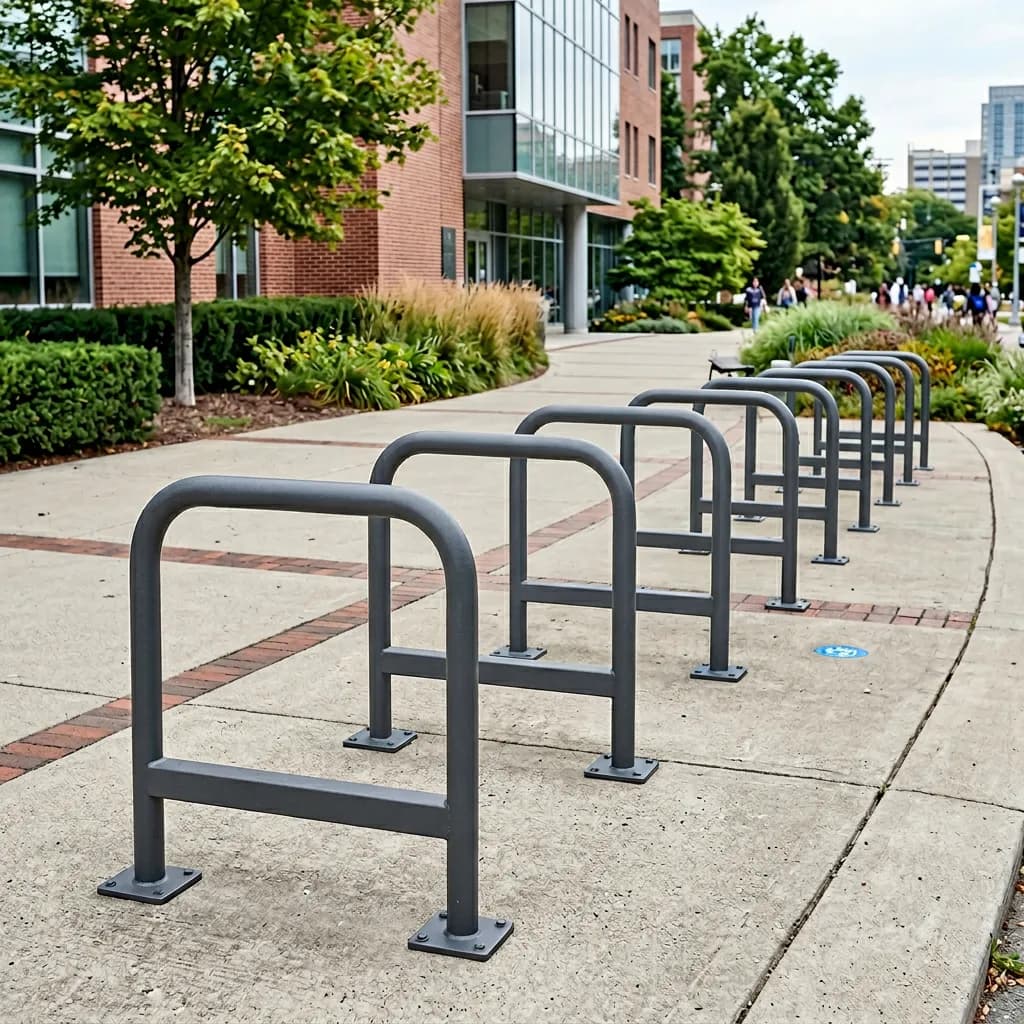
Bike racks face a uniquely demanding service environment. They are subjected to constant metal-to-metal contact from bicycle frames and locks, impact from bicycles being loaded and removed, exposure to all weather conditions, and the deliberate abuse of vandalism. Unlike most urban furniture that is designed for human contact, bike racks must withstand the mechanical interaction of metal bicycles and hardened steel locks — abrasive contacts that would quickly destroy lesser coatings.
Ready to Start Your Project?
From one-off customs to 15,000-part production runs — get precise pricing in 24 hours.
On This Page
Public Bike Racks: Where Durability Meets Urban Design
The design vocabulary of public bike racks has expanded far beyond the simple inverted-U rack. Contemporary bike rack designs include artistic sculptural forms, wave racks, post-and-ring systems, custom branded designs, and integrated bike-share station hardware. Each design presents different coating challenges — from the simple tube geometry of a U-rack to the complex curves and intersections of sculptural designs. The powder coating must achieve complete, uniform coverage on all of these geometries while meeting the performance requirements of outdoor public infrastructure.
Municipal procurement specifications for bike racks typically include detailed coating requirements that reference national standards for outdoor durability, specify minimum performance values for adhesion, hardness, impact resistance, and salt spray endurance, and may include agency-specific requirements for color, anti-graffiti properties, and maintenance procedures. Understanding these specifications is essential for manufacturers and coating applicators serving the public infrastructure market.
Abrasion and Lock Contact Resistance
The most distinctive wear pattern on public bike racks is the abrasion caused by bicycle frames and locks rubbing against the rack surface. This metal-to-metal contact creates localized wear zones where the coating is gradually ground away, exposing the substrate to corrosion. The coating specification must address this specific wear mechanism to ensure long-term protection.
Bicycle lock contact is the most aggressive abrasion source. U-locks, chain locks, and cable locks are made from hardened steel that is significantly harder than any polymer coating. When a lock is applied to a rack, it creates a contact zone where the lock body rests against the coated surface. As the bicycle moves in wind or during loading and unloading, the lock slides and rotates against the coating, creating abrasion that can wear through a standard coating in months of heavy use.
Hard powder coating formulations with pencil hardness of 3H or higher provide the best resistance to lock abrasion. These hard coatings resist the scratching and grinding action of hardened steel locks more effectively than softer formulations. However, hardness alone is not sufficient — the coating must also have good adhesion to prevent the abraded coating from peeling away from the substrate in sheets, which would accelerate the wear process.
Film thickness in lock contact zones should be maximized within practical limits. A film build of 100-120 microns in the primary lock contact zone — typically the horizontal bar of a U-rack or the ring of a post-and-ring system — provides more material to wear through before the substrate is exposed. This increased thickness can be achieved through targeted manual application or by designing the rack geometry to present the lock contact zone in an orientation that naturally accumulates more powder during electrostatic application.
Bicycle frame contact creates a different abrasion pattern — broader, lower-pressure contact that gradually dulls the coating surface rather than cutting through it. The top tube, down tube, and fork of the bicycle rest against the rack surface, and as the bicycle sways in wind, these contact points create polished wear marks. While less aggressive than lock contact, frame abrasion over years of heavy use can eventually wear through the coating on popular racks.
Some rack designers address the abrasion challenge through material selection rather than coating specification. Stainless steel racks eliminate the corrosion concern at wear points, though they sacrifice the color options that powder coating provides. Hybrid designs use stainless steel at lock contact zones with powder-coated mild steel for the structural framework, combining wear resistance where it matters most with color flexibility for the overall design.
Vandal Resistance for Public Installations
Public bike racks are vulnerable to vandalism including graffiti, sticker application, deliberate scratching, and attempted structural damage. The powder coating specification must address these threats to maintain the rack's appearance and functionality in public locations.
Anti-graffiti powder coatings are increasingly specified for bike racks in urban areas where graffiti is prevalent. Permanent anti-graffiti formulations with surface energy below 25 millinewtons per meter prevent spray paint and marker ink from bonding permanently, allowing removal with proprietary cleaning solutions. The anti-graffiti property must be balanced against the abrasion resistance requirement — some anti-graffiti formulations sacrifice hardness for low surface energy, which may not be acceptable for the high-abrasion environment of bike rack service.
Deliberate scratching with keys, coins, and sharp objects is a common form of bike rack vandalism. While no polymer coating can resist determined scratching with a hardened metal tool, hard coatings with pencil hardness of 3H or higher resist casual scratching that would mark softer coatings. The visual impact of scratches can be minimized by specifying textured finishes that camouflage minor surface damage, or by choosing dark colors where scratches are less visible than on light-colored coatings.
Sticker and poster application is a persistent maintenance issue for public bike racks, particularly in commercial and entertainment districts. The anti-graffiti surface properties that resist paint adhesion also facilitate sticker removal, but regular maintenance is still required to prevent adhesive buildup. Racks in high-sticker areas benefit from smooth, non-porous coating surfaces that minimize adhesive penetration into the coating texture.
Structural vandalism — attempts to bend, cut, or remove the rack — is beyond the coating's ability to prevent, but the coating can provide evidence of tampering. Coating damage at bolt connections or weld joints may indicate attempted removal, and regular inspection of coating condition at these points can identify vandalism attempts before the rack is compromised.
The overall vandal resistance strategy for public bike racks combines coating specification with design and installation practices. Racks that are securely anchored to concrete foundations, designed without removable components, and installed in well-lit, high-visibility locations experience less vandalism than poorly secured racks in isolated locations. The coating specification is one element of a comprehensive vandal resistance approach.
Color Selection and Urban Design Integration
Bike rack color is an urban design decision that affects the visual character of the streetscape, and municipalities increasingly specify rack colors that complement the broader public realm design palette. The powder coating must deliver the specified color with accuracy and maintain that color through years of outdoor exposure.
Black is the most commonly specified bike rack color worldwide, chosen for its visual neutrality, ability to complement any architectural context, and practical advantage of hiding minor wear and dirt accumulation. RAL 9005 jet black in satin or semi-gloss finish is the default specification for many municipalities. However, the trend toward more colorful and distinctive urban furniture is driving increased specification of non-black rack colors.
Brand and district colors allow municipalities to create visual identity for specific areas. A commercial district may specify racks in the district's brand color. A university campus may use institutional colors. A waterfront area may choose marine-inspired blues or greens. These custom colors transform utilitarian bike racks into elements of placemaking that reinforce district identity and wayfinding.
High-visibility colors — bright yellow, orange, or green — are specified for bike racks in locations where visibility is a safety concern. Racks near roadways, in parking garages, and at transit stations benefit from high-visibility colors that help cyclists locate parking and alert drivers and pedestrians to the rack's presence. Fluorescent powder coatings provide enhanced visibility under both daylight and artificial lighting.
Metallic and special effect finishes are used for premium bike rack installations in high-profile locations. Stainless steel effect, bronze metallic, and copper metallic powder coatings create a premium appearance that complements high-end architectural settings. These metallic finishes use aluminum or copper flake pigments that create a reflective, metallic appearance varying with viewing angle and lighting conditions.
Color durability is essential for maintaining the design intent over the rack's service life. Super-durable polyester formulations provide 7-10 years of color retention in full outdoor exposure, which is adequate for most bike rack installations with expected service lives of 10-15 years. For premium installations where longer color retention is required, fluoropolymer-modified coatings extend UV resistance to 15-20 years.
Installation Methods and Coating Protection
Bike rack installation methods affect coating integrity, and the installation process must be designed to minimize coating damage during and after installation. The most common installation methods — surface mounting, embedded mounting, and rail mounting — each present specific coating protection challenges.
Surface-mounted racks are bolted to concrete or asphalt surfaces through base plates or flanges. The drilling and bolting process can damage the coating at bolt hole locations if not performed carefully. Pre-drilled and coated bolt holes with protective sleeves minimize installation damage. The base plate contact surface — where the rack meets the ground — should be coated with enhanced thickness or supplementary sealant to prevent moisture ingress at the ground interface.
Embedded mounting involves setting the rack's legs directly into concrete during foundation pouring. The below-grade portion of the rack is in permanent contact with concrete and soil moisture, creating an alkaline environment that can attack some coating systems. The embedded section should be coated with epoxy-based formulation optimized for concrete contact, or wrapped with a supplementary moisture barrier before embedding. The transition zone between the embedded and exposed sections is particularly vulnerable and should receive enhanced coating protection.
Rail-mounted racks are attached to steel rails that are themselves anchored to the ground. The rack-to-rail connection creates a metal-to-metal contact point where coating wear and galvanic corrosion can occur. Isolation washers or pads between the rack and rail prevent galvanic corrosion, and the connection hardware should be coated or made from compatible materials to prevent dissimilar metal corrosion.
Post-installation protection is important during the construction phase when bike racks may be installed before surrounding construction is complete. Concrete splash, paint overspray, and construction debris can damage the coating if the rack is not protected. Temporary protective wrapping should be applied to newly installed racks in active construction zones and removed only when surrounding work is complete.
Anchor bolt and mounting hardware should be coated or finished to match the rack color for a cohesive appearance. Bare zinc-plated or stainless steel hardware on a powder-coated rack creates a visual mismatch that detracts from the design intent. Color-matched hardware — either powder coated or available in matching stainless steel finish — completes the installation aesthetically.
Pretreatment and Coating for Common Rack Materials
Public bike racks are fabricated from several materials, each requiring appropriate pretreatment for optimal powder coating performance. The material selection affects both the coating specification and the expected service life of the finished rack.
Mild steel tube — the most common bike rack material — requires thorough pretreatment for outdoor durability. The standard sequence includes abrasive blasting to Sa 2.5 or acid pickling to remove mill scale, followed by zinc phosphate conversion coating for maximum adhesion and corrosion resistance. For racks in aggressive environments, a zinc-rich epoxy primer applied over the conversion coating before the powder topcoat provides cathodic protection at any coating defect. Minimum salt spray resistance of 750 hours is recommended for standard installations, with 1000 hours or more for coastal and high-salt environments.
Galvanized steel racks combine the cathodic protection of zinc galvanizing with the color and appearance of powder coating. The duplex system provides superior corrosion protection compared to either method alone. Pretreatment of galvanized surfaces requires modified chemistry to address the zinc surface — alkaline cleaning, light acid activation, and zinc-compatible conversion coating. Pre-baking at 200-230 degrees Celsius before powder application prevents outgassing defects.
Stainless steel racks — typically 304 or 316 grade — are specified for premium installations and corrosive environments. Stainless steel provides inherent corrosion resistance, so powder coating serves primarily an aesthetic function. Pretreatment involves alkaline cleaning and light abrasive blasting or acid etching to create adhesion profile on the passive stainless surface. The naturally passive oxide layer on stainless steel resists chemical conversion coating, so adhesion relies primarily on mechanical interlocking.
Aluminum racks — used for lightweight and corrosion-resistant designs — require standard aluminum pretreatment: alkaline cleaning, acid etch, and chromate-free conversion coating. Aluminum racks are particularly suitable for coastal installations where steel corrosion is a concern, and the powder coating provides color and UV protection while the aluminum substrate provides inherent corrosion resistance.
Cast iron racks — used for heritage and decorative designs — may have surface porosity that causes outgassing during powder curing. Pre-baking at 200-220 degrees Celsius for 20-30 minutes before powder application is essential for cast iron substrates. The casting surface should be inspected and any major porosity filled with appropriate filler before coating.
Specification Writing and Procurement Standards
Municipal procurement of powder-coated bike racks requires clear, comprehensive specifications that define coating requirements in measurable terms. A well-written specification reduces quality disputes, ensures consistent product quality across suppliers, and provides a basis for acceptance testing and warranty enforcement.
The specification should define material requirements including coating chemistry, color, gloss level, and any special properties such as anti-graffiti function. Acceptable coating chemistries should be specified by performance class rather than brand name to allow competitive sourcing — for example, specifying super-durable polyester meeting AAMA 2604 performance requirements rather than a specific manufacturer's product.
Performance requirements should include minimum values for film thickness, adhesion, hardness, impact resistance, flexibility, chemical resistance, salt spray endurance, and accelerated weathering. Each requirement should reference the applicable test method and specify the acceptance criterion. For example: film thickness minimum 70 microns per ASTM D7091, adhesion 5B per ASTM D3359, pencil hardness minimum 2H per ASTM D3363, direct impact minimum 100 inch-pounds per ASTM D2794.
Testing and inspection requirements should specify which tests are performed on each production lot, which are performed on periodic samples, and which are performed only during initial qualification. Incoming inspection by the purchasing agency should include film thickness measurement and visual inspection at minimum, with periodic adhesion and hardness testing to verify ongoing compliance.
Warranty requirements should define the warranted performance period, the specific failure modes covered, and the remedies for warranty claims. A typical bike rack coating warranty covers perforation corrosion, delamination, and excessive chalking or fading for 5-10 years, with prorated coverage for the remaining service life. The warranty should specify the environmental conditions covered and any maintenance requirements that must be met to maintain warranty validity.
Sample submission and approval processes should be defined in the specification. Pre-production samples coated to the full specification should be submitted for agency approval before production coating begins. The approved sample becomes the reference standard for production quality, and any deviation from the approved sample requires resubmission and approval.
Accessibility requirements may apply to bike rack installations in public spaces. Contrast between the rack color and the surrounding pavement helps visually impaired pedestrians identify the rack as an obstacle. The specification should consider accessibility guidelines when selecting rack colors, ensuring adequate luminance contrast with the installation surface.
Frequently Asked Questions
How long does powder coating last on public bike racks?
Super-durable polyester provides 7-10 years of color retention in full outdoor exposure. Corrosion protection from properly pretreated and coated steel racks lasts 10-15 years in moderate environments. Lock contact zones may show wear sooner due to metal-to-metal abrasion. Galvanized-plus-powder-coating duplex systems extend corrosion protection to 25-35 years.
What powder coating resists bicycle lock scratching?
Hard polyester formulations with pencil hardness of 3H or higher provide the best resistance to lock abrasion. Increased film thickness of 100-120 microns in lock contact zones provides more material before substrate exposure. No polymer coating can completely prevent wear from hardened steel locks, but hard, thick coatings significantly extend the time before substrate exposure.
Can bike rack powder coating be anti-graffiti?
Yes. Permanent anti-graffiti powder coatings with surface energy below 25 mN/m prevent spray paint and marker from bonding permanently. Graffiti is removed with proprietary cleaning solutions without damaging the coating. The anti-graffiti property must be balanced against abrasion resistance requirements for the high-wear bike rack environment.
What colors are most popular for public bike racks?
Black (RAL 9005) in satin finish is the most commonly specified color worldwide for its visual neutrality and ability to hide wear. However, custom brand colors, district identity colors, and high-visibility colors are increasingly specified. Metallic finishes are used for premium installations in high-profile architectural settings.
How should embedded bike rack legs be coated?
The below-grade portion should be coated with epoxy-based formulation optimized for alkaline concrete contact, or wrapped with a supplementary moisture barrier. The transition zone between embedded and exposed sections needs enhanced coating protection. The above-grade portion uses standard outdoor polyester or super-durable polyester specification.
Ready to Start Your Project?
From one-off customs to 15,000-part production runs — get precise pricing in 24 hours.