The curing oven is typically the largest single piece of equipment in a powder coating line and the largest consumer of energy. Its design determines the maximum throughput capacity, the range of part sizes and geometries that can be processed, the energy cost per part, and the consistency of the cure across all parts in a production batch. A well-designed oven delivers uniform temperature throughout the work zone, heats parts efficiently to cure temperature, and minimizes energy waste through effective insulation and air management.
Technical
Powder Coating Oven Design and Efficiency: Convection, IR, Temperature Uniformity, and Energy Optimization
Sundial Powder Coating·April 22, 2026·14 min
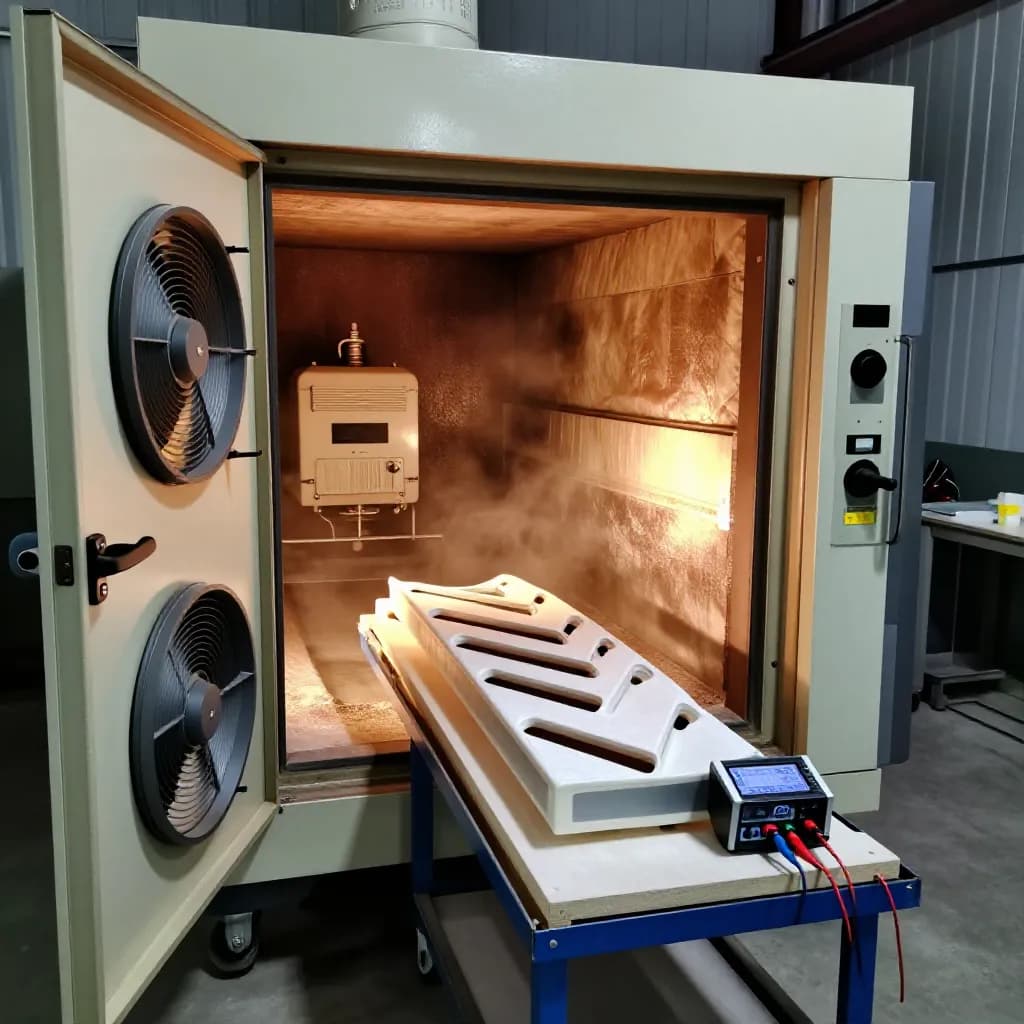
Oven design begins with defining the process requirements: the maximum part size and weight, the required production throughput (parts per hour or square meters per hour), the cure schedule of the powder being used (temperature and time), and the substrate material and thickness range. These parameters determine the oven's internal dimensions, heating capacity, air circulation system, and conveyor or loading configuration.
Ready to Start Your Project?
From one-off customs to 15,000-part production runs — get precise pricing in 24 hours.
On This Page
Oven Design Fundamentals: Matching the Oven to the Process
The two fundamental oven configurations are batch and conveyor. Batch ovens are loaded with a rack or cart of parts, the door is closed, and the oven heats to the setpoint temperature. After the required cure time, the door is opened and the parts are removed. Conveyor ovens maintain a constant temperature while parts travel through continuously on a conveyor system. The choice between batch and conveyor depends primarily on production volume — batch ovens are more flexible and have lower capital cost, while conveyor ovens offer higher throughput and better energy efficiency for sustained production. The crossover point is typically around 500-1500 parts per shift, depending on part size and oven utilization.
Convection Oven Engineering: Air Flow and Heat Transfer
Convection ovens transfer heat to the workpiece through circulating heated air. The rate of heat transfer depends on three factors: the temperature difference between the air and the part (the driving force), the air velocity across the part surface (which determines the convective heat transfer coefficient), and the surface area of the part exposed to the air flow. Maximizing heat transfer efficiency requires optimizing all three factors.
Air velocity is the most controllable variable and has a significant impact on heating rate and temperature uniformity. Higher air velocities increase the convective heat transfer coefficient, reducing the time required to heat parts to cure temperature. Typical air velocities in powder coating ovens range from 1-5 m/s across the part surfaces. Increasing velocity from 1 to 3 m/s can reduce heating time by 30-40% for thin-gauge parts. However, excessively high velocities (above 5 m/s) can disturb the uncured powder layer on parts entering the oven, causing powder to blow off or redistribute unevenly.
Air distribution design is critical for temperature uniformity. The heated air must reach all parts in the work zone at approximately the same temperature and velocity. This is achieved through a system of supply ducts, distribution nozzles, and return ducts that create a controlled air circulation pattern. Common configurations include top-down flow (air supplied from the ceiling and returned at the floor), side-to-side flow (air supplied from one wall and returned at the opposite wall), and combination patterns. The nozzle design — size, spacing, and angle — determines how uniformly the air is distributed across the work zone.
Temperature uniformity is specified as the maximum deviation from the setpoint temperature at any point in the work zone. A well-designed convection oven achieves ±5°C uniformity at the operating temperature, measured with the oven empty and at steady state. With parts loaded, the uniformity may degrade due to the thermal mass of the parts absorbing heat unevenly. AMS 2750 (Pyrometry) provides a classification system for oven uniformity, with Class 2 (±10°C) being typical for powder coating and Class 1 (±5°C) required for critical applications.
Infrared Oven Zones: Rapid Heating and Gel Control
Infrared (IR) heating zones are increasingly incorporated into powder coating ovens, either as standalone IR ovens for specific applications or as pre-heat zones ahead of convection cure sections. IR heating transfers energy directly to the coating and substrate surface through electromagnetic radiation, bypassing the air and achieving much faster surface heating rates than convection alone.
IR emitter types are classified by their peak emission wavelength and temperature. Short-wave emitters (halogen lamps at 2200-2400°C) emit primarily at 0.7-2 μm, providing deep penetration into the coating and rapid substrate heating. They respond almost instantly to power changes (reaching full output in 1-2 seconds), enabling precise control of energy delivery. Medium-wave emitters (quartz tubes at 800-1000°C) emit at 2-4 μm, with energy absorbed primarily by the organic coating layer. Long-wave emitters (ceramic panels at 300-500°C) emit at 4-10 μm, providing gentle surface heating suitable for heat-sensitive substrates.
The most common application of IR in powder coating is the gel zone — a short IR section at the oven entrance that rapidly melts and gels the powder surface before the part enters the convection cure zone. The gel zone serves two purposes: it locks the powder in place so that convection air currents cannot disturb it, and it initiates the melt and flow process that produces a smooth surface finish. A typical gel zone uses medium-wave IR emitters at a power density of 20-40 kW/m², with a residence time of 30-90 seconds. The powder surface reaches 120-160°C in this zone — enough to melt and begin flowing but not enough to initiate significant crosslinking.
Full IR cure ovens are used for flat or simple-geometry parts where uniform IR exposure can be achieved across all surfaces. Applications include flat panels, shelving, wire products, and tubular components. The advantage is dramatically shorter oven length and cure time — a flat panel that requires 20 minutes in a convection oven may cure in 3-5 minutes under IR. The limitation is the line-of-sight nature of IR radiation, which creates non-uniform heating on complex three-dimensional parts with shadowed areas.
Batch Oven Design: Flexibility for Low-to-Medium Volume
Batch ovens are the most common oven type in the powder coating industry, used by the majority of job shops and low-to-medium volume production operations. Their primary advantage is flexibility — a single batch oven can process a wide range of part sizes, from small brackets to large fabricated assemblies, simply by adjusting the rack configuration and cure time. No conveyor system is needed, reducing capital cost and floor space requirements.
Batch oven design considerations include: internal dimensions (must accommodate the largest part plus clearance for air circulation — typically 150-300 mm clearance on all sides); door design (single or double doors, vertical lift or swing, with effective sealing to minimize heat loss); heating capacity (must be sufficient to heat the maximum load from ambient to cure temperature within a reasonable time — typically 15-30 minutes for the ramp-up phase); and air circulation (must provide uniform temperature throughout the loaded work zone).
The thermal efficiency of batch ovens is inherently lower than conveyor ovens because of the door-opening cycle. Each time the door is opened to load or unload parts, a significant amount of heated air escapes and is replaced by ambient air that must be reheated. The oven structure itself — walls, floor, ceiling, and racks — also cools during the door-open period and must be reheated. For a typical batch oven operating at 200°C with a 5-minute door-open cycle, the energy lost per door opening can represent 10-20% of the total energy consumed per batch.
Strategies to improve batch oven efficiency include: minimizing door-open time through efficient loading and unloading procedures; using vestibule or air-curtain doors that reduce heat loss during loading; maximizing the load density (parts per batch) to amortize the fixed energy losses over more parts; and using insulation with low thermal mass (ceramic fiber rather than mineral wool) that stores less heat and recovers temperature faster after door closure. Some operations use a two-oven rotation — loading one oven while the other is curing — to maximize throughput and reduce the impact of door-open losses.
Conveyor Oven Design: Throughput and Continuous Production
Conveyor ovens are designed for continuous production, with parts entering one end and exiting the other on a moving conveyor. The oven maintains a constant temperature, and the cure time is determined by the conveyor speed and the length of the heated zone. Conveyor ovens offer higher throughput, better energy efficiency, and more consistent cure conditions than batch ovens, making them the standard choice for medium-to-high volume production.
The fundamental design equation for a conveyor oven is: Line Speed = Heated Zone Length / Required Oven Residence Time. The required residence time includes both the ramp-up time (for the part to reach cure temperature) and the dwell time (at cure temperature). For example, if the total required residence time is 25 minutes and the heated zone is 15 meters long, the maximum line speed is 0.6 m/min (36 m/hr). Increasing throughput requires either a longer oven or a shorter residence time (achieved through higher air velocity, higher oven temperature, or IR pre-heating).
Conveyor types for powder coating ovens include overhead monorail (parts hang from hooks on a single rail), power-and-free (a two-rail system that allows parts to be accumulated, switched between lines, and varied in spacing), floor conveyor (parts ride on a belt or chain at floor level), and inverted monorail (rail below the parts, used for heavy or awkward loads). Overhead monorail is the most common for general powder coating because it provides good access for spraying and allows parts to hang freely for uniform coating and curing.
Oven entrance and exit design is critical for energy efficiency. The openings where the conveyor enters and exits the oven are major sources of heat loss because heated air escapes through these openings by convection. Effective opening designs include: vestibule sections (enclosed transition zones that trap heated air), air curtains (high-velocity air streams across the opening that block heat escape), and labyrinth openings (S-shaped or Z-shaped conveyor paths that prevent direct line-of-sight between the oven interior and the outside). A well-designed opening system can reduce heat loss through the openings by 60-80% compared to an unprotected opening.
Energy Sources and Heating Systems
Powder coating ovens use three primary energy sources: natural gas, electricity, and LPG (liquefied petroleum gas). The choice depends on energy availability, cost, environmental regulations, and the specific oven design requirements.
Natural gas is the most common energy source for large convection ovens due to its relatively low cost per unit of thermal energy. Gas-fired ovens use either direct-fired or indirect-fired burner systems. Direct-fired burners inject combustion gases directly into the recirculating air stream, providing efficient heat transfer but introducing combustion byproducts (water vapor, CO₂, and trace NOx) into the oven atmosphere. Indirect-fired burners use a heat exchanger to transfer heat from the combustion gases to the recirculating air without mixing them, providing a cleaner oven atmosphere at the cost of slightly lower thermal efficiency (85-90% vs 92-97% for direct-fired).
The choice between direct and indirect firing affects coating quality. Direct-fired ovens can cause yellowing of light-colored coatings due to NOx exposure, and the water vapor from combustion can affect cure chemistry in some powder formulations. Indirect-fired ovens eliminate these concerns but have higher capital and operating costs. For critical color applications (white, light pastels) and moisture-sensitive powder chemistries, indirect firing or electric heating is recommended.
Electric ovens use resistance heating elements to heat the recirculating air. They provide the cleanest oven atmosphere (no combustion byproducts), precise temperature control, and simple installation without gas piping or flue requirements. Electric ovens are preferred for small batch ovens, laboratory ovens, and applications where gas is not available. The operating cost depends on local electricity rates — in regions with low electricity costs, electric ovens can be competitive with gas; in regions with high electricity costs, gas is typically more economical for large ovens.
Energy consumption for powder coating ovens typically ranges from 0.5-2.0 kWh per square meter of coated surface, depending on the oven design, insulation quality, part loading density, and operating temperature. Modern high-efficiency ovens with good insulation, effective air sealing, and optimized air circulation can achieve the lower end of this range, while older or poorly maintained ovens may consume significantly more.
Temperature Uniformity Surveys and Oven Qualification
Temperature uniformity surveys (TUS) are systematic measurements of the temperature distribution throughout the oven work zone, performed to verify that all parts receive equivalent cure conditions regardless of their position in the oven. TUS is required by quality standards such as AMS 2750, CQI-12 (for automotive), and Qualicoat, and should be part of every powder coating operation's quality management system.
A TUS is performed by placing multiple thermocouples at defined positions throughout the empty oven work zone — typically at the corners and center of the work zone at multiple heights — and recording the temperature at each position after the oven has reached steady state at the operating setpoint. The maximum deviation from the setpoint at any measurement point defines the oven's uniformity class. For powder coating, a uniformity of ±5-10°C is typically required.
The TUS should be performed at each operating temperature used in production, as uniformity can vary with temperature. It should be repeated at least quarterly, and additionally after any maintenance that affects the heating or air circulation systems (burner replacement, fan repair, duct modification, insulation repair). The results should be documented and retained as part of the quality records.
In addition to the empty-oven TUS, loaded-oven temperature profiling should be performed to verify that parts actually reach the required cure temperature. This is done by attaching thermocouples to representative parts at the thickest and thinnest sections, connecting them to a data logger, and running the parts through the oven under normal production conditions. The resulting temperature profiles show the actual ramp-up rate, peak metal temperature, and time at cure temperature for each measurement point. Loaded-oven profiling should be performed for each distinct part geometry and loading configuration, and repeated whenever process conditions change.
Common causes of poor temperature uniformity include: blocked or misaligned air distribution nozzles, worn or unbalanced recirculation fans, damaged insulation creating cold spots, burner flame impingement creating hot spots, and excessive loading density that blocks air circulation. Systematic TUS and profiling identifies these problems before they cause coating quality failures.
Energy Optimization Strategies for Existing Ovens
Significant energy savings are achievable in existing powder coating ovens through operational and equipment improvements, often with payback periods of 6-24 months. The first step is an energy audit that identifies where energy is being consumed and where losses occur.
Insulation improvement is often the highest-impact upgrade. Many older ovens have inadequate insulation thickness (less than 100 mm) or degraded insulation that has settled, compressed, or absorbed moisture over time. Upgrading to 150-200 mm of high-quality mineral wool or ceramic fiber insulation can reduce wall heat losses by 40-60%. The outer skin temperature of a well-insulated oven should not exceed 40-50°C above ambient — if the outer walls are noticeably warm to the touch, insulation improvement is warranted.
Air seal improvement at oven openings is the second priority. Conveyor oven openings are the largest single source of heat loss in most installations. Installing or upgrading air curtains, adding vestibule sections, or modifying the opening geometry to create a labyrinth path can reduce opening losses by 50-80%. For batch ovens, replacing worn door seals and ensuring positive door closure eliminates air leakage that wastes energy continuously during the cure cycle.
Exhaust air management offers another opportunity. Powder coating ovens require exhaust ventilation to remove volatiles released during curing, but excessive exhaust rates waste heated air. The exhaust rate should be set to the minimum required to maintain safe volatile concentrations — typically 1-3% of the total recirculation air volume. Heat recovery systems that extract thermal energy from the exhaust air and use it to preheat incoming fresh air can recover 40-60% of the exhaust energy loss.
Operational improvements include: maximizing load density to coat more parts per oven cycle; scheduling production to minimize oven idle time at temperature; reducing the oven setpoint to the minimum required for the powder's cure schedule (every 10°C reduction saves approximately 5-8% of energy); and using oven temperature setback during breaks and shift changes to reduce standby energy consumption. Combined, these strategies can reduce total oven energy consumption by 20-40% without any change in coating quality.
Frequently Asked Questions
What temperature uniformity should a powder coating oven achieve?
A well-designed powder coating oven should achieve ±5°C uniformity throughout the work zone at the operating setpoint, measured empty at steady state. ±10°C is acceptable for general industrial applications. Temperature uniformity surveys should be performed quarterly and documented per AMS 2750 or equivalent standards.
Is a batch oven or conveyor oven better for powder coating?
Batch ovens offer flexibility and lower capital cost, suitable for job shops and low-to-medium volume (under 500-1500 parts/shift). Conveyor ovens provide higher throughput and better energy efficiency for sustained production above this volume. The crossover point depends on part size, oven utilization, and production scheduling.
Should I use direct-fired or indirect-fired gas heating?
Direct-fired burners are more energy-efficient (92-97% vs 85-90%) but introduce combustion byproducts into the oven atmosphere, which can cause yellowing of light colors. Indirect-fired burners provide a cleaner atmosphere at higher cost. For critical color applications and moisture-sensitive powders, indirect firing or electric heating is recommended.
How much energy does a powder coating oven consume?
Typical energy consumption ranges from 0.5-2.0 kWh per square meter of coated surface. Modern high-efficiency ovens with good insulation and air sealing achieve the lower end. Energy optimization strategies — insulation upgrades, air seal improvements, exhaust heat recovery, and operational changes — can reduce consumption by 20-40%.
What is the benefit of an IR pre-gel zone in a convection oven?
An IR gel zone at the oven entrance rapidly melts and gels the powder surface in 30-90 seconds, locking it in place before convection air currents can disturb it. This improves surface finish quality and allows higher convection air velocities in the cure zone. It can also reduce total oven length by 20-30% compared to convection-only designs.
Ready to Start Your Project?
From one-off customs to 15,000-part production runs — get precise pricing in 24 hours.