Outgassing is the release of trapped gases from a substrate during the powder coating cure cycle. As the coated part heats in the oven, gases expand and migrate to the surface, pushing through the melting and gelling powder film. If the gas escapes before the powder fully gels and crosslinks, the film can flow and heal over the escape path, leaving no visible defect. But if the gas breaks through after the film has gelled — when the powder has solidified but not yet fully cured — it creates permanent defects: pinholes, craters, bubbles, or a rough, porous surface texture that cannot self-heal.
Technical
Powder Coating Outgassing: Causes, Identification, and Prevention Strategies
Sundial Powder Coating·April 22, 2026·13 min
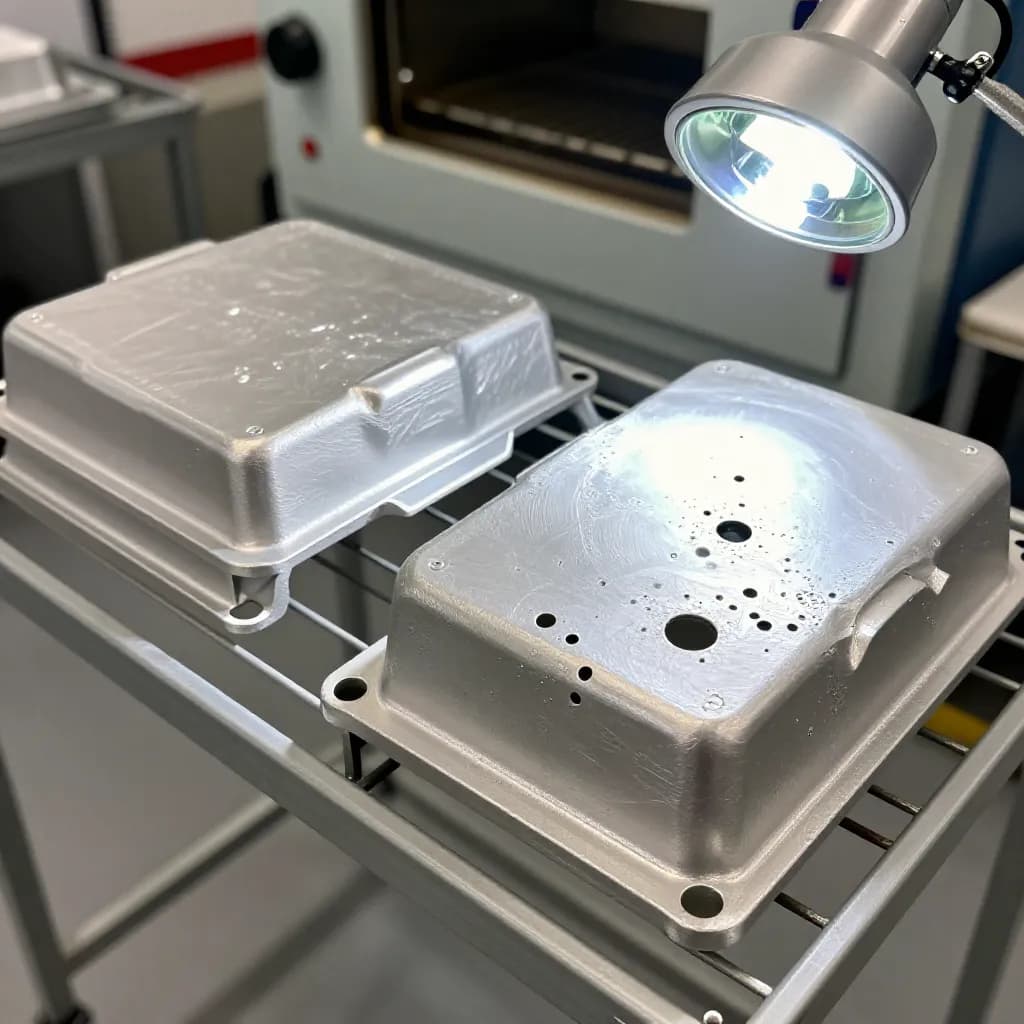
The mechanism is straightforward thermodynamics. Gases trapped in porous substrates, absorbed moisture, or volatile contaminants all expand as temperature rises. At the same time, the powder coating undergoes its own thermal transitions: it melts at approximately 60-80°C, flows and levels between 80-120°C, and begins to gel and crosslink at 140-170°C depending on the formulation. The critical race is between gas escape and film gelation. If all trapped gas escapes during the melt and flow phase — before the film gels — the liquid powder can flow back together and produce a smooth finish. If gas continues to escape after gelation, each gas bubble creates a permanent channel through the solidifying film.
Ready to Start Your Project?
From one-off customs to 15,000-part production runs — get precise pricing in 24 hours.
On This Page
What Is Outgassing and Why Does It Ruin Powder Coatings?
Outgassing is one of the most frustrating defects in powder coating because it is substrate-dependent rather than coating-dependent. A powder that performs flawlessly on clean cold-rolled steel may produce severe pinholes on a cast aluminum part, even with identical application and cure parameters. Understanding which substrates are susceptible and implementing appropriate countermeasures is essential for any operation that coats diverse materials.
Substrates Most Susceptible to Outgassing
Cast metals are the most notorious outgassing substrates. Die-cast aluminum, sand-cast aluminum, cast iron, and cast zinc alloys all contain varying degrees of subsurface porosity — microscopic voids and channels created during the casting process when molten metal solidifies around trapped air or dissolved gases. Die-cast aluminum parts typically have porosity levels of 1-5% by volume, with pore sizes ranging from 10 to 500 micrometers. Sand castings can have even higher porosity due to the coarser mold structure and slower solidification rates.
Hot-dip galvanized steel is another common outgassing substrate. The zinc coating applied during galvanizing contains a complex layered structure of zinc-iron intermetallic phases, and the surface often traps moisture, flux residues, and zinc oxide particles. When heated during powder curing, these contaminants volatilize and create outgassing defects. The severity depends on the galvanizing process, the age and storage conditions of the galvanized parts, and the specific zinc coating weight — heavier coatings generally produce more outgassing.
Welded assemblies present localized outgassing risks. Weld porosity, flux residues from MIG and stick welding, and trapped gases in incomplete weld penetration zones all release volatiles during curing. The defects typically appear as a line or cluster of pinholes following the weld path. Laser-cut edges on steel can also outgas due to the recast layer of oxidized metal created by the cutting process. Even apparently clean substrates can outgas if they have absorbed moisture or machining fluids into surface micro-cracks or grain boundaries — a particular concern with sintered metal parts, powder metallurgy components, and porous ceramics.
The Degas Cycle: Preheating to Drive Out Trapped Gases
The most effective countermeasure against outgassing is the degas cycle — a preheat step performed before powder application that drives trapped gases out of the substrate while the surface is still uncoated. The principle is simple: heat the bare part to a temperature at or above the powder cure temperature, hold it long enough for all trapped gases to escape, then cool it to an appropriate application temperature before spraying powder. With the gas already expelled, the subsequent cure cycle proceeds without outgassing.
Degas temperatures typically range from 200-230°C for most substrates, with hold times of 15-30 minutes depending on the part mass and porosity level. For heavily porous die-cast aluminum, a degas cycle of 220°C for 20-30 minutes is common. For hot-dip galvanized steel, 200-210°C for 15-20 minutes is usually sufficient. The degas temperature should equal or exceed the powder cure temperature to ensure that all gases that would be released during curing have already been expelled. If the degas temperature is lower than the cure temperature, additional gas may still be released during the cure cycle.
After degassing, parts must be cooled to an appropriate temperature for powder application — typically 30-60°C for standard electrostatic application. Applying powder to parts that are too hot causes the powder to melt on contact, preventing proper electrostatic attraction and creating an uneven, heavy film with poor coverage in recessed areas. Some operations apply powder to warm parts (40-80°C) intentionally to improve first-pass coverage on complex geometries, but this technique requires careful control and is not suitable for all powder formulations. The degas cycle adds significant time and energy to the coating process, but for susceptible substrates, it is the only reliable way to eliminate outgassing defects completely.
Identifying Outgassing Defects: Visual and Microscopic Analysis
Accurate identification of outgassing defects is critical because they can be confused with other powder coating defects that have entirely different root causes. True outgassing pinholes are small, typically 0.1-1.0 mm in diameter, and penetrate through the full film thickness to the substrate surface. Under magnification, they appear as cylindrical or conical channels with smooth walls — the path created by a gas bubble pushing through the gelling film. The surrounding film is usually smooth and well-leveled, distinguishing outgassing pinholes from orange peel or other surface texture defects.
Outgassing craters are larger than pinholes, typically 1-3 mm in diameter, and appear as shallow depressions in the film surface rather than through-holes. They form when a gas bubble is large enough to deform the gelling film but not forceful enough to break through completely. Craters often have a slightly raised rim where the displaced coating material has accumulated around the bubble site. Severe outgassing produces a uniformly rough, sandpaper-like texture across the entire surface, indicating that gas is escaping from the entire substrate rather than from isolated pores.
To confirm that a defect is caused by outgassing rather than contamination, solvent entrapment, or moisture in the powder, a simple diagnostic test can be performed: strip the defective coating, degas the bare part at 220°C for 30 minutes, cool, recoat, and cure. If the defects disappear, outgassing is confirmed. If they persist, the root cause lies elsewhere — possibly in the powder itself, the application process, or surface contamination that was not removed by the degas cycle. Cross-sectioning the defective film and examining it under a metallurgical microscope at 50-200x magnification can also reveal the characteristic gas channel morphology that distinguishes outgassing from other defect mechanisms.
Powder Formulation Strategies for Outgassing-Prone Substrates
When degassing is impractical due to production constraints, part size, or energy costs, powder formulation adjustments can mitigate outgassing defects. The key principle is to extend the time window during which the powder film remains liquid and can self-heal over gas escape channels. This is achieved by using powders with longer gel times, lower melt viscosity, or both.
Outgassing-resistant powder formulations — sometimes marketed as 'degas' or 'cast-friendly' powders — typically have gel times of 200-400 seconds at cure temperature, compared to 60-150 seconds for standard formulations. This extended flow window allows more time for trapped gases to escape while the film is still liquid enough to flow back together. The trade-off is that longer gel times can result in increased sagging on vertical surfaces and reduced edge coverage, so these formulations require careful application parameter adjustment.
Texture powders offer another approach. Wrinkle, sand, and hammer-tone textures are inherently more forgiving of outgassing because their intentionally rough surface texture masks small pinholes and craters that would be clearly visible on a smooth gloss finish. Many coating operations specify textured finishes for cast substrates specifically to avoid the need for degassing. The texture also provides functional benefits — improved grip, reduced glare, and better scratch concealment — that may be desirable for the end application.
Film thickness also plays a role. Thicker films are more resistant to outgassing defects because the gas must travel a longer path through the coating, and the greater volume of liquid powder provides more material to flow and heal over escape channels. Increasing film thickness from 60 to 100 micrometers can significantly reduce visible outgassing on moderately porous substrates, though this approach has limits — excessively thick films introduce their own problems including orange peel, sagging, and increased material cost.
Process Optimization for Outgassing Prevention
Beyond degassing and powder selection, several process optimizations can reduce outgassing severity. Oven ramp rate is a critical variable — slower heating rates give trapped gases more time to escape during the melt and flow phase before gelation occurs. Reducing the oven setpoint by 10-20°C and extending the cure time proportionally can dramatically reduce outgassing on borderline substrates. For example, curing at 180°C for 20 minutes instead of 200°C for 10 minutes provides the same total thermal energy but with a gentler ramp that allows more gas to escape before the film gels.
Pretreatment quality directly affects outgassing on some substrates. Alkaline cleaning and acid etching can open surface pores on cast metals, allowing trapped gases to escape more easily during the degas or cure cycle. Conversely, conversion coatings that seal the surface — such as heavy chromate or thick zirconium oxide layers — can trap gases beneath the conversion coating and worsen outgassing. For cast substrates, a lighter conversion coating weight is often preferable.
Oven atmosphere management is sometimes overlooked but can contribute to outgassing-like defects. Direct-fired gas ovens introduce combustion byproducts — water vapor, CO2, and trace contaminants — into the oven atmosphere. These gases can interact with the curing powder film and create surface defects that mimic outgassing. Indirect-fired ovens or electric ovens provide a cleaner atmosphere and eliminate this variable. Adequate oven exhaust is also important: volatiles released from the curing powder itself (flow agents, degassing additives, and reaction byproducts) must be removed from the oven atmosphere to prevent condensation on cooler surfaces and subsequent contamination of parts entering the oven.
Outgassing on Hot-Dip Galvanized Steel: Special Considerations
Hot-dip galvanized steel deserves special attention because it is one of the most commonly powder-coated substrates and one of the most problematic for outgassing. The zinc coating applied during hot-dip galvanizing typically ranges from 45-85 μm in thickness (corresponding to coating weights of 325-600 g/m² per ASTM A123) and contains multiple intermetallic layers — gamma, delta, zeta, and eta phases — each with different thermal expansion characteristics and gas-trapping potential.
The primary outgassing mechanism on galvanized steel is the release of moisture and volatile zinc compounds trapped within the zinc coating structure. Fresh galvanizing is more susceptible than aged galvanizing because the zinc surface has not yet formed a stable oxide layer that seals surface porosity. Parts that have been stored outdoors or in humid conditions absorb additional moisture that exacerbates outgassing. White rust (zinc hydroxide/carbonate) formation on stored galvanized parts is a visual indicator of moisture exposure and a predictor of outgassing risk.
Best practices for powder coating galvanized steel include: allowing freshly galvanized parts to weather for a minimum of 24-48 hours before coating to allow initial oxide formation; thorough alkaline cleaning to remove surface contaminants and zinc salts; a degas preheat at 200-210°C for 15-20 minutes; and use of a zinc-phosphate or iron-phosphate pretreatment specifically formulated for galvanized surfaces. Some operations use a dedicated primer powder — typically an epoxy or epoxy-polyester formulation with outgassing-resistant properties — as a first coat on galvanized steel, followed by a polyester topcoat for UV resistance. This two-coat approach adds cost and complexity but provides the most reliable results on heavily galvanized substrates.
Testing and Qualification of Outgassing-Prone Parts
Before committing to production coating of a new cast or galvanized part, a systematic qualification process should be followed to determine the appropriate outgassing countermeasures. The qualification begins with trial coating of sample parts using the intended production powder and cure schedule, without any degas pretreatment. If the results are acceptable — no visible pinholes, craters, or surface roughness — no additional measures are needed and production can proceed with standard parameters.
If outgassing defects are present on the trial parts, a stepped approach is used to identify the minimum effective countermeasure. Step one: recoat with a slower-gelling powder formulation. Step two: apply a degas preheat at 200°C for 15 minutes before coating. Step three: increase degas temperature to 220°C and extend hold time to 30 minutes. Step four: apply a primer coat followed by a topcoat. Each step is evaluated for defect elimination, and the least costly effective measure is selected for production.
Documentation of the qualification results is essential for process control. The qualification record should include: substrate material and source, part geometry and wall thickness, degas parameters (if required), powder type and batch, application parameters, cure schedule, and inspection results including photographs at 1x and 10x magnification. This record becomes the basis for the production work instruction and provides traceability if outgassing problems recur due to changes in substrate quality, powder batch, or process conditions. For critical applications, incoming substrate inspection should include a porosity assessment — either visual inspection of cut cross-sections or density measurement — to catch high-porosity batches before they enter the coating line.
Frequently Asked Questions
What causes outgassing in powder coating?
Outgassing is caused by trapped gases escaping from the substrate during the cure cycle. Porous substrates like die-cast aluminum, sand castings, and hot-dip galvanized steel contain microscopic voids that trap air, moisture, and volatile compounds. As the part heats, these gases expand and push through the gelling powder film, creating pinholes, craters, or rough surface texture.
How do you prevent outgassing on cast aluminum parts?
The most reliable prevention method is a degas preheat cycle — heating the bare part to 220°C for 20-30 minutes before powder application to drive out trapped gases. Alternative strategies include using outgassing-resistant powder formulations with extended gel times, specifying textured finishes that mask minor defects, increasing film thickness, and using slower oven ramp rates.
Can you powder coat hot-dip galvanized steel without outgassing?
Yes, with proper preparation. Best practices include allowing fresh galvanizing to weather 24-48 hours, thorough alkaline cleaning, a degas preheat at 200-210°C for 15-20 minutes, and appropriate pretreatment. For heavily galvanized parts, a two-coat system with an outgassing-resistant epoxy primer followed by a polyester topcoat provides the most reliable results.
How can you tell if a defect is caused by outgassing or contamination?
Outgassing pinholes are typically small (0.1-1.0 mm), penetrate to the substrate, and appear as cylindrical channels under magnification. To confirm, strip the coating, degas the bare part at 220°C for 30 minutes, recoat, and cure. If defects disappear, outgassing is confirmed. If they persist, contamination or another cause is likely. Cross-section microscopy at 50-200x can also distinguish gas channels from contamination craters.
What is the difference between outgassing pinholes and contamination craters?
Outgassing pinholes originate from the substrate and push outward through the film, creating cylindrical channels. They are typically distributed across the entire surface or concentrated over porous areas. Contamination craters originate at the coating surface from silicone, oil, or other surface-active contaminants, creating shallow depressions with raised rims. Contamination craters are often randomly distributed and may appear on any substrate type.
Ready to Start Your Project?
From one-off customs to 15,000-part production runs — get precise pricing in 24 hours.