Orange peel is the most common surface finish defect in powder coating, characterized by a textured, dimpled appearance that resembles the skin of an orange. Unlike a smooth, mirror-like finish, an orange peel surface has a regular pattern of small undulations — typically 0.5-3 mm in wavelength and 1-20 micrometers in amplitude — that scatter reflected light and reduce the perceived gloss and image clarity of the coated surface. While some degree of orange peel is inherent in all powder coatings due to the particle-based application method, excessive orange peel is a quality defect that can cause parts to be rejected.
Technical
Powder Coating Orange Peel: Causes, Measurement, and How to Fix It
Sundial Powder Coating·April 22, 2026·13 min
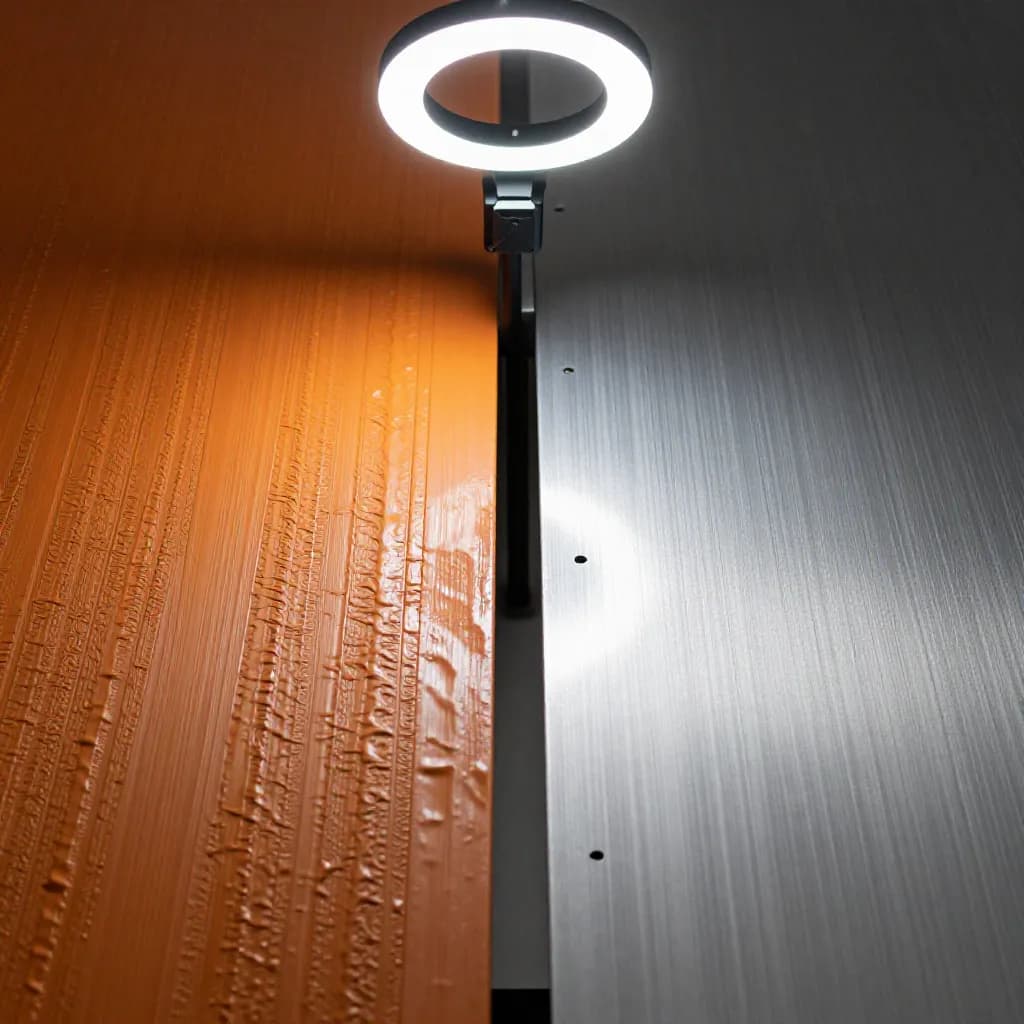
The fundamental cause of orange peel is incomplete leveling of the powder film during the melt and flow phase of the cure cycle. When powder particles melt in the oven, they must flow together and coalesce into a uniform liquid film before gelation locks the surface texture in place. If the molten powder does not have sufficient time, temperature, or flow characteristics to fully level before it gels, the surface retains a textured appearance that reflects the original particle deposition pattern.
Ready to Start Your Project?
From one-off customs to 15,000-part production runs — get precise pricing in 24 hours.
On This Page
Understanding Orange Peel in Powder Coating
Orange peel severity is influenced by a complex interaction of variables spanning powder formulation, application parameters, and cure conditions. Powder chemistry determines melt viscosity and gel time — the two properties that most directly control leveling behavior. Application parameters determine the initial film uniformity and thickness. Cure conditions determine how much time the powder has to flow before gelation. Understanding and controlling these variables is essential for achieving the smooth finishes demanded by automotive, appliance, and architectural applications.
Powder Formulation Factors: Melt Viscosity and Gel Time
The powder formulation is the single largest determinant of orange peel tendency. Two properties dominate: melt viscosity and gel time. Melt viscosity describes the resistance of the molten powder to flow — lower viscosity means the liquid coating flows more easily and levels more completely. Gel time is the duration between initial melting and the onset of crosslinking that solidifies the film. Together, these properties define the leveling window — the period during which the molten powder is fluid enough to flow and smooth out surface irregularities.
Typical powder coatings have melt viscosities in the range of 10-100 Pa·s at their minimum viscosity point, which occurs at approximately 130-160°C depending on the formulation. Powders designed for smooth finishes target the lower end of this range, using resin systems and flow additives that minimize viscosity during the flow phase. The most common flow additive is polyacrylate (often referred to by the trade name Resiflow or Acronal), added at 0.5-2.0% by weight. These additives reduce surface tension and melt viscosity, promoting film leveling. Benzoin is another common additive at 0.5-1.5%, primarily used to prevent pinholes by facilitating air release from the melting film, but it also contributes to improved leveling.
Gel time is controlled by the reactivity of the resin-crosslinker system. Standard polyester-TGIC powders have gel times of 100-200 seconds at 200°C, while polyester-HAA (β-hydroxyalkylamide) systems tend to be slightly faster at 80-150 seconds. Faster gel times reduce the leveling window and increase orange peel tendency. Powder manufacturers can adjust gel time by modifying the crosslinker ratio, resin functionality, and catalyst level, but these changes also affect other film properties including mechanical performance and chemical resistance.
Particle Size Distribution and Its Impact on Surface Finish
Particle size distribution (PSD) has a direct and significant impact on orange peel. Powder coating particles are typically ground to a median particle size (D50) of 30-45 micrometers, with a distribution spanning roughly 10-100 micrometers. The uniformity of the deposited film depends on how evenly these particles pack on the substrate surface before melting. Larger particles create thicker local deposits that require more flow to level, while very fine particles (below 10 μm) tend to agglomerate and create uneven deposition patterns.
A tighter particle size distribution — with a smaller spread between D10 and D90 values — generally produces smoother finishes because the deposited film has more uniform thickness before melting. A typical production powder might have D10 = 15 μm, D50 = 35 μm, and D90 = 70 μm, giving a span value of (D90-D10)/D50 = 1.57. Powders optimized for smooth finishes may target a span below 1.3, achieved through tighter grinding and classification control. Ultra-fine powders with D50 values of 20-25 μm can produce exceptionally smooth finishes but are more difficult to fluidize, transport, and apply electrostatically due to increased interparticle cohesion.
Reclaimed powder — overspray collected from the spray booth and returned to the feed hopper — tends to have a finer particle size distribution than virgin powder because larger particles are preferentially deposited on the part while finer particles remain airborne and are captured by the reclaim system. As the virgin-to-reclaim ratio shifts toward more reclaim, the average particle size decreases and the distribution narrows toward the fine end. This can actually improve leveling in some cases, but excessive fines content (particles below 10 μm exceeding 15-20% of the total) causes poor fluidization, inconsistent spray patterns, and Faraday cage effects that ultimately worsen surface finish uniformity.
Application Parameters That Affect Orange Peel
Electrostatic application parameters influence orange peel through their effect on film thickness, uniformity, and the physical state of the deposited powder layer. Film thickness is the most straightforward variable — thicker films have more material available to flow and level, and the greater film depth dampens surface undulations more effectively. Increasing dry film thickness from 50 to 80 micrometers typically produces a noticeable improvement in orange peel on the same powder formulation. However, excessively thick films (above 100-120 μm) can introduce other defects including sagging, runs, and increased orange peel from back-ionization.
Gun-to-part distance affects the uniformity of the deposited powder layer. At distances of 150-250 mm, the electrostatic field provides good wrap and uniform deposition. At closer distances (below 150 mm), the concentrated powder cloud creates heavy deposits with poor uniformity, and the strong electrostatic field can cause back-ionization — a phenomenon where excessive charge buildup on the deposited powder layer repels incoming particles and creates craters and texture. At distances above 300 mm, transfer efficiency drops and the deposited layer becomes thin and uneven.
Charging voltage in corona guns directly affects deposition behavior. Higher voltages (60-100 kV) provide stronger electrostatic attraction and better wrap but increase the risk of back-ionization, particularly on flat surfaces and at higher film thicknesses. Reducing voltage to 40-60 kV and compensating with slightly closer gun distance or slower line speed can reduce back-ionization-related orange peel. Current limiting — restricting the microampere output of the charging electrode — is another effective technique, with many modern guns offering adjustable current limits of 10-80 μA. Tribo-charging guns, which charge powder through friction rather than corona discharge, produce lower and more uniform charge levels that virtually eliminate back-ionization, often resulting in smoother finishes on flat and simple geometries.
Cure Conditions and Their Effect on Leveling
The cure cycle determines how much time the molten powder has to flow and level before gelation freezes the surface texture. The critical phase is the period between initial melting (approximately 60-80°C) and the onset of gelation (approximately 140-170°C, depending on formulation). During this window, the powder is a low-viscosity liquid that can flow under the combined forces of surface tension and gravity to smooth out surface irregularities. The longer this window remains open, the better the leveling.
Oven ramp rate — the speed at which the part heats from ambient to cure temperature — has a significant effect on leveling. A slower ramp rate extends the time the powder spends in the liquid flow phase before reaching gel temperature. In a convection oven, ramp rate is controlled by the oven setpoint temperature and air velocity. Reducing the oven setpoint from 210°C to 190°C slows the ramp rate and can noticeably improve leveling, though it also extends the total cure time. Some operations use a two-zone oven profile: a lower-temperature first zone (160-170°C) that allows extended flow and leveling, followed by a higher-temperature second zone (190-210°C) that completes the cure.
Infrared pre-gel zones can also improve leveling by rapidly melting the powder surface while the bulk of the film remains cooler and more fluid. The IR energy melts and flows the outer surface of the powder layer, creating a smooth skin that is maintained as the part continues through the convection cure zone. This technique is particularly effective for thick films and powders with short gel times. Conversely, excessively fast heating — such as placing parts directly into a hot oven at 220°C or higher — can cause the powder to gel before it has fully melted and flowed, resulting in severe orange peel. This is a common problem with batch ovens that are preheated to high temperatures before parts are loaded.
Measuring and Quantifying Orange Peel
Subjective visual assessment of orange peel is unreliable because it depends on lighting conditions, viewing angle, surface color, and the observer's experience. Objective measurement requires instruments that quantify the surface waviness profile. The most widely used instrument for this purpose is the wave-scan meter, which measures the optical profile of light reflected from the coated surface as a laser beam scans across it. The wave-scan produces numerical values for different wavelength ranges: short-wave (SW, 0.3-1.2 mm) and long-wave (LW, 1.2-12 mm) structure, which correspond to different visual aspects of surface texture.
Short-wave values correlate with fine texture and micro-orange peel, while long-wave values correlate with the broader undulations visible as classic orange peel. Lower values indicate smoother surfaces. Automotive Class A finishes typically require SW values below 15 and LW values below 10, while general industrial finishes may accept SW values of 25-40 and LW values of 15-30. Powder coatings inherently produce higher wave-scan values than liquid paints due to the particle-based application method, but modern smooth-finish powders can achieve SW values of 15-25 and LW values of 8-15 — approaching liquid paint quality.
Gloss measurement provides an indirect indicator of orange peel severity. A 20° gloss reading is most sensitive to surface texture because the shallow measurement angle emphasizes surface waviness. Distinctness of image (DOI) measurement, per ASTM D5767, quantifies the sharpness of reflected images and is highly sensitive to orange peel. A DOI value above 80 indicates a very smooth surface with minimal orange peel, while values below 60 indicate noticeable texture. For production quality control, establishing numerical acceptance criteria using wave-scan, gloss, or DOI measurements provides objective, repeatable assessment that eliminates the subjectivity of visual inspection.
Systematic Troubleshooting of Orange Peel Defects
When orange peel exceeds acceptable limits, a systematic troubleshooting approach is more effective than random parameter adjustments. The first step is to determine whether the orange peel is consistent across all parts or varies with position on the part, position in the oven, or time during the production run. Consistent orange peel across all parts suggests a powder formulation or cure schedule issue. Position-dependent orange peel suggests application parameter or oven uniformity problems.
Start by verifying the powder formulation. Check the powder batch number against previous acceptable batches. Measure particle size distribution — if D50 has shifted by more than 5 μm or the fines content has changed significantly, this may explain the change in surface finish. Verify that the correct flow additive level is present by checking the powder manufacturer's batch certificate. If reclaim powder is being used, check the virgin-to-reclaim ratio and measure the reclaim PSD separately.
Next, verify application parameters. Measure dry film thickness at multiple points — if thickness has dropped below 50 μm, increasing it to 70-80 μm may resolve the issue. Check gun voltage and current settings against the established process parameters. Verify gun-to-part distance using a measuring stick or laser distance tool. If back-ionization is suspected (indicated by craters or starring patterns in the deposited powder before curing), reduce voltage by 10-20 kV or increase gun distance by 50 mm.
Finally, verify cure conditions. Run an oven temperature profile to confirm that the ramp rate and peak metal temperature match the established process. If the oven has been running hotter than normal, the faster ramp rate may be reducing leveling time. Check oven air velocity — if recirculation fans have been adjusted or filters are clogged, reduced air flow can create temperature non-uniformity that affects leveling differently across the oven cross-section.
Advanced Techniques for Ultra-Smooth Powder Finishes
Achieving ultra-smooth powder finishes comparable to liquid paint requires optimization across the entire process chain. Powder selection is the starting point — specify a formulation designed for smooth finish applications, with low melt viscosity, extended gel time, optimized flow additive package, and tight particle size distribution. Request a powder with D50 of 30-35 μm and span below 1.3. Confirm that the flow additive level is at the upper end of the recommended range (1.5-2.0% polyacrylate).
Application technique should prioritize uniform deposition over speed. Use tribo-charging guns if available, as they produce more uniform charge distribution and eliminate back-ionization. If using corona guns, reduce voltage to 40-60 kV and limit current to 20-40 μA. Apply at 200-250 mm gun distance with slow, overlapping passes. Target a dry film thickness of 75-90 μm — thick enough for good leveling but not so thick that sagging or back-ionization becomes a problem.
Cure optimization for smooth finishes involves maximizing the flow window. Use a two-zone oven profile if available: a first zone at 150-165°C for 5-8 minutes to allow extended melt and flow, followed by a second zone at 190-200°C to complete the cure. If a single-zone oven is used, set the temperature at the lower end of the cure window (180-190°C) and extend the cure time to compensate. Avoid rapid heating that shortens the flow phase. For the smoothest possible results, some operations apply a thin first coat (30-40 μm), partially cure it to create a smooth base layer, then apply a second coat (40-50 μm) and fully cure. This two-coat technique adds cost and complexity but can achieve wave-scan values approaching liquid paint quality.
Frequently Asked Questions
What causes orange peel in powder coating?
Orange peel is caused by incomplete leveling of the molten powder film before it gels and solidifies. Contributing factors include high melt viscosity, short gel time, coarse or uneven particle size distribution, insufficient film thickness, excessive application voltage causing back-ionization, and fast oven ramp rates that reduce the flow window before gelation.
How do you measure orange peel objectively?
Wave-scan meters measure the optical surface profile and produce numerical short-wave (SW) and long-wave (LW) values — lower numbers indicate smoother surfaces. Distinctness of image (DOI) per ASTM D5767 quantifies reflected image sharpness. 20° gloss readings are also sensitive to surface texture. These instruments provide objective, repeatable measurements that eliminate subjective visual assessment.
Does film thickness affect orange peel?
Yes, significantly. Thicker films have more material to flow and level, and the greater depth dampens surface undulations. Increasing dry film thickness from 50 to 80 micrometers typically produces noticeable improvement. However, excessively thick films above 100-120 μm can cause back-ionization, sagging, and other defects that worsen appearance.
Can you get a liquid-paint-smooth finish with powder coating?
Modern smooth-finish powders can approach liquid paint quality, achieving wave-scan short-wave values of 15-25 and long-wave values of 8-15. This requires optimized powder formulation with low melt viscosity and extended gel time, tight particle size distribution, controlled application with tribo charging or low-voltage corona, and a two-zone cure profile that maximizes the flow window.
Does reclaim powder cause more orange peel?
Reclaim powder has a finer particle size distribution than virgin powder because larger particles are preferentially deposited on parts. Moderate reclaim content can actually improve leveling, but excessive fines (below 10 μm exceeding 15-20%) cause poor fluidization and inconsistent spray patterns. Monitoring the virgin-to-reclaim ratio and reclaim PSD is essential for consistent surface finish.
Ready to Start Your Project?
From one-off customs to 15,000-part production runs — get precise pricing in 24 hours.