Powder coating operations present specific occupational health hazards that differ from those associated with liquid painting. While the elimination of organic solvents removes the risks of solvent inhalation, narcotic effects, and chronic organ damage associated with liquid paint application, powder coating introduces its own set of health considerations centered on particulate exposure, chemical sensitization, and thermal hazards. A thorough understanding of these hazards is the foundation for effective occupational health management.
Technical
Occupational Health in Powder Coating: Dust Exposure Limits, Respiratory Protection, and Health Monitoring
Sundial Powder Coating·April 22, 2026·12 min
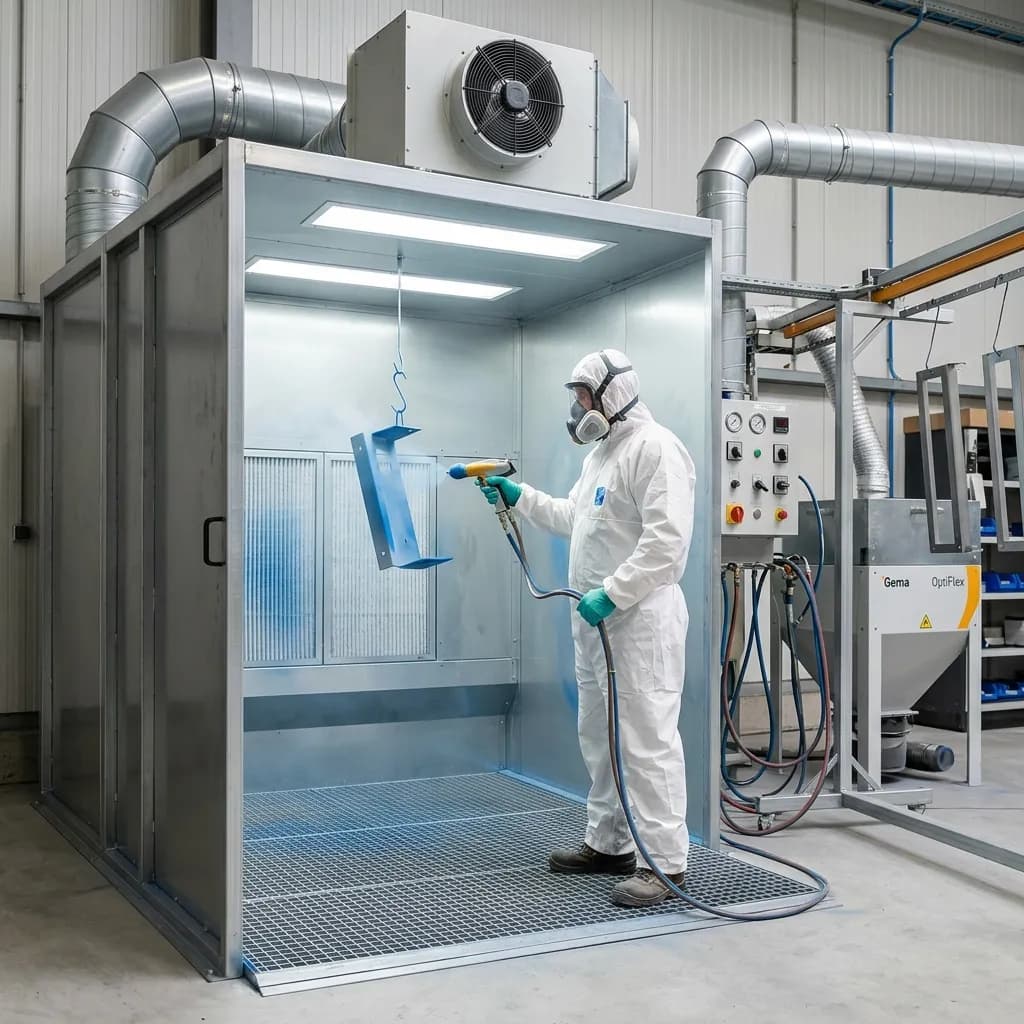
The primary health hazard in powder coating is inhalation of airborne powder particles. Powder coatings are complex chemical mixtures containing resins (polyester, epoxy, acrylic, or hybrid systems), crosslinkers, pigments, fillers, and additives. When inhaled, these particles can cause respiratory irritation, and some components — particularly epoxy resins and certain hardeners — are recognized respiratory and skin sensitizers. The particle size distribution of airborne powder in coating operations includes both inhalable particles (which enter the nose and mouth) and respirable particles (which penetrate deep into the lungs), with the respirable fraction posing the greater health risk.
Ready to Start Your Project?
From one-off customs to 15,000-part production runs — get precise pricing in 24 hours.
On This Page
Occupational Health Hazards in Powder Coating
Skin contact with powder coating materials is another significant exposure pathway. Epoxy resins, in particular, are well-documented skin sensitizers that can cause allergic contact dermatitis. Once sensitization develops, even minimal skin contact can trigger dermatitis reactions, and the condition may persist even after exposure ceases. Other powder coating components, including certain amine-based hardeners and specific pigments, may also cause skin irritation or sensitization. Thermal hazards from hot workpieces, curing ovens, and pretreatment solutions add physical injury risks to the chemical exposure concerns.
Occupational Exposure Limits for Powder Coating Materials
Occupational exposure limits (OELs) establish the maximum airborne concentrations of substances to which workers may be exposed over defined time periods. For powder coating operations, relevant OELs include general dust limits and substance-specific limits for individual coating components. Understanding and applying the correct OELs is essential for exposure assessment and control strategy development.
General dust OELs apply to powder coating particles as a whole. In the United States, OSHA's PEL for particulates not otherwise regulated is 15 mg/m³ total dust and 5 mg/m³ respirable fraction (8-hour TWA). The ACGIH TLV for inhalable particles is 10 mg/m³ and for respirable particles is 3 mg/m³. In Germany, the general dust limit (Allgemeiner Staubgrenzwert) is 10 mg/m³ inhalable and 1.25 mg/m³ respirable. The UK workplace exposure limit for inhalable dust is 10 mg/m³ and for respirable dust is 4 mg/m³.
Substance-specific OELs may apply to individual components of powder coatings. Bisphenol A diglycidyl ether (BADGE), the primary component of epoxy resins, has OELs ranging from 0.5 to 10 mg/m³ depending on the jurisdiction. Titanium dioxide, a common white pigment, has been classified by IARC as Group 2B (possibly carcinogenic to humans) based on inhalation studies in rats, with OELs of 10 mg/m³ total dust in most jurisdictions. Isocyanates in polyurethane powder coatings have very low OELs — typically 0.005-0.02 ppm — reflecting their potent sensitizing properties. When powder coatings contain multiple components with substance-specific OELs, the mixture rule (additive formula) may apply, requiring that the sum of the ratios of each component's concentration to its OEL does not exceed unity.
Exposure Assessment and Workplace Monitoring
Systematic exposure assessment is the cornerstone of occupational health management in powder coating operations. The assessment should identify all exposure scenarios — routine application, color changes, booth cleaning, equipment maintenance, powder handling and mixing — and evaluate the airborne concentrations and dermal exposure potential for each. Personal air sampling, conducted by qualified occupational hygienists, provides the most accurate assessment of worker exposure.
Personal air sampling for inhalable and respirable dust fractions uses calibrated sampling pumps connected to size-selective sampling heads worn in the worker's breathing zone. The IOM sampler is the internationally recognized device for inhalable fraction sampling, while cyclone-type samplers (such as the Higgins-Dewell cyclone) collect the respirable fraction. Samples are collected over representative work periods — typically full shifts for comparison against 8-hour TWA OELs — and analyzed gravimetrically to determine dust concentrations. For substance-specific assessments, collected samples can be analyzed by chemical methods to determine the concentration of specific components such as epoxy resin or isocyanate.
Real-time dust monitoring using optical particle counters or photometric instruments provides immediate feedback on dust levels during specific tasks, enabling identification of peak exposure activities and evaluation of control measure effectiveness. While real-time instruments do not replace gravimetric sampling for regulatory compliance purposes, they are valuable tools for exposure characterization and control optimization. A monitoring program should include baseline assessments when operations begin or change, periodic routine monitoring to verify ongoing control effectiveness, and event-driven monitoring following changes to processes, equipment, or materials that could affect exposure levels.
Engineering Controls for Exposure Reduction
Engineering controls are the most effective and reliable means of reducing worker exposure to powder coating hazards, and should be prioritized over administrative controls and personal protective equipment in the hierarchy of controls. The spray booth is the primary engineering control, providing containment of airborne powder during application. Booth design, maintenance, and operation directly determine the effectiveness of exposure control for application operators.
Local exhaust ventilation (LEV) at powder handling stations — including powder feed hoppers, sieve stations, and manual mixing areas — captures airborne dust at the source before it can disperse into the general work environment. LEV systems should be designed with capture velocities appropriate for the dust generation rate and particle characteristics, typically 0.5-1.0 m/s at the point of dust generation. Regular LEV performance testing using smoke tubes or anemometers, documented in accordance with regulatory requirements, verifies that capture effectiveness is maintained.
Automation of powder coating application reduces operator exposure by removing workers from the immediate spray environment. Automatic reciprocating or robotic spray systems, combined with enclosed booth designs, can virtually eliminate operator exposure during routine production. Manual touch-up operations, which require operators to work inside or adjacent to the spray zone, represent the highest exposure scenario and should be minimized through optimization of automatic application parameters. Where manual application is necessary, supplementary local exhaust ventilation and respiratory protection provide additional exposure control.
Respiratory Protection Programs
Respiratory protection serves as a supplementary control measure when engineering controls alone cannot maintain exposures below OELs, or during non-routine activities such as booth cleaning, filter changes, and equipment maintenance where engineering controls may be temporarily compromised. A respiratory protection program must comply with applicable regulations — OSHA 29 CFR 1910.134 in the United States, or equivalent national regulations in other jurisdictions — and include all required program elements.
Respirator selection must be based on the identified hazards and their airborne concentrations. For routine powder coating operations where dust is the primary hazard, filtering facepiece respirators (FFP2/N95 minimum, FFP3/P100 for higher exposures) provide adequate protection. For operations involving isocyanate-containing powder coatings, supplied-air respirators or full-face respirators with combination particulate/organic vapor cartridges may be required, depending on the exposure assessment results. Half-face elastomeric respirators with P100 particulate filters offer a reusable alternative to disposable filtering facepieces for routine use.
Critical program elements include medical evaluation of workers to confirm fitness for respirator use, fit testing to ensure proper seal between the respirator and the wearer's face (quantitative fit testing using a PortaCount or equivalent instrument provides the most reliable results), training on proper donning, doffing, and maintenance procedures, and regular inspection and replacement of respirators and cartridges. The program should be documented in writing, with records of medical evaluations, fit test results, and training maintained for each worker. A designated program administrator should oversee implementation and ensure ongoing compliance with regulatory requirements.
Skin Protection and Dermal Exposure Control
Dermal exposure to powder coating materials, particularly epoxy-based formulations, presents a significant sensitization risk that requires specific control measures. Skin sensitization to epoxy resins can develop after repeated contact, and once established, the condition is typically permanent — even trace contact can trigger allergic contact dermatitis in sensitized individuals. Prevention of initial sensitization through effective dermal exposure control is therefore critical.
Protective gloves are the primary barrier against dermal exposure. Nitrile gloves provide good chemical resistance to most powder coating components and are the standard recommendation for powder coating operations. Glove thickness should be appropriate for the task — thinner gloves (0.1-0.2 mm) for dexterity-demanding tasks and thicker gloves (0.3-0.5 mm) for handling bulk powder and cleaning operations. Gloves should be changed regularly and immediately if damaged, as powder particles can accumulate inside gloves and cause prolonged skin contact.
Protective clothing — long-sleeved coveralls, closed-toe footwear, and head covering — prevents powder deposition on skin and personal clothing. Disposable coveralls or dedicated work clothing that is laundered separately from personal clothing reduces the risk of take-home contamination. Barrier creams applied before work provide an additional layer of protection for exposed skin areas, though they should not be relied upon as the sole protective measure. Skin care programs that include gentle cleansing products (avoiding harsh solvents that damage the skin barrier), moisturizers to maintain skin integrity, and regular skin condition checks by occupational health professionals help prevent and detect dermal health effects early.
Health Surveillance and Medical Monitoring
Health surveillance programs for powder coating workers provide early detection of health effects, enabling intervention before conditions become established or irreversible. The scope of health surveillance should be based on the hazard assessment and may include respiratory health monitoring, skin health assessment, and substance-specific biological monitoring where applicable.
Respiratory health surveillance typically includes pre-employment baseline spirometry (lung function testing) and periodic follow-up spirometry at intervals determined by the exposure risk — annually for workers with significant dust exposure, or every two to three years for lower-risk roles. Spirometry measures forced vital capacity (FVC) and forced expiratory volume in one second (FEV1), with declining trends indicating possible respiratory effects. For workers exposed to respiratory sensitizers such as isocyanates, more frequent spirometry and symptom questionnaires may be warranted, with immediate referral to an occupational physician if sensitization is suspected.
Skin health surveillance involves regular visual inspection of exposed skin areas for signs of irritation, dryness, cracking, or dermatitis. Workers should be trained to recognize early signs of skin problems and encouraged to report symptoms promptly. For workers handling epoxy-based powder coatings, periodic skin assessments by an occupational health professional are recommended. Patch testing by a dermatologist may be indicated if allergic contact dermatitis is suspected. Health surveillance records must be maintained confidentially for the duration specified by applicable regulations — typically 40 years for records related to occupational disease in many jurisdictions — and should be reviewed periodically by a competent occupational health professional to identify trends that may indicate inadequate exposure control.
Frequently Asked Questions
What are the main health hazards in powder coating operations?
The primary hazards are inhalation of airborne powder particles (causing respiratory irritation and potential sensitization), skin contact with sensitizing components (particularly epoxy resins causing allergic contact dermatitis), and thermal hazards from hot equipment. Isocyanate-containing polyurethane powders present additional respiratory sensitization risks.
What respiratory protection is needed for powder coating?
Minimum FFP2/N95 filtering facepiece respirators for routine dust exposure. FFP3/P100 for higher exposures or booth cleaning. For isocyanate-containing powders, supplied-air respirators or full-face respirators with combination cartridges may be required. All respirator use requires a formal program including medical evaluation and fit testing.
How often should workplace air monitoring be conducted?
Baseline monitoring should be conducted when operations begin or change significantly. Periodic routine monitoring — typically annually or semi-annually — verifies ongoing control effectiveness. Event-driven monitoring should follow any changes to processes, equipment, materials, or ventilation systems that could affect exposure levels.
Can powder coating cause occupational asthma?
Yes. Certain powder coating components, particularly isocyanates in polyurethane systems and some epoxy hardeners, are recognized respiratory sensitizers that can cause occupational asthma. Once sensitization develops, even very low exposures can trigger asthmatic reactions, and the condition may be permanent.
What health surveillance is recommended for powder coating workers?
Recommended surveillance includes baseline and periodic spirometry for respiratory health, regular skin assessments for workers handling sensitizing materials, symptom questionnaires, and substance-specific monitoring where applicable. Pre-employment health assessments establish baselines, and records should be maintained for at least 40 years per most regulatory requirements.
Ready to Start Your Project?
From one-off customs to 15,000-part production runs — get precise pricing in 24 hours.