Neon and fluorescent powder coatings represent the extreme end of the color visibility spectrum, producing colors of extraordinary intensity that appear to glow even under normal lighting conditions. These finishes serve critical safety functions in high-visibility applications and provide unmatched visual impact for creative, artistic, and branding projects where standing out is the primary objective.
Design
Powder Coating Neon and Fluorescent Colors: Safety, Creative, UV Reactive, Limitations, and Durability
Sundial Powder Coating·April 22, 2026·11 min
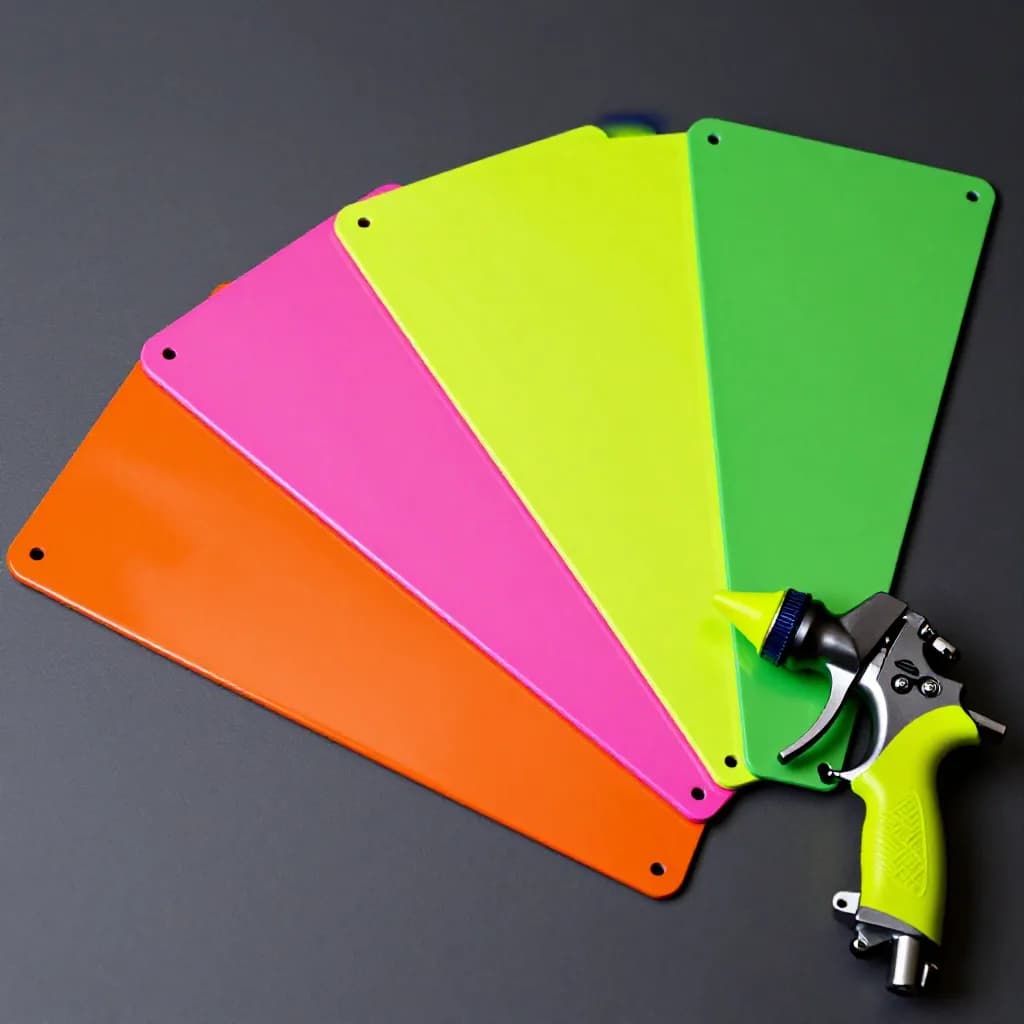
Fluorescent colors achieve their exceptional brightness through a unique optical mechanism. Conventional pigments reflect only a portion of the visible light that strikes them, absorbing the rest. Fluorescent pigments go further by absorbing ultraviolet light, which is invisible to the human eye, and re-emitting it as visible light in the fluorescent color. This means fluorescent surfaces actually emit more visible light than they receive, creating the characteristic glow effect that makes them appear supernaturally bright.
Ready to Start Your Project?
From one-off customs to 15,000-part production runs — get precise pricing in 24 hours.
On This Page
Neon and Fluorescent Powder Coating: Maximum Visual Impact
The fluorescent powder coating palette includes vivid yellows, oranges, reds, pinks, and greens that far exceed the intensity achievable with conventional pigments. These colors are impossible to replicate with standard powder coating formulations, making fluorescent powders the only option when maximum color intensity and visibility are required. However, fluorescent powder coatings come with specific limitations in terms of durability, color stability, and application that must be understood before specification.
Safety Applications: High Visibility Where It Matters Most
The primary functional application of fluorescent powder coatings is in safety and high-visibility contexts where the ability to attract attention and be seen from a distance can prevent accidents and save lives.
Traffic and road safety equipment, including bollards, barrier posts, delineator posts, and crash barriers, uses fluorescent yellow and fluorescent orange powder coatings to maximize visibility for drivers. These colors are specified by highway authorities and transportation departments worldwide because they are visible at greater distances and in poorer lighting conditions than conventional colors.
Construction and industrial safety equipment relies on fluorescent powder coatings for guardrails, safety barriers, equipment guards, and hazard markers. Fluorescent yellow-green, the color with the highest visibility to the human eye under most lighting conditions, is the standard choice for safety equipment in industrial environments. This color is specified by occupational safety standards including ISO 20471 for high-visibility clothing and equipment.
Marine safety equipment, including life ring holders, emergency equipment housings, and navigation markers, uses fluorescent orange and fluorescent red powder coatings for maximum visibility against the blue-grey background of sea and sky. The International Maritime Organization specifies fluorescent colors for certain safety equipment to ensure visibility in emergency conditions.
Aviation ground equipment, including runway markers, ground support equipment, and airport safety barriers, uses fluorescent colors to ensure visibility in the complex visual environment of airport operations. Fluorescent yellow-green and fluorescent orange are the most commonly specified colors for aviation safety applications.
For all safety applications, the fluorescent powder coating must meet the specific visibility and chromaticity requirements defined by the applicable safety standard. Not all fluorescent powder coatings achieve the same level of fluorescence, so specifiers must verify that the proposed product meets the required performance criteria through documented test data.
Creative and Artistic Applications
Beyond safety, fluorescent and neon powder coatings have found enthusiastic adoption in creative, artistic, and commercial applications where maximum visual impact is the design objective.
Public art installations use fluorescent powder coatings to create sculptures and structures that command attention in urban environments. The extraordinary color intensity of fluorescent finishes allows artworks to compete visually with the surrounding cityscape, standing out against buildings, signage, and traffic. Artists working with metal sculpture increasingly specify fluorescent powder coatings for their combination of vivid color and durable, weather-resistant performance.
Retail and commercial environments use fluorescent accents to attract attention and create memorable brand experiences. Fluorescent-coated display fixtures, signage elements, and architectural features create focal points that draw customers and reinforce brand identity. The novelty and intensity of fluorescent colors create a sense of energy and excitement that conventional colors cannot match.
Event and exhibition design relies on fluorescent powder coatings for temporary and semi-permanent structures that must make an immediate visual impact. Trade show displays, festival structures, and pop-up installations in fluorescent colors are visible from across large venues and create the Instagram-worthy visual moments that drive social media engagement.
Automotive and motorcycle customization uses fluorescent powder coatings for wheels, frames, and accent components that make vehicles stand out. Fluorescent green, pink, and orange are popular choices for custom builds and show vehicles where visual drama is the primary objective.
Playground and recreational equipment uses fluorescent colors to create vibrant, engaging environments that appeal to children and contribute to the playful character of recreational spaces. Fluorescent powder coatings are particularly effective for playground equipment because they combine vivid color with the durability and safety characteristics required for equipment that must withstand heavy use and meet safety standards.
UV Reactive Properties and Blacklight Effects
Fluorescent powder coatings exhibit strong UV reactivity, glowing intensely under ultraviolet blacklight illumination. This property opens additional application possibilities in entertainment, hospitality, and experiential design where UV lighting is used to create dramatic visual effects.
Under normal daylight or artificial lighting, fluorescent powder coatings appear as intensely bright versions of their base color. Under UV blacklight, the fluorescent effect is dramatically amplified, with the coated surfaces appearing to glow with an almost electric intensity. This dual-mode visual behavior makes fluorescent powder coatings valuable for environments that transition between normal and UV lighting, such as nightclubs, entertainment venues, and immersive experience installations.
The UV reactive properties of fluorescent powder coatings vary between colors. Fluorescent greens and yellows typically show the strongest UV response, glowing with exceptional intensity under blacklight. Fluorescent oranges and reds show a strong but slightly less intense UV response. Fluorescent pinks and magentas can show dramatic color shifts under UV light, appearing significantly different from their daylight appearance.
For applications specifically designed for UV environments, it is important to evaluate the fluorescent powder coating under the actual UV light sources that will be used in the installation. Different UV light wavelengths can produce different fluorescent responses, and the intensity of the glow depends on the UV light power and the distance from the light source to the coated surface.
Combining fluorescent powder-coated elements with non-fluorescent elements creates dramatic contrast effects under UV lighting. The fluorescent surfaces glow intensely while non-fluorescent surfaces remain dark, creating visual compositions that are impossible to achieve under normal lighting. This contrast effect is widely exploited in entertainment and experiential design to create immersive, otherworldly environments.
Durability Limitations of Fluorescent Powder Coatings
Fluorescent powder coatings have inherent durability limitations that must be understood and managed when specifying these finishes for any application. The fluorescent pigments that create the extraordinary color intensity are organic dye-based materials that are significantly more susceptible to UV degradation than conventional inorganic pigments.
Color fading is the primary limitation. Fluorescent pigments degrade under UV exposure, causing the fluorescent effect to diminish over time. In exterior applications with direct sunlight exposure, noticeable fading can occur within 6-18 months depending on the climate, orientation, and specific pigment system. The color does not disappear entirely but gradually loses its fluorescent intensity, transitioning from a glowing neon appearance to a bright but non-fluorescent version of the color.
The rate of fading depends on several factors. UV intensity is the most significant, with tropical and high-altitude locations causing faster degradation than temperate or shaded environments. The specific fluorescent pigment chemistry affects durability, with some newer formulations offering improved UV stability compared to traditional fluorescent pigments. The powder coating resin system provides some UV protection for the pigments, with super-durable polyester formulations offering better protection than standard polyester.
For exterior safety applications where fluorescent visibility must be maintained, plan for periodic recoating at intervals determined by the local UV environment and the applicable safety standard. Some safety standards specify minimum fluorescence levels that must be maintained throughout the equipment's service life, requiring regular inspection and recoating when fluorescence drops below the required threshold.
For interior applications where UV exposure is limited to artificial lighting, fluorescent powder coatings maintain their intensity for significantly longer periods, often 5-10 years or more depending on the lighting environment. Applications in windowless spaces with LED or incandescent lighting experience minimal fluorescent degradation.
Clear UV-protective topcoats can extend the outdoor life of fluorescent powder coatings by filtering UV radiation before it reaches the fluorescent pigments. However, these topcoats reduce the fluorescent intensity slightly and add cost and complexity to the coating process. The trade-off between extended durability and reduced initial fluorescence should be evaluated for each specific application.
Application and Formulation Considerations
Fluorescent powder coatings present specific application challenges that differ from conventional powder coatings. Understanding these challenges ensures that the coating process produces the best possible result.
Opacity is a common issue with fluorescent powder coatings. Fluorescent pigments are inherently less opaque than conventional pigments, meaning that the substrate color can show through the coating, particularly at lower film thicknesses. To achieve full opacity and maximum fluorescent intensity, fluorescent powder coatings typically require higher film thicknesses than conventional colors, often 80-120 microns or more. Some applicators use a white or light-colored base coat beneath the fluorescent topcoat to maximize opacity and color intensity.
The color range of fluorescent powder coatings is limited compared to conventional powders. Fluorescent pigments are available in a restricted palette of yellows, oranges, reds, pinks, greens, and magentas. True fluorescent blues and purples are not available in powder coating formulations due to the limitations of current fluorescent pigment chemistry. Within the available color range, the specific shades are determined by the fluorescent pigment system and cannot be custom-matched with the same precision as conventional colors.
Curing parameters for fluorescent powder coatings require careful control. Fluorescent pigments are heat-sensitive, and excessive curing temperatures or extended curing times can degrade the fluorescent effect, reducing color intensity and shifting the hue. Follow the powder manufacturer's recommended curing schedule precisely, and verify oven temperature profiles to ensure that the actual metal temperature does not exceed the specified maximum.
Gloss levels for fluorescent powder coatings are typically limited to semi-gloss and gloss finishes. Matte fluorescent formulations are available from some manufacturers but may show reduced fluorescent intensity compared to higher-gloss versions because the matte surface texture scatters light and reduces the perceived brightness of the fluorescent effect.
Batch consistency requires attention because fluorescent pigments can vary between production lots. For projects requiring consistent color across multiple components, specify that all components are coated from the same powder batch and that color verification is performed under both daylight and UV lighting conditions.
Specifying Fluorescent Powder Coating: Practical Guidelines
Specifying fluorescent powder coating requires balancing the desired visual impact with the practical limitations of fluorescent pigment technology. The following guidelines help ensure that the specification is achievable and that the finished result meets expectations.
Define the application environment and expected service life. For exterior applications, acknowledge the limited UV durability of fluorescent pigments and plan for periodic recoating. For safety applications, reference the applicable safety standard and its requirements for maintained fluorescence levels. For interior applications, confirm that the lighting environment will not cause premature fading.
Select the fluorescent color from the manufacturer's standard range rather than attempting custom color matching. Fluorescent colors are formulated around specific pigment systems with limited adjustment capability. Request physical coated samples for evaluation under both daylight and UV lighting conditions if UV reactivity is relevant to the application.
Specify the minimum film thickness required for full opacity and maximum fluorescent intensity. For most fluorescent powder coatings, 80-120 microns is the recommended range. If a base coat is required for opacity, specify the base coat color and film thickness as well as the fluorescent topcoat parameters.
Address the durability expectations clearly in the specification. For exterior applications, state the expected recoating interval and the minimum acceptable fluorescence level at the end of each interval. For safety applications, reference the specific fluorescence measurement standard and threshold values that must be maintained.
Consider specifying a UV-protective clear topcoat for exterior applications where extended fluorescent life is important. Discuss the trade-off between durability extension and fluorescent intensity reduction with the powder manufacturer to determine whether a clear topcoat is appropriate for the specific application.
For projects combining fluorescent and non-fluorescent powder coatings, evaluate the color coordination under both daylight and artificial lighting. Fluorescent colors can appear dramatically different under different light sources, and the relationship between fluorescent and non-fluorescent elements may shift in unexpected ways as lighting conditions change.
Frequently Asked Questions
How long do fluorescent powder coatings last outdoors?
Fluorescent pigments fade under UV exposure, with noticeable intensity loss typically occurring within 6-18 months in direct sunlight. The coating itself remains protective, but the fluorescent glow diminishes. UV-protective clear topcoats can extend fluorescent life. Interior applications maintain intensity for 5-10 years or more.
Do fluorescent powder coatings glow under blacklight?
Yes, fluorescent powder coatings exhibit strong UV reactivity and glow intensely under ultraviolet blacklight. Fluorescent greens and yellows show the strongest UV response. This property makes them valuable for entertainment venues, immersive experiences, and any environment using UV lighting effects.
What fluorescent colors are available in powder coating?
Fluorescent powder coatings are available in yellows, oranges, reds, pinks, greens, and magentas. True fluorescent blues and purples are not currently available due to pigment chemistry limitations. The color range is more restricted than conventional powder coatings.
Can fluorescent powder coating be used for safety equipment?
Yes, fluorescent powder coatings are widely used for traffic safety equipment, industrial safety barriers, marine safety equipment, and aviation ground equipment. The coating must meet specific visibility and chromaticity requirements defined by applicable safety standards. Plan for periodic recoating to maintain required fluorescence levels.
Why do fluorescent powder coatings need thicker application?
Fluorescent pigments are inherently less opaque than conventional pigments, so the substrate can show through at standard film thicknesses. Applying 80-120 microns, or using a white base coat beneath the fluorescent topcoat, ensures full opacity and maximum fluorescent color intensity.
Ready to Start Your Project?
From one-off customs to 15,000-part production runs — get precise pricing in 24 hours.