Minimum order quantities (MOQs) are a reality of powder coating economics that every buyer must understand and plan for. Unlike some manufacturing processes where marginal cost per unit is relatively constant regardless of batch size, powder coating involves significant fixed costs for each production run — booth setup, color loading, pretreatment chemistry preparation, oven warm-up, first-article inspection, and post-run cleaning. These fixed costs must be absorbed across the batch, making very small runs disproportionately expensive per unit.
Guides
Powder Coating Minimum Order Quantities: Batch Economics and Optimization
Sundial Powder Coating·April 22, 2026·11 min
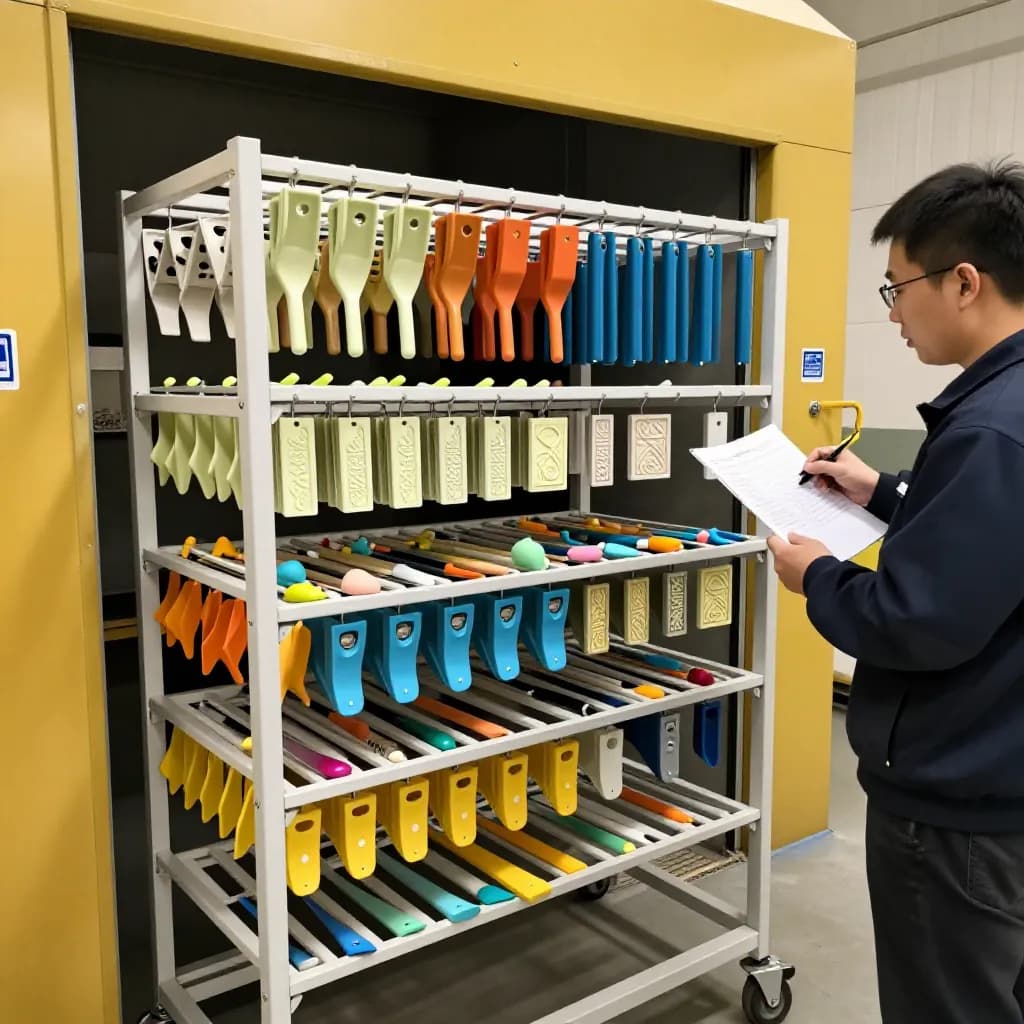
Most powder coating suppliers establish minimum order quantities or minimum charge thresholds to ensure that every job covers its direct costs and contributes to overhead. These minimums vary widely between suppliers and depend on the type of work — a high-volume automated line coating automotive components may have a minimum of several hundred parts, while a job shop with manual application may accept batches as small as one or two pieces, albeit at a premium per-unit charge.
Ready to Start Your Project?
From one-off customs to 15,000-part production runs — get precise pricing in 24 hours.
On This Page
Understanding Minimum Order Quantities in Powder Coating
For buyers, understanding the economics behind MOQs is essential for making informed procurement decisions. It allows you to optimize batch sizes for cost efficiency, negotiate realistic terms with suppliers, and make rational decisions about when to consolidate orders, when to accept minimum charges, and when to consider alternative finishing methods for very small quantities.
The Economics of Setup and Color Change
Every powder coating production run begins with setup activities that consume time and resources regardless of how many parts will be coated. The spray booth must be prepared — guns positioned, powder loaded, electrostatic settings adjusted, and spray patterns verified. If the previous run used a different color, the booth must be thoroughly cleaned to prevent cross-contamination. The pretreatment system must be verified for chemistry concentration and temperature. The curing oven must be at the correct temperature and verified for uniformity.
Color change is typically the most time-consuming setup activity. A full color change on a conventional booth involves purging powder from the delivery system, cleaning spray guns and hoses, vacuuming or blowing down booth walls and floor, replacing or cleaning filters, loading the new powder, and running test shots to verify color and coverage before production begins. This process can take thirty minutes to over an hour depending on the booth design and the color transition involved.
These setup costs are fixed per run, not per part. Whether you coat ten parts or ten thousand parts after a color change, the setup cost is the same. This is why per-unit coating costs decrease dramatically as batch size increases — the fixed setup cost is spread across more units. For a buyer placing a ten-piece order that requires a dedicated color change, the setup cost may represent the majority of the total job cost. Understanding this relationship helps buyers make informed decisions about batch sizing and order consolidation.
How Suppliers Set Their Minimums
Powder coating suppliers set minimum order quantities based on their cost structure, equipment configuration, and target market. A supplier operating an automated conveyorized line with high throughput capacity has higher fixed costs per run (more complex setup, higher energy consumption, more powder waste during startup and shutdown) and therefore needs larger batches to operate efficiently. A smaller job shop with batch ovens and manual application has lower fixed costs and can economically handle smaller quantities.
Some suppliers express their minimums as a minimum number of parts, while others use a minimum charge per order or per color. A minimum charge approach is more flexible because it accommodates variation in part size and complexity — a minimum charge that covers the setup cost allows the supplier to coat anything from one large part to fifty small parts, as long as the total charge meets the threshold.
Suppliers also consider the opportunity cost of small orders. Every hour spent on a small, low-value job is an hour not available for larger, more profitable work. During busy periods, suppliers may increase their effective minimums by declining small orders or quoting premium rates that discourage them. During quieter periods, the same suppliers may welcome small orders to fill capacity. Understanding your supplier's capacity cycle can help you time small orders for better availability and potentially better terms.
Strategies for Optimizing Small Runs
If your business regularly requires small batches of powder-coated parts, several strategies can help optimize costs and lead times. Order consolidation is the most straightforward approach — accumulate parts until you have a batch large enough to coat efficiently, rather than placing frequent small orders. This requires balancing inventory holding costs against coating setup costs, but for many businesses the math favors larger, less frequent coating orders.
Color consolidation is equally effective. If your product range uses multiple colors, consider whether some colors can be standardized or eliminated. Reducing from twenty colors to ten halves the number of color changes required and doubles the average batch size per color. For products where color variety is a market requirement, consider offering a core range of standard colors with short lead times and larger batches, plus a custom color option with longer lead times and minimum quantity requirements.
Coordinate with your coating supplier on their production schedule. If they run RAL 7016 every Wednesday, timing your anthracite grey orders to align with their schedule means your parts can be added to an existing color run without a dedicated setup, potentially reducing both cost and lead time. Some suppliers offer scheduled color days or color grouping services specifically to help small-batch customers benefit from shared setup costs.
Finally, consider whether all parts in your product range truly need powder coating. For very small quantities of non-critical components, alternative finishes such as spray painting, dip coating, or even leaving parts uncoated (if the substrate provides adequate protection) may be more cost-effective than paying minimum charges for powder coating.
Custom Color Minimums and Powder Procurement
Custom colors introduce an additional layer of minimum quantity considerations because the powder itself must be manufactured in minimum batch sizes. Standard catalog colors from major powder manufacturers are produced in large quantities and held in stock, available in any quantity from a single kilogram upward. Custom colors, however, must be manufactured to order, and powder manufacturers typically require minimum production batches of 25-100 kg depending on the formulation complexity and the manufacturer's equipment.
This minimum powder quantity translates into a minimum coated area. A kilogram of powder typically covers 6-10 square meters at standard film thickness (60-80 microns), so a 25 kg minimum powder batch covers approximately 150-250 square meters of surface area. If your project requires less coated area than this, you will either need to purchase more powder than you need (and store or dispose of the excess) or find a supplier who holds stock of your custom color.
For ongoing products with custom colors, the most efficient approach is to order powder in economic batch sizes and have it stored at the coating supplier's facility. This eliminates powder procurement lead time from subsequent orders and ensures color consistency across production batches. Discuss powder storage arrangements with your supplier, including storage conditions, shelf life management, and inventory tracking. Most thermosetting powder coatings have a shelf life of twelve to twenty-four months when stored in cool, dry conditions, so plan your powder procurement to match your consumption rate.
Negotiating MOQ Terms with Suppliers
Minimum order quantities are not always fixed — they are often negotiable, particularly within the context of a broader supply relationship. If you can offer a supplier consistent volume across multiple orders, they may be willing to reduce or waive minimums on individual orders in exchange for the overall volume commitment. A scheduling agreement that guarantees a certain annual volume provides the supplier with revenue certainty, which may justify accepting occasional small batches within the agreement.
Another negotiation approach is to accept a minimum charge rather than a minimum quantity. If you need only five parts coated but the supplier's minimum charge covers twenty parts' worth of work, paying the minimum charge for five parts may still be more cost-effective than alternatives such as holding inventory or using a different finishing method. Discuss this option openly with your supplier — most are willing to accommodate small quantities at a minimum charge rather than turning away business entirely.
For buyers with diverse coating requirements across multiple products, consolidating all coating work with a single supplier can provide leverage for MOQ negotiations. The supplier benefits from the total volume and the simplified commercial relationship, and in return may offer more flexible terms on individual orders. However, balance this against the supply chain risk of single-sourcing — the MOQ flexibility gained from consolidation should not come at the cost of supply security.
When Small Batches Make Sense Despite Higher Unit Costs
While batch size optimization is important, there are legitimate business reasons to accept higher per-unit coating costs on small batches rather than artificially inflating order quantities. Prototype and development work requires small quantities by nature — coating a handful of prototype parts at a premium per-unit cost is far more sensible than coating hundreds of parts for a product that may never reach production.
Make-to-order businesses that produce custom products in small quantities may have no option to consolidate orders. In these cases, the coating cost premium for small batches is simply a cost of doing business that must be factored into product pricing. The key is to understand the cost structure accurately so that product pricing reflects the true coating cost rather than an optimistic estimate based on large-batch economics.
Urgent replacement parts and after-sales service requirements also justify small-batch coating at premium rates. The cost of expediting a small coating order is typically far less than the cost of a production line shutdown waiting for replacement parts or a dissatisfied customer waiting for a warranty replacement. In these situations, the value of speed and availability far outweighs the per-unit cost premium.
The decision framework should compare the total cost of small-batch coating (including the per-unit premium) against the total cost of alternatives — holding finished goods inventory, using a different finishing method, or accepting the consequences of delayed delivery. In many cases, the small-batch premium is the most cost-effective option when all factors are considered.
Frequently Asked Questions
What is a typical minimum order quantity for powder coating?
MOQs vary widely by supplier type. Job shops may accept single pieces at a minimum charge. Production coaters typically require batches of 50-500 parts depending on part size and line configuration. Architectural coaters may set minimums based on surface area rather than part count. Always ask about minimum charges as an alternative to minimum quantities.
Why does powder coating cost more per unit for small batches?
Every coating run involves fixed setup costs — booth preparation, color change, pretreatment verification, first-article inspection, and cleaning. These costs are the same whether you coat ten parts or a thousand. For small batches, the fixed costs represent a larger proportion of the total job cost, increasing the per-unit charge.
How can I reduce the cost of small powder coating orders?
Consolidate orders into larger batches, standardize colors to increase batch sizes per color, coordinate timing with your supplier's production schedule, and negotiate minimum charge arrangements rather than minimum quantities. For ongoing relationships, a volume commitment across multiple orders may secure more flexible terms on individual batches.
What is the minimum order for custom color powder?
Powder manufacturers typically require minimum production batches of 25-100 kg for custom colors. This covers approximately 150-600 square meters of coated surface at standard film thickness. For smaller requirements, check whether the manufacturer offers a small-batch service or whether your coating supplier stocks the custom color.
Should I hold inventory to avoid small-batch coating premiums?
It depends on the trade-off between inventory holding costs and coating premiums. For stable, predictable products, holding coated inventory may be more cost-effective. For products with uncertain demand, frequent design changes, or high variety, the risk of obsolete inventory may outweigh the small-batch premium. Analyze both costs before deciding.
Ready to Start Your Project?
From one-off customs to 15,000-part production runs — get precise pricing in 24 hours.