Mechanical pretreatment — primarily abrasive blasting — serves two essential functions in powder coating preparation: removing surface contaminants (mill scale, rust, old coatings, and oxides) and creating a surface profile (roughness pattern) that provides mechanical adhesion for the powder coating. While chemical pretreatment relies on chemical reactions to clean and condition the surface, mechanical pretreatment uses physical impact energy to achieve these goals.
Technical
Powder Coating Mechanical Pretreatment: Grit Blasting, Shot Blasting, and Surface Profile Standards
Sundial Powder Coating·April 23, 2026·14 min
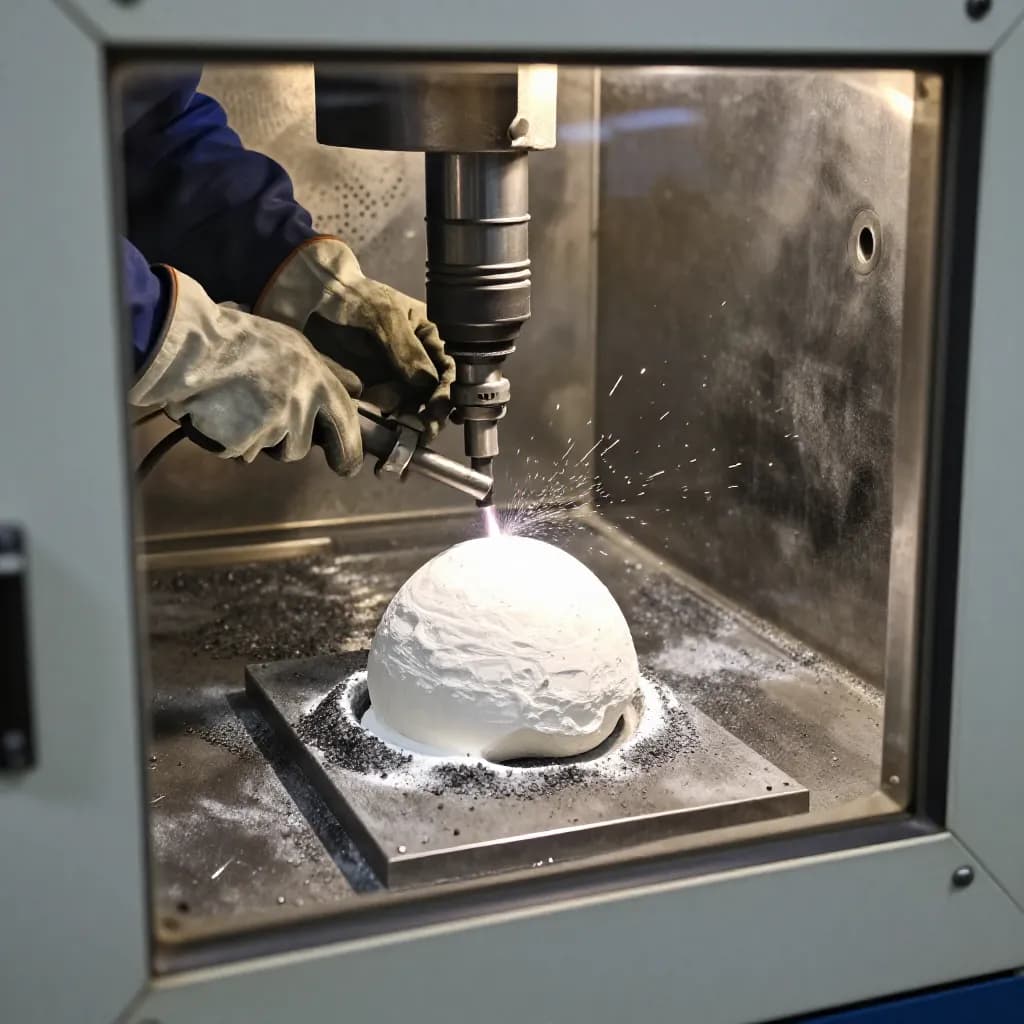
Abrasive blasting is the preferred pretreatment method for heavy fabrications, structural steel, castings, forgings, and any substrate with heavy mill scale, rust, or existing coatings that chemical cleaning cannot effectively remove. It is also specified when the application requires maximum adhesion — the mechanical interlocking between the powder coating and the roughened substrate surface provides adhesion forces that supplement the chemical bonding achieved by conversion coatings.
Ready to Start Your Project?
From one-off customs to 15,000-part production runs — get precise pricing in 24 hours.
On This Page
The Role of Mechanical Pretreatment in Powder Coating
The effectiveness of mechanical pretreatment depends on three factors: the cleanliness level achieved (how completely contaminants are removed), the surface profile created (the depth and pattern of the roughness), and the condition of the surface after blasting (freedom from embedded contaminants, flash rust, and residual dust). Each of these factors is governed by international standards that define measurement methods and acceptance criteria, providing a common language between coating specifiers, applicators, and inspectors.
Abrasive Blasting Methods: Air Blast vs. Wheel Blast
Abrasive blasting methods fall into two broad categories: air blast systems that propel abrasive media using compressed air, and wheel blast (centrifugal) systems that use high-speed rotating wheels to accelerate the media. Each method has distinct characteristics that suit different production scenarios.
Air blast systems use compressed air at 5–7 bar (70–100 psi) to accelerate abrasive media through a nozzle directed at the part surface. The operator (in manual systems) or a programmed manipulator (in automatic systems) controls the nozzle position, angle, and dwell time to achieve the required cleanliness and profile across the entire part surface. Air blast is highly flexible — it can reach internal cavities, complex geometries, and localized areas that wheel blast cannot access. Blast cabinets (enclosed chambers for small parts), blast rooms (walk-in enclosures for large parts), and portable blast equipment (for field work) are all air blast configurations.
Wheel blast systems use one or more centrifugal wheels rotating at 2,000–3,500 RPM to throw abrasive media at the part surface at velocities of 60–80 m/s. The wheels are positioned around a blast chamber through which parts pass on a conveyor, roller table, or rotary fixture. Wheel blast provides much higher throughput than air blast — a single wheel can deliver 100–500 kg/min of abrasive, compared to 5–15 kg/min for an air blast nozzle. This makes wheel blast the standard choice for high-volume production of structural steel, plate, pipe, and fabricated assemblies. However, wheel blast coverage is limited to surfaces in the direct line of throw from the wheels, and complex geometries may require supplemental air blast for complete coverage.
Abrasive Media Types and Selection
The choice of abrasive media determines the surface profile characteristics, the cleaning rate, the media consumption rate, and the risk of surface contamination. The major media categories are metallic abrasives (steel shot and steel grit), mineral abrasives (aluminum oxide, garnet, silicon carbide), and specialty abrasives (glass bead, plastic media, walnut shell).
Steel shot consists of spherical particles that produce a peened (dimpled) surface profile. It is the most common media for wheel blast systems, offering high durability (3,000–5,000 cycles before breakdown), consistent profile generation, and low dust generation. Steel shot is available in sizes from S-110 (0.3 mm) to S-780 (2.0 mm) per SAE J444, with S-230 to S-390 being the most common sizes for powder coating preparation. The spherical impact creates a compressive stress layer on the substrate surface that improves fatigue resistance — a secondary benefit for structural and mechanical components.
Steel grit consists of angular particles that produce a sharp, aggressive surface profile with deeper anchor pattern than shot of equivalent size. Grit is preferred when maximum profile depth is required for thick-film coatings or when removing tenacious contaminants such as heavy mill scale. Steel grit is available in sizes from G-10 (2.8 mm) to G-325 (0.04 mm) per SAE J444, with G-25 to G-50 being common for powder coating preparation.
Aluminum oxide (Al₂O₃) is the standard mineral abrasive for air blast systems, offering high hardness (9 on the Mohs scale), sharp angular particle shape, and no risk of ferrous contamination on non-ferrous substrates. It is the required media for blasting aluminum, stainless steel, and other non-ferrous metals where steel media would embed iron particles that cause galvanic corrosion. Garnet provides similar performance at lower cost but with faster breakdown. Glass bead produces a smooth, peened surface with minimal profile — used for cosmetic finishing rather than coating preparation.
Surface Cleanliness Standards and Visual Assessment
Surface cleanliness after abrasive blasting is assessed against internationally recognized visual standards that define the degree of contaminant removal. The two primary standard systems are ISO 8501-1 (international) and SSPC/NACE (North American), which define equivalent cleanliness grades using different nomenclature.
ISO 8501-1 defines four grades of blast cleaning: Sa 1 (light blast cleaning — loose mill scale, rust, and coatings removed), Sa 2 (thorough blast cleaning — most mill scale, rust, and coatings removed, with slight residual staining permitted), Sa 2½ (very thorough blast cleaning — mill scale, rust, and coatings removed to the extent that residual traces appear only as slight stains), and Sa 3 (blast cleaning to visually clean steel — all mill scale, rust, and coatings completely removed, surface has uniform metallic appearance). The equivalent SSPC grades are SP 7 (brush-off), SP 6 (commercial), SP 10 (near-white), and SP 5 (white metal).
For powder coating applications, Sa 2½ / SSPC SP 10 (near-white metal) is the most commonly specified cleanliness grade. This grade removes virtually all visible contamination while being economically achievable in production — Sa 3 / SP 5 (white metal) requires significantly more blasting time and media consumption for a marginal improvement in coating performance. Visual assessment is performed by comparing the blasted surface to photographic reference standards (ISO 8501-1 includes reference photographs for each grade on four initial surface conditions) under adequate lighting (minimum 500 lux). The assessment should be performed within 4 hours of blasting, before flash rust or re-contamination can obscure the results.
Surface Profile Measurement and Specification
Surface profile — the pattern of peaks and valleys created by abrasive impact — provides mechanical anchorage for the powder coating. The profile depth must be sufficient to provide adequate adhesion but not so deep that the coating cannot fill the valleys, leaving thin spots at the peaks that are vulnerable to corrosion and mechanical damage.
Profile depth is measured using several methods defined by international standards. Replica tape (Testex Press-O-Film per ASTM D4417 Method C) is the most common field method — a compressible foam tape is pressed against the blasted surface, and the compressed thickness is measured with a spring micrometer to determine the peak-to-valley height. Digital surface profile gauges (per ASTM D4417 Method B) use a stylus that traverses the surface and records the profile electronically, providing statistical data including average profile depth (Ra), maximum peak-to-valley height (Rz), and peak count.
For powder coating applications, the recommended surface profile depth is typically 25–75 microns (1.0–3.0 mils), depending on the coating thickness and the application requirements. As a general rule, the profile depth should be approximately 25–33% of the intended dry film thickness — a 75-micron coating should have a profile of 20–25 microns, while a 200-micron coating can accommodate a profile of 50–65 microns. Profile depth is controlled by the abrasive media size, hardness, shape (angular media produces deeper profiles than spherical), blast pressure or wheel speed, and the angle of impact (90° produces the deepest profile). Specifications should define both the minimum and maximum acceptable profile depth, as excessive profile wastes coating material and can create thin spots at profile peaks.
Post-Blast Surface Condition and Contamination Control
Achieving the correct cleanliness grade and surface profile is only part of the mechanical pretreatment challenge. The blasted surface must also be free from embedded abrasive particles, residual dust, soluble salt contamination, and flash rust — any of which can cause coating failures.
Embedded abrasive particles are a concern when using mineral abrasives (aluminum oxide, garnet) on soft substrates. Particles that embed in the surface rather than bouncing off create stress concentrations and potential adhesion failure points under the coating. The risk is minimized by using appropriate blast pressure (not excessive), maintaining proper nozzle angle (60–80° rather than 90°), and using media of appropriate hardness for the substrate.
Residual dust on the blasted surface must be removed before coating. Dust assessment is performed per ISO 8502-3 using a pressure-sensitive adhesive tape applied to the surface and compared to pictorial reference standards. The tape captures loose particles, and the quantity and size of particles are rated on a scale of 1 (very light) to 5 (heavy). For powder coating, a dust rating of 2 or less is typically required. Dust removal is accomplished by compressed air blow-off (using clean, dry, oil-free air), vacuum cleaning, or a combination of both.
Soluble salt contamination — chlorides, sulfates, and nitrates from the atmosphere, handling, or contaminated abrasive — is invisible but devastating to coating performance. Soluble salts trapped under the coating attract moisture through the film by osmosis, creating blisters and initiating corrosion. Salt contamination is measured per ISO 8502-6 (Bresle method) or ISO 8502-9 (conductometric method), with maximum acceptable levels typically specified as less than 20 mg/m² of sodium chloride equivalent for high-performance coatings. If salt contamination exceeds the limit, the surface must be washed with clean water and re-blasted.
Integration with Chemical Pretreatment and Best Practices
Many powder coating operations combine mechanical and chemical pretreatment to achieve the best possible surface preparation. A common sequence is abrasive blasting to remove heavy contamination and create surface profile, followed by chemical pretreatment (cleaning, conversion coating, and sealing) to provide chemical bonding and enhanced corrosion protection. This combination is standard for automotive frames, heavy equipment, and structural steel where both mechanical adhesion and chemical corrosion protection are required.
The time between blasting and subsequent processing is critical. Freshly blasted steel begins to oxidize (flash rust) within minutes in humid environments. ISO 8501-1 specifies that the surface condition should be assessed and coating or further treatment should begin before visible deterioration occurs. In practice, this means blasted parts should be processed through chemical pretreatment or coated within 4 hours in controlled environments, or within 1–2 hours in humid conditions. Dehumidification of the blast area and storage areas can extend this window.
Best practices for mechanical pretreatment include: maintaining abrasive operating mix within specification through regular sieve analysis per ASTM E11; monitoring and controlling blast parameters (pressure, wheel speed, exposure time) for consistency; verifying cleanliness and profile on every production batch using the appropriate standards; maintaining compressed air quality for air blast systems (oil and moisture contamination in blast air deposits on the surface); implementing dust collection and ventilation per OSHA and ACGIH standards to protect operators; and documenting all pretreatment parameters and inspection results for traceability. Regular calibration of profile measurement instruments and training of inspection personnel ensure that quality assessments are accurate and consistent.
Frequently Asked Questions
What blast cleanliness grade is required for powder coating?
Sa 2½ per ISO 8501-1 (equivalent to SSPC SP 10, near-white metal) is the most commonly specified grade for powder coating. This removes virtually all visible contamination while being economically achievable. Sa 3 (white metal) is specified for the most demanding applications but requires significantly more time and media.
What surface profile depth is recommended for powder coating?
The recommended profile depth is typically 25–75 microns (1.0–3.0 mils), depending on coating thickness. As a rule, profile depth should be 25–33% of the intended dry film thickness. Profile is measured using replica tape (ASTM D4417 Method C) or digital surface profile gauges (Method B).
Should you use steel shot or steel grit for powder coating preparation?
Steel shot produces a peened (dimpled) profile suitable for most powder coating applications. Steel grit produces a sharper, deeper profile preferred for thick-film coatings or heavy contamination removal. For non-ferrous substrates (aluminum, stainless steel), aluminum oxide must be used instead of steel media to prevent galvanic corrosion.
How soon after blasting must parts be coated?
Blasted steel should be coated or processed through chemical pretreatment within 4 hours in controlled environments, or within 1–2 hours in humid conditions. Flash rust begins forming within minutes on freshly blasted steel in humid air, degrading the surface preparation quality.
What is soluble salt contamination and why does it matter?
Soluble salts (chlorides, sulfates, nitrates) are invisible contaminants that attract moisture through the coating by osmosis, causing blistering and corrosion. They are measured per ISO 8502-6 (Bresle method). Maximum acceptable levels are typically less than 20 mg/m² of NaCl equivalent for high-performance powder coatings.
Ready to Start Your Project?
From one-off customs to 15,000-part production runs — get precise pricing in 24 hours.