Powder coating has traditionally been associated exclusively with metal substrates, but advances in low-temperature cure and UV-cure powder technologies have opened the door to coating heat-sensitive materials including medium-density fiberboard (MDF), particleboard, and solid wood. This development has significant implications for the furniture, kitchen cabinet, office partition, and retail fixture industries, which consume enormous volumes of MDF and wood panels finished with liquid paints, laminates, and foil wraps.
Technical
Powder Coating MDF and Wood Substrates: UV-Cure, Low-Temperature, and Furniture Applications
Sundial Powder Coating·April 22, 2026·14 min
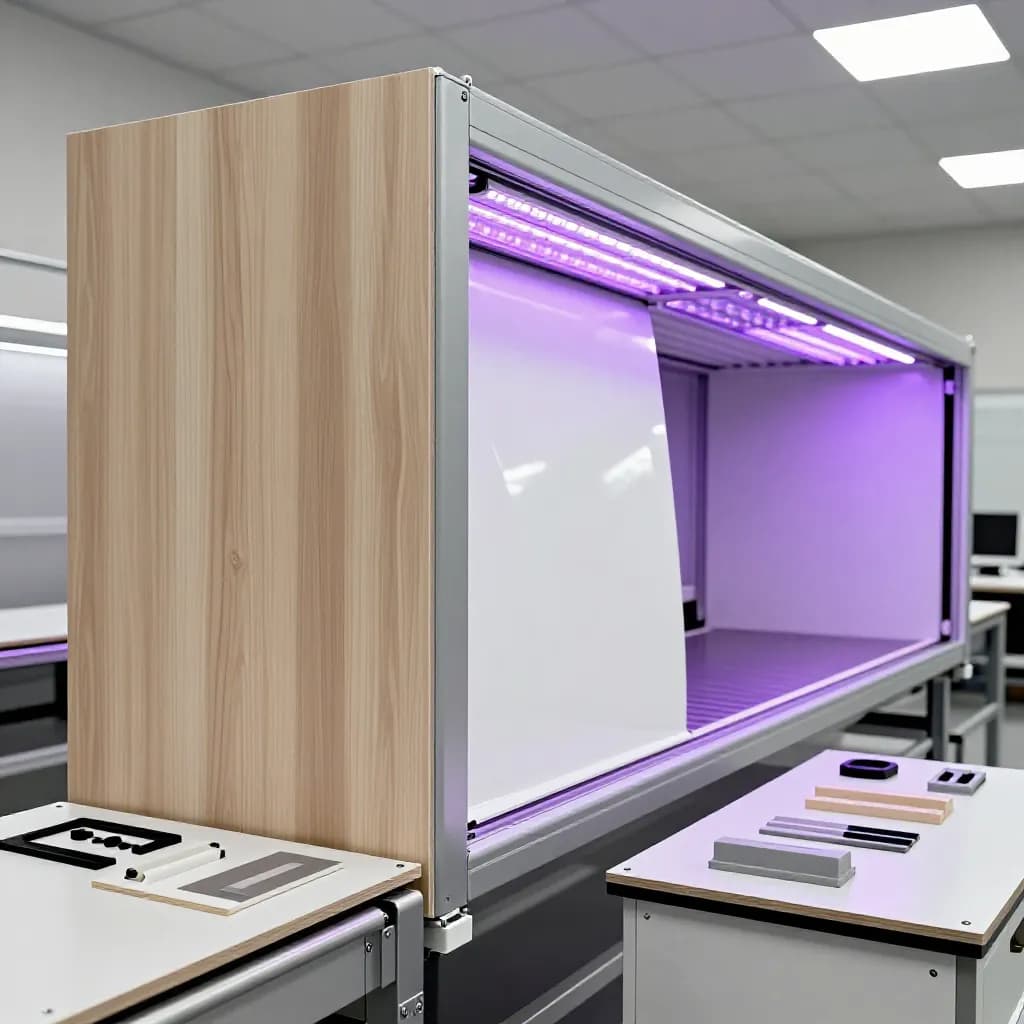
The environmental advantages of powder coating — zero VOC emissions, near-100% material utilization, and elimination of solvent waste — are particularly compelling for the furniture industry, which is one of the largest consumers of liquid coatings and faces increasing regulatory pressure to reduce emissions. A single furniture factory converting from liquid spray painting to powder coating can eliminate tens of thousands of kilograms of VOC emissions annually while reducing coating waste by 90% or more. The economic case is equally strong: powder coating's high transfer efficiency and material reclaim capability reduce coating material consumption by 30-50% compared to liquid spray systems.
Ready to Start Your Project?
From one-off customs to 15,000-part production runs — get precise pricing in 24 hours.
On This Page
Powder Coating Beyond Metal: The MDF and Wood Revolution
The technical challenge is that MDF and wood cannot withstand the 180-200°C cure temperatures used for standard thermosetting powder coatings. MDF begins to degrade at temperatures above 120-130°C, with moisture loss causing warping, cracking, and surface defects. Solid wood is even more temperature-sensitive, with risk of discoloration, resin bleed, and structural damage above 100-110°C. Overcoming this temperature limitation has required the development of entirely new powder coating chemistries and curing technologies that achieve full film formation and crosslinking at temperatures compatible with wood-based substrates.
UV-Cure Powder Coating Technology
UV-cure powder coating represents the most successful technology for coating MDF and wood substrates. The process separates the two functions of a conventional powder cure cycle — melting/flow and crosslinking — into distinct steps that can be performed at different temperatures. The powder is first melted and flowed into a smooth, continuous film using infrared (IR) heating at 100-130°C, which is within the safe temperature range for MDF. The melted film is then crosslinked (cured) by exposure to ultraviolet (UV) radiation, which triggers a photochemical reaction that hardens the coating in seconds without requiring additional heat.
UV-cure powder formulations are based on unsaturated polyester or acrylate resins containing photoinitiators that generate free radicals when exposed to UV light in the 200-400 nanometer wavelength range. These free radicals initiate a rapid chain polymerization reaction that crosslinks the resin within 1-5 seconds of UV exposure. The result is a fully cured, hard, chemically resistant coating that has been formed at a maximum substrate temperature of 120-130°C — well within the safe range for MDF and most engineered wood products.
The UV-cure process offers several advantages beyond temperature compatibility. Cure speed is dramatically faster than thermal cure — a UV-cure line can process panels at 10-30 meters per minute, compared to 2-5 meters per minute for thermal cure systems. Energy consumption is lower because the UV lamps consume far less energy than convection or IR cure ovens operating at 180-200°C. The instant cure also means that coated panels can be handled, stacked, and packaged immediately after the UV station, eliminating the cooling time required after thermal cure. These productivity advantages make UV-cure powder coating economically competitive with liquid coating systems for high-volume panel production.
Low-Temperature Thermal Cure Alternatives
While UV-cure technology dominates the MDF powder coating market, low-temperature thermal cure powders offer an alternative for applications where UV equipment is not available or where the part geometry prevents uniform UV exposure. Low-temperature thermal cure powders are formulated to achieve full crosslinking at 120-150°C for 15-30 minutes, using accelerated crosslinking chemistry that reduces the activation energy required for the curing reaction.
These formulations typically use specially designed polyester resins with blocked isocyanate or glycoluril crosslinkers that unblock and react at lower temperatures than standard TGIC or HAA crosslinkers. The cure window is narrower than standard powders — typically ±5°C versus ±10°C — requiring more precise oven temperature control. Under-cure results in poor mechanical properties and chemical resistance, while over-cure can damage the MDF substrate. Oven profiling with contact thermocouples on the MDF surface is essential for establishing and verifying cure parameters.
The practical temperature limit for MDF is approximately 130°C for 15-20 minutes, which allows the use of low-temperature powders curing at 125-130°C. At these temperatures, the MDF experiences some moisture loss (typically 2-4% of its original moisture content), which can cause minor dimensional changes and surface roughening. Pre-conditioning the MDF to a uniform moisture content of 6-8% before coating, and allowing coated panels to re-equilibrate after cure, minimizes these effects. Solid wood is more problematic — its anisotropic structure and higher moisture sensitivity make it more prone to warping and checking at even moderate temperatures. UV-cure technology is strongly preferred for solid wood applications because the substrate temperature remains below 100°C throughout the process.
Making MDF Conductive: Electrostatic Application Solutions
Conventional electrostatic powder coating relies on the substrate being electrically conductive and grounded to attract and retain charged powder particles. MDF and wood are electrical insulators with surface resistivity of 10⁸-10¹² ohm/square, which is far too high for effective electrostatic deposition. Without modification, charged powder particles simply will not adhere to the surface in sufficient quantity to form a continuous coating. Solving this conductivity problem is essential for applying powder to wood-based substrates.
The most widely used approach is to apply a conductive primer or surface treatment to the MDF before powder application. Water-based conductive primers containing carbon black, graphite, or metallic particles reduce surface resistivity to 10⁴-10⁶ ohm/square, which is sufficient for electrostatic powder deposition. The primer is applied by roller coat, curtain coat, or spray at a dry film thickness of 10-20 micrometers and dried at 60-80°C. The primed surface provides both electrical conductivity for powder attraction and a smooth, sealed substrate that improves powder flow and leveling.
Alternative conductivity solutions include moisture conditioning — raising the MDF's moisture content to 8-12% increases surface conductivity sufficiently for electrostatic deposition in some cases, though the results are less consistent than conductive primer. Conductive MDF grades, manufactured with conductive additives incorporated into the board during production, are available from some MDF suppliers and eliminate the need for a separate priming step. Hot-melt powder application, where the powder is applied to a preheated substrate and adheres through thermal tack rather than electrostatic attraction, is another approach that bypasses the conductivity requirement entirely. Each method has trade-offs in cost, consistency, and coating quality that must be evaluated for the specific application.
Surface Preparation and Panel Quality
The quality of the MDF substrate has a direct and significant impact on the quality of the powder-coated finish. MDF is manufactured by breaking down wood fibers and reconstituting them with resin binder under heat and pressure. The resulting board has a smooth, dense surface layer and a less dense core. Surface density, smoothness, moisture content, and resin distribution all affect coating adhesion, appearance, and durability.
High-quality coating-grade MDF is manufactured specifically for powder coating applications, with optimized surface density (typically 850-950 kg/m³ at the surface versus 650-750 kg/m³ in the core), controlled moisture content (7-9%), and minimal surface defects. The surface should be sanded to 180-220 grit to remove any press marks, fiber raise, or surface irregularities. Over-sanding (finer than 320 grit) can burnish the surface and reduce adhesion, while under-sanding leaves visible defects that telegraph through the coating.
Edge sealing is a critical consideration for MDF powder coating. The cut edges of MDF expose the less dense core material, which absorbs moisture and coating materials differently than the face surface. Unsealed edges produce a rough, porous coating appearance and are vulnerable to moisture ingress that causes swelling and delamination. Edge sealing with a liquid or hot-melt sealant before powder application creates a smooth, uniform surface for coating. Some UV-cure powder systems incorporate an edge-sealing step using a thixotropic powder formulation that builds sufficient film on edges without sagging. Routed profiles and shaped edges require particular attention — the routing process exposes core material and creates complex geometries that challenge uniform powder deposition.
Furniture Industry Applications
The furniture industry represents the largest market for powder-coated MDF, with applications spanning kitchen cabinet doors and drawer fronts, office furniture panels and desktops, retail display fixtures, bathroom vanity units, and residential furniture components. The combination of MDF's design flexibility (it can be routed, shaped, and profiled into virtually any form) with powder coating's durability and environmental advantages creates a compelling alternative to traditional liquid-painted or laminated MDF.
Kitchen cabinet doors are the flagship application for UV-cure powder-coated MDF. The coating must withstand daily exposure to moisture, heat, cooking oils, cleaning chemicals, and mechanical wear while maintaining a flawless aesthetic appearance for 15-20 years. UV-cure powder coatings on MDF achieve hardness levels of 2H-3H (pencil hardness), scratch resistance comparable to high-pressure laminate, and chemical resistance to common household cleaners, vinegar, coffee, and cooking oils. The smooth, non-porous surface is easy to clean and does not harbor bacteria — an important consideration for kitchen environments.
Office furniture represents a high-volume application where powder-coated MDF competes with melamine-faced and laminated panels. Powder coating offers advantages in design flexibility (any color, gloss, or texture versus the limited range of standard laminates), environmental credentials (zero VOC, recyclable overspray), and surface performance (superior scratch and impact resistance compared to melamine). The ability to coat three-dimensional MDF components — curved panels, routed profiles, and shaped edges — in a single operation is a significant manufacturing advantage over laminating, which requires complex forming and edge-banding processes for non-flat components.
Quality Control and Performance Testing
Quality control for powder-coated MDF encompasses both the substrate quality and the coating performance. Incoming MDF inspection should verify board thickness, density, moisture content, and surface quality. Moisture content measurement using a pin-type or capacitance moisture meter should confirm values within the 7-9% range — boards outside this range should be conditioned before coating. Surface density can be assessed by measuring the board's resistance to a standardized indentation test.
Coating performance testing for MDF applications follows a combination of standard coating tests and furniture-specific performance standards. Film thickness measurement on MDF requires non-destructive methods such as ultrasonic gauges or cross-section microscopy, as magnetic and eddy current gauges used for metal substrates do not work on non-conductive substrates. Adhesion testing per ISO 2409 (cross-hatch) should achieve classification 0-1. Hardness testing per ISO 15184 (pencil hardness) should achieve H-2H minimum for furniture applications.
Furniture-specific performance tests include resistance to wet heat (placing a hot, wet cup on the surface for defined periods per EN 12722), resistance to dry heat (contact with a hot object per EN 12721), resistance to cold liquids (exposure to water, coffee, tea, alcohol, and cleaning agents per EN 12720), and scratch resistance (loaded stylus drawn across the surface per EN 15186). These tests simulate real-world use conditions and provide meaningful data on the coating's suitability for furniture applications. UV-cure powder coatings on high-quality MDF routinely pass these tests at levels comparable to or exceeding high-pressure laminate, validating their suitability for demanding furniture applications.
Frequently Asked Questions
Can you really powder coat wood and MDF?
Yes, using UV-cure or low-temperature thermal cure powder technologies. UV-cure powder is melted at 100-130°C using infrared heat, then crosslinked instantly by UV light — keeping the substrate below its damage threshold. Low-temperature thermal cure powders achieve full cure at 120-150°C. Both technologies produce durable, high-quality finishes on MDF and engineered wood products.
How do you make MDF conductive for electrostatic powder coating?
The most common method is applying a water-based conductive primer containing carbon black or graphite particles, reducing surface resistivity from 10⁸-10¹² to 10⁴-10⁶ ohm/square. Alternatives include moisture conditioning (raising moisture to 8-12%), using conductive-grade MDF with built-in additives, or hot-melt application where powder adheres through thermal tack rather than electrostatic attraction.
What temperature can MDF withstand during powder coating?
MDF can safely withstand approximately 130°C for 15-20 minutes. Above this temperature, moisture loss causes warping, cracking, and surface degradation. UV-cure powder coating keeps the substrate below 130°C by using infrared heating only for melting, then UV light for crosslinking. Solid wood is more sensitive, with a practical limit of 100-110°C.
Is powder-coated MDF durable enough for kitchen cabinets?
Yes, UV-cure powder coatings on MDF achieve pencil hardness of 2H-3H, excellent scratch resistance, and chemical resistance to household cleaners, cooking oils, coffee, and vinegar. Performance testing per European furniture standards (EN 12720, EN 12722) confirms durability comparable to or exceeding high-pressure laminate, with expected service life of 15-20 years.
How does UV-cure powder coating work on MDF?
The process has two stages: first, the powder is melted and flowed into a smooth film using infrared heating at 100-130°C. Then, the melted film is instantly crosslinked by exposure to UV light (200-400 nm wavelength), which triggers a photochemical reaction that hardens the coating in 1-5 seconds. The substrate never exceeds 130°C, making it safe for MDF.
Do you need to seal MDF edges before powder coating?
Yes, cut edges expose the less dense core material, which absorbs coating differently and is vulnerable to moisture. Edge sealing with liquid or hot-melt sealant before powder application creates a smooth, uniform surface. Some UV-cure systems use thixotropic powder formulations that build sufficient film on edges without a separate sealing step.
Ready to Start Your Project?
From one-off customs to 15,000-part production runs — get precise pricing in 24 hours.