Masking is the process of protecting specific areas of a part from powder coating — areas that must remain uncoated for functional, assembly, or aesthetic reasons. Common masking requirements include: threaded holes and studs that must remain free for fastener engagement; mating surfaces that require metal-to-metal contact for electrical grounding, thermal transfer, or precise fit; bearing surfaces and journals where coating thickness would interfere with tolerances; electrical contact points; and areas that will receive a different color in a multi-color coating scheme.
Technical
Powder Coating Masking Techniques: Plugs, Caps, Tape, Custom Tooling, and Multi-Color Masking
Sundial Powder Coating·April 22, 2026·13 min
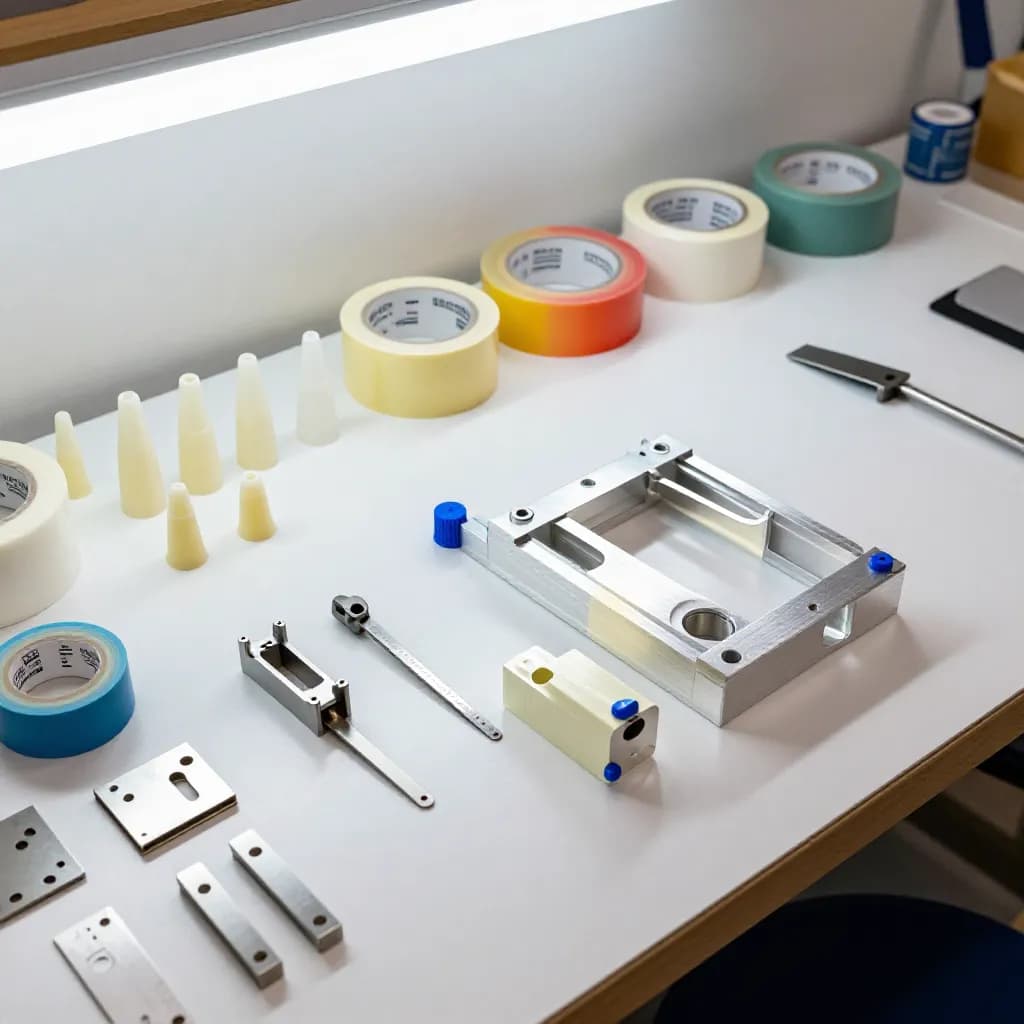
The challenge of masking in powder coating is more demanding than in liquid painting because of the cure temperature. Powder coating cure cycles typically reach 180-220°C for 10-20 minutes, which means all masking materials must withstand these temperatures without degrading, melting, outgassing, or leaving residue on the part surface. Standard painter's tape, plastic plugs, and other masking materials designed for room-temperature liquid painting are completely unsuitable for powder coating — they will melt, burn, or fuse to the part in the oven.
Ready to Start Your Project?
From one-off customs to 15,000-part production runs — get precise pricing in 24 hours.
On This Page
Why Masking Is Essential in Powder Coating
Masking also represents a significant labor cost in many powder coating operations. For complex parts with multiple masking points, the time spent applying and removing masking can exceed the time spent on all other coating operations combined. Efficient masking strategies — including the right choice of masking products, standardized application procedures, and part design that minimizes masking requirements — can dramatically reduce this cost while maintaining coating quality.
Silicone Plugs and Caps: The Workhorse Masking Products
Silicone rubber plugs and caps are the most widely used masking products in powder coating because of their excellent heat resistance (continuous use to 260-315°C), flexibility, reusability, and ease of application and removal. Silicone masking products are available in thousands of standard sizes and shapes to fit common hole diameters, stud sizes, and edge profiles.
Plugs are used to mask holes — they are inserted into the hole and held in place by friction. Standard plug shapes include tapered plugs (which fit a range of hole sizes due to the taper), straight plugs (for precise hole size matching), pull plugs (with a tab for easy removal), and flanged plugs (with a flange that masks the area around the hole as well as the hole itself). Tapered plugs are the most versatile because a single plug size can fit multiple hole diameters, reducing inventory requirements.
Caps are used to mask studs, pins, and protruding features — they slip over the feature and are held by friction. Standard cap shapes include straight caps, tapered caps, and caps with internal ribs that grip the stud. For threaded studs, caps should extend at least 2-3 mm beyond the last thread to ensure complete thread protection.
Silicone masking products are reusable for 50-200 cure cycles depending on the temperature, the powder chemistry, and the care taken during application and removal. Products degrade over time — the silicone becomes less flexible, develops surface cracks, and eventually fails to seal properly. Establishing a replacement schedule based on the number of uses (tracked by visual inspection or cycle counting) prevents masking failures that result in coated areas that should have been protected. Silicone products should be stored clean and dry between uses — powder residue left on the masking surface can transfer to the next part and cause contamination.
High-Temperature Masking Tape: Precision Edge Definition
High-temperature masking tape is used when a precise, straight masking edge is required — typically for two-tone color schemes, decorative stripes, or masking flat surfaces where plugs and caps are not applicable. Powder coating masking tapes must withstand cure temperatures of 200-220°C without shrinking, lifting, leaving adhesive residue, or allowing powder to creep under the tape edge.
The most common tape types for powder coating are polyester (PET) film tapes and polyimide (Kapton) tapes. Polyester tapes are available in thicknesses of 25-75 μm with silicone adhesive, rated for continuous use at 200-220°C. They provide good conformability to curved surfaces and clean removal after curing. Polyimide tapes withstand higher temperatures (up to 260-300°C) and are used for applications requiring extended cure times or higher cure temperatures. Both tape types are available in widths from 3 mm to 50 mm and in die-cut shapes for repetitive masking patterns.
Proper tape application technique is critical for achieving clean masking edges. The tape must be pressed firmly onto a clean, dry surface to ensure full adhesion and prevent powder from creeping under the edge. Air bubbles and wrinkles create channels where powder can penetrate. For curved surfaces, the tape should be applied in short segments with slight overlap rather than attempting to stretch a single piece around the curve, which creates tension that can cause the tape to lift during curing.
Tape removal timing affects the edge quality. Removing tape while the coating is still warm (immediately after the part exits the oven, at 80-120°C) generally produces cleaner edges than removing tape after the coating has fully cooled. The warm coating is slightly more flexible and less likely to chip or fracture at the tape edge. Pulling the tape back at a 180° angle (folding it back on itself) rather than pulling it away at 90° also reduces the risk of edge chipping.
Liquid Masks and Peelable Coatings
Liquid masking compounds are applied by brushing, dipping, or spraying onto areas that need protection, forming a temporary coating that is peeled off after the powder coating cure cycle. They are particularly useful for masking large areas, irregular shapes, and surfaces that are difficult to cover with tape or plugs.
Water-based liquid masks are the most common type for powder coating. They are applied as a liquid that dries to a flexible film in 15-30 minutes at room temperature or 5-10 minutes with forced air drying. The dried film withstands powder coating cure temperatures of 200-220°C and peels off cleanly after curing, leaving no residue on the protected surface. Film thickness of 100-300 μm is typical — thinner films may not peel cleanly, while thicker films waste material and take longer to dry.
Solvent-based liquid masks offer faster drying and better adhesion to oily or contaminated surfaces but have VOC emission concerns and require solvent-resistant application equipment. They are used primarily for specialized applications where water-based products do not perform adequately.
Liquid masks are particularly effective for masking large flat areas (such as the back side of a panel that will be mounted against a wall), complex contoured surfaces that are difficult to tape, and areas with multiple small features (such as a pattern of holes) where individual plugging would be too time-consuming. The main disadvantages are the drying time required before powder application, the labor cost of brush or spray application, and the difficulty of achieving precise edges comparable to tape masking.
For high-volume production, automated liquid mask application using programmable dispensing robots can reduce labor cost and improve consistency. The robot applies a precise bead or pattern of liquid mask to each part based on a programmed path, eliminating the variability of manual application. Drying can be accelerated using IR lamps or warm air blowers positioned after the masking station.
Thread Protection: Maintaining Fastener Engagement
Protecting threaded holes and studs from powder coating is one of the most common and most critical masking requirements. Powder coating that enters a threaded hole or covers a threaded stud can prevent fastener engagement, reduce thread strength, and cause assembly problems. Even a thin layer of cured powder (20-30 μm) on thread flanks can increase the torque required for fastener installation and reduce the effective thread engagement depth.
For threaded holes, the standard masking approach is a silicone tapered plug sized to seal the hole entrance. The plug should extend at least 1-2 mm into the hole to create a positive seal, and the taper should be sufficient to accommodate the tolerance range of the hole diameter. For blind holes (holes that do not go through the part), the plug must seal the entrance without being pushed too deep — a flanged plug that sits against the part surface is preferred.
For through-holes, the plug must seal both ends or be long enough to extend through the entire hole. Alternatively, a silicone cord or rope can be threaded through the hole and pulled tight to seal both openings. For large-diameter through-holes, a combination of a plug on one end and a cap on the other may be necessary.
For threaded studs, silicone caps are the standard solution. The cap should cover the entire threaded length plus 2-3 mm of the unthreaded shank to ensure complete protection. For studs in recessed locations where caps are difficult to apply, wrapping the stud with high-temperature tape provides an alternative, though it is more labor-intensive.
Post-coating thread chasing — running a tap or die through the threads after coating to remove any powder that entered despite masking — is a common practice for critical threaded features. However, this should be a backup measure rather than a primary strategy, as thread chasing removes the protective coating from the thread flanks and can damage the thread form if done carelessly. Proper masking that prevents powder from entering the threads in the first place is always preferable.
Custom Masking Tooling for High-Volume Production
For parts produced in high volume with complex or repetitive masking requirements, custom masking tooling can dramatically reduce masking labor time and improve consistency. Custom tooling is designed to mask multiple features simultaneously with a single application step, replacing the individual application of multiple plugs, caps, and tape pieces.
Custom silicone masks are molded to fit the specific part geometry, covering all areas that require protection in a single piece. The mask is placed over the part, pressed into position, and removed after curing. A well-designed custom mask can reduce masking time from several minutes per part (for individual plugs and tape) to 10-30 seconds per part. The initial tooling cost for a custom silicone mold is typically recovered within a few thousand parts through labor savings.
Metal masking fixtures use machined aluminum or steel plates that clamp over the areas requiring protection. The metal fixture conducts heat away from the masked area, preventing powder from curing on the protected surface even if some powder deposits on the fixture. Metal fixtures are extremely durable (lasting tens of thousands of cycles) and provide precise, repeatable masking edges. They are most commonly used for masking large flat areas, mating surfaces, and features that require tight dimensional tolerances.
Magnetic masks use flexible magnetic sheet material that adheres to ferrous substrates without clips or clamps. The magnetic attraction holds the mask in place during spraying and through the cure oven, and the mask is simply peeled off after curing. Magnetic masks are quick to apply and remove but are limited to flat or gently curved ferrous surfaces and may not seal tightly enough to prevent powder creep at the edges.
The decision to invest in custom tooling depends on the production volume, the complexity of the masking requirement, and the labor cost of manual masking. A break-even analysis comparing the tooling cost against the per-part labor savings determines the minimum production volume that justifies the investment. For parts produced in quantities above 1000-5000 units, custom tooling almost always provides a positive return.
Multi-Color Masking: Two-Tone and Decorative Finishes
Multi-color powder coating — applying two or more colors to different areas of the same part — requires precise masking between the color zones and careful process sequencing to achieve clean color transitions without contamination. The most common multi-color application is two-tone architectural profiles, where the exterior face is one color and the interior face is another.
The standard process for two-color coating is: apply and cure the first color over the entire part; mask the first-color areas that must remain visible; apply the second color over the masked part; and cure the second color. The masking must protect the first color from the second color's overspray while providing a clean, straight transition line between the two colors.
High-temperature masking tape is the primary tool for multi-color masking because it provides the precise edge definition required for a professional-looking color transition. The tape is applied along the color break line after the first color is cured, pressed firmly to ensure adhesion to the cured coating surface. The second color is then applied and cured, and the tape is removed to reveal the clean transition.
Challenges in multi-color masking include: achieving a straight, consistent color break line across long parts (architectural extrusions may be 6-7 meters long); preventing the second color from creeping under the tape edge (which creates a ragged transition); managing the film thickness buildup at the overlap zone (where the second color overlaps the tape edge, creating a step in the coating surface); and ensuring adhesion of the second color to the cured first color (inter-coat adhesion).
For high-volume multi-color production, automated masking systems using robotic tape application can improve consistency and reduce labor. Some operations use a different approach entirely — applying both colors in a single cure cycle using a split booth with two color zones separated by a physical barrier, with the part oriented so that different faces are exposed to different color zones. This eliminates the need for masking tape but requires careful booth design and part orientation control.
Design for Masking: Reducing Masking Requirements Through Part Design
The most effective way to reduce masking cost and complexity is to design parts that minimize the need for masking in the first place. Design for masking (DFM) principles should be considered during the product development phase, when changes to the part geometry are still feasible and inexpensive.
Thread location and orientation can be optimized to simplify masking. Threaded holes on flat, accessible surfaces are easy to mask with standard plugs. Threaded holes in recessed areas, inside channels, or at awkward angles are difficult to access and mask. Relocating threads to accessible surfaces — or using through-holes with nuts instead of blind tapped holes — can significantly reduce masking labor.
Mating surfaces that require metal-to-metal contact can be designed with raised pads or bosses that are easy to mask with flat tape or magnetic masks, rather than large irregular areas that require custom masking. The raised pad also provides a natural edge for the masking boundary, producing a clean transition between coated and uncoated areas.
Color break lines for multi-color parts should be located at natural geometric transitions — edges, grooves, or step changes in the surface — rather than in the middle of a flat surface. A color break at a geometric feature is easier to mask precisely and produces a more visually appealing transition. Designing a shallow groove (0.5-1.0 mm deep) at the intended color break location provides a channel for the masking tape that ensures a straight, consistent line.
Assembly sequence can be optimized to reduce masking. If a component will be assembled after coating, the mating surfaces are naturally masked by the assembly itself — no separate masking is needed. Designing the assembly sequence so that coating occurs before final assembly, with mating surfaces accessible for coating but protected by the subsequent assembly step, eliminates masking for those surfaces entirely.
Communication between the coating engineer and the product designer is essential for implementing DFM principles. A brief design review focused on masking requirements — identifying all areas that need protection, evaluating the difficulty and cost of masking each area, and proposing design modifications that simplify masking — can save significant production cost over the life of the product.
Frequently Asked Questions
What temperature can powder coating masking products withstand?
Silicone plugs and caps withstand 260-315°C continuous use. Polyester masking tape is rated for 200-220°C. Polyimide (Kapton) tape withstands 260-300°C. Water-based liquid masks withstand 200-220°C. All masking products for powder coating must survive the full cure cycle without degrading, melting, or leaving residue.
How many times can silicone masking plugs be reused?
Silicone plugs and caps typically last 50-200 cure cycles depending on temperature, powder chemistry, and handling care. They degrade over time — becoming less flexible and developing surface cracks. Establish a replacement schedule based on visual inspection or cycle counting. Clean plugs between uses to prevent powder residue transfer.
How do you achieve clean color transitions in multi-color powder coating?
Apply and cure the first color, then mask the first-color areas with high-temperature polyester tape pressed firmly along the color break line. Apply and cure the second color, then remove the tape while the part is still warm (80-120°C) by pulling at 180° angle. Locate color breaks at natural geometric transitions for the cleanest results.
When should custom masking tooling be considered?
Custom tooling is justified when production volume exceeds 1000-5000 units and the part has complex or repetitive masking requirements. Custom silicone masks can reduce masking time from several minutes to 10-30 seconds per part. A break-even analysis comparing tooling cost against per-part labor savings determines the minimum volume for positive return.
How do you protect threaded holes during powder coating?
Use silicone tapered plugs sized to seal the hole entrance, extending 1-2 mm into the hole. For blind holes, use flanged plugs that sit against the surface. For through-holes, use plugs on both ends or silicone cord threaded through. Post-coating thread chasing with a tap can remove any powder that bypassed the masking, but proper masking is always preferable.
Ready to Start Your Project?
From one-off customs to 15,000-part production runs — get precise pricing in 24 hours.