Despite the growth of automatic spray systems, manual powder coating remains essential in the finishing industry. Job shops that handle diverse part geometries, low-volume production runs, and custom color work rely heavily on skilled manual operators. Even in highly automated facilities, manual touch-up stations are standard for addressing areas that automatic guns cannot reach — deep recesses, internal corners, weld seams, and complex transitions that create Faraday cage effects.
Technical
Powder Coating Manual Spray Techniques: Operator Training, Gun Handling, and Pattern Control
Sundial Powder Coating·April 23, 2026·13 min
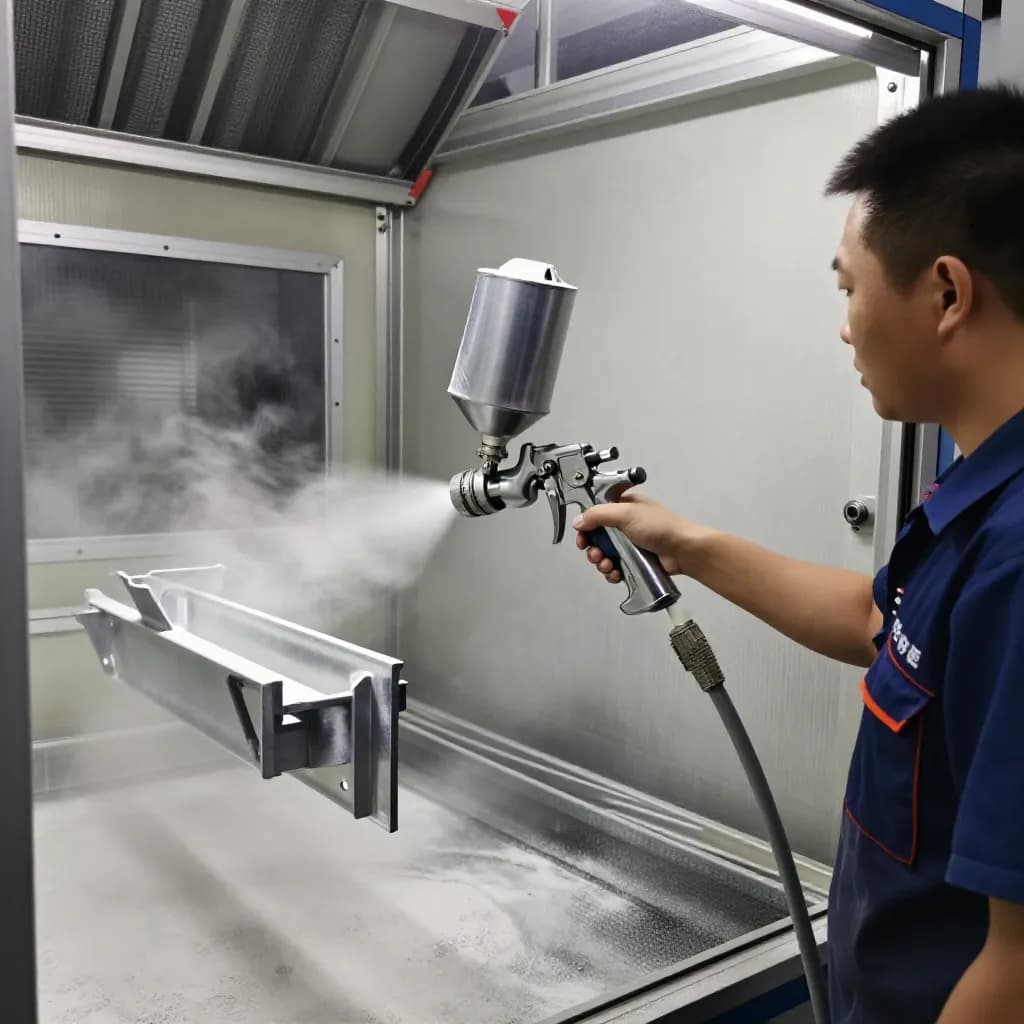
Manual spraying demands a combination of technical knowledge and physical skill that takes months to develop. The operator must simultaneously control gun-to-part distance, gun speed, spray angle, trigger modulation, and overlap pattern while visually assessing powder deposition in real time. Unlike liquid paint, where wet film is clearly visible, powder coating deposits are dry and can be difficult to evaluate visually, especially on light-colored substrates. This makes consistent technique even more critical.
Ready to Start Your Project?
From one-off customs to 15,000-part production runs — get precise pricing in 24 hours.
On This Page
The Enduring Importance of Manual Spray Skills
The quality gap between a trained and untrained manual operator is substantial. A skilled operator can achieve film thickness uniformity within ±10–15 microns across a complex part, while an untrained operator may produce variations of ±30–50 microns or more. This inconsistency leads to powder waste, appearance defects, and potential performance failures where film thickness falls below the minimum specification. Investing in structured operator training programs delivers measurable returns in quality, efficiency, and material savings.
Fundamental Gun Handling Techniques
Proper gun handling begins with maintaining a consistent gun-to-part distance throughout the spray stroke. The optimal distance for most corona-charging guns is 200–300 mm (8–12 inches), measured from the gun tip to the nearest part surface. At this distance, the electrostatic field is strong enough to drive efficient powder deposition while the air velocity from the gun is low enough to avoid blowing deposited powder off the surface. Operators should use their forearm length as a natural reference — holding the gun at a relaxed arm extension typically places the tip at approximately the correct distance.
Gun speed — the rate at which the operator moves the gun across the part surface — directly controls film thickness. Slower gun speed deposits more powder per unit area, building thicker films. Faster gun speed produces thinner films. The target gun speed depends on the powder flow rate setting and the desired film thickness, but a consistent speed of approximately 0.3–0.5 meters per second is typical for standard applications at 150–250 g/min flow rates.
The spray pattern should be applied in parallel, overlapping passes with 50% overlap between adjacent passes. This overlap ensures uniform coverage and prevents striping — alternating thick and thin bands that result from insufficient overlap. Each pass should extend slightly beyond the part edges to avoid heavy film buildup at the start and end of each stroke. The gun should be kept perpendicular to the part surface whenever possible; angling the gun reduces the effective electrostatic field strength and creates an asymmetric spray pattern that is difficult to control consistently.
Coating Complex Geometries and Faraday Cage Areas
Complex part geometries present the greatest challenge for manual operators. Inside corners, deep channels, recessed areas, and narrow gaps create Faraday cage effects where electrostatic field lines concentrate on outer edges and protruding features while bypassing recessed areas. The result is heavy powder buildup on edges and insufficient coverage in recesses — a pattern that no amount of additional spraying with standard settings will correct.
The primary technique for coating Faraday cage areas is to reduce the electrostatic voltage. Lowering the gun voltage from the typical 60–80 kV to 30–50 kV reduces the field strength differential between edges and recesses, allowing powder to penetrate more deeply into confined areas. Some operators use a two-pass approach: first coating recessed areas at low voltage, then switching to higher voltage for the flat and exposed surfaces. Tribo-charging guns, which charge powder by friction rather than corona discharge, are inherently better at penetrating Faraday cage geometries because they do not generate free ions that concentrate on edges.
For deep recesses and internal cavities, operators should direct the gun into the recess at close range (100–150 mm) with reduced air pressure and flow rate. The lower air velocity prevents turbulence inside the cavity that would blow powder back out. Extension nozzles — long, narrow gun tips — allow operators to reach into channels and cavities that the standard gun nozzle cannot access. When coating inside corners, the gun should be aimed directly into the corner rather than sweeping across it, as sweeping tends to deposit powder on the adjacent flat surfaces while leaving the corner itself undercoated.
Touch-Up Techniques and Defect Correction
Touch-up spraying is a specialized skill used to correct coverage deficiencies identified during visual inspection before parts enter the cure oven. Common deficiencies include thin spots in recessed areas, light coverage on edges where powder has been blown off by booth airflow, and bare spots caused by masking or hanging interference. Effective touch-up requires a different approach than initial coating — the goal is to add powder only where needed without overbuilding adjacent areas that already have adequate coverage.
The key to successful touch-up is reducing both powder flow rate and air pressure. A flow rate of 50–100 g/min (compared to 150–250 g/min for initial coating) delivers a lighter, more controllable powder stream that can be precisely directed to the deficient area. Lower atomizing air pressure (1.0–1.5 bar) reduces the spray pattern width and velocity, minimizing overspray onto adjacent surfaces. The gun-to-part distance should be reduced to 100–200 mm for touch-up work, concentrating the powder stream on the target area.
Electrostatic settings for touch-up depend on the situation. If the deficiency is in a recessed area, low voltage (20–40 kV) helps powder penetrate without building up on surrounding edges. If the deficiency is on a flat surface that simply received insufficient coverage, standard voltage settings are appropriate. Operators should avoid the common mistake of increasing voltage to force more powder onto a surface — this often causes back-ionization on areas that already have adequate film thickness, creating orange peel or crater defects. Touch-up should be performed as soon as possible after initial coating, before the electrostatic charge on the deposited powder dissipates, as freshly charged powder provides a more uniform surface for additional deposition.
Operator Training Programs and Skill Development
A structured operator training program is essential for developing consistent manual spray skills. Effective programs combine classroom instruction on powder coating fundamentals with hands-on practice under supervised conditions. The classroom component should cover electrostatic principles, powder characteristics, gun operation and maintenance, film thickness measurement, defect identification and causes, and safety requirements including NFPA 33 booth operation standards.
Hands-on training should progress through a structured sequence. New operators begin by spraying flat test panels to develop consistent gun speed, distance, and overlap technique. Film thickness measurements on these panels provide immediate, objective feedback on technique consistency. Once flat panel technique is consistent (±10 microns across the panel), training progresses to simple three-dimensional parts such as boxes and channels, then to increasingly complex geometries with Faraday cage features.
Skill assessment should be quantitative, based on film thickness measurements at defined locations on standardized test parts. A competent operator should consistently achieve film thickness within ±15 microns of the target across all measurement points, including recessed areas. Assessment should also include powder consumption per part — an efficient operator uses 15–25% less powder than an inefficient one to achieve the same coverage. Ongoing skill maintenance requires periodic refresher training and regular review of film thickness data from production parts. Many facilities post individual operator performance metrics — average film thickness, standard deviation, and powder consumption — to encourage continuous improvement and identify operators who would benefit from additional coaching.
Ergonomics and Operator Fatigue Management
Manual powder coating is physically demanding work that involves repetitive arm motions, sustained grip force on the spray gun, and prolonged standing in a confined booth environment. Without proper ergonomic design, operators develop fatigue that degrades spray technique consistency over the course of a shift, leading to increasing film thickness variation and defect rates as the day progresses.
Gun weight is the most significant ergonomic factor. Modern manual spray guns weigh 300–600 grams, but the effective weight increases when the powder hose and cable are factored in. Hose management systems — overhead reels, articulated arms, or balanced hose supports — reduce the effective weight the operator must support and allow freer gun movement. Gun grip design should accommodate the operator's hand size without requiring excessive grip force to maintain control. Trigger mechanisms should require minimal force (less than 10 Newtons) and allow the operator to modulate flow without sustained finger pressure.
Workstation design should position parts at a height that allows the operator to spray with arms at or below shoulder level. Overhead reaching increases shoulder fatigue dramatically and should be minimized through adjustable part positioning or elevated operator platforms. The booth floor should have anti-fatigue matting, and operators should be rotated between spray stations and other tasks on a 2-hour cycle to prevent cumulative fatigue. Adequate lighting inside the booth — a minimum of 500 lux at the part surface per IESNA recommendations — helps operators assess powder deposition visually and reduces eye strain. Proper respiratory protection with supplied air or powered air-purifying respirators is mandatory per OSHA standards and also reduces operator fatigue compared to negative-pressure respirators.
Quality Control for Manual Spray Operations
Quality control in manual spray operations requires more frequent monitoring than automatic systems because of the inherent variability in human application. A robust quality control program includes in-process film thickness measurement, visual inspection for defects, and periodic adhesion testing to verify that pretreatment and application parameters are producing acceptable results.
Film thickness should be measured on uncured powder using a non-contact gauge or on cured parts using magnetic induction (for steel substrates) or eddy current (for aluminum substrates) gauges per ASTM D7091. Measurement frequency depends on the criticality of the application — automotive and architectural parts may require measurement on every part, while general industrial parts may be sampled at 1-in-10 or 1-in-20 frequency. Measurement locations should be defined on a control plan that identifies critical surfaces, recessed areas, and edges where thickness variation is most likely.
Visual inspection should check for orange peel, runs, sags, craters, fisheyes, bare spots, and contamination before parts enter the cure oven. Defective parts identified at this stage can be blown off with compressed air and recoated, avoiding the cost and difficulty of stripping and recoating cured parts. Adhesion testing per ASTM D3359 (cross-cut tape test) should be performed at the start of each shift and after any process change to verify that the pretreatment and powder are producing adequate adhesion. Results should be documented and trended to identify gradual degradation that might indicate pretreatment bath depletion or substrate contamination issues.
Frequently Asked Questions
What is the correct gun-to-part distance for manual powder coating?
The optimal gun-to-part distance for most corona-charging guns is 200–300 mm (8–12 inches). At this distance, the electrostatic field efficiently drives powder deposition without the air jet blowing deposited powder off the surface. For touch-up work, the distance can be reduced to 100–200 mm.
How do you coat inside corners and recesses manually?
Reduce electrostatic voltage to 30–50 kV to minimize the Faraday cage effect, lower air pressure and flow rate, and aim the gun directly into the recess at close range (100–150 mm). Extension nozzles help reach deep cavities. Tribo-charging guns are inherently better at penetrating recessed geometries.
How long does it take to train a manual powder coating operator?
Basic competency on flat parts typically takes 2–4 weeks of supervised practice. Proficiency on complex three-dimensional parts with Faraday cage features requires 2–3 months of progressive training. Ongoing skill maintenance through periodic refresher training and performance monitoring is essential.
What causes orange peel in manual powder coating?
Orange peel in manual application is typically caused by excessive film thickness (over-application), gun-to-part distance that is too close, or electrostatic voltage that is too high causing back-ionization. Reducing flow rate, maintaining proper distance, and lowering voltage usually resolve the issue.
How often should film thickness be checked during manual spraying?
Measurement frequency depends on application criticality. Automotive and architectural parts may require every-part measurement. General industrial parts are typically sampled at 1-in-10 or 1-in-20 frequency. Measurements should cover critical surfaces, recesses, and edges per a documented control plan.
Ready to Start Your Project?
From one-off customs to 15,000-part production runs — get precise pricing in 24 hours.