Designing a powder coating line begins with defining the production requirements and working backward to determine the equipment specifications. The key inputs are: the range of parts to be coated (sizes, weights, substrates, and geometries); the required throughput (parts per hour, square meters per hour, or linear meters per hour); the coating specification (pretreatment type, powder chemistry, film thickness, cure schedule); the number of colors and frequency of color changes; and the available floor space, ceiling height, and utility connections.
Technical
Powder Coating Line Design and Layout: Conveyor, Booth, Oven Sizing, and Lean Layout Principles
Sundial Powder Coating·April 22, 2026·14 min
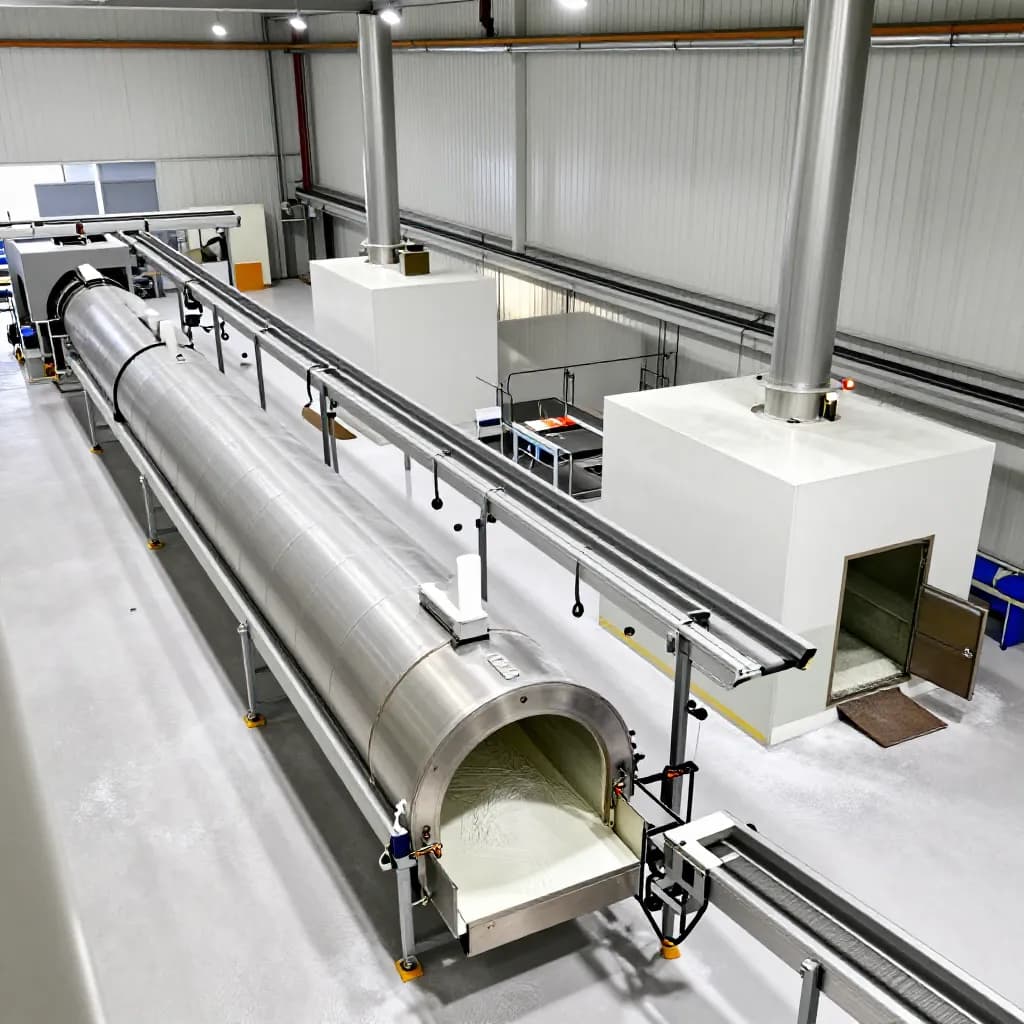
The design process follows a logical sequence: first, determine the conveyor type and line speed based on throughput requirements; second, size the pretreatment system based on the required chemical contact times and the line speed; third, design the spray booth based on the part size, number of guns, and color change requirements; fourth, size the cure oven based on the required residence time and line speed; and finally, lay out the complete line within the available space, optimizing material flow and operator access.
Ready to Start Your Project?
From one-off customs to 15,000-part production runs — get precise pricing in 24 hours.
On This Page
Line Design Principles: From Throughput Requirements to Equipment Specification
Each equipment element must be sized to match the others — a bottleneck at any point limits the throughput of the entire line. The oven is typically the pacing element because it requires the longest residence time, and its length directly determines the maximum line speed. The pretreatment system must provide adequate chemical contact time at the line speed determined by the oven. The spray booth must accommodate the required number of guns and provide adequate air flow for powder containment at the production rate. Balancing these elements to achieve the target throughput without oversizing (wasting capital) or undersizing (limiting capacity) is the core challenge of line design.
Conveyor Systems: Types, Selection, and Speed Calculation
The conveyor system is the backbone of a continuous powder coating line, transporting parts through every process stage from loading to unloading. The conveyor type, speed, and configuration determine the line's throughput capacity, flexibility, and operating efficiency.
Overhead monorail conveyors are the simplest and most common type for powder coating. Parts hang from hooks or fixtures attached to a single I-beam rail, driven by a continuous chain. Monorail systems are economical, reliable, and suitable for lines with a single processing sequence where all parts follow the same path at the same speed. Typical chain speeds range from 1-6 m/min, with load capacities of 50-500 kg per meter of chain depending on the rail and chain size.
Power-and-free conveyors use a two-rail system — a powered chain on the upper rail and free (unpowered) trolleys on the lower rail that carry the parts. The trolleys can be engaged with or disengaged from the powered chain at specific points, allowing parts to be accumulated (stored on a siding while the main line continues), diverted to different process paths, and varied in spacing. Power-and-free systems are more expensive than monorail but provide the flexibility needed for complex operations with multiple pretreatment sequences, multiple spray booths, or variable cure schedules.
Line speed calculation starts with the oven: Line Speed (m/min) = Oven Heated Length (m) / Required Oven Residence Time (min). For example, a 15-meter oven with a 25-minute residence time yields a line speed of 0.6 m/min. The throughput in parts per hour is then: Parts/Hour = (Line Speed × 60) / Part Spacing. If parts are spaced at 0.5 m intervals on the conveyor, the throughput is (0.6 × 60) / 0.5 = 72 parts per hour. Part spacing depends on the part width plus clearance for spraying — typically the part width plus 100-200 mm on each side.
The conveyor must also be designed for the loading and unloading zones, which require adequate space and time for operators to hang and remove parts safely. Loading zone length should provide at least 30-60 seconds per part at the line speed for manual loading, or be sized for the cycle time of automatic loading equipment.
Spray Booth Design: Containment, Air Flow, and Color Change
The spray booth is the enclosure where powder is applied to the parts. Its design must achieve three objectives: contain the powder overspray within the booth to prevent contamination of the surrounding environment; provide adequate air flow to transport overspray to the reclaim system; and enable efficient color changes with minimal downtime and cross-contamination risk.
Booth dimensions are determined by the maximum part size plus clearance for gun movement and air flow. The booth width should be the maximum part width plus 600-1000 mm on each side for gun positioning and air flow. The booth height should be the maximum part height plus 300-500 mm above and below for gun reciprocation overshoot. The booth length depends on the number of gun stations and the line speed — longer booths provide more spray time per part, enabling higher film thickness or faster line speeds.
Air flow design is critical for powder containment and reclaim efficiency. The booth operates under slight negative pressure (typically 10-50 Pa below ambient) to prevent powder from escaping through the conveyor openings. Air is drawn through the booth by the reclaim system's exhaust fan, entering through the conveyor openings and exiting through the reclaim ductwork. The air velocity through the booth should be 0.3-0.6 m/s — fast enough to capture overspray and transport it to the reclaim system, but not so fast that it disrupts the electrostatic deposition pattern or strips powder from the parts.
Booth construction materials affect color change speed and contamination risk. Smooth, non-porous surfaces — stainless steel, polypropylene, or conductive polyethylene — are preferred because they resist powder adhesion and are easy to clean. Conductive materials prevent electrostatic charge buildup on the booth walls that can attract and hold powder. Booth interior features should be minimized — no ledges, brackets, or horizontal surfaces where powder can accumulate. Lighting fixtures should be flush-mounted and sealed to prevent powder ingress.
For operations with frequent color changes, quick-color-change booth designs incorporate features such as: smooth conductive interior surfaces, automated air-blow cleaning systems, quick-disconnect gun and hose connections, and dedicated color hopper modules that can be swapped in seconds. These features can reduce color change time from 30-60 minutes to 5-15 minutes, dramatically improving productivity for multi-color operations.
Oven Sizing and Integration with the Line
The cure oven is typically the longest and most energy-intensive element of the coating line, and its design directly determines the maximum line speed and throughput. Oven sizing requires balancing the heated zone length, the required residence time, and the target line speed.
The heated zone length is calculated as: Length = Line Speed × Required Residence Time. The required residence time includes both the ramp-up time (for the heaviest part to reach cure temperature) and the dwell time (at cure temperature per the powder data sheet). For a typical application with 15-minute ramp-up and 10-minute dwell, the total residence time is 25 minutes. At a line speed of 0.6 m/min, the heated zone must be 15 meters long.
Oven cross-section dimensions must accommodate the maximum part size plus clearance for air circulation and conveyor hardware. The internal width should be the maximum part width plus 300-500 mm on each side. The internal height should be the maximum part height (including the hook and conveyor) plus 300-500 mm above and below. Oversizing the cross-section wastes energy by heating unnecessary air volume; undersizing restricts air flow and creates temperature uniformity problems.
Oven entrance and exit transitions must prevent heat loss while allowing the conveyor and parts to pass through. Common designs include vestibule sections (enclosed transition zones 2-4 meters long), air curtains, and labyrinth openings. The transition design must also prevent the uncured powder from being disturbed by air currents at the oven entrance — a gel zone (IR or low-temperature convection) at the entrance can melt and stabilize the powder before it encounters the main oven air flow.
For lines with multiple cure schedules (different powders requiring different temperatures or times), the oven may be designed with independently controlled zones that can be set to different temperatures. Alternatively, a power-and-free conveyor can vary the speed of individual carriers through the oven, providing different residence times for different parts. These features add complexity and cost but provide the flexibility needed for operations that coat a wide range of products.
Pretreatment System Integration
The pretreatment system must be integrated with the coating line conveyor and sized to provide adequate chemical contact time at the line speed. For spray pretreatment systems (the most common type for conveyor lines), the contact time in each stage is determined by the stage length and the line speed: Contact Time = Stage Length / Line Speed.
A typical multi-stage spray pretreatment system for steel substrates includes: alkaline cleaner (60-120 seconds contact time), rinse (30-60 seconds), conversion coating (60-120 seconds), rinse (30-60 seconds), and DI rinse (30-60 seconds). At a line speed of 0.6 m/min, a 90-second contact time requires a stage length of 0.9 meters. The total pretreatment tunnel length for a 5-stage system is approximately 4-6 meters, plus transition zones between stages.
Immersion pretreatment systems — where parts are dipped into tanks rather than sprayed — provide longer contact times and better coverage of complex geometries but require the conveyor to descend into and rise out of each tank. This is typically achieved with a power-and-free conveyor that lowers the carrier into the tank, holds it for the required immersion time, and raises it out. Immersion systems are more common for zinc phosphate pretreatment (which requires longer contact times of 90-180 seconds) and for parts with complex internal geometries that spray systems cannot reach.
The dry-off oven between pretreatment and the spray booth must remove all moisture from the parts before powder application. Its length and temperature are determined by the line speed and the part geometry — parts with water-trapping features (channels, joints, blind holes) require longer drying times. A typical dry-off oven operates at 110-150°C with a residence time of 5-15 minutes. Blow-off stations using compressed air or air knives before the dry-off oven accelerate drying by removing bulk water from the part surfaces.
Wastewater from the pretreatment system must be collected and treated before discharge. The wastewater treatment system should be located adjacent to the pretreatment tunnel for efficient piping, with capacity to handle the maximum wastewater flow rate plus a safety margin for bath dumps and cleaning operations.
Lean Layout Principles for Powder Coating Lines
Lean manufacturing principles applied to powder coating line layout focus on minimizing waste — wasted motion, wasted time, wasted material, and wasted space — while maximizing throughput and quality. The goal is a smooth, continuous flow of parts through the process with minimal interruptions, handling, and non-value-added activities.
Single-piece flow is the ideal lean configuration, where each part moves continuously through the process without batching or queuing. A well-designed conveyor line naturally supports single-piece flow because parts move at a constant speed through each process stage. However, batch operations (such as batch ovens or manual masking stations) interrupt the flow and create work-in-process inventory. Minimizing batch operations and integrating all process steps into the continuous conveyor flow is a key lean objective.
Operator workstation design should follow ergonomic principles and minimize unnecessary motion. Loading and unloading stations should be at comfortable working height (900-1200 mm for standing operators), with parts, hooks, and fixtures within easy reach. Masking stations should have all masking materials organized and accessible without walking or searching. Inspection stations should have adequate lighting, instruments within reach, and a clear work surface for documentation.
Material flow should follow a logical sequence without backtracking or cross-traffic. The ideal layout is a U-shape or straight line where raw parts enter at one end and finished parts exit at the other, with all process stages arranged in sequence along the conveyor path. Support functions — powder storage, masking material storage, quality lab, maintenance workshop — should be located adjacent to the process stages they serve.
Visual management tools support lean operations by making the process status visible to everyone. Andon boards display real-time production data (parts coated, defect rate, line speed, oven temperature). Color-coded floor markings define work zones, material storage areas, and traffic paths. Standard work instructions posted at each workstation ensure consistent procedures. These visual tools enable operators and supervisors to identify problems quickly and take corrective action before they affect production quality or throughput.
Capacity Planning and Future Expansion
A well-designed powder coating line should accommodate not only current production requirements but also anticipated future growth. Building in expansion capability during the initial design is far less expensive than retrofitting an existing line to increase capacity.
Capacity planning begins with a realistic assessment of current and projected throughput requirements, including seasonal variations, new product introductions, and market growth projections. The line should be designed for the peak expected throughput within a 3-5 year planning horizon, with provisions for further expansion beyond that horizon.
Conveyor systems should be specified with motor and drive capacity to handle higher line speeds than the initial operating speed. If the initial line speed is 0.6 m/min, specifying the drive for 1.0 m/min provides 67% growth capacity without conveyor modifications. The conveyor rail and chain should be rated for the maximum anticipated load, including heavier parts that may be added to the product mix in the future.
Oven expansion is the most difficult and expensive retrofit, so the initial oven design should include provisions for future lengthening. This can be achieved by locating the oven with open space at one or both ends, using modular oven construction that allows additional sections to be added, and sizing the heating and air circulation systems for the expanded oven length. Alternatively, the initial oven can be designed longer than currently needed and operated at a lower line speed, with the speed increased as production volume grows.
Spray booth expansion options include: adding gun stations within the existing booth (if the booth length allows), adding a second booth in series for two-coat applications or increased capacity, or replacing the existing booth with a larger one. Floor space adjacent to the booth should be reserved for these expansion options.
Utility infrastructure — gas supply, electrical power, compressed air, water supply, and wastewater treatment — should be sized for the expanded capacity from the initial installation. Upgrading utility infrastructure after the line is built is disruptive and expensive. Specifying utility connections, piping, and electrical panels for the maximum anticipated capacity ensures that future expansion can proceed without utility constraints.
Common Line Design Mistakes and How to Avoid Them
Experience across hundreds of powder coating line installations has identified several common design mistakes that cause persistent operational problems. Avoiding these mistakes during the design phase saves significant cost and frustration during operation.
Undersized ovens are the most common mistake. Designers often calculate oven length based on the powder's published cure schedule without adequately accounting for the ramp-up time of the heaviest parts in the product mix. A 6 mm steel fabrication requires 15-20 minutes to reach cure temperature in a convection oven — this ramp-up time must be added to the published dwell time to determine the total required residence time. Always base oven sizing on the worst-case (heaviest, most thermally massive) part, not the average part.
Inadequate pretreatment staging is another frequent error. Shortening the pretreatment tunnel to save space or cost results in insufficient chemical contact times that compromise coating adhesion and corrosion resistance. The pretreatment system should be sized for the required contact times at the maximum line speed, not the initial operating speed.
Poor conveyor routing creates operational problems that are difficult to fix after installation. Sharp turns, steep inclines, and tight clearances cause parts to swing, collide, or contact the booth walls. The conveyor path should use gentle curves (minimum radius 1.5-2.0 meters), gradual inclines (maximum 30° for overhead conveyors), and adequate clearance at all points. A full-scale mockup of the conveyor path using the largest parts in the product mix can identify clearance problems before the conveyor is installed.
Insufficient space for loading, unloading, and masking stations forces operators to work in cramped conditions, reducing productivity and increasing the risk of handling damage. These stations should provide at least 3-4 meters of conveyor length per operator position, with adequate floor space for material staging and movement.
Neglecting maintenance access makes routine maintenance difficult and time-consuming, leading to deferred maintenance that degrades equipment performance. All equipment should be accessible for inspection, cleaning, and component replacement without disassembling adjacent equipment or stopping the production line. Maintenance access doors, platforms, and walkways should be included in the initial design.
Frequently Asked Questions
How do you calculate the required line speed for a powder coating line?
Line Speed = Oven Heated Length / Required Oven Residence Time. The residence time includes both ramp-up time (for the heaviest part to reach cure temperature) and dwell time (at cure temperature). For example, a 15-meter oven with 25-minute total residence time yields 0.6 m/min. Throughput in parts/hour = (Line Speed × 60) / Part Spacing.
What conveyor type is best for powder coating?
Overhead monorail is the simplest and most common, suitable for single-sequence lines. Power-and-free conveyors provide flexibility for complex operations with multiple process paths, variable spacing, and accumulation capability. Floor conveyors are used for heavy or awkward parts. The choice depends on production complexity, part variety, and budget.
How long should a powder coating spray booth be?
Booth length depends on the number of gun stations and line speed. Each gun station (one reciprocator with 6-12 guns) requires approximately 1.5-2.5 meters of booth length. A typical automatic line has 2-4 gun stations per side, requiring 6-12 meters of booth length. Manual touch-up stations add another 2-3 meters. Longer booths provide more spray time per part.
What is the most common line design mistake?
Undersized ovens are the most common mistake. Designers often calculate oven length based on the powder's published cure schedule without accounting for the ramp-up time of heavy parts. A 6 mm steel part may need 15-20 minutes just to reach cure temperature. Always size the oven for the worst-case (heaviest) part in the product mix.
How do you plan for future capacity expansion?
Specify conveyor drives for higher speeds than initial operation, reserve floor space adjacent to the oven and booth for expansion, use modular oven construction, and size utility infrastructure (gas, electrical, water, compressed air) for maximum anticipated capacity. Building in expansion capability during initial design is far less expensive than retrofitting later.
Ready to Start Your Project?
From one-off customs to 15,000-part production runs — get precise pricing in 24 hours.