Lean manufacturing is a systematic approach to identifying and eliminating waste in production processes while maximizing value delivered to the customer. Originally developed in the Toyota Production System, lean principles are directly applicable to powder coating operations, where waste in the form of excess powder consumption, unnecessary motion, waiting time, overprocessing, defects, and underutilized capacity represents significant opportunity for improvement.
Technical
Powder Coating Lean Manufacturing: 5S, Value Stream Mapping, Waste Reduction, and Changeover Optimization
Sundial Powder Coating·April 23, 2026·14 min
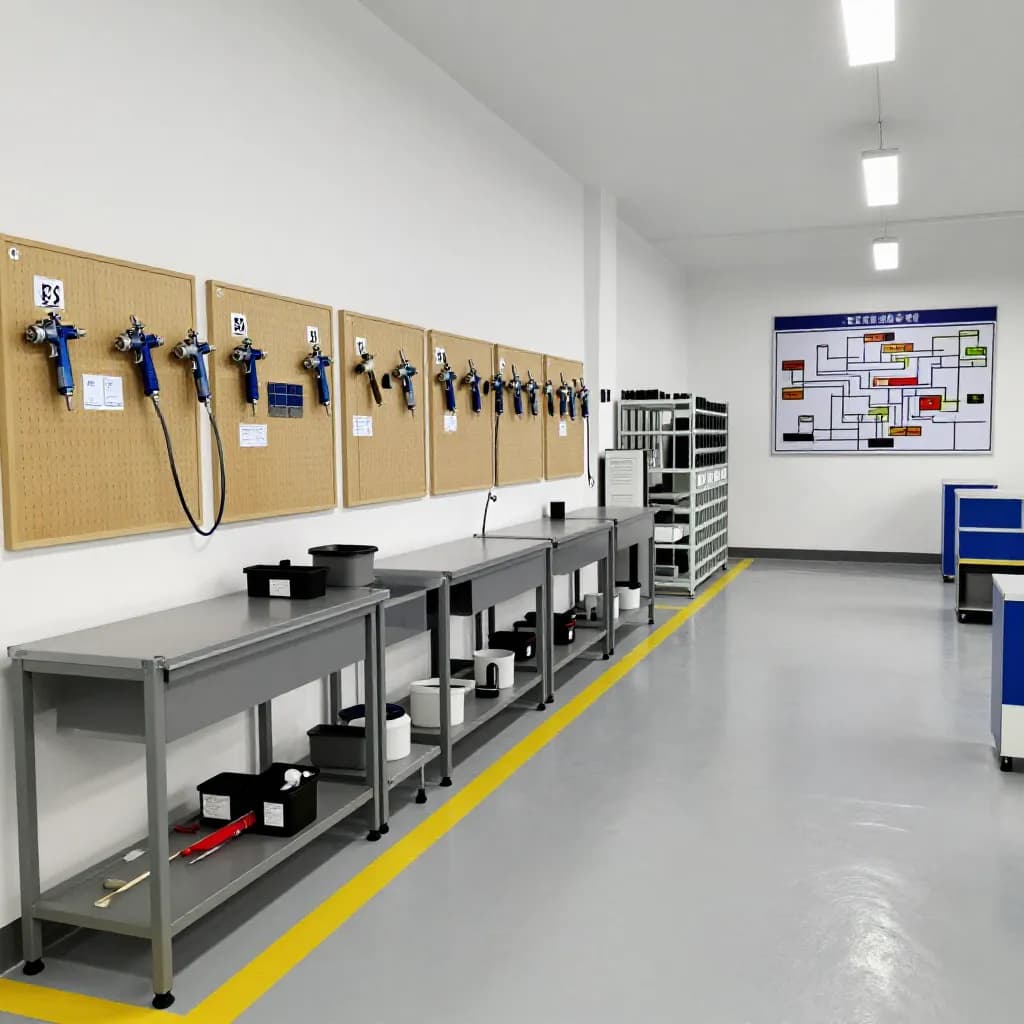
The core lean principle is the distinction between value-adding activities (those that transform the product in ways the customer is willing to pay for) and non-value-adding activities (waste). In a powder coating operation, value-adding activities include pretreatment, powder application, and curing — the steps that actually transform a bare metal part into a coated product. Non-value-adding activities include waiting for parts, searching for tools, walking between stations, reworking defective parts, changing colors, and cleaning equipment. While some non-value-adding activities are necessary (color changes, equipment maintenance), many can be reduced or eliminated through systematic lean improvement.
Ready to Start Your Project?
From one-off customs to 15,000-part production runs — get precise pricing in 24 hours.
On This Page
Lean Manufacturing Principles Applied to Powder Coating
Applying lean to powder coating requires understanding the specific waste categories that affect finishing operations and implementing targeted improvement tools for each. The eight wastes of lean — transportation, inventory, motion, waiting, overproduction, overprocessing, defects, and underutilized talent — all manifest in powder coating operations in specific, identifiable ways that can be measured, analyzed, and reduced.
5S: Foundation for Workplace Organization
5S is the foundational lean tool for workplace organization, creating a clean, orderly, and standardized work environment that supports efficient, high-quality production. The five S's — Sort, Set in Order, Shine, Standardize, and Sustain — provide a structured methodology for transforming a disorganized workspace into a model of efficiency.
Sort (Seiri) involves removing all unnecessary items from the work area. In a powder coating operation, this means removing unused spray guns, obsolete fixtures, expired chemicals, broken tools, and accumulated scrap from the booth area, pretreatment zone, and oven surroundings. Red-tagging — placing a red tag on questionable items and moving them to a holding area for disposition — is the standard Sort technique. Items not claimed or justified within 30 days are discarded, donated, or relocated.
Set in Order (Seiton) assigns a specific location for every remaining item based on frequency of use and ergonomic accessibility. Spray guns, nozzles, and gun maintenance tools should be stored at the booth within arm's reach. Thickness gauges and inspection tools should be at the inspection station. Pretreatment test kits should be at the pretreatment control panel. Shadow boards — tool storage panels with painted outlines showing where each tool belongs — provide visual confirmation that all tools are present and in their correct location.
Shine (Seiso) establishes cleaning routines that maintain the organized workspace and serve as inspection opportunities. Daily cleaning of the spray booth interior, weekly cleaning of the pretreatment area, and monthly deep cleaning of the oven and conveyor system prevent contamination-related defects and allow operators to identify equipment problems (leaks, wear, loose connections) during the cleaning process. Standardize (Seiketsu) documents the Sort, Set in Order, and Shine practices as standard procedures with assigned responsibilities and schedules. Sustain (Shitsuke) maintains the 5S discipline through regular audits, visual management, and leadership commitment.
Value Stream Mapping for Powder Coating Lines
Value stream mapping (VSM) is a lean analysis tool that documents the complete flow of material and information through the powder coating process, from raw part receipt to finished part shipment. The value stream map provides a visual representation of every process step, queue, and information flow, enabling the team to identify waste, bottlenecks, and improvement opportunities that are not visible when looking at individual process steps in isolation.
Creating a current-state value stream map for a powder coating operation involves walking the process from end to end and recording key data at each step: cycle time (the time to process one part or batch), changeover time (the time to switch between products or colors), uptime (the percentage of scheduled time the equipment is actually running), work-in-process inventory (the number of parts waiting between steps), and the number of operators at each station. The map also documents information flows — how production schedules, color sequences, and quality data move between process steps and management systems.
The current-state map typically reveals that value-adding time (the time parts are actually being cleaned, coated, and cured) represents only 5–15% of the total lead time from receipt to shipment. The remaining 85–95% is non-value-adding time spent in queues, waiting for color changes, waiting for oven space, being transported between stations, or being reworked. This ratio — the process cycle efficiency — is the primary metric that VSM seeks to improve.
The future-state value stream map defines the target process with waste eliminated or reduced. Common future-state improvements for powder coating include: reducing batch sizes to enable more frequent color changes with less WIP inventory, implementing pull systems where downstream processes signal upstream processes to produce, leveling the production schedule to reduce peak-to-valley demand variation, and co-locating process steps to eliminate transportation waste.
Waste Identification and Reduction in Powder Coating
Each of the eight lean wastes manifests in specific ways in powder coating operations, and targeted reduction strategies exist for each.
Transportation waste includes moving parts between buildings or distant process areas, transporting powder from storage to the booth, and moving finished parts to inspection and packaging. Reduction strategies include co-locating pretreatment, coating, and curing in a continuous flow line, positioning powder storage adjacent to the booth, and integrating inspection into the coating line rather than at a separate station.
Inventory waste includes excess raw parts waiting for coating, work-in-process parts between process stages, and finished coated parts waiting for shipment. Excess inventory ties up capital, occupies floor space, and increases the risk of damage and obsolescence. Reducing batch sizes, implementing kanban pull systems, and leveling the production schedule reduce inventory throughout the value stream.
Motion waste includes operators walking to retrieve tools, reaching for spray guns, bending to access powder hoppers, and searching for information. 5S workplace organization, ergonomic workstation design, and point-of-use storage eliminate unnecessary motion.
Waiting waste — the largest waste category in many powder coating operations — includes parts waiting for oven space, operators waiting for color changes, and equipment waiting for parts. Reducing changeover time (SMED), balancing line capacity to eliminate bottlenecks, and scheduling production to maximize equipment utilization reduce waiting waste.
Defect waste includes scrapped parts, reworked parts, and the inspection effort required to detect defects. Root cause analysis, SPC implementation, preventive maintenance, and operator training reduce defect rates. Overprocessing waste includes applying thicker coating than specified, performing unnecessary inspection steps, and running pretreatment baths at higher concentrations than needed. Standardized work procedures and process optimization eliminate overprocessing.
SMED: Single-Minute Exchange of Die for Color Changes
Color changeover is one of the largest sources of non-productive time in powder coating operations. SMED (Single-Minute Exchange of Die) is a lean methodology for systematically reducing changeover time by converting internal setup activities (those that can only be performed while the equipment is stopped) to external setup activities (those that can be performed while the equipment is running).
Applying SMED to powder coating color changes begins with documenting the current changeover process in detail — every step, its duration, and whether it requires the line to be stopped. A typical color change involves: stopping the spray system, purging powder from guns and hoses, cleaning the booth interior, cleaning or replacing the reclaim system, loading the new powder color, adjusting gun parameters for the new color, spraying test parts, and verifying film thickness and color. Total changeover time may range from 10 to 60 minutes depending on the system design and the degree of cleaning required.
SMED analysis typically reveals that many changeover activities can be performed externally — while the previous color is still running. Preparing the next color (staging the powder, pre-programming the gun recipe, preparing test panels) can be done before the changeover begins. Pre-cleaning accessible booth surfaces during the last few parts of the current color reduces the cleaning time after shutdown. Having a second set of gun hoses pre-loaded with the next color eliminates the purge-and-reload step entirely.
Internal activities that cannot be converted to external should be streamlined. Quick-disconnect fittings on powder hoses replace threaded connections. Automated booth blow-down systems replace manual cleaning. Pre-programmed recipes eliminate manual gun parameter adjustment. Dense phase pumps that purge in 5–15 seconds replace venturi pumps that require 30–60 seconds. Through systematic SMED application, color changeover times of 30–60 minutes can typically be reduced to 5–15 minutes — a 70–85% reduction that directly increases productive capacity.
Total Productive Maintenance for Coating Equipment
Total Productive Maintenance (TPM) is a lean approach to equipment maintenance that aims to maximize equipment effectiveness by eliminating the six big losses: breakdowns, setup and adjustment time, idling and minor stoppages, reduced speed, process defects, and reduced yield during startup. In powder coating operations, equipment reliability directly determines production capacity and coating quality.
Overall Equipment Effectiveness (OEE) is the TPM metric that quantifies equipment performance. OEE = Availability × Performance × Quality, where Availability is the percentage of scheduled time the equipment is running (reduced by breakdowns and changeovers), Performance is the actual production rate as a percentage of the maximum rate (reduced by minor stoppages and speed losses), and Quality is the percentage of good parts produced (reduced by defects and startup waste). World-class OEE is 85% or higher; many powder coating operations achieve only 50–65% before TPM implementation.
Autonomous maintenance — the TPM practice of training operators to perform basic equipment care — is particularly effective in powder coating. Operators who clean, inspect, and lubricate their equipment daily detect developing problems (worn gun tips, clogged nozzles, loose hose connections, conveyor chain wear) before they cause breakdowns or quality defects. A structured autonomous maintenance program defines the daily, weekly, and monthly tasks for each piece of equipment, provides training and visual aids for operators, and tracks completion through checklists and audits.
Planned maintenance schedules for critical powder coating equipment — spray guns, pumps, booth filters, oven burners, conveyor chain, and pretreatment systems — should be based on manufacturer recommendations, equipment condition monitoring data, and historical failure patterns. Predictive maintenance technologies such as vibration analysis (for conveyor drives and fans), infrared thermography (for electrical connections and oven insulation), and oil analysis (for compressors and gearboxes) enable condition-based maintenance that replaces components based on actual wear rather than fixed time intervals.
Continuous Improvement Culture and Kaizen Events
Lean manufacturing is not a one-time project but a continuous improvement culture that engages every employee in identifying and eliminating waste. Kaizen — the Japanese term for continuous improvement — is implemented through both daily incremental improvements (suggestion systems, small team problem-solving) and focused kaizen events (intensive 3–5 day improvement workshops targeting specific processes or problems).
Kaizen events for powder coating operations typically focus on a specific waste or bottleneck identified through value stream mapping or performance data analysis. Common kaizen event topics include: reducing color changeover time (SMED kaizen), improving first-pass yield (defect reduction kaizen), reducing powder consumption per part (material waste kaizen), improving pretreatment bath life (chemical optimization kaizen), and reducing energy consumption (energy kaizen). Each event follows a structured methodology: define the problem and improvement target, analyze the current state with data, develop and test countermeasures, implement the validated improvements, and establish standard work to sustain the gains.
Visual management supports the continuous improvement culture by making process performance visible to everyone on the production floor. Production status boards display real-time data on output rate, quality metrics, changeover count, and equipment status. Andon systems — visual and audible signals — alert supervisors when a process problem occurs, enabling rapid response. Trend charts showing key performance indicators (KPIs) over time — first-pass yield, OEE, powder consumption per square meter, energy per part — make improvement progress visible and motivate continued effort.
Sustaining lean improvements requires leadership commitment, regular gemba walks (management visits to the production floor to observe processes and engage with operators), and a structured problem-solving methodology (A3 thinking, PDCA cycle, or 8D) that ensures root causes are identified and permanent corrective actions are implemented rather than temporary fixes. The most successful lean powder coating operations treat every defect, every delay, and every waste as an improvement opportunity rather than an acceptable cost of doing business.
Frequently Asked Questions
What are the biggest wastes in powder coating operations?
The largest wastes are typically waiting (parts waiting for oven space, operators waiting for color changes), defects (rework and scrap from coating failures), and overprocessing (applying more coating than specified). Color changeover time is often the single largest source of non-productive time in multi-color operations.
How does 5S apply to a powder coating shop?
5S organizes the workspace: Sort removes unused items, Set in Order assigns locations for tools and materials, Shine establishes cleaning routines that prevent contamination defects, Standardize documents the practices, and Sustain maintains discipline through audits. Shadow boards for spray guns and inspection tools are common 5S implementations.
What is a good OEE target for powder coating equipment?
World-class OEE is 85% or higher. Many powder coating operations achieve only 50–65% before lean implementation. OEE combines availability (uptime), performance (actual vs. maximum speed), and quality (good parts percentage). Improving any of these three factors increases OEE.
How much can SMED reduce color changeover time?
SMED typically reduces color changeover time by 70–85%. A changeover that takes 30–60 minutes can often be reduced to 5–15 minutes through converting internal activities to external, streamlining remaining internal activities, and implementing quick-change equipment such as dense phase pumps and automated booth cleaning.
What is value stream mapping and why use it?
Value stream mapping documents the complete flow of material and information through the coating process, revealing that value-adding time is typically only 5–15% of total lead time. The map identifies queues, bottlenecks, and waste that are not visible when looking at individual process steps, enabling targeted improvement efforts.
How do you sustain lean improvements in powder coating?
Sustaining improvements requires standard work documentation, visual management (production boards, trend charts), regular audits, leadership gemba walks, and a structured problem-solving methodology for addressing new issues. Every defect and delay should be treated as an improvement opportunity rather than an acceptable cost.
Ready to Start Your Project?
From one-off customs to 15,000-part production runs — get precise pricing in 24 hours.