Infrared (IR) curing represents a fundamentally different approach to powder coating cure compared to conventional convection ovens. While convection ovens heat parts by circulating hot air around them — a slow process limited by the thermal conductivity of air — infrared emitters transfer energy directly to the coating surface through electromagnetic radiation. This direct energy transfer can heat the powder coating to its gel and cure temperatures much faster than convection, reducing cure times from 15–20 minutes to as little as 30–90 seconds for thin-walled parts.
Technical
Powder Coating Infrared Curing Technology: Gas IR, Electric IR, and Energy-Efficient Cure Systems
Sundial Powder Coating·April 23, 2026·14 min
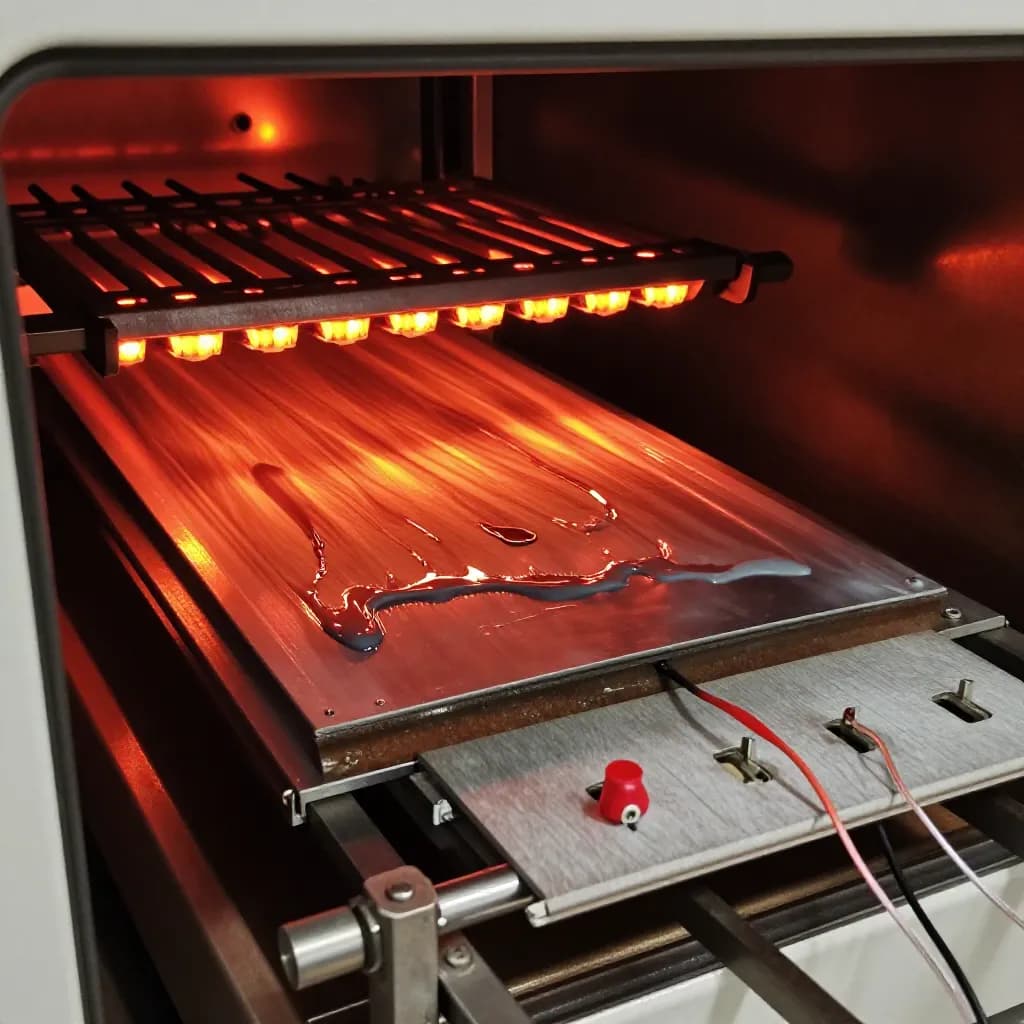
The speed advantage of IR curing translates directly into shorter oven lengths, smaller facility footprints, and reduced energy consumption. A convection oven that requires 60 feet of conveyor length for a 20-minute cure at 10 FPM line speed can potentially be replaced by an IR oven of 10–15 feet, freeing valuable floor space for other operations. Energy savings of 30–50% compared to convection are commonly reported, driven by the elimination of large volumes of heated air and the reduced thermal mass of the oven structure.
Ready to Start Your Project?
From one-off customs to 15,000-part production runs — get precise pricing in 24 hours.
On This Page
Infrared Curing: An Alternative to Convection Ovens
However, IR curing is not a universal replacement for convection. Its effectiveness depends on part geometry, substrate thickness, and coating chemistry. IR energy heats surfaces directly but does not penetrate into recesses or around corners the way hot air does. This makes IR curing ideal for flat or simple-geometry parts but challenging for complex three-dimensional parts with shadowed areas. Understanding the physics of infrared energy transfer and the characteristics of different IR wavelengths is essential for successful implementation.
Infrared Wavelength Ranges: Near, Medium, and Far
Infrared radiation spans a broad wavelength range from 0.7 to 1,000 microns, but powder coating curing uses three specific bands: near-infrared (NIR, 0.7–2.0 microns), medium-wave infrared (MWIR, 2.0–4.0 microns), and far-infrared (FIR, 4.0–10 microns). Each wavelength band interacts differently with powder coatings and substrates, and the choice of wavelength significantly affects cure performance.
Near-infrared radiation has the shortest wavelength and highest energy per photon. NIR penetrates through the powder coating layer and is absorbed primarily by the metal substrate beneath. The substrate heats rapidly and conducts heat back into the coating from below, curing the powder from the inside out. This inside-out cure produces excellent adhesion because the coating-substrate interface reaches cure temperature first. NIR emitters operate at filament temperatures of 2,000–2,400°C and respond almost instantly to power changes, enabling precise zone control. However, NIR is highly reflective on light-colored and metallic surfaces, reducing absorption efficiency on these substrates.
Medium-wave infrared is absorbed more strongly by organic materials, including powder coatings, than by metals. MWIR heats the coating layer directly, curing from the outside in. This can be advantageous for thick coatings where substrate heating is not desired, but it risks surface over-cure while the coating-substrate interface remains under-cured. Far-infrared is absorbed strongly by most materials and provides gentle, uniform heating but at lower power density than NIR or MWIR. FIR is commonly used for preheating and gel stages where gradual, uniform temperature rise is preferred over rapid surface heating.
Gas-Fired Infrared Emitters
Gas-fired infrared emitters use natural gas or propane combustion to heat a ceramic or metal emitter surface that radiates infrared energy toward the coated parts. Gas IR emitters typically operate in the medium-wave to far-infrared range, with emitter surface temperatures of 400–900°C. The emitter surface may be a porous ceramic tile through which the gas-air mixture passes and combusts (catalytic emitters), a perforated metal plate heated by an adjacent flame (indirect emitters), or a tube heated by internal combustion (tube emitters).
Catalytic gas IR emitters are the most common type in powder coating applications. The gas-air mixture passes through the porous ceramic surface and combusts flameless on the surface, producing uniform infrared radiation across the emitter face. These emitters are efficient, with radiant efficiency of 40–55%, and provide a broad, even radiation pattern. They are well-suited for large-area heating of flat parts such as panels, shelving, and sheet metal components.
Gas IR systems offer lower operating energy costs than electric IR in regions where natural gas is significantly less expensive than electricity. They also provide high power density — up to 40–60 kW/m² of emitter surface — enabling rapid heating of heavy parts. However, gas IR emitters have slower response times than electric emitters (minutes vs. seconds to reach operating temperature), making them less suitable for intermittent operation or rapid power modulation. They also produce combustion byproducts (water vapor and CO₂) that must be exhausted from the oven, and they require gas supply infrastructure and safety interlocks per NFPA 86 standards for ovens and furnaces.
Electric Infrared Emitters
Electric infrared emitters convert electrical energy to infrared radiation using resistive heating elements enclosed in quartz tubes, ceramic housings, or metal-sheathed assemblies. The wavelength output depends on the element temperature: quartz-halogen lamps operating at 2,000–2,400°C produce near-infrared radiation, quartz tube elements at 800–1,200°C produce medium-wave infrared, and ceramic or metal-sheathed elements at 300–700°C produce far-infrared.
Quartz-halogen NIR emitters offer the fastest response time — reaching full power in 1–3 seconds — and the highest power density of any IR emitter type, up to 80–150 kW/m². This rapid response enables precise zone-by-zone power control and the ability to shut down instantly when no parts are present, eliminating idle energy consumption. NIR emitters are the preferred choice for high-speed lines, intermittent production, and applications requiring rapid thermal response.
Medium-wave quartz tube emitters provide a balance between response time (15–60 seconds to full power) and absorption efficiency on organic coatings. They are widely used in combination cure systems where MWIR zones handle the initial gel and flow stage while convection zones complete the crosslinking cure. Electric IR systems are cleaner than gas IR — no combustion byproducts — and easier to install since they require only electrical connections rather than gas piping. They also offer more precise power control through solid-state controllers that modulate power output in response to part temperature feedback from pyrometers or thermocouples. The trade-off is higher energy cost per kW in most regions, though the higher efficiency and faster response of electric IR can offset this in many applications.
Gel Zone and Cure Zone Design
Effective IR curing system design divides the oven into distinct functional zones: a gel zone where the powder melts and flows into a continuous film, and a cure zone where the crosslinking reaction completes. This zoned approach allows each stage to be optimized independently, producing better finish quality and more complete cure than a single-zone design.
The gel zone uses moderate IR intensity to raise the powder temperature gradually from ambient to its gel point — typically 80–120°C depending on the powder chemistry. Rapid heating in this stage can cause defects: if the powder surface skins over before the underlying layer has melted, outgassing from the substrate becomes trapped beneath the film, creating pinholes and blisters. The gel zone should heat the powder at a rate of 5–15°C per second, allowing uniform melting and flow before the surface begins to crosslink. Far-infrared or medium-wave emitters at moderate power density are typically used for the gel zone.
The cure zone applies higher IR intensity to raise the coating temperature to the full cure temperature — typically 180–200°C for standard thermoset powders — and maintain it for the required cure time. Near-infrared or high-power medium-wave emitters provide the energy density needed for rapid temperature rise in this zone. Temperature uniformity across the part surface is critical in the cure zone; hot spots cause localized over-cure (yellowing, embrittlement) while cold spots result in under-cure (poor chemical resistance, reduced adhesion). Zone power levels are adjusted based on part thermal mass — heavier parts require more energy input — and pyrometer feedback can automatically modulate power to maintain target surface temperature regardless of part variation.
Combination IR-Convection Cure Systems
Many powder coating operations use combination systems that pair infrared emitters with convection heating to leverage the advantages of both technologies. The most common configuration uses IR emitters at the oven entrance for rapid initial heating and gel, followed by a convection zone for final cure. This combination reduces overall oven length by 30–50% compared to pure convection while providing the uniform, all-around heating that complex parts require for complete cure.
The IR boost zone at the oven entrance rapidly heats the coating surface to its gel temperature, initiating melting and flow within the first 1–3 minutes of the cure cycle. This is the stage where IR's speed advantage is most valuable — convection heating is slowest during initial temperature rise because the temperature differential between the air and the part is at its maximum. Once the coating has gelled and the part has begun to heat through, the convection zone takes over, providing uniform heating from all directions to complete the crosslinking reaction.
Combination systems are particularly effective for mixed-product lines where part geometry and thermal mass vary significantly. The IR zone provides consistent initial heating regardless of part shape, while the convection zone ensures that recessed areas and shadowed surfaces reach cure temperature. Control systems coordinate IR power levels with convection oven temperature and conveyor speed to maintain optimal cure conditions across the product mix. Energy monitoring data from combination systems consistently shows 20–35% energy savings compared to equivalent pure convection ovens, with the savings coming primarily from reduced oven length, lower air volume requirements, and faster response to production interruptions.
Energy Efficiency and Process Optimization
Maximizing the energy efficiency of IR curing requires matching the emitter characteristics to the coating and substrate properties, optimizing the emitter-to-part distance, and implementing intelligent power management. Emitter-to-part distance is a critical variable — IR intensity follows the inverse square law, meaning that doubling the distance reduces the intensity to one-quarter. Typical emitter-to-part distances range from 100 to 300 mm, with closer spacing providing faster heating but requiring more precise part positioning to avoid hot spots.
Emitter arrangement — the pattern and spacing of IR elements within the oven — must be designed to provide uniform irradiance across the part surface. For flat parts, a uniform array of parallel emitters provides even heating. For three-dimensional parts, emitters may be arranged on multiple sides of the oven cavity, with power levels adjusted per zone to compensate for varying part-to-emitter distances. Reflectors behind the emitters redirect radiation that would otherwise be lost to the oven walls, improving energy utilization by 15–25%.
Intelligent power management systems use part detection sensors and pyrometer feedback to modulate IR power in real time. When no parts are present, emitters are reduced to standby power or shut off entirely (for fast-response NIR emitters), eliminating idle energy consumption that accounts for 20–40% of total energy use in convection ovens. When parts enter the oven, power ramps to the level required for the specific part type, as determined by the recipe management system. This part-responsive power control, combined with the inherently lower thermal mass of IR ovens compared to convection ovens, enables energy savings of 30–50% while maintaining or improving cure quality and throughput.
Implementation Considerations and Safety Requirements
Implementing IR curing in a powder coating operation requires careful evaluation of the product mix, production schedule, and facility constraints. IR curing is most beneficial for operations that process flat or simple-geometry parts at high line speeds, that experience frequent production interruptions requiring rapid oven startup and shutdown, or that are constrained by floor space and cannot accommodate long convection ovens. Operations that process primarily complex three-dimensional parts with deep recesses may find that IR alone cannot provide adequate cure uniformity and should consider combination IR-convection systems.
Safety requirements for IR curing systems are governed by NFPA 86 (Standard for Ovens and Furnaces) and include explosion relief panels, automatic fire suppression, over-temperature controls, and interlocks that shut down emitters if the conveyor stops or airflow drops below minimum levels. Gas-fired IR systems require additional safety provisions per NFPA 86 including flame supervision, gas leak detection, and purge cycles before ignition. The high surface temperatures of IR emitters (up to 2,400°C for NIR) require guarding to prevent operator contact and ignition of combustible materials.
Process validation for IR-cured powder coatings uses the same methods as convection-cured coatings: temperature profiling with data loggers and thermocouples to verify that the coating reaches the required cure temperature for the required time, followed by physical testing including adhesion (ASTM D3359), hardness (ASTM D3363), impact resistance (ASTM D2794), and solvent resistance (MEK double rub per ASTM D5402). The cure window — the combination of temperature and time that produces acceptable properties — must be established for each powder chemistry and part type through systematic testing during commissioning.
Frequently Asked Questions
How much faster is infrared curing than convection?
IR curing can reduce cure times from 15–20 minutes (convection) to 30–90 seconds for thin-walled parts. The speed advantage comes from direct energy transfer to the coating surface rather than heating through hot air. Actual time savings depend on part thickness and geometry.
What is the difference between near, medium, and far infrared?
Near-infrared (0.7–2.0 microns) penetrates through the coating and heats the substrate, curing from inside out. Medium-wave (2.0–4.0 microns) is absorbed by the coating itself, heating from outside in. Far-infrared (4.0–10 microns) provides gentle, uniform heating at lower power density. Each wavelength suits different applications.
Can infrared cure complex three-dimensional parts?
IR alone struggles with complex parts because it heats surfaces in direct line-of-sight only — recesses and shadowed areas receive little IR energy. Combination IR-convection systems solve this by using IR for rapid initial heating and convection for uniform final cure of all surfaces including recesses.
How much energy does infrared curing save?
IR curing systems typically save 30–50% energy compared to equivalent convection ovens. Savings come from shorter oven length, lower air volume requirements, faster startup, and the ability to reduce power when no parts are present. Combination IR-convection systems save 20–35%.
Is gas or electric infrared better for powder coating?
Gas IR offers lower operating energy costs and high power density but has slower response times and produces combustion byproducts. Electric IR provides faster response (1–3 seconds for NIR), cleaner operation, and more precise control. The choice depends on energy costs, production patterns, and part requirements.
Ready to Start Your Project?
From one-off customs to 15,000-part production runs — get precise pricing in 24 hours.