Industry 4.0 — the fourth industrial revolution characterized by cyber-physical systems, the Internet of Things, cloud computing, and artificial intelligence — is transforming manufacturing across every sector. Powder coating operations, traditionally reliant on operator experience and periodic manual quality checks, are now being reimagined as data-driven, interconnected smart systems that optimize themselves in real time.
Innovation
Industry 4.0 and Powder Coating: Automation, AI, and the Smart Factory
Sundial Powder Coating·April 22, 2026·12 min
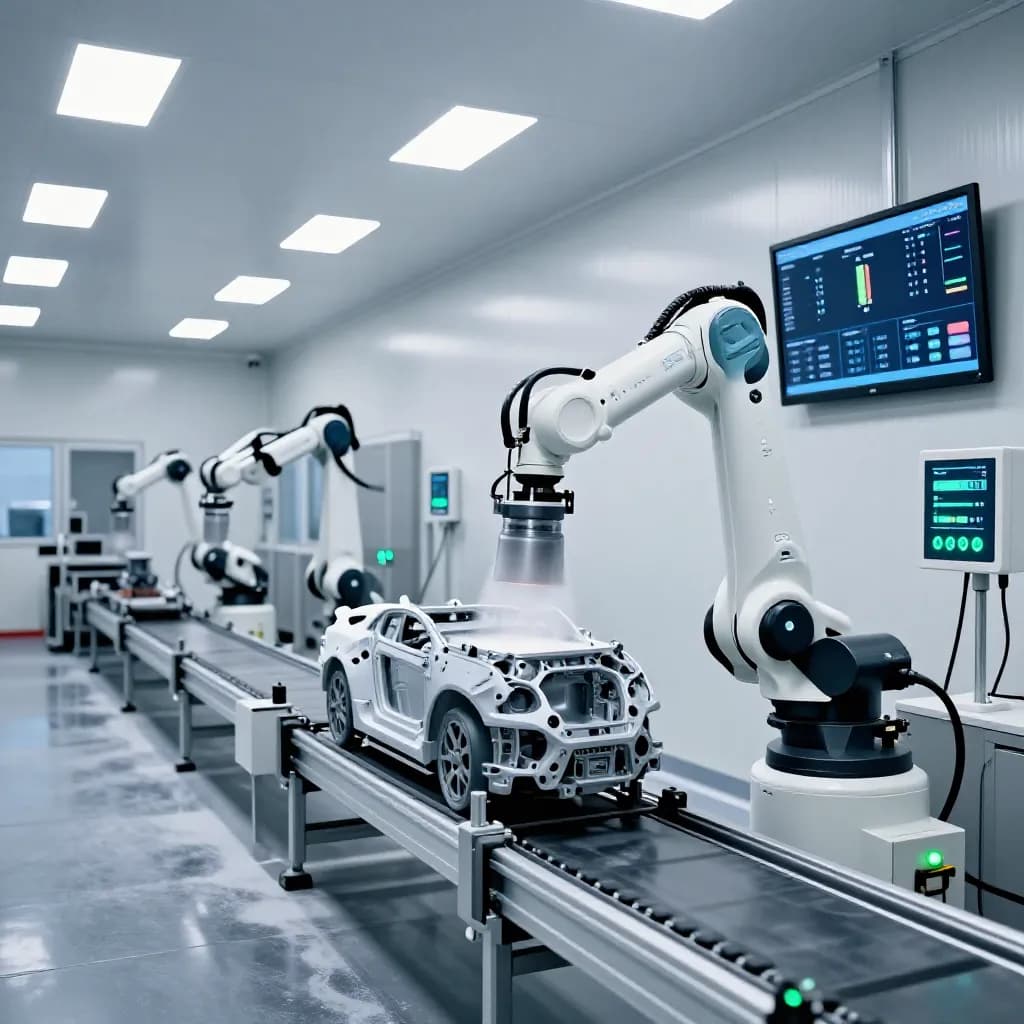
The powder coating process is inherently well-suited to Industry 4.0 integration. Every stage — pretreatment, powder application, curing, and quality inspection — involves measurable parameters that influence coating quality: chemical concentrations, temperatures, spray patterns, film thickness, oven profiles, and surface appearance. By instrumenting these parameters with sensors, connecting them through industrial networks, and applying analytics and machine learning, manufacturers can achieve levels of process control, consistency, and efficiency that manual operations cannot match.
Ready to Start Your Project?
From one-off customs to 15,000-part production runs — get precise pricing in 24 hours.
On This Page
Industry 4.0 Meets Surface Finishing
The business case for smart powder coating operations is compelling. Coating defects that result in rework or scrap represent significant cost — typically 3-8% of production in conventional operations. Energy consumption in curing ovens is often higher than necessary due to conservative temperature settings. Powder consumption exceeds theoretical minimums due to suboptimal spray parameters. Unplanned equipment downtime disrupts production schedules. Industry 4.0 technologies address each of these cost drivers through real-time optimization, predictive analytics, and closed-loop process control.
Robotic Powder Application Systems
Robotic powder application has evolved from simple reciprocating gun movers to sophisticated multi-axis robotic systems that adapt their spray patterns to the geometry of each part in real time. Modern coating robots use six-axis articulated arms with powder spray guns mounted on the end effector, providing the dexterity to coat complex three-dimensional parts with uniform film thickness across all surfaces, edges, and recesses.
The key advancement enabling intelligent robotic coating is 3D part recognition. Using laser scanners, structured light sensors, or vision cameras mounted at the booth entrance, the system creates a three-dimensional model of each incoming part and generates an optimized spray program on the fly. This eliminates the need for manual programming of spray recipes for each part type and enables mixed-model production where different parts can be coated in random sequence without changeover delays.
Robotic systems also enable closed-loop film thickness control. Inline thickness measurement sensors — based on magnetic induction, eddy current, or optical principles — measure the deposited film thickness during or immediately after application. The robot controller uses this feedback to adjust gun-to-part distance, traverse speed, powder flow rate, and electrostatic voltage in real time, compensating for variations in part geometry, grounding quality, and powder characteristics. This closed-loop approach can reduce film thickness variation from the typical plus or minus 20% of manual application to plus or minus 5-10%, saving powder material while ensuring minimum thickness specifications are consistently met.
AI-Powered Quality Control and Defect Detection
Artificial intelligence is revolutionizing quality control in powder coating operations by enabling automated, objective, and comprehensive inspection of every coated part. Traditional quality control relies on visual inspection by trained operators who check a sample of parts for defects such as orange peel, craters, pinholes, color variation, contamination, and insufficient coverage. This approach is subjective, inconsistent, and limited in coverage — defects on uninspected parts escape detection.
AI-powered vision systems use high-resolution cameras and deep learning algorithms trained on thousands of images of acceptable and defective coatings to classify coating quality automatically. These systems can detect defects that are invisible to the human eye, including subtle color shifts, micro-craters, and early-stage contamination patterns. The inspection is performed on every part at line speed, providing 100% coverage rather than statistical sampling.
Beyond defect detection, AI systems provide defect classification and root cause analysis. By correlating defect types and frequencies with upstream process parameters — pretreatment chemistry, powder batch, application settings, oven temperature profile — the AI can identify the process variable responsible for a quality deviation and recommend corrective action. Over time, the system builds a comprehensive model of the relationship between process inputs and coating quality outputs, enabling predictive quality management where potential defects are anticipated and prevented before they occur. This shift from reactive inspection to predictive quality represents a fundamental change in how coating operations manage quality.
IoT Sensor Networks for Process Monitoring
The Internet of Things provides the sensory infrastructure that makes smart powder coating operations possible. IoT sensor networks continuously monitor critical process parameters throughout the coating line, transmitting data to centralized analytics platforms where it is stored, visualized, and analyzed in real time.
In the pretreatment stage, IoT sensors monitor chemical bath concentrations, pH levels, conductivity, temperature, and rinse water quality. Automated dosing systems maintain chemical parameters within specification, while trend analysis detects gradual drift that could lead to adhesion failures if uncorrected. In the powder application booth, sensors track air temperature and humidity, booth airflow velocity, powder flow rates, electrostatic voltage and current, and gun-to-part distance. These parameters directly influence powder deposition efficiency, film thickness uniformity, and surface quality.
The curing oven is instrumented with multiple temperature sensors along its length, supplemented by product temperature profiling using trailing thermocouples or infrared pyrometers at the oven exit. IoT-connected oven controllers maintain the temperature profile within tight tolerances and alert operators to deviations that could result in undercure or overcure. Energy monitoring sensors track gas consumption, electrical power draw, and heat recovery system performance, providing data for energy optimization and carbon accounting.
The value of IoT sensor data extends beyond real-time monitoring to long-term process optimization. By analyzing historical data across thousands of production runs, manufacturers can identify optimal parameter combinations for each product type, detect seasonal variations in process behavior, and quantify the impact of raw material changes on coating quality. This data-driven approach replaces trial-and-error process adjustment with evidence-based optimization.
Digital Twins for Powder Coating Lines
A digital twin is a virtual replica of a physical system that mirrors its behavior in real time using data from IoT sensors. In powder coating, digital twins model the entire coating line — from pretreatment through application and curing — enabling simulation, optimization, and predictive analysis without disrupting production.
The digital twin of a powder coating booth, for example, incorporates computational fluid dynamics models of airflow patterns, electrostatic field simulations, and powder particle trajectory calculations. Fed with real-time data on booth conditions, powder properties, and part geometry, the digital twin can predict film thickness distribution on a part before it is coated, enabling preemptive adjustment of spray parameters. If the simulation predicts insufficient coverage in a recessed area, the robot program can be modified before the part enters the booth.
Digital twins of curing ovens model heat transfer from the oven atmosphere to the part surface, accounting for part mass, geometry, loading density, and oven temperature profile. This enables precise prediction of the cure schedule each part experiences, ensuring that every part achieves the minimum cure specification without excessive thermal exposure. For mixed-load production where parts of different sizes and masses are cured simultaneously, the digital twin can optimize part sequencing and oven temperature settings to minimize energy consumption while guaranteeing cure quality.
The strategic value of digital twins extends to capacity planning and process design. Manufacturers can simulate the impact of adding a second shift, changing line speed, introducing a new product, or modifying equipment layout without physical trials. This virtual experimentation accelerates decision-making and reduces the risk of capital investments in line modifications or new equipment.
Predictive Maintenance and Equipment Reliability
Unplanned equipment downtime is one of the most costly disruptions in powder coating operations. A failed pump, worn spray nozzle, degraded oven burner, or malfunctioning conveyor drive can halt production for hours or days, resulting in missed delivery commitments, overtime costs, and potential quality issues from rushed restarts. Predictive maintenance uses sensor data and machine learning to anticipate equipment failures before they occur, enabling planned maintenance interventions during scheduled downtime.
Vibration sensors on pumps, motors, and conveyor drives detect changes in vibration patterns that indicate bearing wear, imbalance, or misalignment weeks before failure occurs. Current monitoring on electric motors identifies increasing power draw that signals mechanical resistance or winding degradation. Pressure sensors in powder delivery systems detect nozzle wear or blockage through changes in flow resistance. Temperature sensors on oven burners and heat exchangers identify efficiency degradation from fouling or component wear.
Machine learning algorithms analyze these sensor data streams, comparing current patterns against historical baselines and known failure signatures to generate maintenance alerts with estimated time to failure. This enables maintenance teams to schedule repairs during planned downtime, order replacement parts in advance, and prioritize maintenance activities based on failure probability and production impact. The result is higher equipment availability, lower maintenance costs, and more predictable production scheduling. Industry data suggests that predictive maintenance can reduce unplanned downtime by 30-50% and extend equipment life by 20-40% compared to reactive or time-based maintenance strategies.
Data Integration and Manufacturing Execution Systems
The full potential of Industry 4.0 in powder coating is realized when data from all process stages is integrated into a unified manufacturing execution system that provides end-to-end visibility and control. An MES for powder coating operations connects pretreatment monitoring, powder application control, oven management, quality inspection, and maintenance systems into a single platform that tracks every part from raw substrate to finished product.
Traceability is a key capability enabled by MES integration. Each part or batch is assigned a unique identifier — via barcode, RFID tag, or vision-based tracking — that links it to the complete set of process parameters it experienced: pretreatment chemistry and duration, powder batch and application settings, oven temperature profile, and quality inspection results. This traceability enables rapid root cause analysis when quality issues arise, supports customer quality documentation requirements, and provides the data foundation for continuous improvement programs.
MES platforms also enable real-time production dashboards that display key performance indicators including first-pass yield, powder utilization efficiency, energy consumption per part, line speed, and equipment availability. These dashboards provide management visibility into operational performance and enable data-driven decision-making at all levels of the organization. The integration of coating line data with enterprise resource planning systems further connects production performance to business metrics such as cost per unit, on-time delivery, and customer satisfaction.
Implementation Roadmap and Return on Investment
Implementing Industry 4.0 in powder coating operations is best approached as a phased journey rather than a single transformation project. The first phase typically focuses on connectivity — installing IoT sensors on critical equipment, establishing network infrastructure, and implementing a data collection platform. This phase provides immediate value through real-time process visibility and historical data analysis, with relatively modest investment.
The second phase introduces automation and closed-loop control — robotic application systems, automated quality inspection, and feedback-controlled process parameters. This phase requires larger capital investment but delivers significant returns through reduced labor costs, improved consistency, lower defect rates, and material savings. The third phase implements advanced analytics — digital twins, predictive maintenance, and AI-driven optimization — that extract maximum value from the data infrastructure established in earlier phases.
Return on investment varies by operation size and starting point, but industry case studies consistently report payback periods of 18-36 months for comprehensive Industry 4.0 implementations in powder coating. The primary value drivers are reduced rework and scrap from improved quality control, lower powder consumption from optimized application, reduced energy costs from oven optimization, and decreased downtime from predictive maintenance. For operations processing high-value parts or operating in competitive markets with tight margins, the ROI case is particularly strong. The competitive advantage of a fully digitized, data-driven coating operation — in terms of quality consistency, cost efficiency, and responsiveness to customer requirements — is increasingly becoming a market differentiator rather than a luxury.
Frequently Asked Questions
What is the biggest benefit of Industry 4.0 for powder coating?
The biggest benefit is consistent quality through closed-loop process control. By continuously monitoring and adjusting process parameters based on real-time sensor data and AI analysis, Industry 4.0 systems reduce coating defects, minimize rework, and ensure every part meets specification. This consistency also drives material and energy savings as secondary benefits.
Do I need to replace my existing equipment to implement Industry 4.0?
No. Industry 4.0 can be implemented incrementally by adding sensors, connectivity, and analytics to existing equipment. Retrofit IoT sensor packages are available for most powder coating equipment, and cloud-based analytics platforms can process data from mixed equipment of different ages and manufacturers. Full equipment replacement is not required to begin the digital transformation journey.
How does AI quality control compare to human inspection?
AI vision systems inspect every part at line speed with consistent, objective criteria, while human inspectors can only sample a fraction of production and are subject to fatigue and subjectivity. AI systems can detect subtle defects invisible to the human eye and correlate defect patterns with process variables for root cause analysis. However, human expertise remains valuable for interpreting unusual defects and making judgment calls on borderline cases.
What data infrastructure is needed for a smart coating line?
A smart coating line requires IoT sensors on critical equipment, a reliable industrial network connecting sensors to a data platform, a data storage and analytics system, and visualization tools for operators and management. Cloud-based platforms reduce on-site IT infrastructure requirements. The specific sensors and network architecture depend on the coating line configuration and the process parameters most critical to quality.
Is Industry 4.0 only for large coating operations?
No. While large operations may achieve faster ROI due to scale, Industry 4.0 technologies are increasingly accessible to small and medium coating operations. Cloud-based analytics platforms eliminate the need for expensive on-site computing infrastructure, and modular sensor packages allow incremental investment. Even basic IoT monitoring of oven temperature and powder consumption can deliver meaningful improvements for smaller operations.
Ready to Start Your Project?
From one-off customs to 15,000-part production runs — get precise pricing in 24 hours.