Industrial shelving and racking systems form the structural backbone of modern warehousing and logistics operations. Pallet racking alone represents a multi-billion-dollar global market, with millions of tonnes of steel erected in warehouses, distribution centers, and manufacturing facilities worldwide. The protective coating on these structures serves purposes that extend far beyond aesthetics — it provides corrosion protection that maintains structural integrity, color coding that supports safety and operational efficiency, and fire resistance that can be critical in emergency scenarios.
Industrial
Powder Coating for Industrial Shelving and Racking: Impact-Resistant Finishes for Warehouse Environments
Sundial Powder Coating·April 22, 2026·12 min
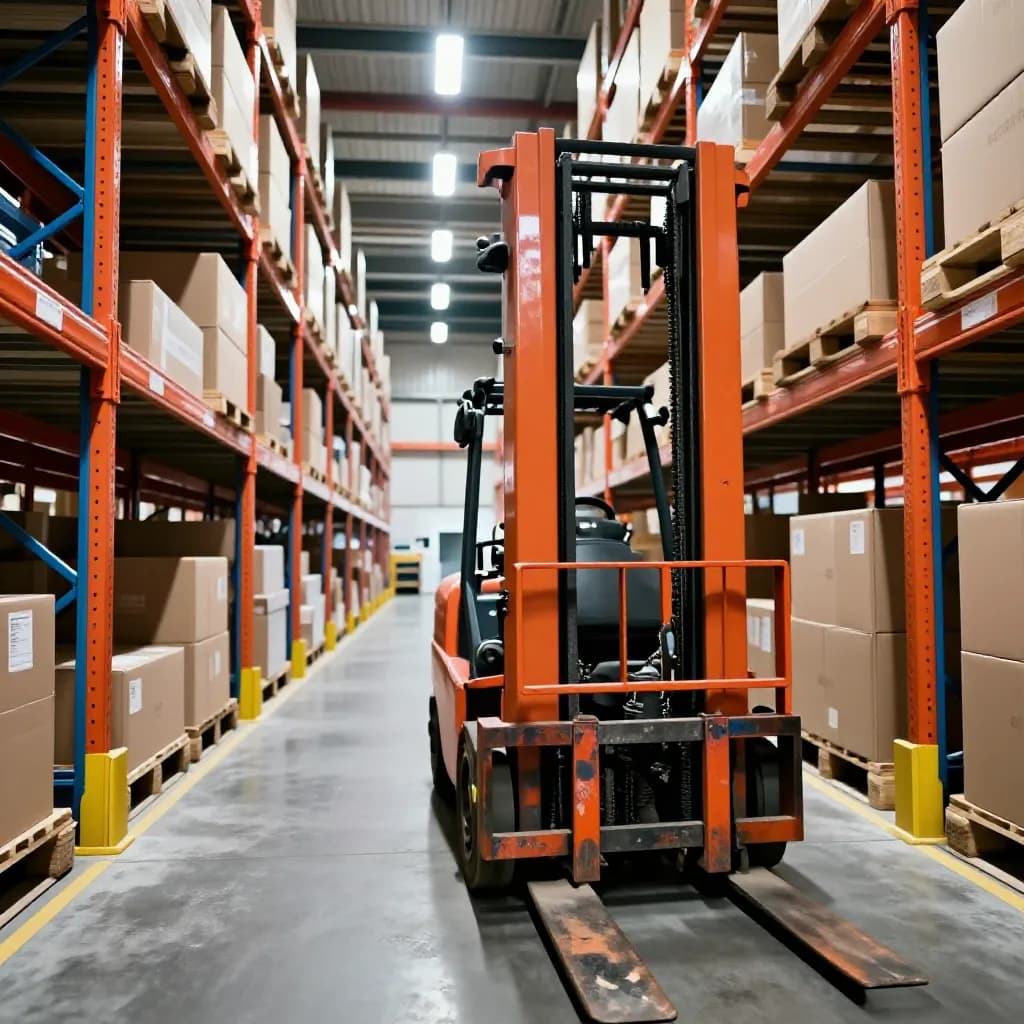
The consequences of coating failure on racking systems are more severe than in most other applications. Corrosion that weakens a racking upright or beam connector can lead to catastrophic structural collapse, endangering workers and destroying inventory. The European standard EN 15512 for the design of steel static pallet racking systems requires that the structural capacity of racking components accounts for corrosion loss over the design life, making effective corrosion protection a structural safety requirement rather than merely a cosmetic consideration.
Ready to Start Your Project?
From one-off customs to 15,000-part production runs — get precise pricing in 24 hours.
On This Page
The Critical Role of Coatings in Warehouse Racking Systems
Powder coating has become the predominant finishing technology for industrial racking, displacing wet paint and offering significant advantages in production efficiency, environmental compliance, and coating performance. The electrostatic application process is particularly well-suited to the long, linear profiles used in racking construction, and the single-coat, single-cure process aligns with the high-volume, cost-sensitive production requirements of the racking industry.
This article examines the specific requirements, technologies, and standards that govern powder coating for industrial shelving and racking systems across the full range of warehouse environments.
Pallet Racking: Uprights, Beams, and Connectors
Selective pallet racking — the most common warehouse storage system — consists of vertical uprights (frames) connected by horizontal beams that support palletized loads. Each of these components has distinct coating requirements driven by its geometry, stress profile, and exposure to damage.
Uprights are the most critical structural elements and the most vulnerable to damage. Forklift impacts on racking uprights are the leading cause of racking collapse in warehouses. The powder coating on uprights must therefore provide not only corrosion protection but also visual indication of damage. Many racking manufacturers use specific colors for uprights (commonly orange RAL 2004 or blue RAL 5010) that make dents, scrapes, and deformation immediately visible during routine inspections. A damaged coating that exposes bare steel serves as an early warning of structural compromise.
The perforated slot pattern in racking uprights — the regularly spaced holes or slots that accept beam connectors — creates numerous edges that challenge coating coverage. Each perforation has four cut edges where the steel thickness is exposed, and these edges are the most vulnerable points for corrosion initiation. Powder coating's electrostatic wrap-around effect provides better edge coverage than liquid paint, but achieving adequate film build on perforation edges still requires careful attention to application parameters, including gun-to-part distance, powder charge, and conveyor speed.
Beam components are typically roll-formed from pre-galvanized or cold-rolled steel and powder coated in contrasting colors to the uprights for visual identification. The beam-to-upright connection zone experiences concentrated mechanical stress during pallet loading and unloading, and the coating in this area must withstand repeated insertion and removal of beam connectors without excessive wear.
Beam connectors (clips or hooks) are small, complex-geometry components that are challenging to coat uniformly. Barrel-loading or rack-mounting these components for powder coating ensures all surfaces receive adequate coverage, including the internal hook profiles that engage with upright perforations.
Cantilever Racking and Specialized Storage Systems
Cantilever racking systems, designed for storing long, bulky items such as timber, steel sections, pipes, and sheet materials, present unique coating challenges due to the heavy loads and rough handling these systems endure. The cantilevered arms that support loads are subjected to concentrated point loads and abrasion from materials being slid on and off, requiring coatings with exceptional hardness and abrasion resistance.
Polyester powder coatings with pencil hardness ratings of 2H to 3H are standard for cantilever arms, providing resistance to the scratching and gouging that occurs when steel beams, timber bundles, or pipe stacks are loaded and unloaded. Film thickness of 80-100 microns is typical, providing a robust barrier that can absorb surface damage without exposing the steel substrate to corrosion.
Drive-in and drive-through racking systems, where forklifts enter the racking structure to access pallets, experience the highest levels of coating damage of any racking type. The guide rails that direct forklift wheels and the upright faces within the drive lanes are subjected to repeated contact with forklift masts, forks, and loads. Heavy-duty powder coatings at 100-120 microns, often applied over hot-dip galvanized substrates in a duplex system, provide the maximum protection for these high-abuse applications.
Mobile racking systems (powered mobile bases that move racking rows to eliminate fixed aisles) add vibration and movement to the coating stress profile. The continuous low-frequency vibration from the drive motors and the intermittent shock loads from base movement and stopping can fatigue coatings at stress concentration points such as welds and bolt holes. Flexible polyester powder coatings with good elongation properties (>3% at break) resist fatigue cracking in these dynamic applications.
Automated storage and retrieval systems (AS/RS) use racking structures that must meet tighter dimensional tolerances than conventional racking because automated cranes and shuttles operate with minimal clearances. Powder coating film thickness must be controlled within ±10 microns to avoid dimensional interference, and the coating surface must be smooth enough to prevent friction issues with automated handling equipment.
Impact Resistance and Mechanical Performance Standards
Impact resistance is arguably the most important mechanical property for powder coatings on industrial racking. Forklift collisions, falling objects, and rough handling during installation and reconfiguration subject racking coatings to impact energies that would destroy most decorative finishes. The coating must absorb these impacts without cracking, chipping, or delaminating in ways that expose the steel substrate to corrosion.
The standard test method for impact resistance is ASTM D2794 (Gardner impact test), which measures the coating's ability to withstand rapid deformation caused by a falling weight. Industrial racking coatings typically specify minimum impact resistance of 80-120 inch-pounds (direct impact), significantly higher than the 40-60 inch-pounds acceptable for decorative architectural coatings. Some heavy-duty racking specifications require 160 inch-pounds or more for components in high-traffic forklift zones.
Abrasion resistance is tested using the Taber abraser method per ASTM D4060, which measures weight loss after a specified number of abrasion cycles with calibrated abrasive wheels. Racking coatings typically achieve weight loss of less than 100 mg per 1,000 cycles with CS-17 wheels, indicating good resistance to the sliding abrasion that occurs during pallet loading and material handling.
Flexibility testing per ASTM D522 (mandrel bend test) verifies that the coating can withstand the bending and forming that racking components experience during manufacture and installation. A minimum bend performance of 3 mm mandrel diameter without cracking is standard for racking coatings, ensuring the finish survives the cold-forming operations used to produce upright profiles and beam sections.
Adhesion testing per ASTM D3359 (cross-cut tape test) or ISO 2409 confirms that the coating remains bonded to the substrate under mechanical stress. A rating of 4B or 5B (less than 5% or 0% coating removal) is required for racking applications, ensuring that impact damage does not propagate beyond the immediate contact area through adhesion failure.
Salt spray resistance per ASTM B117 provides an accelerated measure of corrosion protection. Industrial racking coatings typically achieve 500-1,000 hours of salt spray resistance, with duplex systems (galvanizing plus powder coating) exceeding 1,500 hours.
Fire Ratings and Intumescent Coating Systems
Fire protection of steel racking structures has become an increasingly important consideration as warehouse sizes have grown and the value of stored inventory has increased. While steel does not burn, it loses structural strength rapidly at elevated temperatures — at 550°C, structural steel retains only about 60% of its ambient-temperature yield strength, and at 700°C this drops to approximately 23%. In a warehouse fire, unprotected steel racking can collapse within 15-20 minutes, creating a cascading failure that spreads the fire and endangers firefighters.
Intumescent powder coatings provide passive fire protection by expanding when exposed to heat, forming an insulating char layer that slows the rate of temperature rise in the steel substrate. These coatings are applied and cured like conventional powder coatings but contain reactive ingredients — typically a carbon source (such as pentaerythritol), an acid catalyst (ammonium polyphosphate), and a blowing agent (melamine) — that undergo an endothermic chemical reaction at temperatures above 200-250°C.
When activated by fire, intumescent powder coatings expand to 20-50 times their original thickness, creating a low-density insulating char that can maintain steel temperatures below critical thresholds for 30-60 minutes depending on the coating thickness and fire severity. This fire resistance period allows time for sprinkler activation, fire brigade response, and building evacuation.
The fire performance of intumescent coatings on racking is assessed according to national and international standards. In Europe, EN 13501-2 classifies the fire resistance of structural elements, with ratings expressed as R15, R30, R60, or R90 (where the number indicates minutes of load-bearing capacity under standard fire conditions). In North America, UL 263 and ASTM E119 provide equivalent fire resistance classifications.
It is important to note that intumescent powder coatings for racking are specialized products that differ significantly from standard decorative powder coatings. They are typically applied at higher film thicknesses (250-1,000 microns depending on the required fire rating and steel section factor), require specific pretreatment and application procedures, and must be tested and certified for the specific racking configuration in which they will be used.
Warehouse Environment Classifications and Coating Selection
The appropriate powder coating specification for industrial racking depends heavily on the warehouse environment in which the racking will operate. Environmental conditions vary enormously across different warehouse types, from climate-controlled distribution centers to unheated agricultural storage buildings, and the coating system must be matched to the specific exposure conditions.
Dry, climate-controlled warehouses represent the least demanding environment for racking coatings. Temperature and humidity are maintained within comfortable ranges (18-25°C, 40-60% RH), and the primary coating threats are mechanical damage from forklift operations and general handling. Standard polyester powder coating at 60-80 microns over iron phosphate pretreatment provides adequate protection for these environments, with expected coating service lives of 15-20 years.
Unheated or partially heated warehouses experience wider temperature and humidity fluctuations, including condensation events when warm, moist air contacts cold steel surfaces during temperature transitions. Condensation-driven corrosion is a significant concern in these environments, particularly in maritime or tropical climates. Enhanced pretreatment (zinc phosphate rather than iron phosphate) and increased film thickness (80-100 microns) are recommended for unheated warehouse racking.
Cold storage and freezer warehouses present extreme conditions for coatings. Temperatures of -25°C to -40°C in deep-freeze facilities cause thermal contraction of both the steel substrate and the coating, testing adhesion and flexibility. Condensation and ice formation occur at the interface between cold and ambient zones, creating persistent moisture exposure. Epoxy or epoxy-polyester hybrid powder coatings are preferred for cold storage racking due to their superior adhesion retention at low temperatures and resistance to moisture-driven delamination.
Chemical storage warehouses require coatings that resist specific chemical exposures. Racking in fertilizer warehouses must withstand ammonium nitrate dust and humidity, while racking in battery storage facilities may be exposed to sulfuric acid fumes. Chemical resistance testing per ASTM D1308 against the specific chemicals present in the warehouse environment is essential for specifying the correct powder coating chemistry.
Color Coding Systems and Safety Compliance
Color coding of racking components serves critical safety and operational functions in warehouse environments. Standardized color schemes enable rapid visual identification of racking types, load capacities, and damage status, supporting both operational efficiency and workplace safety compliance.
The most common color coding convention uses orange (RAL 2004 or RAL 2008) for racking uprights and blue (RAL 5010 or RAL 5015) for beams. This high-contrast combination provides clear visual differentiation between structural elements and makes damage inspection easier — dents, scrapes, and deformation are immediately visible against the bright orange or blue background. Some operators use yellow (RAL 1023) for uprights in areas where forklift traffic is particularly heavy, leveraging the high visibility of yellow to alert drivers to the presence of structural elements.
Load capacity signage and labels are typically applied to powder-coated racking surfaces. The coating must provide a suitable surface for adhesive label attachment, and the label adhesive must be compatible with the powder coating chemistry. Smooth polyester powder coatings provide excellent adhesion for pressure-sensitive labels, while heavily textured finishes may require mechanical fastening of signage.
Safety regulations in many jurisdictions require that racking damage be identified and assessed promptly. The SEMA (Storage Equipment Manufacturers' Association) code of practice for the use of static steel pallet racking classifies damage into green (acceptable), amber (requires monitoring), and red (requires immediate action) categories. A well-maintained powder coating finish facilitates this damage assessment by providing a uniform background against which deformation, cracking, and corrosion are readily visible.
Floor-level racking components, including base plates and floor-level upright sections, are particularly vulnerable to damage from floor-cleaning equipment, water ingress, and chemical spills. Some operators specify a different, more robust coating system for the bottom 300 mm of racking uprights, such as a duplex galvanizing-plus-powder system or an increased film thickness, to provide enhanced protection in this high-risk zone.
Production Efficiency and Coating Line Design for Racking
The industrial racking sector is characterized by high production volumes and intense cost pressure, making coating line efficiency a critical competitive factor. Racking manufacturers operate dedicated powder coating lines optimized for the specific geometries and throughput requirements of racking components.
Upright frames, which can be 6-12 meters long, require coating lines with extended spray booths and curing ovens. Vertical hanging of uprights on overhead conveyors is the standard approach, with the uprights suspended from their top ends and traveling through the coating line at speeds of 2-4 meters per minute. This orientation allows gravity to assist powder flow into the perforated slot pattern and ensures uniform coverage on all four faces of the upright profile.
Beam components are typically coated in horizontal orientation, hung in pairs or groups from cross-bars on the conveyor. The shorter length of beams (typically 1.8-3.6 meters) allows higher packing density on the conveyor, improving line utilization and throughput. Automatic spray guns positioned on both sides of the conveyor provide simultaneous coverage of all beam surfaces.
Powder reclaim efficiency is particularly important in racking coating operations due to the high volumes of powder consumed. Cyclone reclaim systems recover 95-98% of overspray powder for reuse, and the relatively simple geometries of racking components (compared to, say, automotive parts) result in high first-pass transfer efficiency of 60-70%. Combined first-pass and reclaim efficiency typically exceeds 95%, minimizing powder waste and material cost.
Pretreatment for racking components is typically a multi-stage spray wash process incorporating alkaline degreasing, water rinse, iron phosphate or zinc phosphate conversion coating, and a final deionized water rinse. The entire pretreatment sequence is completed in 3-5 minutes, with the conveyor speed matched to provide adequate contact time at each stage. Some racking manufacturers have adopted zirconium-based pretreatment systems that reduce the number of process stages, lower operating temperatures, and eliminate the sludge disposal issues associated with phosphate systems.
Frequently Asked Questions
Why is powder coating preferred over liquid paint for warehouse racking?
Powder coating delivers thicker, more uniform films in a single coat (60-120 microns vs 25-40 for liquid paint), provides better edge coverage on perforated uprights, achieves 95-98% material utilization, emits zero VOCs, and offers superior impact resistance. These advantages translate to better corrosion protection, lower environmental impact, and higher production efficiency.
What fire rating can powder-coated racking achieve?
Standard decorative powder coatings do not provide fire resistance. Intumescent powder coatings, applied at 250-1,000 microns, expand when heated to form an insulating char that can protect steel racking for 30-60 minutes under standard fire conditions, achieving R30 or R60 ratings per EN 13501-2.
How does cold storage affect powder coating on racking?
Temperatures of -25°C to -40°C in freezer warehouses cause thermal contraction that tests coating adhesion and flexibility. Condensation at cold-warm zone interfaces creates persistent moisture exposure. Epoxy or epoxy-polyester hybrid powder coatings are recommended for cold storage due to superior adhesion retention and moisture resistance at low temperatures.
Why are racking uprights typically orange and beams blue?
The orange-and-blue color scheme provides high visual contrast between structural elements, making damage inspection easier. Dents, scrapes, and deformation are immediately visible against bright backgrounds. This color coding also helps forklift operators identify structural elements and supports safety compliance with SEMA damage classification protocols.
How long does powder coating last on warehouse racking?
In dry, climate-controlled warehouses, powder-coated racking lasts 15-20 years. In unheated or humid environments, 10-15 years is typical. Cold storage and chemically aggressive environments may reduce service life to 8-12 years. Duplex systems combining galvanizing with powder coating extend protection significantly in all environments.
What impact resistance should racking powder coating have?
Industrial racking coatings should achieve 80-120 inch-pounds direct impact resistance per ASTM D2794, significantly higher than the 40-60 inch-pounds acceptable for decorative coatings. Heavy-duty specifications for high-traffic forklift zones may require 160 inch-pounds or more to withstand collision damage.
Ready to Start Your Project?
From one-off customs to 15,000-part production runs — get precise pricing in 24 hours.