Industrial environments expose powder coatings to a complex cocktail of atmospheric pollutants that accelerate degradation far beyond what natural weathering alone would produce. Sulfur dioxide (SO2) from fossil fuel combustion, nitrogen oxides (NOx) from high-temperature industrial processes and vehicle emissions, hydrogen chloride from waste incineration, and particulate matter containing heavy metals and acidic compounds all contribute to an aggressive chemical atmosphere that attacks coating systems through multiple mechanisms.
Technical
Powder Coating in Industrial Pollution Environments: SO2, NOx, Acid Rain, and Chemical Fallout
Sundial Powder Coating·April 22, 2026·12 min
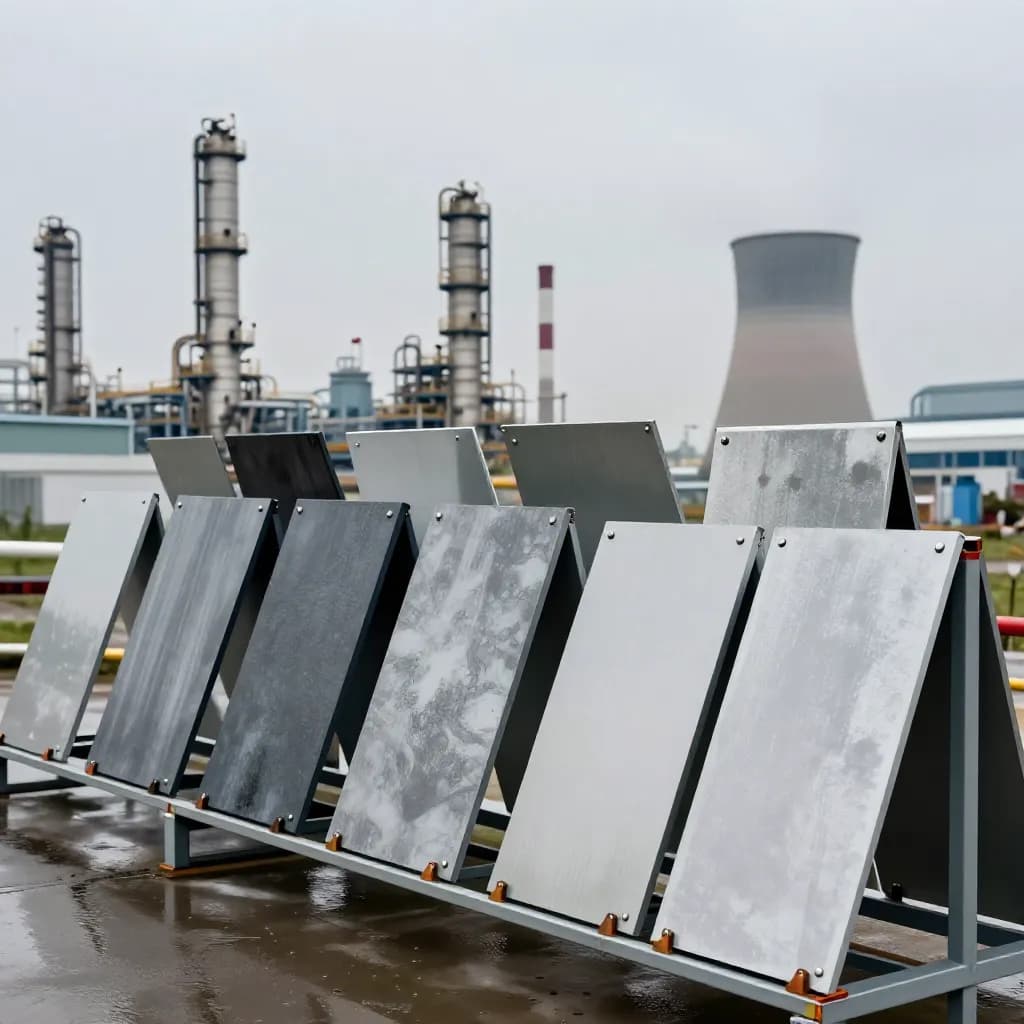
ISO 9223 classifies industrial atmospheres based on measured SO2 deposition rates and time of wetness. Industrial zones with SO2 deposition rates of 80-200 mg/m²/day fall into corrosivity category C4 (High), while heavy industrial areas exceeding 200 mg/m²/day are classified C5-I (Very High, Industrial). These categories directly determine the coating system requirements per ISO 12944-5, with C5-I demanding the most robust protection systems available.
Ready to Start Your Project?
From one-off customs to 15,000-part production runs — get precise pricing in 24 hours.
On This Page
Industrial Atmospheres and Coating Degradation
The synergistic effects of multiple pollutants create conditions more aggressive than any single pollutant alone. SO2 and NOx combine with atmospheric moisture to form sulfuric and nitric acids — the components of acid rain — which attack both the organic coating film and the metal substrate. Particulate fallout from industrial processes deposits acidic or alkaline compounds on coating surfaces, creating localized chemical attack points. The combination of chemical exposure with UV radiation and moisture cycling creates a degradation environment that challenges even the most advanced coating technologies.
Understanding the specific pollutant profile of an industrial site is essential for correct coating specification. A petrochemical complex, a steel mill, a cement plant, and a waste incineration facility each produce different pollutant mixtures that require different coating resistance profiles.
Sulfur Dioxide and Acid Rain Attack Mechanisms
Sulfur dioxide is the most significant industrial atmospheric pollutant for coating degradation. SO2 dissolves in surface moisture films to form sulfurous acid (H2SO3), which oxidizes to sulfuric acid (H2SO4) in the presence of atmospheric oxygen and catalytic metal particles. This acid attacks powder coatings through hydrolysis of the polymer binder, degradation of pigments, and corrosion of the underlying metal substrate.
The rate of SO2 attack on powder coatings depends on three factors: SO2 concentration, time of wetness (the duration for which the surface remains wet), and temperature. Industrial sites with high SO2 levels and frequent fog, rain, or condensation experience the most aggressive acid attack. The time of wetness is particularly critical — SO2 can only attack the coating when dissolved in a surface moisture film, so dry industrial environments are less aggressive than humid ones despite similar SO2 concentrations.
Polyester powder coatings are moderately resistant to dilute acid exposure, with the ester bonds in the polymer backbone being susceptible to acid-catalyzed hydrolysis over extended periods. Super-durable polyester formulations with higher crosslink density and optimized resin chemistry offer improved acid resistance compared to standard grades. Polyurethane powder coatings provide better acid resistance due to the greater hydrolytic stability of the urethane linkage.
For the most aggressive industrial acid environments, fluoropolymer powder coatings offer exceptional chemical resistance. The carbon-fluorine bonds are essentially inert to acid attack, and the dense, low-permeability film structure minimizes acid penetration to the substrate. Epoxy powder coatings also provide excellent acid resistance but are unsuitable for exterior applications due to UV sensitivity — they are, however, widely used as primers in multi-coat industrial systems where the topcoat provides UV protection.
NOx Exposure and Photochemical Degradation
Nitrogen oxides — primarily NO and NO2 — are produced by high-temperature combustion processes in power plants, industrial furnaces, and vehicle engines. While NOx concentrations in ambient air are typically lower than SO2 in heavy industrial zones, their contribution to coating degradation is significant through both direct chemical attack and photochemical reactions.
NO2 is a strong oxidizing agent that can directly attack organic coatings, causing discoloration, chalking, and loss of gloss. The brown-colored gas is particularly aggressive toward light-colored coatings, where it can cause visible yellowing. Powder coatings containing aromatic amine-based crosslinkers or certain organic pigments are more susceptible to NOx discoloration than those based on aliphatic chemistry.
The photochemical role of NOx is equally important. In the presence of sunlight, NOx catalyzes the formation of ozone (O3) and other reactive oxygen species that are powerful oxidizing agents for organic coatings. Ground-level ozone concentrations in industrial and urban areas can reach 100-200 ppb during summer months — levels that significantly accelerate the oxidative degradation of powder coating binders and pigments.
For powder coatings in NOx-rich industrial environments, formulation strategies to improve resistance include using aliphatic rather than aromatic resin chemistry, selecting NOx-resistant pigments (avoiding pigments known to be sensitive to oxidizing gases), and incorporating antioxidant stabilizer packages that scavenge free radicals generated by NOx and ozone exposure. Super-durable polyester formulations with optimized HALS packages provide good NOx resistance for most industrial applications.
Monitoring NOx levels at the project site using passive diffusion tubes or continuous analyzers provides data for accurate corrosivity assessment and coating specification. Sites with annual average NO2 concentrations exceeding 40 µg/m³ should be considered for enhanced coating specifications.
Chemical Fallout and Particulate Deposition
Industrial chemical fallout — the deposition of airborne particles and aerosols from industrial processes — creates localized chemical attack on powder-coated surfaces that can be more aggressive than the general atmospheric pollution. The composition of fallout varies dramatically depending on the industrial source: cement dust is highly alkaline (pH 12-13), steel mill fallout contains iron particles that catalyze corrosion, chemical plant emissions may include organic solvents and acids, and waste incineration produces complex mixtures of chlorides, heavy metals, and acidic compounds.
Cement dust fallout is particularly problematic for powder coatings. The calcium hydroxide and calcium oxide in cement dust dissolve in surface moisture to create a strongly alkaline solution that attacks polyester coatings through saponification — the alkaline hydrolysis of ester bonds. Prolonged exposure to cement dust can cause visible softening, blistering, and delamination of standard polyester powder coatings. Polyurethane and acrylic powder coatings offer significantly better alkali resistance for applications near cement plants.
Metallic particle fallout from steel mills, foundries, and metalworking operations creates a different degradation mechanism. Iron particles embedded in the powder coating surface rust in the presence of moisture, creating unsightly rust staining and localized coating damage. The expanding rust products can lift the coating from the substrate, creating defect points for further corrosion. For applications near ferrous metal processing facilities, regular cleaning to remove metallic particles before they corrode is essential.
Chloride-containing fallout from waste incineration, PVC processing, and chemical manufacturing is among the most aggressive forms of industrial deposition. Chloride ions penetrate powder coating films and initiate pitting corrosion on aluminum and steel substrates. Coatings for chloride-rich industrial environments should achieve minimum 1,500 hours neutral salt spray resistance and incorporate chloride-barrier pigments such as zinc phosphate or strontium chromate in primer layers.
Coating System Design for Industrial Corrosivity
Designing powder coating systems for industrial environments requires a systematic approach based on accurate corrosivity assessment, appropriate standard selection, and multi-layer system design that addresses the specific pollutant profile of the installation site.
For steel substrates in C4 industrial environments, ISO 12944-5 recommends minimum total dry film thicknesses of 160-200 microns for High durability (15-25 years). A typical system comprises a zinc-rich epoxy primer (60-80 microns), an epoxy intermediate coat (60-80 microns), and a polyester or polyurethane topcoat (60-80 microns). The zinc-rich primer provides cathodic protection at damage points, the epoxy intermediate coat provides chemical and moisture barrier properties, and the topcoat provides UV resistance and aesthetic appearance.
For C5-I industrial environments, total system thicknesses increase to 200-320 microns, with enhanced requirements for each layer. The zinc-rich primer may be replaced or supplemented with thermal spray zinc or zinc-aluminum for maximum cathodic protection. Intermediate coats may incorporate barrier pigments such as micaceous iron oxide (MIO) that create a tortuous path for moisture and chemical penetration through the film.
For aluminum substrates in industrial environments, the coating system design differs because aluminum does not benefit from cathodic protection in the same way as steel. Instead, the focus is on maximizing the barrier properties of the coating system and ensuring robust pretreatment. Multi-stage chrome-free pretreatment with enhanced conversion coating weights, followed by 80-120 micron super-durable polyester or fluoropolymer topcoats, provides effective protection for aluminum in C4-C5 industrial atmospheres.
Chemical resistance testing should be tailored to the specific industrial environment. Standard tests include resistance to sulfuric acid (1-10% solutions), sodium hydroxide (1-10% solutions), and industrial solvents relevant to the site. ASTM D1308 (spot test method) and ISO 2812-1 (immersion method) provide standardized frameworks for chemical resistance evaluation.
Monitoring and Assessment of Industrial Coating Performance
Ongoing monitoring of powder coating condition in industrial environments is essential because the aggressive and variable nature of industrial pollution can cause unexpected degradation patterns. A structured monitoring program enables early detection of coating problems, targeted maintenance interventions, and data-driven decisions about recoating timing.
Environmental monitoring at the installation site provides the foundation for coating performance prediction. Continuous or periodic measurement of SO2, NOx, chloride deposition, and particulate matter levels enables tracking of changes in the industrial pollution profile over time. Industrial processes change — new facilities open, old ones close, emission controls are upgraded or degraded — and these changes directly affect coating degradation rates.
Coating condition assessment should follow standardized methods per ISO 4628, which provides rating scales for common degradation phenomena: chalking (Part 6), blistering (Part 2), cracking (Part 4), flaking (Part 5), and corrosion (Part 3). Regular assessments — typically annually for C4 environments and semi-annually for C5-I — create a degradation timeline that enables prediction of remaining service life.
Gloss retention measurement provides a sensitive early indicator of coating degradation. Gloss loss precedes visible chalking and color change, making it a useful leading indicator for maintenance planning. Measuring gloss at 60° angle per ISO 2813 at consistent locations during each assessment cycle creates a degradation curve that can be extrapolated to predict when the coating will reach its end-of-life criteria.
Adhesion testing using cross-cut (ISO 2409) or pull-off (ISO 4624) methods at representative locations confirms that the coating-substrate bond remains intact despite chemical exposure. Loss of adhesion without visible surface degradation may indicate chemical attack at the pretreatment interface — a serious condition that requires prompt investigation and remediation.
Case Studies: Industrial Powder Coating Performance
Real-world performance data from industrial installations provides valuable insights into powder coating behavior under actual pollution conditions. These case studies illustrate both successful specifications and lessons learned from premature failures.
Petrochemical facility cladding in a C5-I environment in the Middle East demonstrated that super-durable polyester powder coatings at 80 microns on properly pretreated aluminum maintained acceptable appearance and adhesion after 12 years of exposure to SO2, H2S, and hydrocarbon vapors. The key success factor was the multi-stage chrome-free pretreatment with enhanced conversion coating weight, which prevented chemical attack at the coating-substrate interface despite the aggressive atmosphere.
Steel structural members at a coastal industrial complex in Southeast Asia, exposed to combined marine salt and SO2 from a nearby power plant, showed that duplex galvanizing-plus-polyester systems significantly outperformed single-coat polyester systems. After 8 years, the duplex system showed less than 5% surface degradation, while the single-coat system exhibited 30-40% corrosion at edges and fastener locations — confirming the critical importance of cathodic protection in combined industrial-coastal environments.
A cement plant in central Europe provided a cautionary example: standard polyester powder coatings on aluminum ventilation louvres showed severe alkaline attack within 3 years due to cement dust fallout. Replacement with polyurethane powder coatings, combined with increased cleaning frequency from annual to quarterly, resolved the problem and achieved 10+ years of acceptable performance.
These case studies reinforce the importance of site-specific pollutant assessment, appropriate resin chemistry selection, and maintenance programs tailored to the industrial environment. Generic specifications that do not account for the specific industrial pollution profile consistently underperform compared to site-specific designs.
Frequently Asked Questions
What corrosivity category applies to industrial environments?
Industrial environments are classified per ISO 9223 as C4 (High) with SO2 deposition of 80-200 mg/m²/day, or C5-I (Very High, Industrial) exceeding 200 mg/m²/day. Site-specific measurement of SO2, chloride deposition, and time of wetness per ISO 9225 is recommended for accurate classification.
How does acid rain affect powder coatings?
Acid rain (sulfuric and nitric acids formed from SO2 and NOx) attacks powder coatings through hydrolysis of the polymer binder, particularly the ester bonds in polyester coatings. Super-durable polyester with higher crosslink density, polyurethane, and fluoropolymer coatings offer progressively better acid resistance.
What powder coating system is best for heavy industrial environments?
For steel in C5-I environments, a multi-coat system is recommended: zinc-rich epoxy primer (60-80µm), epoxy intermediate coat with MIO barrier pigments (60-80µm), and polyurethane topcoat (60-80µm), totaling 200-320 microns per ISO 12944-5. For aluminum, 80-120µm super-durable polyester or fluoropolymer over enhanced pretreatment.
How does cement dust damage powder coatings?
Cement dust dissolves in surface moisture to create strongly alkaline solutions (pH 12-13) that attack polyester coatings through saponification — alkaline hydrolysis of ester bonds. This causes softening, blistering, and delamination. Polyurethane and acrylic powder coatings offer significantly better alkali resistance for applications near cement plants.
How often should powder coatings be inspected in industrial environments?
Annual inspections are recommended for C4 industrial environments and semi-annual for C5-I. Assessments should follow ISO 4628 for degradation rating, include gloss measurement per ISO 2813 as an early degradation indicator, and adhesion testing per ISO 2409 or ISO 4624 to verify coating-substrate bond integrity.
Ready to Start Your Project?
From one-off customs to 15,000-part production runs — get precise pricing in 24 hours.