Induction curing is a fundamentally different approach to powder coating cure that uses electromagnetic fields to generate heat directly within the metal substrate. An alternating current flowing through an induction coil creates a rapidly oscillating magnetic field. When a conductive metal part is placed within this field, eddy currents are induced in the part surface, and the electrical resistance of the metal converts these currents into heat. The substrate heats from within, conducting thermal energy outward into the powder coating layer and curing it from the inside out.
Technical
Powder Coating Induction Curing Technology: Electromagnetic Heating for High-Speed Applications
Sundial Powder Coating·April 23, 2026·13 min
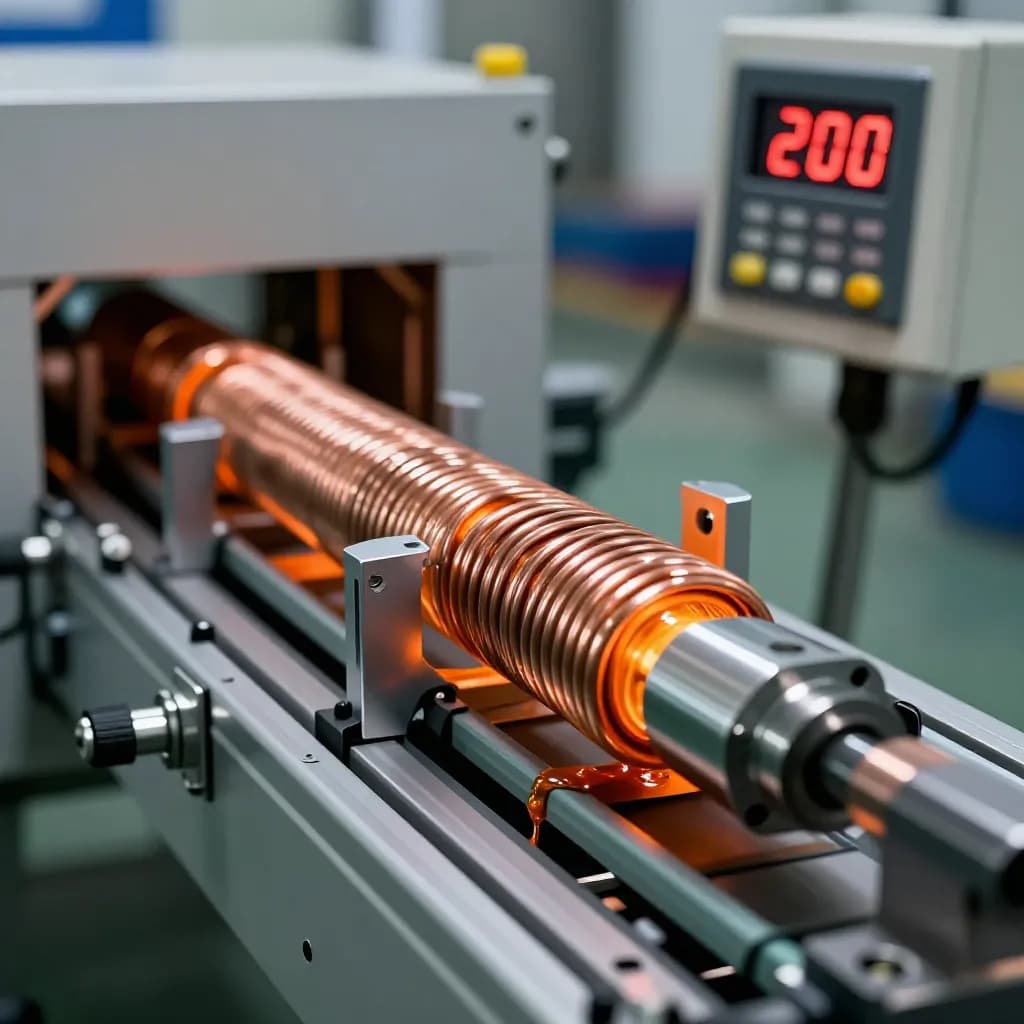
This inside-out heating mechanism offers several compelling advantages over convection and infrared curing. Because heat is generated within the substrate itself, there is no need to heat large volumes of air or to transfer energy across an air gap. The heating is extremely rapid — substrate temperatures can rise at rates of 50–200°C per second, compared to 1–5°C per second for convection heating. This speed enables cure times measured in seconds rather than minutes, with corresponding reductions in oven length, floor space, and energy consumption.
Ready to Start Your Project?
From one-off customs to 15,000-part production runs — get precise pricing in 24 hours.
On This Page
Induction Curing: Heating the Substrate, Not the Air
Induction curing is inherently selective — only the conductive metal substrate heats, while non-conductive materials in the vicinity (conveyor components, fixtures, the air itself) remain cool. This selectivity eliminates the massive thermal mass of a convection oven, enables instant startup and shutdown with no warmup period, and allows the curing system to be placed in close proximity to other equipment without thermal interference. The technology has been used in industrial heating applications for decades and is now finding growing adoption in powder coating, particularly for pipe, tube, and continuous strip coating operations.
Electromagnetic Principles and Coil Design
The effectiveness of induction heating depends on the frequency of the alternating current, the coil geometry, the coupling distance between the coil and the workpiece, and the electrical and magnetic properties of the substrate material. These parameters must be carefully matched to achieve uniform, efficient heating for powder coating cure.
Frequency selection is governed by the skin depth effect — the depth to which eddy currents penetrate into the substrate. Higher frequencies produce shallower skin depth, concentrating heating at the surface. Lower frequencies penetrate deeper, heating a greater cross-section of the material. For powder coating cure, where the goal is to heat the surface layer rapidly without overheating the bulk of the part, medium to high frequencies (10–400 kHz) are typically used. Thin-walled parts and sheet metal respond well to higher frequencies (100–400 kHz), while thicker sections require lower frequencies (10–50 kHz) for adequate penetration.
Coil design determines the magnetic field pattern and therefore the heating uniformity across the part surface. Solenoid coils (helical coils that surround the part) provide uniform circumferential heating and are ideal for pipes, tubes, and cylindrical parts. Pancake coils (flat spiral coils positioned adjacent to the part surface) heat one face of a flat part and are used for strip and panel coating. Channel coils and hairpin coils are designed for specific part geometries. The coupling distance — the gap between the coil and the part surface — should be minimized for maximum energy transfer efficiency, typically 5–25 mm. Larger gaps reduce coupling efficiency and heating uniformity.
Pipe and Tube Coating Applications
The pipe and tube coating industry is the largest user of induction-cured powder coatings. Steel pipes for oil and gas transmission, water distribution, and structural applications require corrosion-protective coatings that can be applied at high line speeds on continuous production lines. Induction curing is uniquely suited to this application because pipes are cylindrical, conductive, and processed in continuous lengths — a geometry that matches perfectly with solenoid induction coils.
In a typical pipe coating line, the steel pipe is first cleaned by abrasive blasting to Sa 2.5 or Sa 3 per ISO 8501-1, then passed through a solenoid induction coil that heats the pipe surface to 200–250°C in seconds. Fusion-bonded epoxy (FBE) powder is then applied by electrostatic spray or fluidized bed immediately after the induction heating zone, while the pipe surface is at the target application temperature. The powder melts on contact with the hot surface and begins crosslinking immediately. A second induction coil or a short convection zone may follow to complete the cure, depending on the line speed and coating specification.
Line speeds for induction-cured pipe coating range from 5 to 30 meters per minute, with pipe diameters from 25 mm to over 1,500 mm. The induction power required scales with pipe diameter, wall thickness, and line speed — a 300 mm diameter pipe at 15 m/min may require 200–500 kW of induction power. Coating specifications for pipeline FBE are governed by standards including CSA Z245.20, ISO 21809-2, and API RP 5L7, which define requirements for coating thickness (typically 300–500 microns), adhesion, cathodic disbondment resistance, flexibility, and impact resistance.
Continuous Strip and Coil Coating
Induction curing is increasingly used in coil coating operations where flat metal strip is coated with powder and cured in a continuous process. The strip — typically steel or aluminum at thicknesses of 0.3–2.0 mm — passes through a powder application station (electrostatic spray or electrostatic fluidized bed) and then through an induction curing zone where pancake or transverse flux coils heat the strip to cure temperature.
The advantages of induction curing for coil coating are dramatic. Conventional coil coating lines using convection ovens require oven lengths of 30–60 meters to achieve adequate cure at line speeds of 30–100 m/min. Induction curing zones can achieve the same cure in 3–10 meters, reducing the total line length and building footprint significantly. The instant-on capability of induction eliminates the 30–60 minute warmup period required for convection ovens, improving line availability and reducing energy waste during startup and shutdown.
Transverse flux induction heating is the preferred technology for strip coating because it heats the strip uniformly across its width regardless of strip thickness variations. The magnetic field passes through the strip thickness rather than along its surface, producing uniform eddy current heating even on thin gauge material where conventional solenoid coils would be inefficient. Strip temperatures of 200–250°C are achieved in 2–5 seconds of exposure, with temperature uniformity of ±5°C across the strip width. This uniformity is critical for consistent powder cure and appearance across the coated coil.
Speed Advantages and Production Economics
The speed advantage of induction curing fundamentally changes the economics of powder coating operations. By reducing cure time from minutes to seconds, induction enables either dramatically higher throughput on existing line lengths or dramatically shorter lines for the same throughput. This speed advantage is most pronounced for thin-walled parts and continuous products (pipe, tube, strip) where the substrate heats rapidly and uniformly.
For a concrete comparison, consider a powder coating line processing steel tubes at 10 meters per minute. A convection oven requiring 15 minutes of cure time would need 150 meters of oven length. An induction system achieving the same cure in 15 seconds needs only 2.5 meters. Even accounting for the gel zone and cooling section, the total induction cure system is typically 5–10 meters — a 90–95% reduction in oven length. The floor space savings alone can justify the investment in many facilities.
Energy efficiency is another economic advantage. Induction systems convert 80–95% of input electrical energy into heat in the workpiece, compared to 30–60% for convection ovens where much of the energy heats the oven structure, air, and exhaust. The instant-on capability eliminates idle energy consumption — when no parts are present, the induction system draws negligible power. For intermittent production schedules, this can reduce total energy consumption by 50–70% compared to convection ovens that must maintain temperature during gaps in production. The combination of reduced floor space, lower energy consumption, and higher throughput makes induction curing increasingly attractive as energy costs rise and manufacturing floor space becomes more valuable.
Substrate Considerations and Limitations
Induction curing is inherently limited to conductive substrates, and its effectiveness varies significantly with the electrical and magnetic properties of the material. Ferromagnetic materials — carbon steel, low-alloy steel, and ferritic stainless steel — are the most efficient substrates for induction heating because they exhibit both eddy current heating and hysteresis heating (energy dissipated as the magnetic domains in the material realign with each cycle of the alternating field). This dual heating mechanism makes ferromagnetic materials heat 3–5 times faster than non-magnetic conductors at the same induction power.
Non-magnetic conductive materials — aluminum, copper, austenitic stainless steel, and brass — can be induction heated but require higher frequencies and more power to achieve the same heating rate. Aluminum, the most common non-magnetic substrate in powder coating, requires approximately 2–3 times the power of carbon steel for equivalent heating. This higher power requirement reduces the economic advantage of induction curing for aluminum parts but does not eliminate it — induction-cured aluminum coil coating lines are in commercial operation.
Non-conductive substrates — plastics, composites, glass, and wood — cannot be directly heated by induction. However, susceptor-assisted induction heating is possible, where a conductive element (such as a metal mesh or foil) is incorporated into or placed behind the non-conductive substrate to generate heat. This approach is used in some specialty applications but adds complexity and cost. Parts with highly variable cross-sections present another challenge — thick sections heat more slowly than thin sections, creating temperature non-uniformity that can result in under-cure in thick areas or over-cure in thin areas. Careful coil design and power profiling can mitigate this but may not eliminate it entirely for parts with extreme thickness variations.
System Integration and Process Control
Integrating an induction curing system into a powder coating line requires attention to power supply sizing, coil positioning, temperature monitoring, and safety interlocks. The induction power supply must be sized to deliver sufficient energy to heat the maximum part mass at the maximum line speed to the required cure temperature. Power requirements are calculated from the part mass flow rate (kg/min), the required temperature rise, and the specific heat capacity of the substrate material, with an efficiency factor of 0.80–0.95 depending on the coil design and coupling distance.
Temperature monitoring is critical for process control and is typically performed using non-contact infrared pyrometers positioned immediately after the induction zone. Pyrometer readings provide real-time feedback to the power supply controller, which adjusts output power to maintain the target substrate temperature as part dimensions, line speed, or ambient conditions vary. Closed-loop temperature control with pyrometer feedback can maintain substrate temperature within ±5°C of the setpoint, ensuring consistent cure quality.
Safety considerations for induction systems include electromagnetic field exposure limits for operators (per ICNIRP guidelines and OSHA regulations), high-voltage hazards from the power supply and coil connections, and the risk of overheating parts if the conveyor stops while the induction field is active. Interlocks must shut down the induction power immediately if the conveyor stops, if the part temperature exceeds a maximum limit, or if cooling water flow to the coil drops below the minimum rate. The induction coil itself is water-cooled to prevent overheating of the copper conductor, and the cooling system must be monitored for flow rate, temperature, and pressure to ensure reliable operation.
Frequently Asked Questions
How fast can induction cure powder coatings?
Induction curing can heat substrates at 50–200°C per second, achieving full cure in as little as 5–30 seconds for thin-walled parts. This compares to 15–20 minutes for convection ovens. The speed depends on substrate material, thickness, and the induction power available.
What substrates can be induction cured?
Induction curing works on conductive metal substrates. Ferromagnetic materials (carbon steel, ferritic stainless) heat most efficiently. Non-magnetic conductors (aluminum, copper, austenitic stainless) can be heated but require 2–3 times more power. Non-conductive materials cannot be directly induction heated.
Why is induction curing popular for pipe coating?
Pipes are cylindrical and conductive — ideal for solenoid induction coils that provide uniform circumferential heating. Induction enables line speeds of 5–30 m/min with cure zones of only 2–5 meters, compared to 30–60 meter convection ovens. This is critical for high-volume pipe production.
How energy-efficient is induction curing?
Induction systems convert 80–95% of input electrical energy into heat in the workpiece, compared to 30–60% for convection ovens. Combined with instant-on capability that eliminates idle energy consumption, total energy savings of 50–70% are achievable for intermittent production schedules.
Can induction curing replace convection ovens for all parts?
No. Induction curing is best suited for simple geometries, continuous products (pipe, tube, strip), and conductive substrates. Complex 3D parts with variable cross-sections may heat unevenly, and non-conductive substrates cannot be directly heated. Combination systems or convection ovens remain necessary for these applications.
Ready to Start Your Project?
From one-off customs to 15,000-part production runs — get precise pricing in 24 hours.