The automotive industry's relationship with powder coating began in the early 1970s, when car manufacturers first recognized the technology's potential to improve corrosion protection on vehicle underbodies and structural components. The initial adoption was driven not by aesthetics but by a pressing quality crisis — consumer complaints about premature rust-through on vehicle bodies were damaging brand reputations and generating costly warranty claims.
Automotive
Powder Coating in Automotive History: From Early Adoption to Modern OEM Integration
Sundial Powder Coating·April 23, 2026·11 min
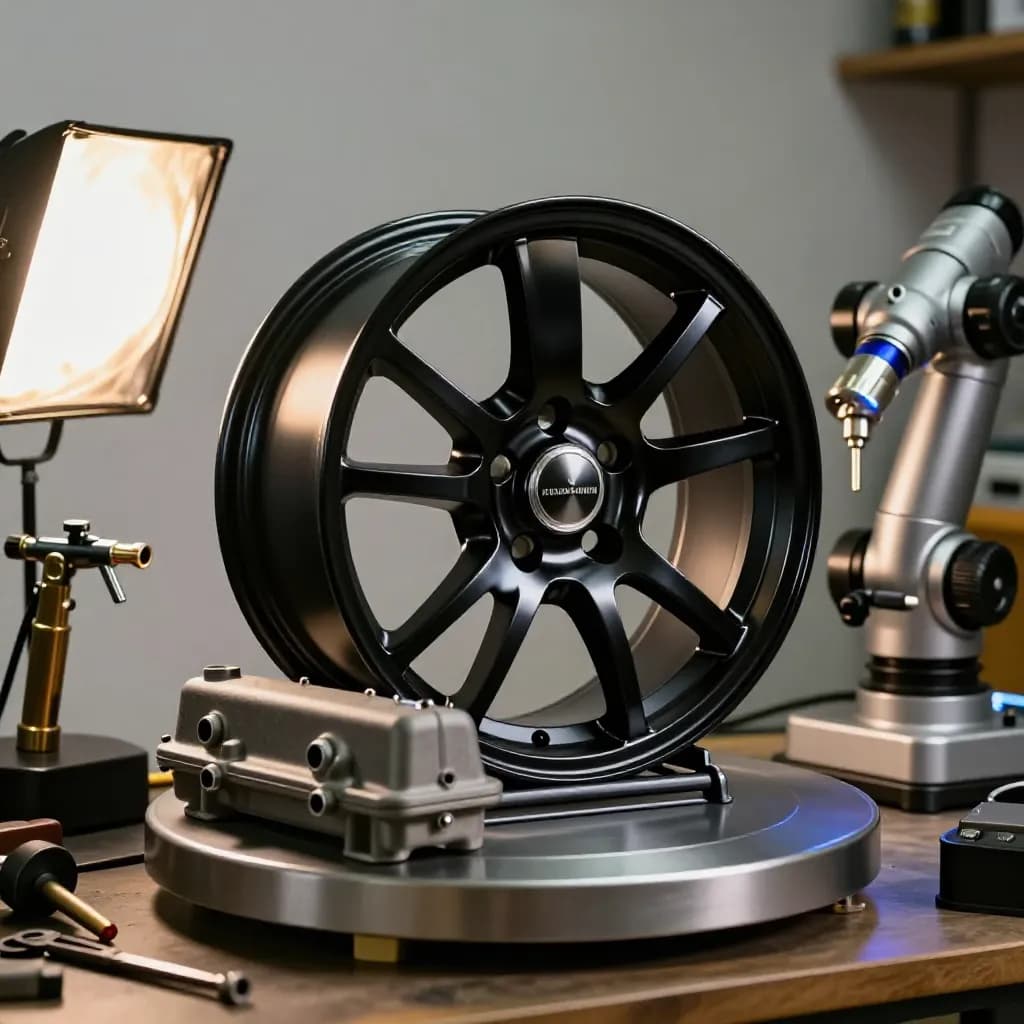
The first significant automotive application of powder coating was epoxy primer for underbody components. General Motors, Ford, and Chrysler in North America, along with European manufacturers including BMW, Volkswagen, and Volvo, began experimenting with epoxy powder primers as replacements for the solvent-based primers that had been standard practice. The results were compelling: powder primers provided thicker, more uniform films with superior edge coverage, dramatically improving corrosion protection on complex stamped and welded components.
Ready to Start Your Project?
From one-off customs to 15,000-part production runs — get precise pricing in 24 hours.
On This Page
Early Automotive Adoption: The 1970s Primer Revolution
The economic case for powder primer was equally strong. Material utilization rates of 95-98% compared to 40-60% for liquid primers meant significant raw material savings. The elimination of solvent purchase, handling, and disposal costs further improved the economics. And the absence of VOC emissions simplified environmental compliance at a time when the US Clean Air Act and equivalent European regulations were imposing increasingly strict limits on industrial solvent emissions.
By the late 1970s, powder primer application had become standard practice for automotive underbody components across most major manufacturers. The technology proved itself in the demanding automotive environment — withstanding stone chip impact, road salt exposure, and the thermal cycling between winter cold and summer heat that characterizes vehicle service conditions.
This early success established powder coating's credibility in the automotive industry and set the stage for its gradual expansion into more visible and technically demanding applications. The automotive sector's rigorous testing requirements and high production volumes also drove significant improvements in powder coating equipment, formulation technology, and quality control methods that benefited the broader powder coating industry.
Expanding Applications: 1980s and 1990s Growth
The 1980s and 1990s saw powder coating expand from underbody primers into a growing range of automotive applications, driven by improvements in powder formulation technology and application equipment. Each new application represented a step up in technical difficulty and visibility, progressively demonstrating powder coating's versatility in the automotive environment.
Automotive wheels became one of the most commercially significant powder coating applications during this period. The combination of excellent corrosion resistance, stone chip resistance, and the ability to achieve attractive metallic and chrome-effect finishes made powder coating the preferred technology for both steel and aluminum wheels. By the mid-1990s, the majority of OEM automotive wheels worldwide were powder coated, a position the technology has maintained ever since.
Engine components — including valve covers, oil pans, intake manifolds, and brackets — were increasingly specified with powder coatings that could withstand the high temperatures, oil exposure, and chemical environment under the hood. Heat-resistant silicone-modified polyester and epoxy powder coatings were developed specifically for these applications, capable of continuous service at temperatures up to 200-250°C.
Suspension components, brake components (excluding friction surfaces), and chassis parts transitioned to powder coating as manufacturers sought to improve corrosion protection and reduce warranty costs. The thick, tough films achievable with powder coating provided superior protection against the stone impact, road debris, and salt exposure that these components endure.
The 1990s also saw the introduction of powder clear coats for automotive applications. Applied over liquid basecoats, powder clear coats offered superior scratch resistance, chemical resistance, and environmental compliance compared to solvent-based liquid clear coats. BMW was among the first manufacturers to adopt powder clear coat technology on production vehicles, demonstrating that powder coating could meet the exacting appearance standards of premium automotive finishes.
Throughout this period, the automotive industry's adoption of powder coating was facilitated by advances in application equipment — particularly automatic spray systems with rapid color change capability, robotic gun movers for complex part geometries, and sophisticated reclaim systems that maintained powder quality through multiple recycling passes.
The Push for Powder Basecoat and Topcoat
The ultimate prize in automotive powder coating — replacing liquid basecoat and topcoat on vehicle body panels — has been the subject of intensive research and development since the 1990s. This application represents the most technically demanding challenge in powder coating, requiring film smoothness, color matching, and appearance quality that rivals or exceeds the best liquid paint finishes.
The technical barriers to powder body coating are significant. Automotive body panels demand extremely smooth finishes with minimal orange peel — a requirement that pushes against powder coating's natural tendency to produce slightly textured surfaces due to the particle nature of the material. Film thickness must be precisely controlled in the 50-70 micron range, thinner than typical powder coating applications. And color matching must be exact across panels produced on different days and different production lines.
Several major OEMs have invested heavily in powder body coating technology. BMW's plant in Munich was among the first to implement powder primer-surfacer on body shells, replacing the liquid primer-surfacer that had been standard practice. This application demonstrated that powder coating could achieve the surface smoothness required for automotive body panels when applied over properly prepared electrocoat.
Honda's Sayama plant in Japan implemented a powder clear coat process for vehicle bodies in the early 2000s, achieving appearance quality comparable to liquid clear coat while eliminating VOC emissions from the clear coat application step. The success of this installation demonstrated the feasibility of powder body coating in high-volume production.
More recently, several manufacturers have piloted or implemented powder basecoat systems that apply colored powder directly to the vehicle body. These systems use ultra-fine powder particles (median size 20-30 microns) and advanced application technology to achieve the smooth, uniform films required for automotive body appearance. While adoption has been gradual, the technology continues to improve, and industry observers expect powder basecoat to gain significant market share over the coming decade.
The environmental benefits of powder body coating are substantial. Replacing liquid basecoat and clear coat with powder equivalents can reduce VOC emissions from the paint shop by 50-70%, significantly contributing to automotive manufacturers' sustainability targets.
Electric Vehicles and the Sustainability Imperative
The rise of electric vehicles (EVs) is creating new momentum for powder coating adoption in the automotive industry. EV manufacturers, many of which are building new production facilities without legacy liquid paint infrastructure, have the opportunity to design their coating processes around powder technology from the ground up. And the sustainability positioning of EVs creates a natural alignment with powder coating's zero-VOC, high-efficiency environmental profile.
Tesla's manufacturing approach has drawn attention to the potential for powder coating in EV production. The company's focus on manufacturing efficiency and environmental performance has led to exploration of powder coating technologies for various vehicle components. The large aluminum castings used in Tesla's structural battery packs and underbody assemblies are well-suited to powder coating, which provides excellent corrosion protection and electrical insulation.
Battery enclosures and battery pack components represent a particularly important application for powder coating in EVs. These components require coatings that provide corrosion protection, electrical insulation, thermal management, and resistance to battery electrolyte chemicals. Specialized powder coating formulations have been developed to meet these demanding requirements, with some systems incorporating thermally conductive fillers that help manage battery heat dissipation.
The electric motor and power electronics components in EVs also benefit from powder coating. Electrical insulation coatings for motor stators and rotors, protective coatings for power inverter housings, and thermal management coatings for heat sinks are all applications where powder coating's combination of electrical, thermal, and protective properties is valuable.
EV charging infrastructure — including charging stations, cable management systems, and associated electrical equipment — represents an additional growth market for powder coating. These outdoor installations require durable, weather-resistant finishes that maintain their appearance and protective function over many years of exposure. Powder coating's proven outdoor durability makes it the natural choice for this application.
The broader automotive industry's commitment to carbon neutrality is also driving powder coating adoption. Major manufacturers including Volkswagen, BMW, Mercedes-Benz, and Toyota have announced ambitious carbon reduction targets for their manufacturing operations. Converting from liquid to powder coating is one of the most impactful steps a paint shop can take to reduce energy consumption, eliminate solvent emissions, and decrease waste generation.
OEM Milestones and Technology Evolution
The history of automotive powder coating is marked by a series of OEM milestones — specific implementations by major manufacturers that demonstrated new capabilities and set precedents for the broader industry. These milestones trace the technology's progression from simple functional coatings to sophisticated decorative finishes.
In 1972, General Motors became one of the first major automakers to use powder coating in production, applying epoxy powder to underbody components at several North American assembly plants. This early adoption validated powder coating for high-volume automotive manufacturing and encouraged other OEMs to follow.
BMW's adoption of powder primer-surfacer at its Munich plant in the late 1990s was a landmark event that demonstrated powder coating's capability for body-in-white applications. The success of this installation influenced other European manufacturers to evaluate powder primer-surfacer for their own production lines.
Honda's implementation of powder clear coat at the Sayama plant in Japan, operational from the early 2000s, proved that powder coating could achieve the appearance quality required for the outermost layer of an automotive finish. This was a significant psychological barrier to overcome, as the clear coat is the layer most visible to the consumer and most critical for perceived quality.
Volkswagen Group's investment in powder coating technology across multiple brands and plants has been one of the most comprehensive in the industry. The group has implemented powder coating for wheels, underbody components, engine parts, and structural elements across its Volkswagen, Audi, Porsche, and other brand production facilities.
Toyota's development of powder coating processes for hybrid and electric vehicle components has positioned the company at the forefront of EV-specific coating technology. The company's expertise in lean manufacturing has also contributed to optimizing powder coating processes for maximum efficiency and minimum waste.
These OEM milestones collectively demonstrate a clear trajectory: powder coating is progressively moving from hidden, functional applications toward visible, decorative applications on the vehicle body. Each successful implementation builds confidence in the technology and encourages further adoption across the industry.
Aftermarket and Custom Automotive Powder Coating
While OEM applications represent the largest volume of automotive powder coating, the aftermarket and custom automotive sectors have played an important role in popularizing the technology among car enthusiasts and demonstrating its capabilities for decorative applications.
Custom wheel refinishing is one of the most visible aftermarket powder coating applications. Car enthusiasts seeking unique colors, textures, or effects for their wheels have driven demand for an enormous range of powder coating finishes — from subtle satin blacks and gunmetal grays to vivid candy colors, chrome effects, and color-shifting chameleon finishes. The durability of powder coating compared to liquid paint makes it particularly attractive for wheels, which are subjected to brake dust, road salt, curb impacts, and frequent cleaning.
Brake caliper coating has become another popular aftermarket application, with performance car owners choosing brightly colored powder coatings to create a visual accent visible through open-spoke wheels. Red, yellow, blue, and orange powder-coated calipers have become a signature styling element for performance and luxury vehicles.
Engine bay components — valve covers, intake manifolds, brackets, and heat shields — are frequently powder coated by enthusiasts seeking a clean, professional appearance under the hood. The heat resistance of appropriate powder coating formulations (silicone-modified polyesters or high-temperature epoxies) makes them well-suited to the thermal environment of the engine bay.
Suspension components, roll cages, chassis braces, and structural accessories are commonly powder coated in the aftermarket for both protection and appearance. The thick, tough films provided by powder coating offer superior protection against stone chips, road debris, and corrosion compared to rattle-can or brush-applied liquid paints.
The custom automotive powder coating market has also been a testing ground for new colors, effects, and application techniques that sometimes find their way into OEM production. Innovations in metallic effects, texture coatings, and multi-layer finish systems have often been pioneered in the aftermarket before being adopted by vehicle manufacturers for production applications.
The growth of social media and automotive enthusiast communities has amplified the visibility of powder-coated automotive components, creating awareness among a broader audience and driving demand for both aftermarket services and OEM powder-coated options.
The Road Ahead: Automotive Powder Coating's Future
The future of powder coating in the automotive industry is shaped by converging trends in sustainability, electrification, lightweighting, and manufacturing efficiency. These trends collectively point toward significantly increased powder coating adoption across all vehicle types and component categories.
Full body powder coating — applying powder basecoat, and potentially powder primer and clear coat, to the entire vehicle body — remains the industry's long-term aspiration. Advances in ultra-fine powder technology, improved flow and leveling additives, and sophisticated application systems are steadily closing the appearance gap between powder and liquid body finishes. Industry experts anticipate that powder body coating will become commercially mainstream within the next decade, driven by the combination of environmental regulation, sustainability commitments, and improving technology.
The growth of aluminum and mixed-material vehicle bodies, driven by lightweighting requirements for both conventional and electric vehicles, favors powder coating adoption. Aluminum body panels and structural components are naturally suited to powder coating, which provides excellent adhesion to aluminum substrates and does not require the complex multi-layer primer systems needed for steel bodies.
Advanced driver assistance systems (ADAS) and autonomous driving technology are creating new coating requirements. Radar-transparent coatings that allow millimeter-wave radar signals to pass through painted bumper fascias without attenuation are an active development area. Powder coating formulations that are transparent to radar frequencies while maintaining automotive appearance quality are being developed by several major coating manufacturers.
The circular economy concept is influencing automotive coating strategy. Powder coating's high material efficiency, zero solvent waste, and compatibility with aluminum recycling align with the automotive industry's goals for closed-loop material flows. Some manufacturers are exploring the use of recycled-content powder coatings and the recovery of powder coating material from end-of-life vehicles.
As the automotive industry transforms through electrification, digitalization, and sustainability, powder coating is positioned to play an increasingly central role in vehicle manufacturing. The technology's combination of environmental performance, material efficiency, and improving aesthetic capability makes it the coating technology best aligned with the automotive industry's future direction.
Frequently Asked Questions
When did the automotive industry start using powder coating?
The automotive industry began adopting powder coating in the early 1970s, starting with epoxy primers for underbody components. General Motors was among the first major OEMs to implement powder coating in production around 1972. The technology expanded to wheels, engine parts, and suspension components through the 1980s and 1990s.
Can powder coating be used on car body panels?
Yes, though adoption has been gradual due to the demanding appearance requirements. BMW implemented powder primer-surfacer, Honda adopted powder clear coat, and several manufacturers have piloted powder basecoat systems using ultra-fine particles (20-30 micron median size). Full powder body coating is expected to become mainstream within the next decade.
How does powder coating benefit electric vehicles?
Powder coating aligns with EV sustainability goals through zero VOC emissions and high material efficiency. It provides critical functions for EV-specific components including battery enclosure corrosion protection, electrical insulation for motors and power electronics, and thermal management coatings. New EV factories can design around powder technology from the start.
What automotive components are commonly powder coated?
Common applications include wheels, underbody components, engine parts (valve covers, intake manifolds), suspension components, brake calipers, chassis parts, battery enclosures, and structural elements. Powder clear coat over liquid basecoat is used on some vehicle bodies, and full powder body coating is in development.
Why is powder coating popular for aftermarket automotive work?
Powder coating offers superior durability compared to liquid paint for wheels, calipers, engine parts, and suspension components. It provides thick, chip-resistant films, excellent corrosion protection, and a wide range of colors and effects including metallics, candies, and textures. The finish withstands the harsh conditions automotive components face in service.
Ready to Start Your Project?
From one-off customs to 15,000-part production runs — get precise pricing in 24 hours.