Heat exchangers and radiators operate in environments that aggressively attack unprotected metal surfaces — condensing moisture, corrosive process fluids, airborne contaminants, and thermal cycling all contribute to corrosion that reduces heat transfer efficiency and ultimately causes equipment failure. Powder coating provides a durable, corrosion-resistant barrier that extends equipment life while maintaining the thermal performance that is the primary function of these components.
Technical
Powder Coating Heat Exchangers and Radiators: Thermal Impact, Thin Film, and HVAC Applications
Sundial Powder Coating·April 22, 2026·13 min
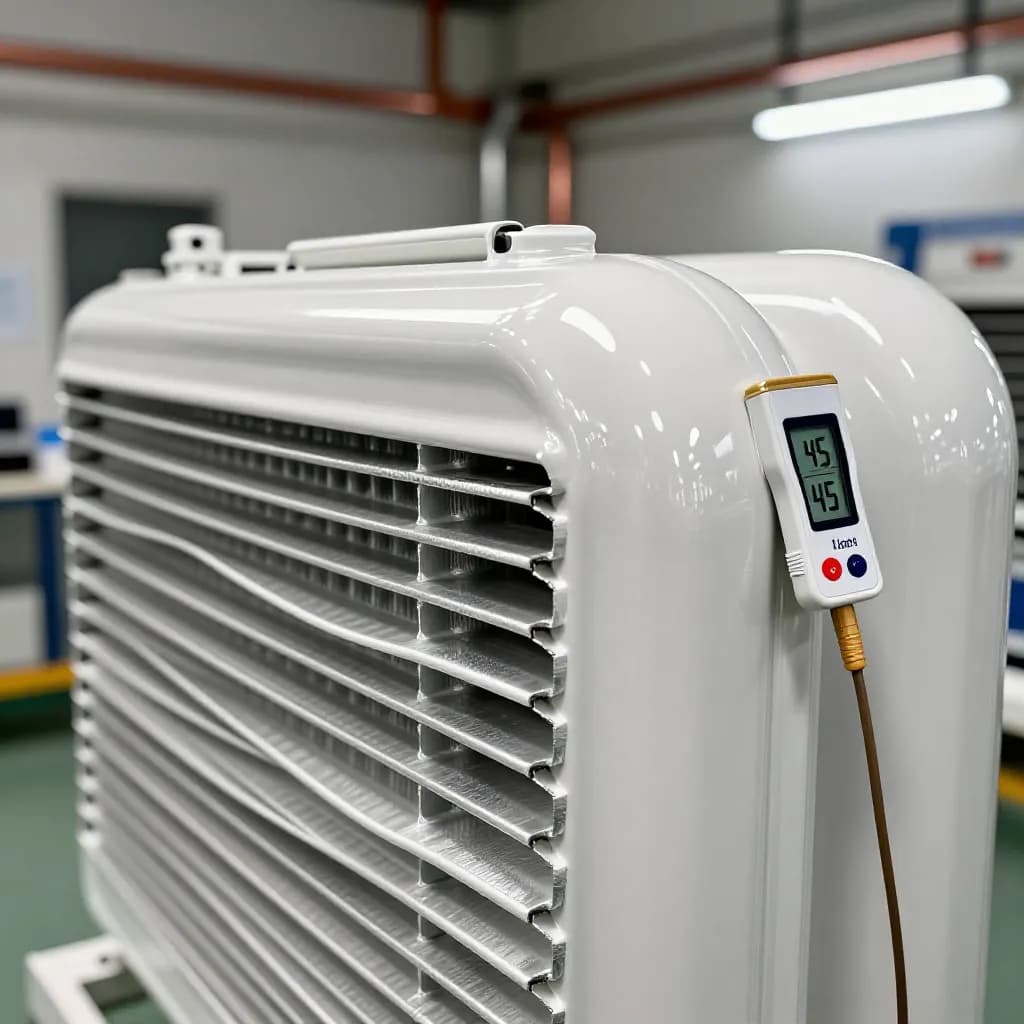
The corrosion challenge is particularly acute for HVAC equipment installed in coastal, industrial, or high-humidity environments. Aluminum fin-and-tube heat exchangers in air conditioning condensers and evaporators are exposed to salt-laden air, acid rain, and airborne pollutants that cause pitting corrosion of the aluminum fins and galvanic corrosion at the aluminum-copper tube interface. Unprotected units in coastal locations can lose 30-50% of their heat transfer capacity within 5-7 years due to fin corrosion and blockage. Powder coating the fin pack extends service life to 15-20 years in the same environment, dramatically reducing maintenance costs and equipment replacement frequency.
Ready to Start Your Project?
From one-off customs to 15,000-part production runs — get precise pricing in 24 hours.
On This Page
Why Powder Coat Heat Transfer Equipment?
Steel panel radiators for hydronic heating systems, automotive radiators, and industrial process heat exchangers also benefit from powder coating for corrosion protection, aesthetic finishing, and fluid compatibility. The challenge in all heat transfer applications is balancing corrosion protection (which favors thicker coatings) against thermal performance (which favors thinner coatings or no coating at all). Understanding the thermal impact of powder coatings and optimizing film thickness for each application is the key to successful heat exchanger coating.
Thermal Conductivity Impact of Powder Coatings
Powder coatings are thermal insulators, with thermal conductivity values of 0.15-0.30 W/m·K — roughly 1000 times lower than aluminum (205 W/m·K) and 200 times lower than steel (50 W/m·K). This means that a powder coating layer adds thermal resistance to the heat transfer path, reducing the overall heat transfer coefficient of the coated surface. The magnitude of this reduction depends on the coating thickness, the base metal's thermal conductivity, and the dominant mode of heat transfer (conduction, convection, or radiation).
For a typical aluminum fin-and-tube heat exchanger with a powder coating thickness of 25-40 micrometers, the thermal resistance added by the coating is relatively small compared to the air-side convective resistance, which is the dominant resistance in most air-cooled heat exchangers. Calculations and experimental measurements show that a 30-micrometer powder coating on aluminum fins reduces overall heat transfer by approximately 2-5%, depending on the heat exchanger geometry and operating conditions. This modest reduction is generally acceptable given the significant corrosion protection benefit, and it can be compensated by a small increase in fan speed or heat exchanger surface area.
For steel radiators with thicker coatings (60-100 micrometers), the thermal impact is somewhat larger — approximately 3-8% reduction in heat output. However, steel's lower thermal conductivity means that the coating's thermal resistance is a smaller fraction of the total wall resistance compared to aluminum. In practice, radiator manufacturers account for the coating's thermal resistance in their heat output ratings, so the published performance data already reflects the coated condition. The thermal impact becomes more significant for thick coatings (above 100 micrometers) or for applications where the coating is applied to both sides of the heat transfer surface, doubling the insulating effect.
Thin Film Coating Techniques for Fins and Tubes
Achieving thin, uniform powder coatings on heat exchanger fins and tubes requires specialized application techniques that differ from standard industrial powder coating. The target film thickness for heat exchanger applications is typically 20-40 micrometers — significantly thinner than the 60-100 micrometers standard for general industrial coating. At these thin film builds, coating uniformity, edge coverage, and defect control become more challenging, and the application process must be optimized for precision rather than throughput.
Electrostatic spray application of thin films requires careful parameter control. Powder flow rate should be reduced to 50-100 g/min per gun (versus 150-300 g/min for standard applications), and electrostatic voltage should be moderate (50-70 kV) to avoid back-ionization that causes orange peel and poor adhesion at thin film builds. Fine particle size powders (D50 of 20-30 micrometers versus 35-45 micrometers for standard powders) produce smoother, more uniform thin films because the smaller particles flow and level more readily during cure. However, fine powders are more difficult to fluidize and transport, requiring optimized powder delivery systems.
For fin-and-tube heat exchangers, the coating is typically applied to the assembled fin pack rather than to individual fins and tubes. The fin pack presents a dense array of closely spaced fins (typically 1.5-3.0 mm fin spacing) that create severe Faraday cage effects, preventing electrostatic spray from penetrating to the inner fins and tube surfaces. Dip coating in a fluidized bed of fine powder, followed by controlled heating to melt and flow the coating, can achieve more uniform coverage of the fin pack interior. Alternatively, the fins can be coated individually before assembly, though this adds manufacturing complexity and requires the coating to withstand the fin-tube joining process (typically mechanical expansion or brazing).
Pretreatment for Heat Exchanger Substrates
Pretreatment for heat exchangers must be compatible with the multi-metal construction typical of these assemblies. Fin-and-tube heat exchangers commonly combine aluminum fins with copper tubes, creating a galvanic couple that is susceptible to corrosion at the interface. The pretreatment process must clean and convert both metals without preferentially attacking either one, and the conversion coating must provide corrosion protection at the bimetallic interface.
Chromate conversion coatings have historically been the standard pretreatment for aluminum heat exchangers, providing excellent corrosion resistance at the aluminum-copper interface. The transition to chromate-free alternatives has been driven by environmental regulations, with titanium/zirconium-based and silane-based conversion coatings emerging as the leading replacements. These systems deposit thin, protective layers on both aluminum and copper surfaces, providing corrosion resistance and adhesion promotion without the toxicity of hexavalent chromium.
For steel panel radiators, iron phosphate or zinc phosphate conversion coatings are standard, applied through spray or immersion pretreatment lines. The pretreatment must reach all internal surfaces of the radiator — including the water channels and header connections — to provide corrosion protection on surfaces that will contact the heating system water. Cathodic electrocoat (e-coat) is sometimes used as a primer on steel radiators before powder topcoating, providing excellent coverage of internal surfaces through the electrodeposition process. The e-coat primer at 15-25 micrometers provides corrosion protection on internal surfaces, while the powder topcoat at 60-80 micrometers provides the external decorative and protective finish.
HVAC Condenser and Evaporator Coating
HVAC condensers and evaporators are the largest application segment for powder-coated heat exchangers, driven by the need to protect aluminum fin packs from corrosion in outdoor and aggressive indoor environments. Rooftop air conditioning units, split system condensers, heat pump outdoor units, and commercial refrigeration condensers all benefit from fin pack coating, particularly in coastal, industrial, and high-humidity installations.
The coating process for HVAC fin packs typically involves alkaline cleaning to remove forming oils and metal fines from the fin manufacturing process, chromate-free conversion coating, drying, powder application, and cure. The entire fin pack — which may measure 500-2000 mm wide, 300-1000 mm tall, and 25-100 mm deep — is processed as a single unit. Powder is applied by electrostatic spray to the external faces and by airflow-assisted deposition to the interior fins. Some manufacturers use a combination of electrostatic spray and fluidized bed dip to achieve uniform coverage throughout the fin pack depth.
The cure cycle for coated fin packs must account for the assembly's thermal characteristics. The dense array of thin aluminum fins (0.1-0.15 mm thick) heats up rapidly, but the copper tubes (6-12 mm diameter, 0.3-0.5 mm wall) have significantly higher thermal mass and heat more slowly. The cure oven must bring the entire assembly — including the tube surfaces within the fin pack — to cure temperature without over-curing the fins. Convection ovens with high air velocity provide the most uniform heating of fin pack assemblies, as the forced air penetrates between the fins and heats all surfaces simultaneously. Cure temperatures of 180-200°C for 10-15 minutes at metal temperature are standard for polyester powder coatings on HVAC heat exchangers.
Automotive and Industrial Radiator Coating
Automotive radiators — both engine cooling radiators and heater cores — are powder coated for corrosion protection and aesthetic finishing. Modern automotive radiators are predominantly aluminum construction (aluminum tubes and fins with plastic header tanks), replacing the traditional copper-brass construction. The all-aluminum construction eliminates the galvanic corrosion concern but introduces new challenges related to the thin-gauge aluminum materials (tube walls of 0.2-0.4 mm, fin thickness of 0.05-0.1 mm) and the brazed construction that creates potential leak paths if corrosion penetrates the tube wall.
Powder coating automotive radiators requires ultra-thin film application — typically 15-25 micrometers — to minimize thermal impact on the critical engine cooling function. At these film thicknesses, the coating provides meaningful corrosion protection while adding less than 2% thermal resistance to the heat transfer path. The thin film requirement demands fine particle size powders, precise electrostatic control, and careful cure optimization to achieve a continuous, defect-free coating at minimal thickness.
Industrial process heat exchangers — shell-and-tube, plate-and-frame, and air-cooled types — are powder coated for corrosion protection in chemical processing, power generation, oil and gas, and water treatment applications. These heat exchangers may operate with aggressive process fluids (acids, alkalis, brines, hydrocarbons) at elevated temperatures, requiring coating chemistries with specific chemical and thermal resistance. Epoxy powder coatings provide the broadest chemical resistance for industrial heat exchangers, while fluoropolymer (PTFE, PFA, ETFE) coatings offer the ultimate in chemical inertness and non-stick properties for fouling-prone applications. Fusion-bonded epoxy (FBE) at 200-400 micrometers is used for heavy-duty protection of heat exchanger shells and headers in offshore and chemical plant service.
Testing and Performance Validation
Performance validation for powder-coated heat exchangers must evaluate both the coating's protective properties and its impact on thermal performance. Corrosion testing is the primary qualification requirement, with test methods and acceptance criteria tailored to the specific service environment. For HVAC applications, ASTM B117 neutral salt spray testing (500-3000 hours depending on the specification), ASTM G85 Annex A5 (SO₂ salt spray for industrial environments), and SWAAT testing per ASTM G85 Annex A3 (synthetic sea water acetic acid test for marine environments) are commonly specified.
Thermal performance testing compares the heat transfer capacity of coated and uncoated heat exchangers under standardized conditions. The test measures the overall heat transfer coefficient (U-value) or the heat rejection/absorption capacity at defined fluid temperatures and flow rates. The acceptable thermal performance reduction depends on the application — HVAC specifications typically allow 3-5% reduction, while automotive specifications may limit the reduction to 2% or less. Any thermal performance loss must be documented and communicated to the equipment designer so that the heat exchanger can be sized appropriately for the coated condition.
Adhesion testing for heat exchanger coatings must account for the thermal cycling that these components experience in service. Cross-hatch adhesion per ISO 2409 should achieve classification 0 both initially and after thermal cycling representative of the service conditions — for HVAC applications, 500-1000 cycles between -20°C and +60°C; for automotive radiators, 500 cycles between -40°C and +120°C. Humidity resistance testing per ISO 6270 (1000-2000 hours at 40°C/100% RH) evaluates the coating's resistance to moisture-driven adhesion loss and blistering. For coatings in contact with process fluids, immersion testing in the actual process fluid at service temperature provides the most relevant performance data.
Frequently Asked Questions
How much does powder coating reduce heat exchanger performance?
A 25-40 micrometer powder coating on aluminum fins reduces overall heat transfer by approximately 2-5%. On steel radiators with 60-100 micrometer coatings, the reduction is 3-8%. This modest impact is generally acceptable given the significant corrosion protection benefit and can be compensated by slightly increasing the heat exchanger surface area or fan speed.
What film thickness is used for heat exchanger coating?
Heat exchanger fins are typically coated at 20-40 micrometers to minimize thermal impact. Automotive radiators use ultra-thin films of 15-25 micrometers. Steel panel radiators receive standard 60-80 micrometer coatings. Industrial heat exchanger shells may use 200-400 micrometer fusion-bonded epoxy for heavy-duty corrosion protection where thermal impact is less critical.
How do you coat inside a dense fin pack?
Dense fin packs (1.5-3.0 mm fin spacing) create severe Faraday cage effects that prevent electrostatic spray penetration. Solutions include airflow-assisted powder deposition that carries powder between fins, fluidized bed dip coating of the assembled fin pack, or pre-coating individual fins before assembly. High-velocity convection cure ovens ensure uniform heating throughout the fin pack depth.
What powder type is best for HVAC heat exchangers?
Polyester powder coatings are standard for HVAC applications, providing UV resistance for outdoor condensers, corrosion protection, and good thermal stability. For industrial heat exchangers with aggressive process fluids, epoxy powders offer broader chemical resistance. Fluoropolymer coatings (PTFE, PFA) provide ultimate chemical inertness for fouling-prone applications.
Does powder coating prevent aluminum fin corrosion in coastal areas?
Yes, powder-coated aluminum fin packs in coastal HVAC installations can achieve 15-20 years of service life compared to 5-7 years for uncoated units. The coating prevents salt-laden air from directly attacking the aluminum surface and protects the aluminum-copper interface from galvanic corrosion. Chromate-free conversion coating plus 25-40 micrometer polyester powder is the standard system.
Ready to Start Your Project?
From one-off customs to 15,000-part production runs — get precise pricing in 24 hours.