Grey has emerged as the defining color of contemporary architecture and industrial design. From the anthracite window frames that characterize modern residential buildings to the light grey enclosures that populate data centers and manufacturing facilities, grey powder coating bridges the gap between the authority of black and the brightness of white while offering a sophistication that neither extreme can achieve alone.
Design
Powder Coating Grey Finishes: RAL 7016, 7035, 7040, 7042 and Architectural Grey Selection
Sundial Powder Coating·April 22, 2026·12 min
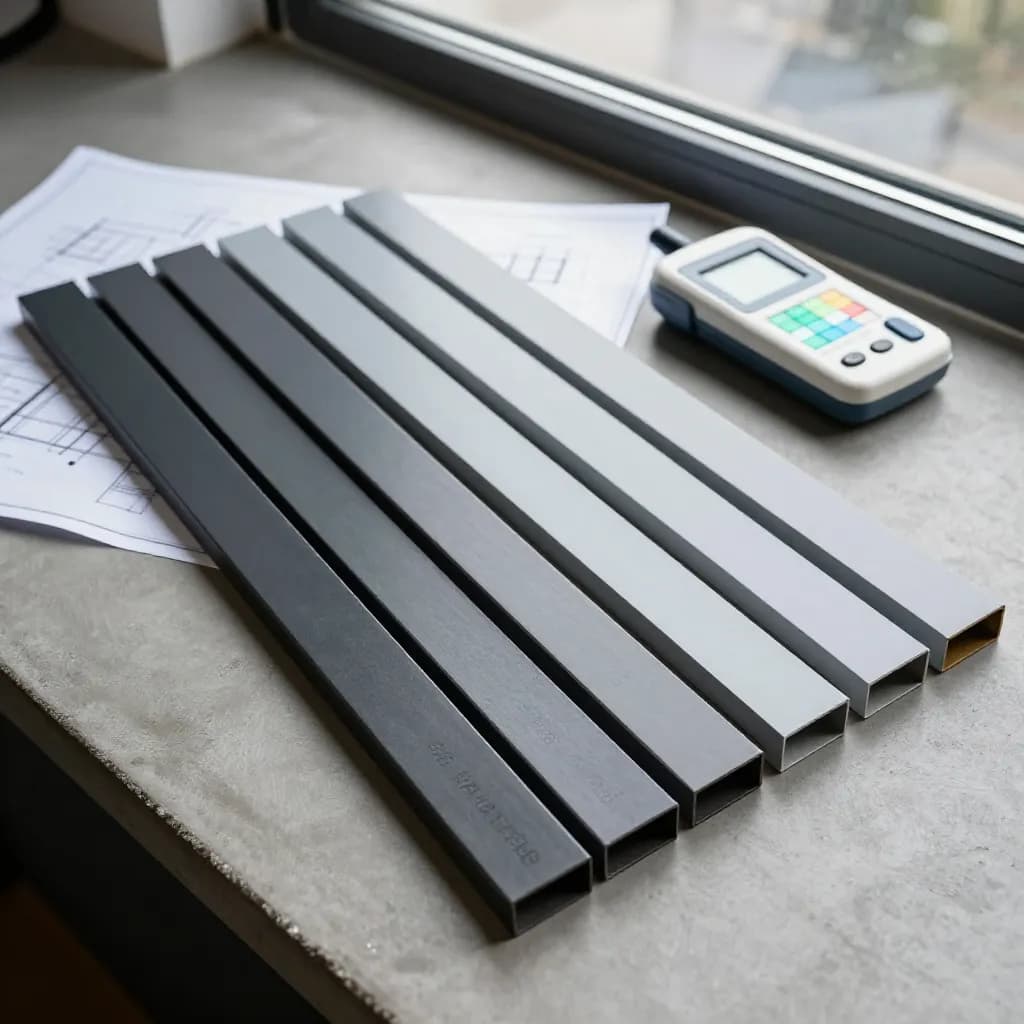
The RAL 7000 series contains over 40 distinct grey shades, ranging from near-white light greys to near-black dark greys, with warm, cool, and neutral undertones across the spectrum. This breadth of choice allows designers to select greys that precisely complement their material palettes, lighting conditions, and design intentions. A warm grey with brown undertones creates an entirely different mood than a cool grey with blue undertones, even when both are similar in lightness.
Ready to Start Your Project?
From one-off customs to 15,000-part production runs — get precise pricing in 24 hours.
On This Page
Grey: The Architect's Most Versatile Powder Coating Color
Grey powder coating also offers practical advantages. Medium greys hide dirt and weathering more effectively than white while absorbing less solar radiation than black, making them excellent choices for exterior applications in all climates. Grey surfaces show fingerprints and handling marks less readily than either black or white, reducing maintenance demands. These practical benefits, combined with grey's inherent design versatility, explain why grey shades collectively account for a significant proportion of all architectural powder coating specified globally.
RAL 7016 Anthracite Grey: The Modern Architecture Standard
RAL 7016 Anthracite Grey has become the single most specified grey in contemporary architecture. This deep, dark grey with a subtle blue undertone has achieved near-universal adoption for window frames, door systems, curtain wall mullions, and exterior metalwork on modern residential and commercial buildings. Its popularity stems from its ability to provide strong visual definition without the starkness of black, creating clean architectural lines that complement a wide range of facade materials.
The appeal of RAL 7016 lies in its chameleon-like quality. In bright sunlight, it reads as a medium-dark grey with visible depth and dimension. In overcast conditions or shadow, it darkens toward near-black, providing the contrast and definition that architects seek. This variability under different lighting conditions gives RAL 7016 a dynamic quality that flat black cannot match.
RAL 7016 pairs exceptionally well with natural materials. Against red or buff brick, it provides crisp, contemporary contrast. Alongside timber cladding, it creates a sophisticated modern-rustic aesthetic. Combined with white render or concrete, it delivers the clean, graphic quality that defines current architectural trends. This versatility across material palettes is a key reason for its dominance.
For exterior applications, RAL 7016 should be specified in super-durable polyester to maintain its depth and undertone over time. Standard polyester formulations may shift slightly in tone after extended UV exposure, potentially losing the blue undertone that distinguishes RAL 7016 from warmer dark greys. Qualicoat Class 2 or AAMA 2605 certification ensures the color remains true throughout the building's service life.
RAL 7035 Light Grey: The Industrial and Technical Standard
RAL 7035 Light Grey occupies a unique position in the powder coating world as the default color for industrial and technical applications. Electrical enclosures, control cabinets, server racks, laboratory equipment, and machine housings are overwhelmingly finished in RAL 7035, to the point where it has become an unwritten industry standard. Its dominance in these sectors is so complete that specifying any other color for an electrical cabinet often requires explicit justification.
The reasons for RAL 7035's industrial dominance are practical rather than aesthetic. Its light tone maximizes visibility inside enclosures, making it easier to identify components, read labels, and perform maintenance tasks. It provides sufficient contrast for cable identification and component marking without the glare associated with white. RAL 7035 also shows contamination and damage clearly, which is important for quality control and maintenance inspection in industrial environments.
RAL 7035 is a neutral light grey with minimal warm or cool bias, making it visually unobtrusive in any environment. It does not compete with the equipment or systems it houses, allowing the functional elements to remain the visual focus. This neutrality also means RAL 7035 coordinates acceptably with virtually any surrounding color scheme, from clinical white laboratories to raw concrete industrial spaces.
Beyond industrial applications, RAL 7035 has found increasing use in architectural contexts where a clean, bright grey is desired. It works well for ceiling systems, ventilation grilles, and interior metalwork where a lighter alternative to anthracite is needed. In these applications, a satin or matte gloss level is typically preferred over the semi-gloss finish common in industrial use, giving RAL 7035 a more refined architectural character.
RAL 7040 and RAL 7042: The Sophisticated Mid-Range Greys
RAL 7040 Window Grey and RAL 7042 Traffic Grey A represent the sophisticated middle ground of the grey spectrum, offering medium-toned options that are lighter than anthracite but darker than the light industrial greys. These mid-range greys have gained significant traction in architectural and product design as alternatives to the ubiquitous RAL 7016.
RAL 7040 Window Grey is a medium grey with a cool, slightly blue undertone. As its name suggests, it was originally developed for window frame applications and remains popular in fenestration. RAL 7040 provides architectural definition without the visual weight of darker greys, making it suitable for buildings where a lighter, more open appearance is desired. It is particularly effective on larger facade elements where a dark grey might feel oppressive, and on buildings in northern climates where maximizing the perception of light is important.
RAL 7042 Traffic Grey A is a slightly warmer medium grey with a more neutral undertone than RAL 7040. It reads as a balanced, unbiased grey that neither advances nor recedes visually. RAL 7042 is widely used in automotive, transportation, and urban infrastructure applications, and has crossed over into architectural specification for projects seeking a contemporary grey without the cool edge of RAL 7040 or the darkness of RAL 7016.
Both RAL 7040 and RAL 7042 offer practical advantages for exterior applications. Their medium tone provides good dirt-hiding capability without the heat absorption issues associated with darker greys. They maintain visual consistency across varying lighting conditions more effectively than very light or very dark greys, which can appear to change dramatically between sun and shade. For projects where consistent appearance throughout the day is important, mid-range greys deliver the most predictable results.
Warm Grey vs Cool Grey: Understanding Undertones
The distinction between warm and cool greys is one of the most important considerations in grey powder coating specification, yet it is frequently overlooked. Two greys that appear identical in lightness can create completely different visual effects depending on their undertone. A warm grey with brown or yellow undertones creates a cozy, organic feeling, while a cool grey with blue or green undertones produces a crisp, technical atmosphere.
Warm greys in the RAL system include RAL 7006 Beige Grey, RAL 7048 Pearl Mouse Grey, and RAL 7039 Quartz Grey. These shades contain visible brown, taupe, or olive undertones that connect them to natural materials and earth tones. Warm greys are increasingly popular in residential architecture, hospitality design, and retail environments where creating an inviting, approachable atmosphere is important. They pair naturally with timber, leather, natural stone, and warm-toned metals like brass and copper.
Cool greys include RAL 7016 Anthracite Grey, RAL 7040 Window Grey, RAL 7001 Silver Grey, and RAL 7046 Telegrey 2. These shades carry blue, violet, or green undertones that give them a technical, contemporary character. Cool greys dominate commercial architecture, technology products, and industrial design where precision and modernity are the desired associations.
Neutral greys, such as RAL 7035 Light Grey and RAL 7042 Traffic Grey A, minimize undertone bias and work as versatile backgrounds in any context. They are the safest choice when the grey must coordinate with multiple surrounding colors or when the lighting conditions are variable.
Always evaluate grey samples under the specific lighting conditions of the intended installation. Fluorescent lighting emphasizes cool undertones, while incandescent and warm LED lighting brings out warm undertones. A grey that appears perfectly neutral under one light source may reveal a strong undertone under another.
Grey Powder Coating in Architectural Facade Design
Grey powder coating plays a central role in contemporary facade design, serving as both the primary finish and the supporting element in multi-material compositions. The current architectural trend toward monochromatic grey facades, where different shades and textures of grey create visual interest through subtle variation rather than color contrast, has driven demand for an expanded range of grey powder coating options.
Dark grey facades using RAL 7016 or similar anthracite shades create bold, graphic buildings that stand out in urban environments. These facades work particularly well with large-format cladding panels, where the dark color emphasizes the panel geometry and joint patterns. Dark grey also provides dramatic contrast when combined with feature elements in contrasting materials such as timber, copper, or exposed concrete.
Medium grey facades offer a more restrained approach that integrates buildings into their surroundings rather than making a bold statement. Shades like RAL 7040 or RAL 7037 Dusty Grey are popular for institutional buildings, healthcare facilities, and residential developments where a calm, dignified appearance is appropriate. Medium greys also age gracefully, showing less visible weathering and dirt accumulation than either very light or very dark alternatives.
Light grey facades create bright, open buildings that maximize the perception of space and light. RAL 7035 and RAL 7038 Agate Grey are common choices for commercial and industrial buildings where a clean, professional appearance is desired without the maintenance demands of white. Light grey facades reflect more solar radiation than darker alternatives, contributing to reduced cooling loads in warm climates.
For multi-tone grey facades, specifiers should ensure that all grey shades are evaluated together as a coordinated palette. The relationship between the greys is as important as the individual colors, and undertone mismatches between shades can undermine the intended design effect.
Textured and Metallic Grey Finishes
Grey powder coatings are available in an extensive range of textures and special effects that expand the design possibilities beyond smooth, solid finishes. Textured greys add tactile interest and practical benefits, while metallic greys introduce depth and visual complexity that solid colors cannot achieve.
Fine texture grey finishes, often described as sand or leather textures, are popular for architectural applications where a subtle surface interest is desired. These textures soften the appearance of large metal surfaces, reducing the industrial character that smooth finishes can convey. Fine-textured greys are also more forgiving of substrate imperfections and resist showing fingerprints and minor scratches, making them practical choices for high-traffic architectural elements.
Metallic grey powder coatings incorporate aluminum flakes that create a sparkling, dimensional effect. The metallic particles catch and reflect light differently depending on the viewing angle, giving the surface a dynamic quality that changes throughout the day. Metallic greys range from subtle, barely perceptible shimmer to bold, highly reflective finishes. They are widely used for automotive components, premium consumer products, and architectural feature elements where a standard solid grey feels too flat.
RAL 9006 White Aluminium and RAL 9007 Grey Aluminium are the most commonly specified metallic greys in the RAL system. RAL 9006 is a bright, silver-toned metallic that approximates the appearance of natural aluminum. RAL 9007 is a darker, more subdued metallic grey. Both are popular for architectural cladding, window frames, and facade elements where a metallic appearance is desired without the cost and maintenance requirements of actual metal finishes.
When specifying metallic or textured greys, physical sample approval is essential. These finishes cannot be accurately represented in digital format because their appearance depends on lighting angle, viewing distance, and surface geometry. Request coated sample panels in the actual substrate material and evaluate them under representative lighting conditions.
Specifying Grey Powder Coating: Key Considerations
Effective grey powder coating specification requires precision because the grey spectrum is so broad that vague descriptions inevitably lead to mismatched expectations. The following considerations will help ensure your grey specification delivers the intended result.
Always specify grey by RAL number or custom color reference rather than by name alone. Terms like dark grey, medium grey, or charcoal are interpreted differently by every manufacturer and coater. Even within the RAL system, there are multiple greys that could reasonably be described by the same common name. RAL 7016, RAL 7021, and RAL 7024 are all dark greys, but they differ significantly in undertone and depth.
Consider the viewing context when selecting a grey. A grey that looks perfect on a small sample chip may appear very different when applied to a large facade panel. Darker greys tend to appear lighter at architectural scale, while lighter greys can appear darker. Request large-format samples, ideally 300mm by 300mm or larger, for evaluation of greys intended for large-surface applications.
Account for metamerism, the phenomenon where two colors appear to match under one light source but differ under another. Grey powder coatings are particularly susceptible to metamerism because their complex pigment blends can respond differently to changes in illumination. If components will be viewed under multiple light sources, such as daylight and artificial lighting, verify color consistency under all relevant conditions.
For exterior applications, specify the appropriate durability standard. Super-durable polyester is the minimum recommendation for architectural grey finishes, with Qualicoat Class 2 or AAMA 2605 certification for projects requiring maximum long-term color stability. Dark greys like RAL 7016 absorb more solar radiation than lighter greys, so consider thermal performance implications for exterior applications in hot climates, similar to the considerations for black finishes.
Frequently Asked Questions
What is the most popular grey for modern architecture?
RAL 7016 Anthracite Grey is the most specified grey in contemporary architecture. Its deep, dark tone with a subtle blue undertone provides strong visual definition for window frames, doors, and facade elements while complementing a wide range of building materials including brick, timber, render, and concrete.
Why is RAL 7035 used for electrical enclosures?
RAL 7035 Light Grey maximizes visibility inside enclosures, making it easier to identify components and read labels. Its neutral tone provides good contrast for cable identification without the glare of white. It also shows contamination clearly, which is important for quality control and maintenance inspection.
What is the difference between warm grey and cool grey powder coating?
Warm greys contain brown, taupe, or olive undertones that create a cozy, organic feeling. Cool greys have blue, violet, or green undertones that produce a crisp, technical atmosphere. The undertone significantly affects how the grey coordinates with surrounding materials and the overall mood of the space.
Does dark grey powder coating have heat absorption issues?
Yes, dark greys like RAL 7016 absorb more solar radiation than lighter colors, leading to higher surface temperatures. For exterior applications in hot climates, consider solar-reflective formulations or lighter grey alternatives. Medium greys offer a good balance between visual depth and thermal performance.
How do I choose between RAL 7040 and RAL 7042 grey?
RAL 7040 Window Grey has a cool, slightly blue undertone suited to contemporary and technical aesthetics. RAL 7042 Traffic Grey A is warmer and more neutral, working well in a broader range of contexts. Evaluate both under your project's specific lighting conditions, as the undertone difference becomes more apparent in certain light.
Ready to Start Your Project?
From one-off customs to 15,000-part production runs — get precise pricing in 24 hours.