Greenhouses and horticultural structures create one of the most aggressive environments for metal coatings. Interior humidity levels routinely exceed 80-90% relative humidity, with condensation forming continuously on metal frames as warm, moisture-laden air contacts cooler structural elements. This persistent moisture exposure creates ideal conditions for corrosion, particularly at joints, fixings, and areas where water can pool and stagnate.
Architecture
Powder Coating for Greenhouses and Horticultural Structures
Sundial Powder Coating·April 20, 2026·9 min
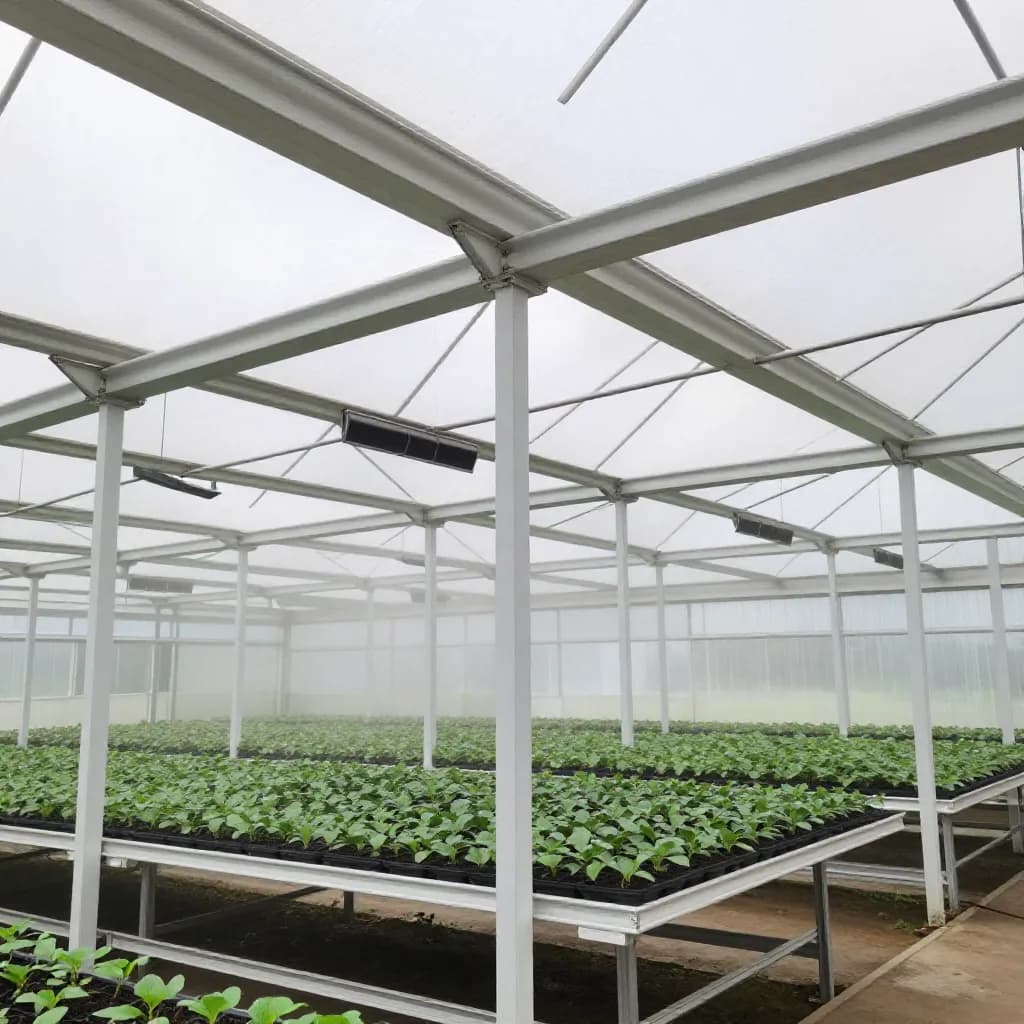
UV exposure in greenhouse environments is intense and continuous. The transparent glazing that defines greenhouse design allows solar radiation to penetrate directly onto structural frames, subjecting coatings to UV levels comparable to full outdoor exposure. Unlike conventional buildings where structural elements are shielded by opaque cladding, greenhouse frames receive direct UV irradiation throughout daylight hours, accelerating the photodegradation of coating systems.
Ready to Start Your Project?
From one-off customs to 15,000-part production runs — get precise pricing in 24 hours.
On This Page
Greenhouse Coating Challenges
Chemical exposure from fertilizers, pesticides, and growth regulators adds another layer of challenge. These agricultural chemicals, often applied as sprays or mists, settle on structural surfaces and create a chemically aggressive film that attacks coating systems over time. The combination of high humidity, UV exposure, and chemical contamination makes greenhouses one of the most demanding environments for any architectural coating.
Aluminum Greenhouse Frames and Fittings
Aluminum is the dominant structural material for modern greenhouse construction, valued for its corrosion resistance, light weight, and ability to be extruded into the complex profiles required for glazing systems. While aluminum does not rust like steel, it is susceptible to surface pitting and white corrosion in the humid, chemically contaminated atmosphere of greenhouse interiors. Powder coating provides the protective barrier that prevents this degradation.
Greenhouse aluminum profiles include main structural members, glazing bars, ridge and eave sections, ventilation hardware, and gutter systems. Each of these components faces the full combination of humidity, UV, and chemical exposure that defines the greenhouse environment. Powder coating at 60-120 microns provides consistent protection across all of these diverse profile shapes, with the electrostatic application process ensuring coverage on the complex geometries of glazing bar sections and ventilation mechanisms.
Fittings and accessories, including shelf brackets, hanging basket supports, staging frames, and irrigation system mounts, are subject to the same environmental challenges as the main structure. These smaller components are often overlooked in coating specifications but are equally vulnerable to the corrosive greenhouse atmosphere. Powder coating provides the same level of protection to these accessories as to the primary structure, ensuring that the entire greenhouse system maintains its integrity over its operational life.
Corrosion Resistance in Humid Growing Environments
The persistent high humidity within greenhouses creates corrosion conditions that test any coating system. Condensation forms on metal surfaces daily, and in heated greenhouses, the cycle of warming and cooling creates repeated wetting and drying that concentrates dissolved salts and chemicals on the metal surface. This concentration effect accelerates corrosion at rates that exceed those found in most outdoor environments.
Powder coating's dense, pinhole-free film at 60-120 microns provides an effective barrier against this moisture-driven corrosion. The thermoset polymer matrix does not absorb water or allow moisture to permeate through to the metal substrate, maintaining the protective barrier even under continuous high-humidity conditions. This is a critical advantage over liquid paint at 25-50 microns, where the thinner film is more susceptible to moisture permeation and the micro-porosity that allows corrosive agents to reach the substrate.
For aluminum greenhouse structures, chromate-free conversion coating pretreatment followed by polyester powder topcoat provides the optimal corrosion protection system. The conversion coating promotes adhesion between the aluminum substrate and the powder coating while providing an additional corrosion-inhibiting layer. This dual-protection approach delivers reliable performance in the demanding humidity conditions of commercial greenhouse operations.
Color Options for Greenhouse Structures
Traditional greenhouse color is white, chosen for its high light reflectance that maximizes the distribution of natural light within the growing space. White powder coating in RAL 9010 or similar references remains the most popular specification for commercial greenhouse structures, providing the bright, clean appearance that growers and garden center visitors expect while reflecting light onto plants from structural surfaces.
Green, in various shades from RAL 6005 Moss Green to RAL 6009 Fir Green, is the traditional alternative for domestic and ornamental greenhouses. Green frames blend with garden surroundings and create a natural, harmonious appearance that complements the planted environment within. Powder coating delivers these greens with the UV stability needed to maintain their depth and richness through years of direct sunlight exposure.
Anthracite grey, particularly RAL 7016, has emerged as a popular contemporary choice for modern greenhouse designs. This dark, sophisticated tone creates a striking contrast with glazing and plant material, lending a contemporary architectural character to greenhouse structures. Powder coating's color stability ensures that anthracite finishes maintain their depth without the fading to a washed-out grey that affects liquid paint under intense UV exposure.
Why Powder Coating Outlasts Paint in Greenhouse Conditions
The performance gap between powder coating and liquid paint is particularly dramatic in greenhouse environments. Liquid paint at 25-50 microns degrades rapidly under the combined assault of high humidity, UV radiation, and chemical exposure that defines greenhouse conditions. Within just a few years, liquid-painted greenhouse frames can show chalking, fading, and adhesion loss that compromises both appearance and protective function.
Powder coating's 60-120 micron film thickness provides a fundamentally more robust barrier. The thicker film takes longer to degrade under UV exposure, resists moisture permeation more effectively, and provides a greater reserve of coating material before the substrate is exposed. The cross-linked thermoset structure of cured powder coating also provides inherent resistance to the fertilizer and pesticide chemicals that attack liquid paint films.
The lifecycle advantage is compelling. Powder-coated greenhouse structures maintain their appearance and protective properties for 20-25 years, while liquid-painted equivalents may require recoating every 5-8 years in the aggressive greenhouse environment. Given the difficulty of recoating greenhouse frames — which requires either removing glazing or working around it — the extended maintenance intervals provided by powder coating represent a significant practical advantage for greenhouse owners and operators.
Frequently Asked Questions
How long does powder coating last in greenhouse conditions?
Powder coating on greenhouse structures typically lasts 20-25 years, even in the demanding conditions of high humidity, UV exposure, and chemical contamination. This compares favorably to liquid paint which may require recoating every 5-8 years in greenhouse environments due to the accelerated degradation caused by persistent moisture and UV.
Can powder coating resist the humidity inside greenhouses?
Yes. Powder coating's dense, pinhole-free film at 60-120 microns provides an effective moisture barrier that does not absorb water or allow permeation to the metal substrate. This is critical in greenhouse environments where humidity routinely exceeds 80-90% and condensation forms continuously on structural surfaces.
What colors are available for powder-coated greenhouses?
White (RAL 9010) remains the most popular choice for maximum light distribution. Traditional greens (RAL 6005, 6009) blend with garden settings, while anthracite grey (RAL 7016) provides a contemporary aesthetic. All colors maintain their appearance for 20-25 years thanks to powder coating's UV stability.
Does powder coating resist fertilizer and pesticide chemicals?
Yes. Powder coating's cross-linked thermoset structure provides inherent resistance to the fertilizer solutions, pesticides, and growth regulators commonly used in greenhouse operations. The 60-120 micron film maintains its integrity through years of chemical exposure that would degrade thinner liquid paint films.
Ready to Start Your Project?
From one-off customs to 15,000-part production runs — get precise pricing in 24 hours.