The glass transition temperature (Tg) is one of the most fundamental physical properties of a powder coating, governing its behavior during storage, application, and curing. Tg is the temperature at which an amorphous polymer transitions from a hard, glassy state to a soft, rubbery state. Below Tg, the polymer chains are essentially frozen in place, and the material behaves as a rigid solid. Above Tg, the chains gain sufficient thermal energy to move and rearrange, and the material becomes progressively softer and more fluid as temperature increases.
Technical
Glass Transition Temperature in Powder Coatings: Tg, Storage Stability, and Formulation Impact
Sundial Powder Coating·April 22, 2026·13 min
For powder coatings, Tg has direct practical consequences at every stage of the product lifecycle. During storage and handling, the powder must remain as free-flowing, discrete particles — this requires that the storage temperature remain well below the Tg of the powder formulation. During application, the powder particles must carry electrostatic charge and deposit uniformly on the substrate — properties that depend on the powder being in its glassy state. During curing, the powder must melt, flow, and level to form a smooth film before crosslinking — a process that begins as the powder temperature exceeds Tg and continues as viscosity decreases with increasing temperature.
Ready to Start Your Project?
From one-off customs to 15,000-part production runs — get precise pricing in 24 hours.
On This Page
What Is Glass Transition Temperature and Why It Matters
The Tg of a powder coating formulation is determined primarily by the Tg of the base resin, but it is also influenced by the crosslinker, additives, pigments, and fillers in the formulation. Typical Tg values for commercial powder coatings range from 40-65°C, with most standard products falling in the 45-55°C range. This range represents a compromise between storage stability (which favors higher Tg) and melt flow behavior (which favors lower Tg for better leveling).
Understanding and controlling Tg is essential for powder coating formulators, manufacturers, and applicators. Tg affects shelf life, shipping and storage requirements, application window, flow and leveling, cure behavior, and final film properties. A thorough understanding of Tg and its implications enables better formulation design, more reliable production, and more consistent coating quality.
Storage Stability and the Blocking Problem
Blocking — the sintering or agglomeration of powder particles during storage — is the most common storage-related quality problem in powder coatings, and it is directly related to Tg. When powder is stored at temperatures approaching or exceeding its Tg, the particle surfaces soften sufficiently to allow adjacent particles to fuse together, forming clumps that cannot be fluidized or sprayed. Severely blocked powder is unusable and must be scrapped, representing a direct material loss.
The relationship between Tg and blocking resistance is not a simple threshold. Blocking begins to occur at temperatures 10-15°C below the measured Tg of the powder, because the glass transition is not a sharp phase change but a gradual transition that occurs over a temperature range. The onset of molecular mobility — and therefore the onset of surface softening — begins below the midpoint Tg value measured by DSC. This means that a powder with a measured Tg of 50°C may begin to show blocking behavior at storage temperatures as low as 35-40°C.
Practical storage recommendations for standard powder coatings specify maximum storage temperatures of 25-30°C, which provides a safety margin below the blocking onset temperature for most commercial products. However, in hot climates or during summer shipping, ambient temperatures can easily exceed these limits. Powder stored in non-climate-controlled warehouses, shipping containers, or delivery vehicles may experience temperatures of 40-50°C or higher, creating significant blocking risk.
Formulators address blocking resistance through several strategies. Selecting resins with higher Tg values (55-65°C) provides a larger safety margin but may compromise melt flow and leveling. Adding dry-flow additives — typically fumed silica or alumina — to the powder surface reduces inter-particle contact and inhibits sintering. These post-blend additives coat the particle surfaces with a thin layer of inorganic nanoparticles that act as physical spacers, preventing the polymer surfaces from coming into direct contact even when slightly softened.
The particle size distribution also influences blocking susceptibility. Finer powders have higher surface area per unit mass and therefore greater inter-particle contact area, making them more prone to blocking than coarser powders. This is one reason why ultra-fine powders (D50 below 20 microns) used for thin-film applications require higher Tg resins and more aggressive dry-flow additive treatment.
Tg and Melt Flow Behavior During Curing
When a powder coating enters the curing oven, its temperature rises through and above the Tg, initiating the sequence of physical changes that transform discrete powder particles into a continuous, smooth coating film. Understanding the relationship between Tg, melt viscosity, and cure kinetics is essential for optimizing coating appearance and performance.
As the powder temperature exceeds Tg, the particles begin to soften and deform. At approximately Tg + 20-30°C, the particles have softened sufficiently to coalesce — merging into a continuous but still rough film. As temperature continues to rise, the viscosity of the molten coating decreases further, and surface tension forces drive the flow and leveling process that smooths out particle boundaries and surface irregularities. The minimum melt viscosity — the point of lowest viscosity before crosslinking begins to increase viscosity — determines the maximum degree of leveling achievable.
The relationship between Tg and minimum melt viscosity is not straightforward. A lower Tg resin does not necessarily produce a lower minimum melt viscosity, because melt viscosity depends on molecular weight, molecular weight distribution, and chain architecture as well as Tg. However, lower Tg resins generally reach their minimum viscosity at lower temperatures and earlier in the cure cycle, providing a longer flow window before crosslinking restricts further leveling.
The flow window — the time between the onset of adequate flow and the gel point where crosslinking prevents further leveling — is the critical parameter for surface quality. A longer flow window allows more complete leveling and produces smoother surfaces with lower orange peel. Formulators can extend the flow window by using slower-reacting crosslinkers, adding flow additives that reduce surface tension, or selecting resins with lower melt viscosity profiles. However, extending the flow window too far can cause sagging on vertical surfaces and edge pull-back on horizontal surfaces.
For applications requiring the highest surface quality — automotive clear coats, appliance finishes, and premium architectural coatings — the Tg, melt viscosity profile, and cure kinetics must be precisely balanced to maximize the flow window while maintaining adequate sag resistance and edge coverage.
Measuring Tg: DSC and Other Analytical Methods
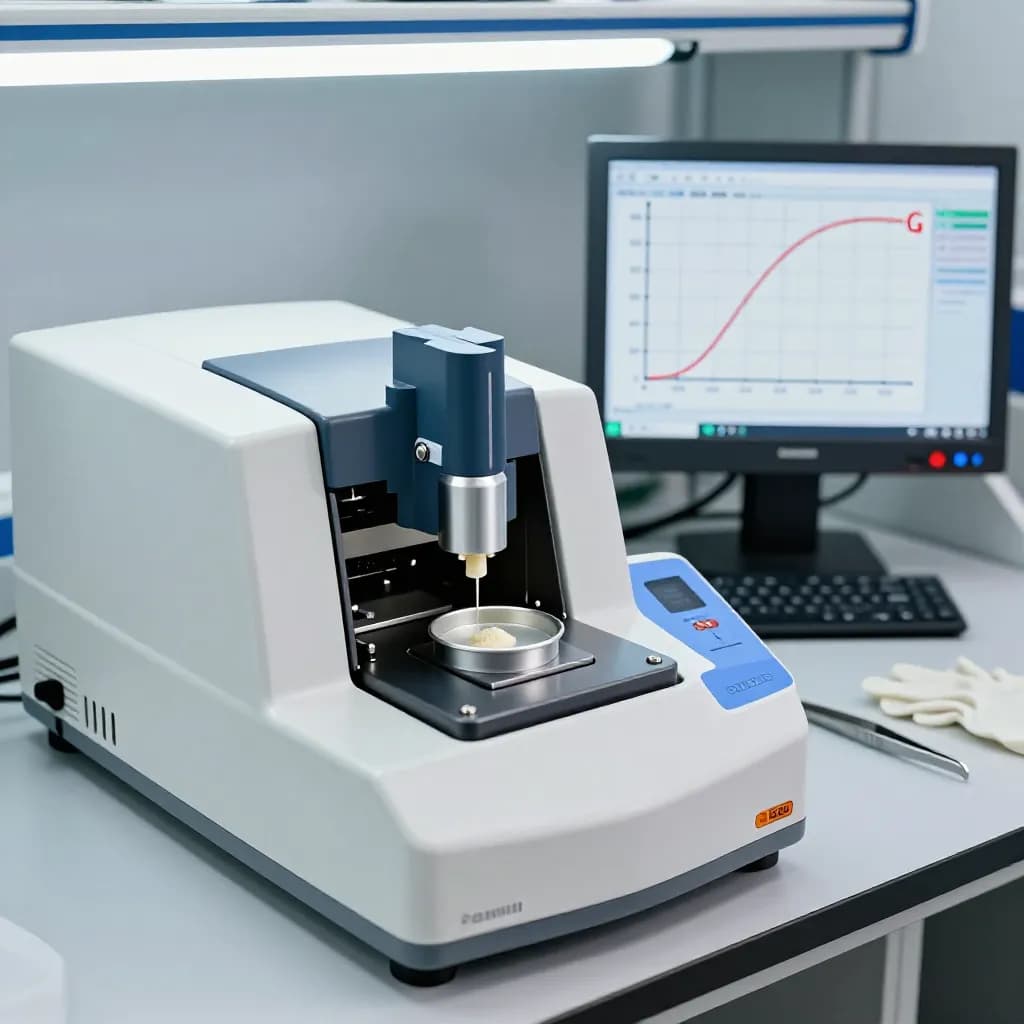
Differential scanning calorimetry (DSC) is the standard analytical method for measuring the glass transition temperature of powder coatings. In a DSC measurement, a small sample of powder (typically 5-15 mg) is heated at a controlled rate (usually 10°C/min) while the heat flow into the sample is measured relative to an empty reference pan. The glass transition appears as a step change in the heat flow signal, reflecting the increase in heat capacity that occurs as the polymer transitions from the glassy to the rubbery state.
The Tg value reported from a DSC measurement depends on the convention used to define it. The midpoint Tg — the temperature at the midpoint of the step change in heat flow — is the most commonly reported value and is specified in ASTM E1356 and ISO 11357-2. The onset Tg — the temperature at which the step change begins — is a more conservative value that better represents the temperature at which molecular mobility first becomes significant. For powder coating storage stability assessments, the onset Tg is often more relevant than the midpoint Tg.
DSC also provides information about the cure reaction of powder coatings. The exothermic peak that appears at higher temperatures in the DSC scan represents the crosslinking reaction, and its onset temperature, peak temperature, and enthalpy provide information about cure reactivity and completeness. By comparing the cure exotherm of uncured powder with that of a cured film sample, the degree of cure can be assessed — a fully cured sample will show no residual exotherm.
Dynamic mechanical analysis (DMA) provides an alternative and often more sensitive measurement of Tg. In DMA, a cured coating film is subjected to oscillating mechanical deformation while temperature is varied, and the storage modulus, loss modulus, and tan delta (damping factor) are measured. The Tg is identified as the peak in the tan delta curve or the onset of the drop in storage modulus. DMA Tg values are typically 10-20°C higher than DSC Tg values for the same material due to the frequency dependence of the glass transition.
Thermomechanical analysis (TMA) measures dimensional changes as a function of temperature and can detect Tg as a change in the coefficient of thermal expansion. While less commonly used than DSC for routine Tg measurement, TMA provides complementary information about the thermal expansion behavior of cured coatings, which is relevant for applications involving thermal cycling or dimensional stability requirements.
Formulation Strategies for Tg Optimization
Optimizing Tg in powder coating formulations requires balancing competing requirements: higher Tg for storage stability versus lower Tg for better melt flow and leveling. The formulator's toolkit for Tg manipulation includes resin selection, crosslinker type and level, additive selection, and pigment and filler loading.
Resin Tg is the dominant factor. Polyester resin manufacturers offer products spanning a Tg range of approximately 40-70°C, with the Tg determined by the monomer composition and molecular architecture of the polyester. Resins based on neopentyl glycol and isophthalic acid tend to have higher Tg values, while resins incorporating longer-chain aliphatic diols or adipic acid have lower Tg values. Blending high-Tg and low-Tg resins is a common approach to achieving intermediate Tg values with optimized flow properties.
Crosslinker type and level influence the Tg of the uncured powder and the Tg of the cured film differently. In the uncured powder, the crosslinker acts as a low-molecular-weight component that can plasticize the resin and reduce Tg. TGIC, HAA, and blocked isocyanate crosslinkers each have different effects on uncured powder Tg depending on their molecular weight, crystallinity, and compatibility with the base resin. In the cured film, higher crosslinker levels increase crosslink density and raise the Tg of the cured network.
Pigments and fillers generally increase the effective Tg of the powder by restricting polymer chain mobility through physical interaction with the resin matrix. Heavily pigmented formulations (high pigment volume concentration) tend to have better storage stability than clear or lightly pigmented formulations at the same resin Tg, because the pigment particles physically impede the sintering process. However, this effect is secondary to the resin Tg and should not be relied upon as the primary strategy for blocking resistance.
Flow additives and other low-molecular-weight additives can reduce the Tg of the powder formulation by acting as plasticizers. While this effect is usually small (1-3°C reduction), it can be significant for formulations that are already marginal in storage stability. Formulators must account for the Tg-depressing effect of additives when designing formulations for hot-climate markets or extended storage requirements.
Tg of Cured Films: Impact on Service Performance
The Tg of the cured coating film is a distinct property from the Tg of the uncured powder, and it has important implications for the service performance of the finished coating. During curing, the crosslinking reaction creates a three-dimensional polymer network that restricts chain mobility and raises the Tg significantly above that of the uncured resin. A well-cured polyester powder coating typically has a cured film Tg of 70-100°C, compared to an uncured powder Tg of 45-55°C.
The cured film Tg determines the maximum service temperature at which the coating maintains its mechanical properties. Above the cured Tg, the coating transitions from a hard, glassy state to a soft, rubbery state, losing hardness, scratch resistance, and chemical resistance. For most architectural and industrial applications, service temperatures remain well below the cured Tg, and this is not a concern. However, for applications involving elevated temperatures — engine components, exhaust systems, industrial ovens, and heat exchangers — the cured Tg must be verified to ensure it exceeds the maximum expected service temperature.
Undercured coatings have lower cured Tg values than fully cured coatings because incomplete crosslinking leaves more unreacted chain segments with greater mobility. This is one reason why undercured coatings show poor hardness, chemical resistance, and weathering performance — the lower Tg means the coating is closer to its rubbery state at service temperature, reducing its ability to resist mechanical and chemical attack.
The cured Tg also influences the coating's response to thermal cycling. When a coated part is subjected to temperature cycles that approach or exceed the cured Tg, the coating undergoes repeated glass-to-rubber transitions that can cause stress buildup, microcracking, and adhesion loss over time. For applications involving thermal cycling, selecting coating chemistries with higher cured Tg values provides better long-term durability.
Measuring the cured film Tg by DSC or DMA provides a useful quality control tool for verifying cure completeness. A cured film Tg that is significantly lower than the expected value for the formulation indicates undercure, while a Tg that matches or exceeds the expected value confirms adequate crosslink density.
Practical Implications for Coating Operations
For powder coating applicators, understanding Tg translates into practical guidelines for powder handling, storage, and application that directly affect coating quality and operational efficiency.
Storage management is the most immediate practical concern. Powder should be stored in climate-controlled environments at 20-25°C, with maximum temperatures never exceeding 30°C. First-in-first-out (FIFO) inventory management ensures that older powder is used before newer stock, minimizing the risk of extended storage at marginal temperatures. Powder received during hot weather should be inspected for blocking before use — a simple sieve test through a 150-micron mesh screen will identify powder that has begun to agglomerate.
Shipping and logistics require attention to temperature exposure during transit. Powder shipped in non-refrigerated trucks or containers during summer months can experience temperatures of 50-60°C, well above the blocking threshold for most commercial products. Insulated packaging, temperature indicators, and expedited shipping during hot weather help mitigate this risk. For export shipments to tropical markets, higher-Tg formulations or enhanced dry-flow additive treatment may be necessary.
Application booth temperature and humidity also interact with Tg-related powder properties. In hot, humid environments, powder in the feed hopper and reclaim system can absorb moisture and soften, affecting fluidization, charging, and transfer efficiency. Maintaining booth temperatures below 30°C and relative humidity below 60% helps ensure consistent powder behavior. Dehumidification of the compressed air supply is essential for reliable electrostatic charging in humid conditions.
When troubleshooting surface quality issues, Tg-related factors should be considered alongside more obvious causes. Poor flow and leveling may result from a powder that has partially blocked during storage, altering its particle size distribution and melt behavior. Inconsistent surface quality between batches may reflect Tg variations in the incoming resin supply. Seasonal variations in coating quality may correlate with ambient temperature changes affecting powder storage and handling conditions.
Frequently Asked Questions
What is a good Tg for powder coatings?
Most commercial powder coatings have Tg values of 45-55°C, balancing storage stability with melt flow performance. For hot-climate markets or extended storage, Tg values of 55-65°C are preferred. For applications requiring maximum flow and leveling, lower Tg values of 40-48°C may be used with enhanced dry-flow additive treatment.
How does Tg relate to powder blocking?
Blocking begins at temperatures 10-15°C below the measured Tg because the glass transition occurs over a range rather than at a sharp point. A powder with Tg of 50°C may start blocking at 35-40°C. Storage below 25-30°C is recommended for standard products to maintain adequate safety margin below the blocking onset temperature.
How is Tg measured in powder coatings?
Differential scanning calorimetry (DSC) is the standard method, heating a small powder sample at a controlled rate and detecting the step change in heat flow at the glass transition. The midpoint Tg (ASTM E1356) is most commonly reported. Dynamic mechanical analysis (DMA) provides an alternative measurement on cured films.
Does Tg change after the powder is cured?
Yes, significantly. Crosslinking during cure creates a rigid polymer network that raises Tg well above the uncured value. A polyester powder with uncured Tg of 50°C typically has a cured film Tg of 70-100°C. The cured Tg determines the maximum service temperature and is an indicator of cure completeness.
Can blocked powder be recovered?
Mildly blocked powder can sometimes be recovered by sieving through a 150-micron mesh to break up soft agglomerates. However, severely blocked powder where particles have fused into hard lumps cannot be recovered and must be scrapped. Prevention through proper storage temperature control is far more effective than attempting recovery.
Ready to Start Your Project?
From one-off customs to 15,000-part production runs — get precise pricing in 24 hours.