Public waste bins and recycling stations endure some of the harshest treatment of any urban furniture element. They receive constant physical abuse from waste disposal — heavy items dropped from height, sharp objects dragged across surfaces, and liquid waste splashed against interior and exterior walls. They are exposed to corrosive waste leachate, cleaning chemicals, and the full range of outdoor weather conditions. And they must maintain a clean, attractive appearance that encourages proper waste disposal and reflects positively on the public space they serve.
Architecture
Powder Coating for Waste Bins and Recycling Stations: Color Coding, Durability, and Easy Cleaning
Sundial Powder Coating·April 23, 2026·11 min
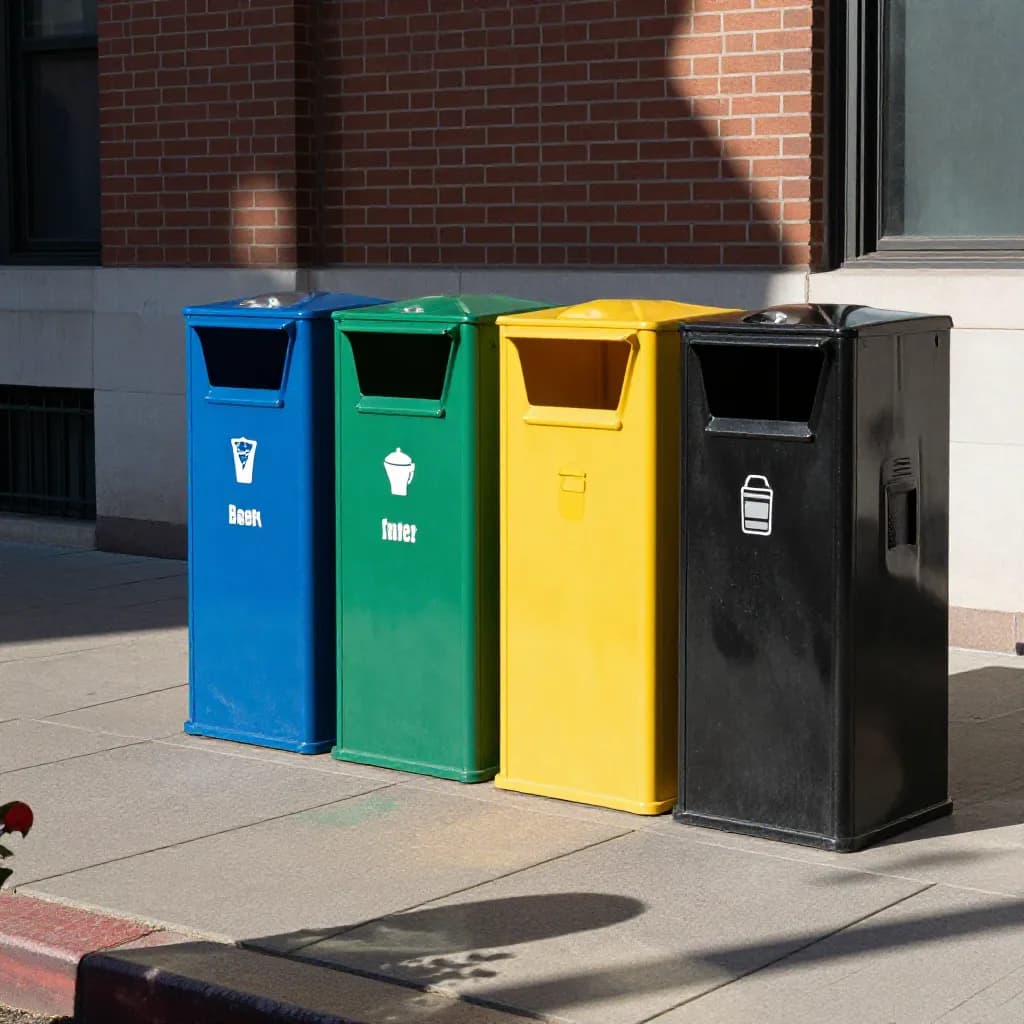
Powder coating is the standard finishing technology for metal waste bins and recycling stations because it provides the combination of chemical resistance, impact toughness, cleanability, and color flexibility that this demanding application requires. The dense, crosslinked thermoset film resists the chemical attack of waste leachate, the thick single-coat application absorbs impact from disposed items, and the smooth, non-porous surface facilitates cleaning and resists odor absorption.
Ready to Start Your Project?
From one-off customs to 15,000-part production runs — get precise pricing in 24 hours.
On This Page
Public Waste Bins: Coating for the Toughest Urban Service
The waste bin market includes a wide range of products: simple open-top litter bins for streets and parks, enclosed bins with rain hoods and ash trays, multi-stream recycling stations with separate compartments for different waste types, underground waste collection systems with above-ground access points, and smart bins with compaction mechanisms and fill-level sensors. Each product type has specific coating requirements related to its design, function, and installation environment.
Color coding is a critical function of waste bin powder coating, particularly for recycling stations where different colors identify different waste streams. The coating must deliver precise, consistent colors that comply with local recycling color standards and remain recognizable throughout the bin's service life. Faded or inconsistent colors on recycling stations cause contamination of waste streams, reducing recycling effectiveness and increasing processing costs.
Color Coding Standards for Recycling Streams
Recycling color coding varies by country and municipality, but the principle is universal: different colors identify different waste streams to guide users in sorting their waste correctly. The powder coating must deliver these colors accurately and maintain them through years of outdoor exposure to support effective recycling programs.
In the European Union, EN 16403 provides guidance on waste container color coding, though implementation varies by member state. Common European conventions include blue for paper and cardboard, yellow for plastics and packaging, green for glass, brown for organic waste, and gray or black for residual waste. Some countries use additional colors — red for hazardous waste, orange for metals, and white for mixed recyclables.
North American recycling color conventions are less standardized but generally follow common patterns: blue for recyclables, green for organic or compost, and black or gray for landfill waste. Some municipalities use additional colors for specific streams — yellow for plastics, brown for glass, and red for hazardous materials. The lack of a universal standard means that powder coating specifications must be tailored to each municipality's color scheme.
Color accuracy is essential for recycling effectiveness. Research has shown that contamination rates in recycling streams increase significantly when bin colors are faded, inconsistent, or non-standard. A blue recycling bin that has faded to pale gray may be mistaken for a residual waste bin, causing recyclable materials to be disposed of incorrectly. The powder coating specification should require UV-stable pigments and super-durable polyester formulations that maintain color accuracy for the bin's entire service life.
Color consistency across a fleet of bins is equally important. Bins installed at different times and manufactured by different suppliers must match in color when placed side by side at a recycling station. Spectrophotometric color specification with Delta E tolerances below 2.0 ensures visual consistency across the fleet. Physical color reference panels maintained by the municipality provide the standard against which production coating is verified.
Contrast between bin colors and the surrounding environment affects user recognition and sorting accuracy. Bins should be visually distinct from each other and from the background to help users quickly identify the correct stream. High-chroma colors with strong mutual contrast — such as blue, green, and yellow — are more effective than subtle color differences that may be difficult to distinguish in varying lighting conditions.
Chemical Resistance and Waste Leachate Protection
Waste bins are exposed to a remarkable range of chemicals from the waste they contain. Food waste produces acidic leachate. Beverage containers contribute sugary and acidic liquids. Cleaning products, batteries, and other improperly disposed items introduce alkaline, acidic, and solvent-based chemicals. The powder coating must resist all of these exposures without degradation, both on interior surfaces that contact waste directly and on exterior surfaces that may be splashed during disposal or collection.
Interior surface coating is the most chemically demanding zone. Waste leachate — the liquid that drains from mixed waste — is typically acidic with pH values of 4-6, containing organic acids from food decomposition, dissolved sugars, and various chemical contaminants. This leachate pools at the bottom of the bin and contacts the interior coating continuously between collection cycles. Epoxy-polyester hybrid powder coatings provide the best resistance to this mixed chemical exposure, maintaining adhesion and hardness after prolonged contact with acidic leachate.
Cleaning chemical resistance is equally important. Public waste bins are cleaned regularly with pressure washers, detergents, and disinfectants to control odor and maintain hygiene. The cleaning chemicals may include alkaline degreasers, chlorine-based disinfectants, quaternary ammonium sanitizers, and citrus-based solvents. The coating must resist all of these chemicals without softening, staining, or losing adhesion. Chemical resistance testing with the specific cleaning products used by the municipal maintenance department ensures compatibility.
Odor resistance is a practical concern for waste bin coatings. Porous or textured coatings can absorb odor-causing compounds from waste, creating a persistent smell that is difficult to eliminate through cleaning. Smooth, non-porous powder coatings with low surface porosity resist odor absorption and release absorbed odors more readily during cleaning. Antimicrobial powder coating additives — typically silver-based or zinc-based — can reduce bacterial growth on the coating surface, further controlling odor development between cleaning cycles.
The bin liner retention system — clips, hooks, or frame elements that hold the waste bag in place — experiences concentrated chemical exposure where the bag contacts the retention hardware. These small components should be coated with the same chemical-resistant formulation used on the bin interior, or fabricated from stainless steel to eliminate corrosion concerns at these high-exposure points.
Durability and Impact Resistance for Public Use
Public waste bins absorb tremendous physical abuse from the waste disposal process and from the general rough treatment of public infrastructure. The powder coating must survive this abuse while maintaining its protective and aesthetic functions for the bin's design service life of 10-15 years.
Waste disposal impact is the primary mechanical stress. Users drop heavy items — glass bottles, canned goods, construction debris — into bins from heights of 0.5-1.5 meters, creating impact forces that can dent the bin wall and chip the coating at the impact site. The interior coating must absorb these impacts without cracking or delaminating, maintaining the corrosion barrier at impact sites. A minimum of 120 inch-pounds direct impact resistance is recommended for bin interior coatings, with 160 inch-pounds preferred for bins that accept heavy waste streams such as glass and construction debris.
Collection process damage occurs when bins are emptied by mechanical collection vehicles. The bin is lifted, inverted, and shaken to dislodge waste, then returned to its position. This process creates impact and abrasion at the bin's lifting points, rim, and base. The coating at these high-wear zones should be specified with enhanced thickness of 100-120 microns and maximum hardness to resist the repeated mechanical contact of the collection process.
Vandalism damage — kicking, striking, and attempted arson — is a persistent threat to public waste bins. The coating must resist casual vandalism without catastrophic failure, though determined vandalism with tools or fire will exceed any coating's capability. Fire-resistant powder coatings that self-extinguish when the ignition source is removed provide some protection against arson attempts, though the bin's structural design and material selection are more important factors in fire resistance.
Weather exposure adds environmental stress to the mechanical demands. UV radiation degrades the coating's polymer structure, rain and humidity challenge adhesion, and temperature cycling creates thermal stress. The combination of mechanical abuse and environmental exposure is more damaging than either factor alone — a coating weakened by UV degradation is more susceptible to impact damage, and impact damage that exposes the substrate accelerates corrosion in wet conditions.
Base and foot protection deserves special attention because waste bins sit directly on the ground where moisture, salt, and debris accumulate. The bin base should be coated with enhanced thickness and chemical-resistant formulation, or fabricated from corrosion-resistant material such as stainless steel or high-density polyethylene to eliminate ground-level corrosion concerns.
Easy Cleaning and Hygiene Considerations
Cleanability is a critical coating property for waste bins because regular cleaning is essential for odor control, hygiene, and public acceptance. The powder coating must facilitate effective cleaning while resisting the cleaning chemicals and mechanical action of the cleaning process.
Smooth, non-porous coating surfaces are the foundation of easy cleaning. Waste residue, grease, and biological contamination adhere less strongly to smooth surfaces than to rough or textured surfaces, and smooth surfaces release contaminants more readily during pressure washing. Surface roughness values of Ra 0.8-1.6 micrometers provide the optimal balance — smooth enough for easy cleaning but not so smooth that the surface becomes slippery when wet, which could be a handling hazard during collection.
Anti-graffiti coating properties benefit waste bin cleaning by reducing the adhesion of all surface contaminants, not just graffiti. The low surface energy of anti-graffiti formulations makes waste residue, adhesive labels, and biological contamination easier to remove during routine cleaning. For bins in high-maintenance locations, the additional cleaning efficiency of anti-graffiti coatings can justify their specification even if graffiti is not a primary concern.
Pressure washing is the standard cleaning method for public waste bins, using water pressures of 100-200 bar with detergent injection. The powder coating must resist the mechanical force of pressure washing without erosion, blistering, or adhesion loss. Well-cured polyester and epoxy-polyester coatings withstand standard pressure washing without damage, but undercured coatings or coatings with adhesion defects may fail under pressure washing, making cure verification an important quality control step.
Disinfection requirements for waste bins in food service areas, healthcare facilities, and public health-sensitive locations may include chemical disinfection with chlorine-based or quaternary ammonium products, or thermal disinfection with steam or hot water. The coating must resist these disinfection methods without degradation. Chemical disinfection compatibility should be verified through spot testing with the specific disinfectant products used in the maintenance program.
Interior coating design can facilitate cleaning by minimizing features that trap waste and resist cleaning. Smooth interior corners with generous radii, continuous coating without gaps or seams, and drainage provisions that allow cleaning water to exit the bin all contribute to effective cleaning. The coating specification should address interior surface finish requirements separately from exterior requirements, recognizing the different functional demands of each surface.
Smart Bin Integration and Sensor Compatibility
Smart waste bins incorporating fill-level sensors, compaction mechanisms, solar panels, and wireless communication systems are increasingly deployed in urban waste management programs. The powder coating specification for smart bins must accommodate these electronic and mechanical systems while providing the same durability and appearance expected of conventional bins.
Fill-level sensors — typically ultrasonic or infrared — are mounted inside the bin to measure waste volume and transmit data to collection management systems. The interior coating surface must not interfere with sensor operation. Ultrasonic sensors require a smooth, hard surface at the sensor mounting point to provide a consistent acoustic reference. Infrared sensors need a coating surface that does not create false reflections that could affect measurement accuracy. Sensor mounting areas should be specified with controlled surface finish and coating thickness to ensure reliable sensor performance.
Solar panels mounted on bin lids or sides power the electronic systems and must be integrated with the coated surface. The coating around solar panel mounting areas must be compatible with the panel's adhesive or mechanical attachment system. Panel frame edges create a transition zone between the coated surface and the panel that must be sealed against water ingress. The coating color adjacent to solar panels should be selected to minimize heat absorption that could affect panel efficiency — light colors reflect more solar radiation away from the panel mounting area.
Compaction mechanisms in smart bins create additional coating demands. The compaction plate and its guide surfaces experience repeated mechanical contact that wears the coating. These surfaces should be coated with hard, abrasion-resistant formulations or fabricated from stainless steel to eliminate wear concerns. The compaction chamber interior faces the most aggressive combination of waste contact, mechanical wear, and cleaning chemical exposure, requiring the most robust coating specification in the bin.
Wireless communication antennas — typically cellular or LoRaWAN — must transmit through the bin enclosure without excessive signal attenuation. Metal bin enclosures block radio signals, so antennas are typically mounted externally or behind non-metallic panels. The powder coating on metal surfaces adjacent to antenna locations does not significantly affect signal transmission, as the metal substrate is the primary signal barrier. However, if antenna windows are incorporated into the bin design using non-metallic panels, the coating on surrounding metal surfaces should not extend over the antenna window area.
The electronic compartment housing the control board, battery, and communication module must be sealed against moisture and waste contamination. The coating on the electronic compartment provides a secondary moisture barrier that supplements the compartment's gasket sealing. The coating must be continuous and defect-free on all electronic compartment surfaces, with particular attention to fastener penetrations and cable entry points.
Procurement Specifications and Fleet Management
Municipal procurement of powder-coated waste bins requires specifications that ensure consistent quality across large fleet purchases while accommodating the range of bin types and installation environments within the waste management system. The specification must address both the coating performance requirements and the color coding standards that support the municipality's recycling program.
Fleet color standardization is essential for recycling program effectiveness. The specification should define exact colors for each waste stream using standard color systems with spectrophotometric tolerances. Physical color reference panels should be maintained by the waste management department and provided to bin suppliers for color matching. New bin purchases should be verified against the reference panels before acceptance to ensure fleet color consistency.
Performance requirements should be tiered based on the bin's installation environment. Bins in sheltered indoor locations — shopping centers, transit stations, and office buildings — can use standard polyester coatings with moderate corrosion protection. Bins in outdoor urban locations need super-durable polyester with enhanced corrosion protection. Bins in coastal, industrial, or high-salt environments need premium coating systems with maximum corrosion and UV resistance.
Acceptance testing for large fleet purchases should include film thickness measurement, adhesion testing, hardness verification, and color measurement on a statistical sample from each production lot. The sample size and acceptance criteria should be defined in the specification using standard sampling plans such as ANSI/ASQ Z1.4. Failed lots should be dispositioned through the specification's non-conformance procedure, which may include rework, sorting, or rejection depending on the severity of the deficiency.
Spare parts and touch-up materials should be included in the procurement specification. Color-matched touch-up paint, replacement components coated to the same specification, and cleaning product recommendations should be provided with each fleet purchase. This ensures that the maintenance department has the materials needed to maintain the bins' appearance and protection throughout their service life.
Lifecycle considerations should influence the procurement evaluation. Bins with higher-quality coatings that require less maintenance and last longer provide better lifecycle value than lower-specification bins that need frequent touch-up and earlier replacement. The specification should encourage lifecycle thinking by requiring suppliers to provide maintenance cost estimates and expected coating service life data as part of their bid submissions.
End-of-life recyclability of powder-coated steel bins is excellent. The organic coating burns off during the steel melting process, and the steel is fully recyclable through standard processes. This recyclability supports municipal sustainability goals and should be documented in the procurement specification as a positive environmental attribute.
Frequently Asked Questions
What colors are used for recycling bin coding?
Color coding varies by municipality. Common European conventions include blue for paper, yellow for plastics, green for glass, brown for organic waste, and black for residual waste. North American conventions typically use blue for recyclables, green for compost, and black for landfill. The powder coating must match local standards with Delta E tolerances below 2.0 for fleet consistency.
How does powder coating resist waste bin odors?
Smooth, non-porous powder coatings with low surface porosity resist odor absorption and release absorbed odors more readily during cleaning than textured or porous surfaces. Antimicrobial additives — typically silver or zinc-based — reduce bacterial growth that causes odor. Regular pressure washing with compatible detergents maintains hygiene between collection cycles.
What impact resistance do waste bins need?
Interior coatings should achieve minimum 120 inch-pounds direct impact resistance, with 160 inch-pounds preferred for bins accepting heavy items like glass bottles. Collection process wear zones — lifting points, rim, and base — need enhanced film thickness of 100-120 microns. Exterior surfaces require standard 80-100 inch-pounds for vandalism resistance.
Can powder-coated waste bins be pressure washed?
Yes. Well-cured polyester and epoxy-polyester powder coatings withstand standard pressure washing at 100-200 bar without damage. The smooth, non-porous surface facilitates effective cleaning and waste residue removal. Undercured coatings may fail under pressure washing, making cure verification an important quality control step during manufacturing.
How long does powder coating last on public waste bins?
With super-durable polyester at 70-90 microns over zinc phosphate pretreatment, exterior coating maintains appearance for 7-10 years. Interior coating life depends on waste type and cleaning frequency — typically 5-8 years before significant wear is visible. The duplex galvanizing-plus-powder-coating system provides corrosion protection for 15-25 years.
Ready to Start Your Project?
From one-off customs to 15,000-part production runs — get precise pricing in 24 hours.