Turbo manifolds and exhaust headers operate at temperatures that destroy conventional coatings. Exhaust gas temperatures in a naturally aspirated engine can reach 700-900 degrees Celsius at the manifold, and turbocharged engines can push exhaust temperatures even higher under boost. The manifold and header surfaces themselves typically operate at 400-650 degrees Celsius during sustained high-load driving, with brief spikes above 700 degrees Celsius during hard acceleration.
Automotive
Powder Coating Turbo Manifolds and Headers: High-Temperature Ceramic Coatings for Exhaust Systems
Sundial Powder Coating·April 23, 2026·10 min
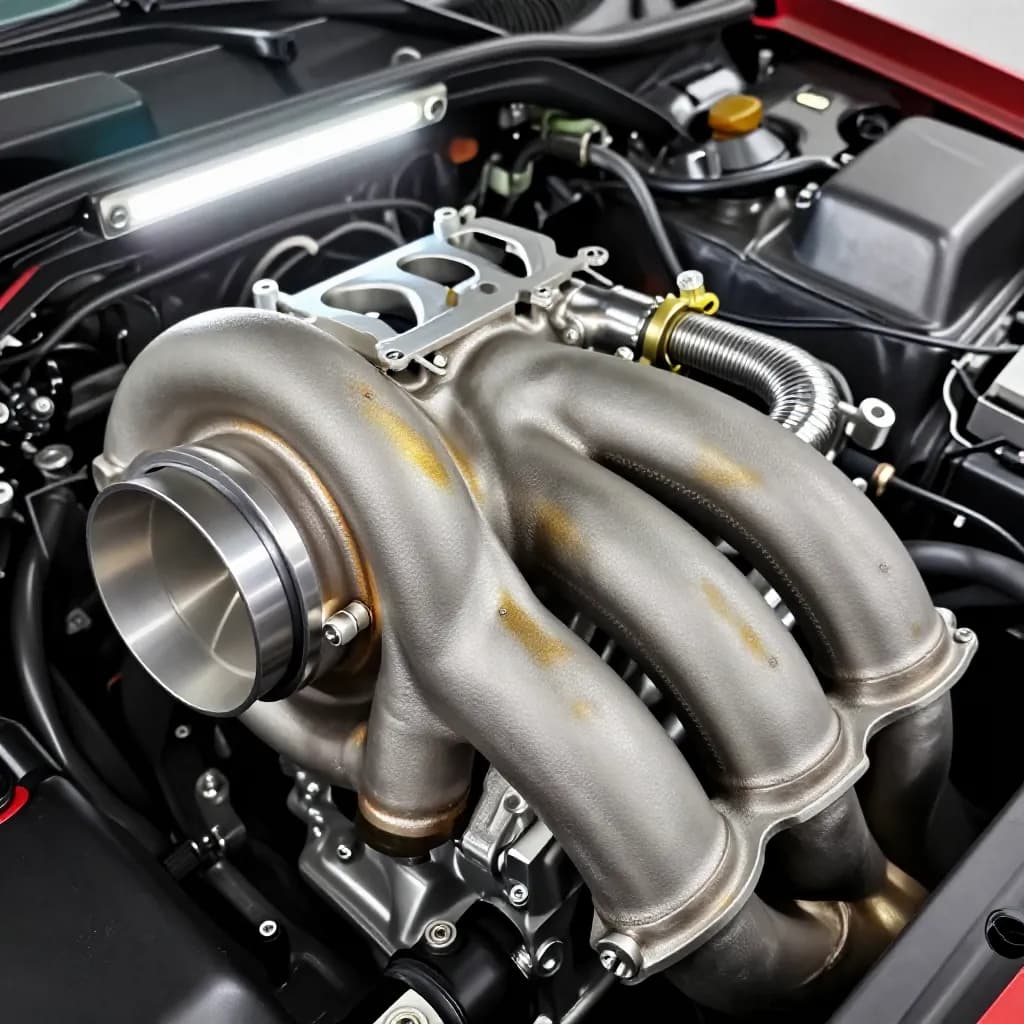
These temperatures are far beyond the capability of standard powder coatings, which are rated for continuous service at 150-200 degrees Celsius. Applying a standard polyester or hybrid powder to an exhaust manifold will result in rapid discoloration, blistering, and complete coating failure within minutes of engine operation. The coating literally burns off the surface.
Ready to Start Your Project?
From one-off customs to 15,000-part production runs — get precise pricing in 24 hours.
On This Page
The Extreme Demands of Exhaust Coating
High-temperature powder coatings formulated specifically for exhaust applications use ceramic-filled silicone resin systems that withstand continuous temperatures of 600-800 degrees Celsius. These specialized powders cure at standard temperatures but develop their full heat resistance through an initial heat cycle that drives off volatile components and cross-links the silicone-ceramic matrix. The result is a durable, heat-stable finish that protects the manifold from corrosion and provides thermal management benefits.
High-Temperature Powder Chemistry Explained
High-temperature exhaust coatings are fundamentally different from the polyester and epoxy powders used for most automotive applications. Understanding the chemistry helps explain both their capabilities and their limitations.
The base resin in high-temperature exhaust powders is typically a silicone or silicone-modified polymer. Silicone resins maintain their molecular structure at temperatures that would decompose organic polymers like polyester and epoxy. The silicone backbone provides thermal stability, while ceramic fillers such as aluminum oxide, titanium dioxide, and various metal oxides add heat resistance, hardness, and color.
These coatings cure in two stages. The initial oven cure at 190-230 degrees Celsius melts and flows the powder into a continuous film, similar to standard powder coating. The second cure occurs during the first engine heat cycle, when temperatures above 300 degrees Celsius drive off remaining volatile components and complete the cross-linking of the silicone-ceramic matrix. During this initial heat cycle, the coating may smoke slightly and emit an odor as volatiles burn off. This is normal and expected.
The trade-off for extreme heat resistance is reduced mechanical properties compared to standard powders. High-temperature coatings are generally harder and more brittle than polyester powders, with lower impact resistance and flexibility. They also offer a more limited color range, with black, silver, grey, and cast iron being the most common options. Bright colors and metallic finishes are not available in true high-temperature formulations because the pigments that create these colors decompose at exhaust temperatures.
Thermal Barrier Benefits for Performance
Beyond corrosion protection and appearance, high-temperature powder coating on exhaust manifolds and headers provides a measurable thermal barrier effect that benefits engine performance and underhood temperature management.
The ceramic-filled coating acts as an insulating layer that reduces radiant heat transfer from the exhaust surface to the surrounding engine bay. This keeps underhood temperatures lower, which benefits heat-sensitive components like intake manifolds, fuel rails, ignition coils, and wiring harnesses. Lower underhood temperatures also reduce heat soak into the intake charge, supporting better performance during sustained high-load driving.
On the exhaust side, keeping heat inside the manifold and headers improves exhaust gas velocity. Hot exhaust gases flow faster than cooler gases, which improves scavenging efficiency and can produce measurable gains in exhaust flow rate and engine output. This effect is most significant on naturally aspirated engines with tuned-length headers, where exhaust pulse timing and velocity are critical to performance.
For turbocharged engines, maintaining exhaust gas temperature at the turbine inlet improves turbo spool characteristics. Hotter exhaust gases carry more energy, which spins the turbine faster and reduces turbo lag. A coated turbo manifold delivers more thermal energy to the turbine compared to an uncoated manifold that radiates heat into the engine bay.
The thermal barrier effect of a single powder coat layer is modest compared to dedicated ceramic thermal barrier coatings applied by plasma spray or other specialized processes. However, the powder coat provides a meaningful improvement over bare metal while also delivering corrosion protection and a finished appearance that dedicated thermal coatings do not offer.
Surface Preparation for Exhaust Components
Exhaust manifolds and headers are manufactured from cast iron, stainless steel, or mild steel, and each material requires specific preparation for high-temperature powder coating. The preparation must be thorough because the extreme operating temperatures will expose any shortcomings in surface cleanliness or profile.
Cast iron manifolds are the most common OEM material. They are porous and often coated with a factory heat-resistant paint that must be completely removed. Abrasive blasting with aluminum oxide or steel grit at 60-80 mesh removes old coatings, rust, and casting scale. Cast iron porosity can cause outgassing during the initial cure, so a pre-bake at cure temperature is recommended. The rough, granular surface of blasted cast iron provides excellent mechanical adhesion for the powder.
Stainless steel headers, typically 304 or 321 grade, require aggressive blasting to overcome the passive chromium oxide layer. Angular aluminum oxide at moderate to high pressure creates the surface profile needed for adhesion. The blasted surface must be coated promptly before the passive layer reforms. Some high-temperature powder systems include a specialized primer formulated for stainless steel adhesion.
Mild steel headers and turbo manifolds are straightforward to prepare. Blast to white metal, apply a high-temperature compatible pretreatment if available, and coat promptly. Mild steel headers are the most susceptible to corrosion, so thorough coverage including the interior of the primary tubes is beneficial if the coating system allows it.
All exhaust components must be completely free of oil, grease, and carbon deposits before coating. Engine oil contamination is the most common cause of adhesion failure on exhaust parts. Soak components in a hot alkaline cleaner or use a burn-off oven to carbonize and remove all organic contamination before blasting.
Application Techniques for Complex Geometries
Turbo manifolds and exhaust headers have complex geometries with tight bends, merged collectors, and recessed areas that challenge uniform powder application. The tubular construction creates Faraday cage effects that prevent electrostatic powder from reaching inner surfaces, and the varying wall thicknesses of cast and fabricated components affect how quickly different areas reach cure temperature.
For tubular headers with individual primary tubes merging into a collector, the inner surfaces of the merge area are the most difficult to coat. Reducing the electrostatic voltage and using a small-diameter extension nozzle helps direct powder into these recessed areas. Multiple light passes from different angles build up coverage more effectively than a single heavy pass.
Tribo-charging guns, which use friction rather than a high-voltage electrode to charge the powder particles, are often more effective than corona guns for complex exhaust geometries. Tribo-charged particles are less affected by the Faraday cage effect and penetrate into recessed areas more readily. The trade-off is slower deposition rate, which means longer application time.
Flange surfaces where the manifold or header bolts to the cylinder head and where the collector connects to the downpipe should be masked. Coating buildup on flange surfaces can prevent proper gasket sealing and create exhaust leaks. Use high-temperature masking tape or silicone gaskets to protect these critical sealing surfaces.
Oxygen sensor bungs, EGT probe fittings, and wastegate flange surfaces must also be masked. These threaded fittings require clean threads for proper sensor installation and sealing. Plug the bungs with high-temperature silicone plugs during the coating process and verify thread cleanliness after curing.
Curing and Initial Heat Cycle
The curing process for high-temperature exhaust powders differs from standard powder coating and requires understanding of the two-stage cure mechanism to achieve optimal results.
The initial oven cure follows standard powder coating practice. The coated component is placed in the cure oven at the temperature specified by the powder manufacturer, typically 190-230 degrees Celsius, and held for the recommended duration. This stage melts the powder, flows it into a continuous film, and initiates the primary cross-linking reaction. After this cure, the coating appears finished but has not yet developed its full high-temperature resistance.
The second cure stage occurs during the first engine heat cycle. As the exhaust component reaches operating temperature, the coating undergoes further chemical changes that complete the silicone-ceramic cross-linking. During this initial heat cycle, the coating may smoke, emit an odor, and change color slightly. This is the volatile components burning off and is completely normal. The smoke and odor typically subside within 15-30 minutes of engine operation.
For the initial heat cycle, it is best to bring the engine up to operating temperature gradually rather than immediately driving at high load. Idle the engine for 5-10 minutes, then drive at moderate load for 15-20 minutes, allowing the coating to cure progressively. Avoid sustained high-RPM or high-boost operation until the initial smoke and odor have completely stopped.
After the initial heat cycle, the coating is fully cured and will maintain its appearance and protective properties through subsequent thermal cycles. The finish may darken slightly over time with continued heat exposure, which is normal for silicone-based high-temperature coatings and does not indicate degradation.
Alternatives and Complementary Coatings
High-temperature powder coating is one of several coating options for exhaust components, and understanding the alternatives helps in selecting the right approach for each application.
Ceramic thermal barrier coatings applied by plasma spray or air spray provide the highest level of thermal insulation. These coatings are typically 200-500 microns thick and offer significantly more thermal resistance than powder coating. However, they are more expensive, require specialized application equipment, and do not provide the same smooth, uniform appearance as powder coating. They are best suited for dedicated competition vehicles where maximum thermal performance is the priority.
Exhaust wrap is a low-cost alternative that provides excellent thermal insulation but has significant drawbacks. The wrap traps moisture against the exhaust surface, accelerating corrosion, and it degrades over time, requiring periodic replacement. It also has a rough, industrial appearance that is not suitable for show vehicles. Powder coating provides a cleaner, more durable solution with moderate thermal benefits.
Combining powder coating with other treatments can optimize both appearance and performance. Some builders apply a ceramic thermal barrier coating to the interior of the exhaust tubes for maximum heat retention, then powder coat the exterior for appearance and corrosion protection. This dual approach provides the best of both worlds but adds complexity and cost to the coating process.
For components that see extreme temperatures above 800 degrees Celsius, such as turbo housings and downpipe sections immediately after the turbine, even high-temperature powder coatings may not be sufficient. These components may require ceramic coatings, raw stainless steel, or specialized metallic coatings like aluminum diffusion treatments that can withstand temperatures above 1000 degrees Celsius.
Frequently Asked Questions
What temperature can high-temperature powder coating withstand?
High-temperature ceramic powder coatings for exhaust applications are rated for continuous service at 600-800 degrees Celsius, depending on the specific formulation. This covers the operating range of most exhaust manifolds and headers. Components that exceed 800 degrees Celsius may require specialized ceramic or metallic coatings.
Will the coating smoke when the engine first runs?
Yes. During the initial heat cycle, high-temperature powder coatings emit smoke and odor as volatile components burn off and the silicone-ceramic matrix completes its cross-linking. This is normal and typically subsides within 15-30 minutes of engine operation. Bring the engine up to temperature gradually for the first run.
Can you use regular powder coating on exhaust headers?
No. Standard polyester and hybrid powder coatings are rated for 150-200 degrees Celsius maximum and will burn off exhaust components within minutes. Only high-temperature ceramic powder coatings formulated for exhaust applications should be used on manifolds and headers.
Does coating exhaust headers improve performance?
Yes, modestly. The thermal barrier effect keeps heat inside the exhaust, improving gas velocity and scavenging efficiency. For turbocharged engines, maintaining exhaust temperature at the turbine improves spool characteristics. The effect is measurable but modest compared to dedicated ceramic thermal barrier coatings.
What colors are available for high-temperature exhaust coatings?
The color range is limited compared to standard powders. Black, silver, grey, and cast iron are the most common options. Bright colors and metallics are not available in true high-temperature formulations because the pigments decompose at exhaust operating temperatures.
Ready to Start Your Project?
From one-off customs to 15,000-part production runs — get precise pricing in 24 hours.