Traffic signal poles are safety-critical infrastructure components that must maintain structural integrity and visual effectiveness for 25-50 years of continuous outdoor service. The powder coating on these poles serves multiple essential functions: protecting the steel or aluminum substrate from corrosion that could compromise structural capacity, maintaining the visual appearance that supports traffic safety, providing color coding that communicates pole function and ownership, and resisting the environmental and mechanical stresses of roadside installation.
Industrial
Powder Coating for Traffic Signal Poles: DOT Specifications, UV Resistance, and Safety Colors
Sundial Powder Coating·April 23, 2026·12 min
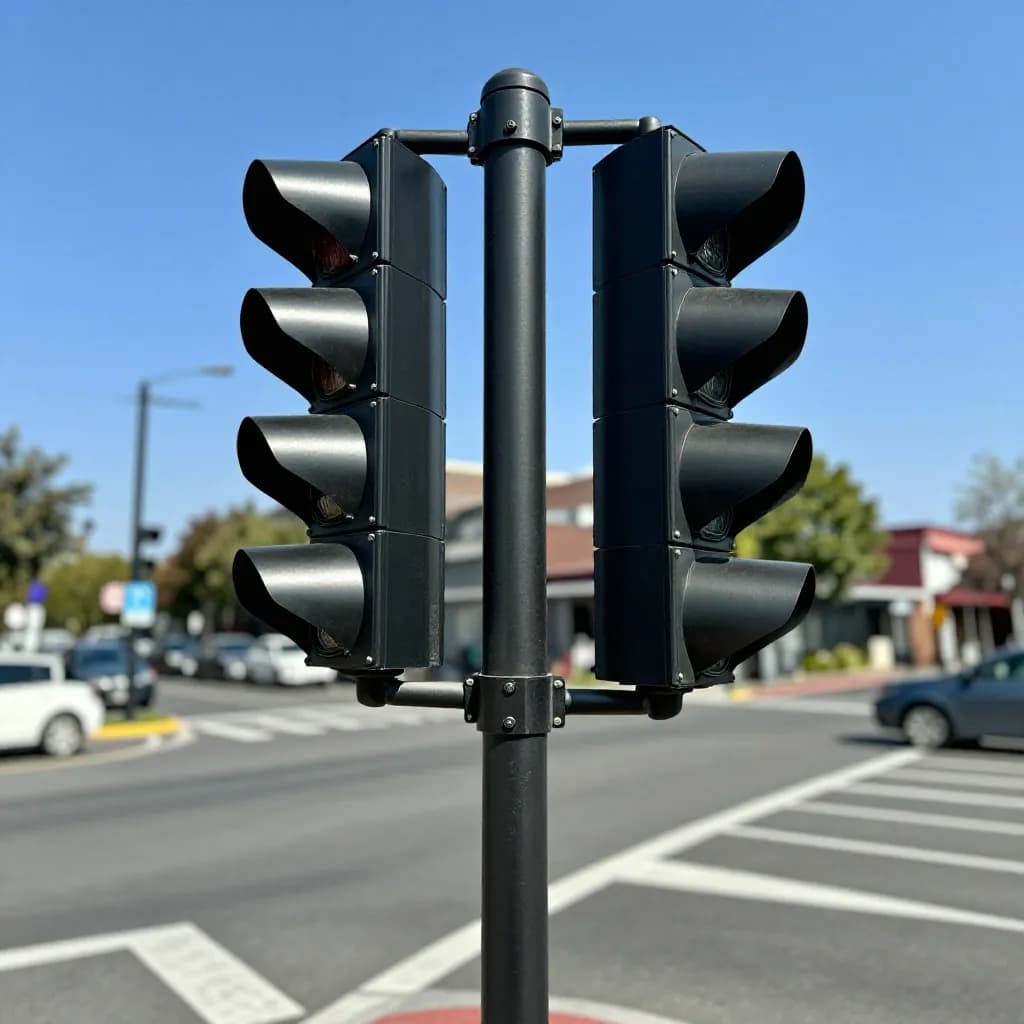
The traffic signal pole market includes signal poles, mast arms, pedestrian signal poles, signal controller cabinets, and associated hardware. These components are manufactured from galvanized steel, aluminum alloy, or in some cases weathering steel, with powder coating applied as either the primary finish or as a supplementary coating over galvanizing. The coating specification is governed by state and federal Department of Transportation standards that define material requirements, performance criteria, and testing protocols.
Ready to Start Your Project?
From one-off customs to 15,000-part production runs — get precise pricing in 24 hours.
On This Page
Traffic Signal Poles: Critical Infrastructure Coating Requirements
Traffic infrastructure coating specifications are among the most demanding in the powder coating industry. The combination of continuous outdoor exposure, safety-critical function, and minimal maintenance access creates a specification environment where coating failure has consequences beyond aesthetics — a corroded pole that fails structurally can cause signal outage, traffic accidents, and potential injury. This safety dimension elevates coating specification from a maintenance consideration to a public safety requirement.
Powder coating has gained significant market share in traffic signal pole finishing over the past two decades, competing with and increasingly replacing liquid paint systems. The advantages of powder coating for this application include superior film thickness and uniformity, zero VOC emissions that simplify environmental compliance, excellent corrosion resistance when properly specified, and the ability to achieve the specific colors required by transportation agencies.
Department of Transportation Coating Specifications
State and federal Departments of Transportation maintain detailed specifications for traffic signal pole coatings that define acceptable materials, application processes, performance requirements, and testing protocols. These specifications vary between jurisdictions but share common themes rooted in the AASHTO standards and federal highway administration guidelines.
AASHTO M 72 and related standards establish baseline requirements for protective coatings on steel highway structures. For powder-coated traffic signal poles, the specification typically requires polyester or super-durable polyester chemistry, minimum film thickness of 75-100 microns, adhesion rating of 5B per ASTM D3359, pencil hardness of H or higher, and accelerated weathering resistance demonstrated by QUV or xenon arc testing. Salt spray resistance requirements range from 1000 to 3000 hours depending on the jurisdiction and the corrosion severity of the installation environment.
Many state DOTs have developed their own powder coating specifications that supplement or replace the AASHTO baseline. These state-specific specifications may define approved powder coating products by manufacturer and product name, require specific pretreatment systems, mandate particular testing protocols, or specify colors unique to the state's traffic infrastructure standards. Coating applicators serving the traffic signal market must maintain current knowledge of the specifications applicable in each state where they supply product.
Qualified Products Lists are maintained by many state DOTs, listing specific powder coating products that have been tested and approved for use on traffic infrastructure. Gaining QPL approval requires submitting the powder coating product for laboratory testing against the state's specification, which may include accelerated weathering, salt spray, chemical resistance, and mechanical property tests. The approval process can take several months, and maintaining QPL status requires periodic retesting and compliance audits.
Federal Highway Administration guidelines influence state specifications through the Manual on Uniform Traffic Control Devices and related publications. While the FHWA does not directly specify coating materials, its requirements for signal visibility, color standards, and structural integrity create performance requirements that the coating must support. The coating specification must ensure that the pole's color does not interfere with signal visibility and that the structural protection provided by the coating supports the pole's design service life.
UV Resistance for Decades of Sun Exposure
Traffic signal poles are installed in open roadway environments with full sun exposure and no maintenance painting schedule. The coating must maintain its protective and aesthetic properties for the pole's entire service life — typically 25-50 years — without recoating. This extreme UV durability requirement drives the selection of premium coating chemistries and rigorous accelerated weathering testing.
Super-durable polyester powder coatings are the minimum acceptable chemistry for traffic signal pole applications, providing 7-10 years of color and gloss retention. For poles with expected service lives of 25 years or more, this level of UV resistance is insufficient — the coating will chalk and fade significantly before the pole reaches end of life. Fluoropolymer-modified powder coatings that provide 15-25 years of UV resistance are increasingly specified for traffic infrastructure, particularly in southern states with high UV intensity.
The AAMA 2605 specification, originally developed for architectural aluminum, is sometimes referenced for traffic signal pole coatings because it includes the most rigorous weathering requirements in the powder coating industry. AAMA 2605 requires 10 years of South Florida outdoor exposure testing with specific color retention, gloss retention, chalk resistance, and film integrity criteria. Coatings that meet AAMA 2605 provide confidence in long-term outdoor performance, though the specification was designed for aluminum substrates and may need adaptation for steel pole applications.
Chalking — the formation of a loose, powdery surface layer from UV degradation — is the most visible manifestation of UV damage on traffic signal poles. Chalking changes the pole's color appearance, reduces the effectiveness of any reflective elements, and can transfer to clothing and vehicles that contact the pole. The coating specification should include maximum chalking ratings per ASTM D4214, with a rating of 8 or higher (minimal chalking) required after the specified accelerated weathering exposure.
Color fading from UV exposure is particularly problematic for safety-colored poles where the color communicates specific information. A safety yellow pole that fades to pale cream no longer provides the intended visual warning. UV-stable inorganic pigments should be specified for safety colors, and the accelerated weathering test should include color change measurement with a maximum Delta E of 3.0-5.0 depending on the color criticality.
Impact Resistance and Structural Protection
Traffic signal poles are installed in the roadside environment where they face impact threats from vehicle collisions, maintenance equipment contact, and debris thrown by passing traffic. The powder coating must absorb minor impacts without cracking or delaminating, maintaining the corrosion barrier at impact sites that would otherwise become corrosion initiation points.
Vehicle impact is the most severe threat to traffic signal poles. While major collisions that damage the pole structure are beyond the coating's ability to prevent, minor impacts from parking maneuvers, mirror strikes, and low-speed contact can chip or crack the coating without damaging the underlying steel. The coating must resist these minor impacts to prevent corrosion at the impact site. A minimum of 100 inch-pounds direct impact resistance per ASTM D2794 is recommended, with 160 inch-pounds preferred for poles in high-traffic areas.
Breakaway base designs used on many traffic signal poles create a specific coating challenge. These bases are designed to separate from the foundation upon vehicle impact, allowing the pole to fall away rather than stopping the vehicle abruptly. The breakaway mechanism includes slip planes and frangible connections that must function reliably after decades of outdoor exposure. The powder coating must not interfere with the breakaway mechanism — coating buildup on slip plane surfaces or frangible bolt connections could prevent proper breakaway function. These critical surfaces must be masked during coating or verified for proper function after coating.
Stone chip damage from passing traffic is a chronic low-level impact threat. Tires throw small stones and road debris at velocities sufficient to chip thin coatings, particularly on the lower sections of poles adjacent to travel lanes. The lower 2-3 meters of traffic signal poles should be specified with enhanced impact resistance, either through increased film thickness of 100-120 microns or through the use of impact-resistant primer systems beneath the topcoat.
Maintenance equipment contact — from mowers, snow plows, and utility vehicles — causes localized coating damage that is often not reported or repaired promptly. The coating specification should anticipate this type of damage by providing robust corrosion protection that prevents rapid substrate degradation even when the coating is locally breached. Zinc-rich primer beneath the powder topcoat provides cathodic protection at coating defects, preventing rust formation and buying time for repair.
Reflectivity and Visibility Considerations
Traffic signal poles must be visible to drivers for both safety and navigation purposes, and the powder coating finish affects pole visibility through its color, gloss, and interaction with applied reflective elements. The coating specification must support the visibility requirements established by the Manual on Uniform Traffic Control Devices and state-specific standards.
Pole color affects daytime visibility against varying backgrounds. The most common traffic signal pole colors are dark gray, black, dark green, and dark bronze — colors chosen to minimize visual clutter and avoid confusion with signal indications. However, these dark colors can make poles difficult to see against dark backgrounds, particularly at dawn, dusk, and in poor weather. Some jurisdictions require reflective bands or retroreflective sheeting on signal poles to enhance nighttime visibility, and the powder coating must provide a suitable surface for adhesion of these reflective elements.
Retroreflective sheeting adhesion to powder-coated surfaces depends on the coating's surface energy, texture, and cleanliness. Standard powder coatings with moderate surface energy provide good adhesion for pressure-sensitive retroreflective sheeting. However, anti-graffiti or low-surface-energy coatings can cause sheeting adhesion failures, which is a safety concern if reflective bands detach from the pole. If anti-graffiti coatings are specified for vandalism resistance, the reflective band application areas should be masked during anti-graffiti coating application or treated with adhesion promoter before sheeting application.
Gloss level affects the pole's visual appearance and its interaction with vehicle headlights. High-gloss coatings can create specular reflections from headlights that momentarily distract drivers, particularly on wet surfaces. Matte and satin finishes with gloss levels of 20-50 units at 60 degrees minimize specular reflection while maintaining a clean, well-maintained appearance. Most DOT specifications require satin or semi-gloss finishes for traffic signal poles.
Signal head mounting areas on the pole must not create visual interference with the signal indications. The coating color in the signal head vicinity should provide contrast with the signal housing to help drivers distinguish the signal from its mounting structure. Dark pole colors — black, dark gray, or dark green — provide good contrast with the yellow signal housing, supporting signal recognition.
Nighttime visibility of the pole itself is primarily achieved through retroreflective elements rather than the coating. However, light-colored coatings on the lower pole section can improve visibility in headlight illumination, helping drivers judge their distance from the pole. Some jurisdictions specify a light-colored band at driver eye height for this purpose.
Galvanized Steel Pole Coating Systems
The majority of traffic signal poles are fabricated from hot-dip galvanized steel, and the powder coating is applied over the galvanized surface to create a duplex protection system. This combination provides superior corrosion protection compared to either galvanizing or powder coating alone, and understanding the interaction between the two protection layers is essential for optimal specification.
Hot-dip galvanizing deposits a zinc coating of 85-100 microns on the steel surface, providing sacrificial cathodic protection that prevents steel corrosion even at coating defects. The zinc corrodes preferentially, protecting the steel substrate. In moderate atmospheric conditions, hot-dip galvanizing alone provides 30-50 years of corrosion protection. Adding powder coating over the galvanizing extends the total system life by protecting the zinc layer from atmospheric attack, slowing the rate of zinc consumption.
Pretreatment of galvanized surfaces for powder coating requires careful attention to the zinc surface chemistry. Fresh galvanizing has a reactive zinc surface that forms zinc oxide and zinc hydroxide films within hours of exposure to air. These films must be removed or converted before powder application to ensure adhesion. The standard pretreatment sequence for galvanized steel includes alkaline cleaning to remove zinc oxide films and any post-galvanizing treatments, light acid activation to create a clean zinc surface, and chromate-free conversion coating compatible with zinc substrates.
The timing between galvanizing and powder coating affects adhesion quality. Freshly galvanized surfaces — within 24 hours of galvanizing — provide the best adhesion because the zinc surface is clean and reactive. Aged galvanized surfaces develop thicker oxide films and may accumulate atmospheric contamination that requires more aggressive cleaning. If galvanized poles are stored outdoors before coating, white rust — zinc hydroxide corrosion product — may form, requiring removal by acid cleaning or light abrasive blasting before pretreatment.
Outgassing from the galvanized surface is a common defect source when powder coating over hot-dip galvanizing. The zinc coating contains microscopic pores and inclusions that trap air and moisture, which expand during the powder curing process and create pinholes or blisters in the cured film. Pre-baking the galvanized pole at 200-230 degrees Celsius for 10-15 minutes before powder application drives out trapped gases, dramatically reducing outgassing defects. This pre-bake step is considered essential for quality powder coating over hot-dip galvanizing.
Film thickness on galvanized surfaces should account for the surface roughness of the galvanizing. Hot-dip galvanized surfaces have a rough, crystalline texture that requires more powder to achieve a smooth, uniform appearance. Minimum film thickness of 80-100 microns is recommended over galvanized surfaces, compared to 60-80 microns on smooth steel, to ensure complete coverage of the galvanized surface texture.
Installation, Maintenance, and Field Repair
Traffic signal poles are installed using heavy equipment and are subject to handling damage during transport, erection, and hardware mounting. The coating specification and installation procedures must minimize handling damage and provide for field repair of any damage that occurs.
Transport protection is the first line of defense against coating damage. Poles should be transported with protective wrapping or padding at contact points with the transport vehicle and between stacked poles. Nylon slings or padded chains should be used for lifting — bare chain or wire rope slings will damage the coating at contact points. Any coating damage observed during receiving inspection should be documented and repaired before installation.
Foundation installation involves setting the pole base in a concrete foundation or bolting it to an anchor bolt pattern. The coating on the base section — below grade and within the concrete — faces a different environment than the above-grade portion. Below-grade coating is in continuous contact with concrete and soil moisture, creating an alkaline environment that can attack some coating systems. Epoxy-based coatings provide the best resistance to alkaline concrete contact, and some specifications require a separate below-grade coating system optimized for this environment.
Field repair of coating damage should be performed promptly to prevent corrosion initiation at exposed areas. Touch-up repair kits matched to the pole's powder coating color should be available to installation and maintenance crews. The repair process involves cleaning the damaged area to bare metal, applying a zinc-rich primer for cathodic protection, and topcoating with a color-matched repair coating. While field repair does not match the performance of the original factory-applied powder coating, it restores the corrosion barrier and prevents damage progression.
Periodic inspection of traffic signal pole coatings should be incorporated into the jurisdiction's infrastructure maintenance program. Annual visual inspection identifies coating damage, corrosion initiation, and chalking or fading that may affect safety marking visibility. Coating condition data should be recorded in the asset management system and used to prioritize maintenance and replacement decisions.
End-of-life considerations for powder-coated traffic signal poles include the recyclability of the coated steel. The powder coating does not prevent steel recycling — the organic coating burns off during the steel melting process. Galvanized and powder-coated steel poles are fully recyclable through standard steel recycling processes, supporting the sustainability goals of transportation agencies.
Frequently Asked Questions
What DOT specifications apply to traffic signal pole powder coating?
AASHTO M 72 provides baseline requirements, but most states maintain their own specifications that may be more stringent. Common requirements include super-durable polyester chemistry, 75-100 micron minimum film thickness, 1000-3000 hours salt spray resistance, and accelerated weathering testing. Many states maintain Qualified Products Lists of approved powder coatings.
How long does powder coating last on traffic signal poles?
Super-durable polyester provides 7-10 years of color retention, while fluoropolymer-modified coatings achieve 15-25 years. The duplex system of galvanizing plus powder coating provides corrosion protection for 40-60 years. The coating's protective function typically outlasts its cosmetic appearance, maintaining corrosion resistance even after visible chalking begins.
Can powder coating interfere with breakaway pole bases?
Yes, if not properly managed. Coating buildup on slip plane surfaces or frangible bolt connections can prevent proper breakaway function. These critical surfaces must be masked during coating application, and breakaway function should be verified after coating. DOT specifications typically address masking requirements for breakaway components.
Why do galvanized poles need powder coating too?
The duplex galvanizing-plus-powder-coating system provides superior protection compared to either method alone. The powder coating protects the zinc galvanizing from atmospheric attack, extending its life. The galvanizing provides sacrificial cathodic protection at any powder coating defect. Together, the system can achieve 40-60 years of corrosion protection.
What causes pinholes when powder coating galvanized poles?
Outgassing from trapped air and moisture in the galvanized zinc layer causes pinholes during powder curing. The solution is pre-baking the galvanized pole at 200-230 degrees Celsius for 10-15 minutes before powder application, which drives out trapped gases. This pre-bake step is considered essential for quality powder coating over hot-dip galvanizing.
Ready to Start Your Project?
From one-off customs to 15,000-part production runs — get precise pricing in 24 hours.