Street lighting poles are among the most visible and numerous elements of urban infrastructure, with millions installed across cities worldwide. While their primary function is to support luminaires that illuminate roadways and pedestrian areas, they also serve as significant urban design elements that contribute to the character and identity of streetscapes, parks, commercial districts, and residential neighborhoods. The powder coating on a street lighting pole is the primary determinant of its visual appearance and a critical factor in its long-term durability.
Architecture
Powder Coating for Street Lighting Poles: Urban Design, Corrosion Protection, and Heritage Styles
Sundial Powder Coating·April 23, 2026·12 min
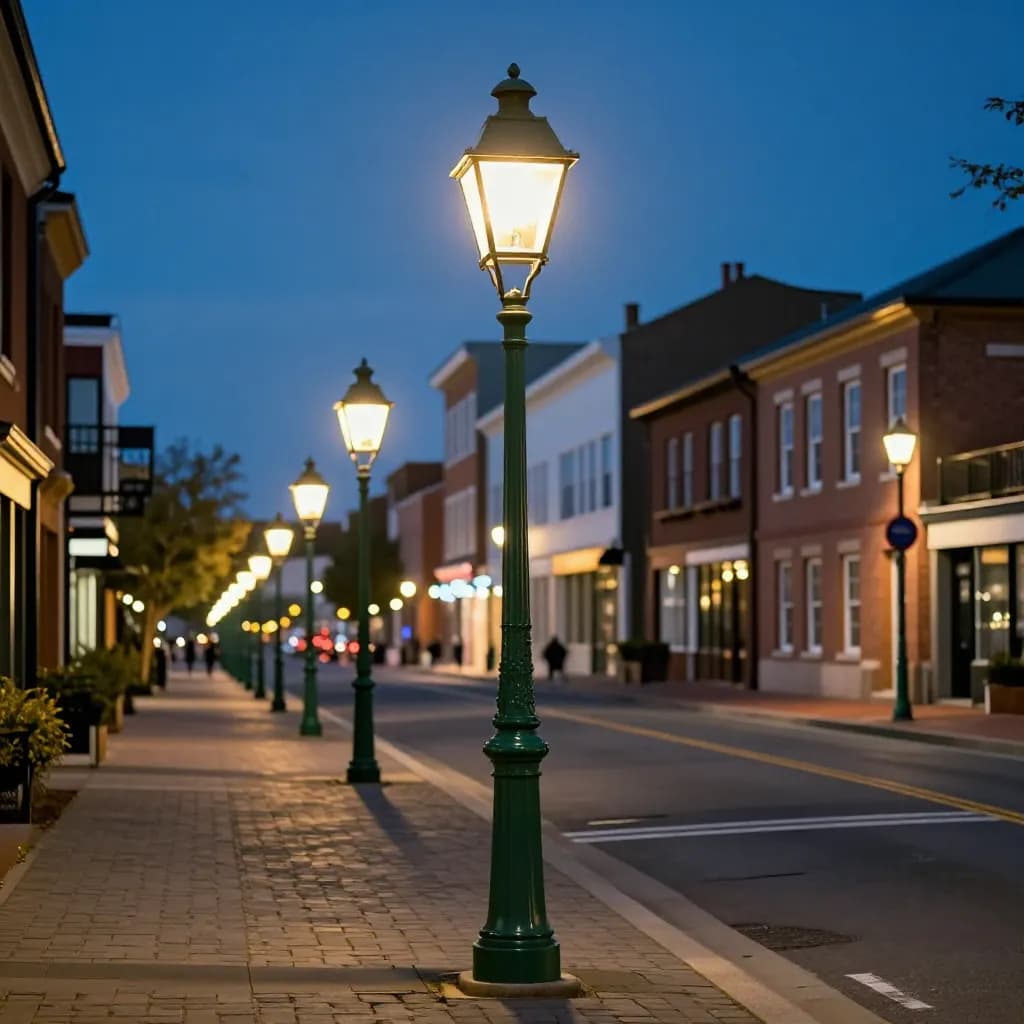
Urban designers and landscape architects increasingly specify street lighting poles as integral components of the public realm design, selecting pole styles, colors, and finishes that complement the architectural context and reinforce the desired character of each district. A historic downtown may specify ornate cast iron reproduction poles in heritage black or dark green. A modern commercial district may choose sleek cylindrical poles in silver or anthracite gray. A waterfront promenade may feature marine-grade poles in coastal blue or white. In each case, the powder coating delivers the specified color and finish while protecting the pole from the environmental stresses of its installation.
Ready to Start Your Project?
From one-off customs to 15,000-part production runs — get precise pricing in 24 hours.
On This Page
Street Lighting Poles as Urban Design Elements
The street lighting pole market encompasses a wide range of products: utilitarian steel poles for highway and arterial lighting, decorative cast aluminum poles for pedestrian areas, composite poles for corrosive environments, and heritage reproduction poles for historic districts. Each product type has different substrate materials, geometric complexity, and aesthetic requirements that affect the powder coating specification.
Powder coating has become the dominant finishing technology for street lighting poles because it offers the combination of durability, color range, and finish quality that urban design applications demand. The technology delivers consistent, high-quality finishes on both simple cylindrical poles and complex ornamental castings, with the environmental benefits of zero VOC emissions and high material efficiency that align with municipal sustainability goals.
Corrosion Protection for 30-Year Service Life
Street lighting poles are expected to provide 30-40 years of service with minimal maintenance, and the powder coating must maintain its protective function throughout this extended service life. The corrosion environment varies dramatically between installations — from benign suburban settings to aggressive coastal, industrial, and de-icing salt environments — and the coating specification must be matched to the specific conditions of each installation.
Steel poles — the most common substrate for utilitarian and mid-range decorative applications — require robust corrosion protection to prevent the structural degradation that could lead to pole failure. The standard protection system for steel lighting poles is hot-dip galvanizing followed by powder coating, creating a duplex system that provides 40-60 years of corrosion protection in moderate environments. The galvanizing provides sacrificial cathodic protection at any coating defect, while the powder coating protects the zinc layer from atmospheric consumption.
Aluminum poles — used for decorative and heritage applications — have inherent corrosion resistance from their natural oxide layer but still benefit from powder coating for aesthetic purposes and enhanced protection in aggressive environments. In coastal or industrial atmospheres, bare aluminum can develop unsightly white oxidation corrosion that, while not structurally threatening, degrades the pole's appearance. Powder coating prevents this surface degradation and maintains the specified color and finish.
Base plate and foundation interface protection deserves special attention because this area faces the most aggressive corrosion conditions on the pole. The base plate is in contact with concrete, which creates an alkaline environment. Standing water accumulates around the base during rain events. De-icing salt concentrates at ground level. And the base plate is the most structurally critical section of the pole, where corrosion-induced wall thinning has the greatest impact on structural capacity.
For steel poles, the base plate area should receive enhanced corrosion protection beyond the standard pole specification. Options include increased powder coating thickness of 100-150 microns on the base section, application of a zinc-rich epoxy primer beneath the powder topcoat, or specification of a separate below-grade coating system optimized for concrete and soil contact. Some municipalities specify stainless steel base plates on galvanized steel poles to eliminate base plate corrosion entirely.
The interior of hollow steel poles is another corrosion-vulnerable area. Condensation forms inside the pole due to temperature cycling, and this moisture — combined with any water ingress through the hand hole or luminaire mounting — creates a persistently damp environment. Internal coating with a thin epoxy film or the use of internal galvanizing provides protection against interior corrosion that could weaken the pole from within.
Heritage and Decorative Pole Finishes
Heritage and decorative street lighting poles require powder coating finishes that replicate traditional materials and patinas while providing modern durability. Cast iron reproduction poles, Victorian-style lantern posts, and Art Deco-inspired designs all demand finishes that evoke historical authenticity while resisting the environmental stresses of contemporary urban environments.
Traditional black is the most commonly specified heritage pole color, replicating the appearance of painted cast iron that has characterized street lighting since the gaslight era. However, heritage black is not a single color — it encompasses a range of tones from warm brownish-black to cool blue-black, and the specific shade should be selected to match the historical context. RAL 9005 jet black and RAL 9017 traffic black are common starting points, but custom color matching to historical reference samples may be necessary for authentic restoration projects.
Dark green — particularly the deep Brunswick green associated with Victorian-era ironwork — is another popular heritage color. This color is specified for heritage districts, parks, and conservation areas where it complements natural surroundings and historical architecture. RAL 6005 moss green and RAL 6012 black green are close matches, but heritage green specifications often require custom formulation to achieve the specific depth and warmth of traditional Brunswick green.
Antique and patina effects add visual depth and historical character to heritage poles. Powder coating can replicate the appearance of aged bronze, weathered copper, and patinated iron through multi-coat techniques and specialized effect powders. A common approach uses a dark base coat — typically black or dark brown — with a lighter metallic or textured topcoat applied in a controlled pattern that simulates natural weathering. The topcoat is applied more heavily on raised surfaces and more lightly in recesses, creating the light-and-shadow effect of genuine patina.
Metallic finishes for heritage poles include bronze, copper, brass, and antique gold effects achieved through metallic pigments in the powder formulation. These metallic powders contain aluminum or copper flake pigments that create a reflective, metallic appearance. The metallic effect varies with viewing angle and lighting conditions, adding visual interest that flat colors cannot achieve. Bonded metallic formulations — where the metallic pigment is bonded to the powder particle surface — provide more consistent metallic effect than dry-blended formulations.
Textured finishes are frequently specified for heritage poles to replicate the surface character of cast iron. Fine wrinkle textures, sand textures, and leatherette effects create surface interest that complements ornamental casting details. These textures also have the practical benefit of hiding minor surface imperfections in the casting, reducing the finishing labor required to achieve an acceptable appearance.
Base Plate Protection and Ground-Level Durability
The base plate area of a street lighting pole faces the most severe corrosion conditions of any section, and coating failure at the base is the most common cause of premature pole replacement. Understanding the specific threats to base plate coatings and specifying appropriate protection is essential for achieving the pole's design service life.
De-icing salt is the primary chemical threat to base plate coatings in northern climates. Salt-laden water from road spray and snowmelt concentrates at the pole base, creating a persistently corrosive environment during winter months. The salt concentration at ground level can be many times higher than the general atmospheric salt level, making the base plate environment significantly more aggressive than the upper pole sections. Salt spray resistance requirements for base plate coatings should be 50-100 percent higher than the general pole specification.
Dog urine is an often-overlooked but significant corrosion threat to street lighting pole bases in urban areas. The uric acid and salts in dog urine create a localized acidic environment that attacks both the coating and the underlying zinc galvanizing. Poles in areas with high dog traffic — parks, sidewalks, and residential streets — show accelerated base corrosion compared to poles in vehicle-only areas. Acid-resistant coating formulations and increased film thickness on the lower 50 centimeters of the pole help resist this exposure.
Mechanical damage at the base plate level results from lawn mower contact, snow plow strikes, vehicle bumper contact, and pedestrian foot traffic. The coating must resist these impacts without chipping or cracking, maintaining the corrosion barrier at the most vulnerable section of the pole. Impact resistance of 120 inch-pounds or more is recommended for the base section, compared to 80 inch-pounds for the upper pole.
Water pooling around the base plate creates a persistent wet environment that accelerates corrosion at any coating defect. Proper foundation design with drainage provisions helps minimize water accumulation, but the coating specification should assume that some water pooling will occur. The base plate coating should be specified for immersion resistance — the ability to maintain adhesion and protection when submerged in water for extended periods. Epoxy-based primers provide excellent immersion resistance and are recommended for the base plate area of poles in wet environments.
The hand hole cover — an access panel in the lower pole section for electrical connections — is another base-level vulnerability. The hand hole frame and cover create a joint where water can enter the pole interior, and the coating at the hand hole perimeter must be carefully applied to seal this joint. Gasket materials used to seal the hand hole cover must be compatible with the powder coating surface to maintain a watertight seal.
Color Selection for Urban Streetscape Design
Street lighting pole color selection is an urban design decision that affects the visual character of the streetscape, and the powder coating must deliver the specified color with accuracy and long-term stability. Municipal design guidelines, historic district regulations, and landscape architecture specifications all influence color selection, and the coating must meet these requirements while providing the durability needed for outdoor infrastructure.
Neutral colors dominate the street lighting pole palette. Black, dark gray, dark bronze, and dark green account for the majority of specifications because they provide visual weight and formality appropriate for public infrastructure while receding into the background of the streetscape. These dark colors complement most architectural styles and landscape settings, making them safe choices for municipal standardization.
Light and medium colors are specified for specific design contexts. White and silver poles are used in modern, minimalist streetscapes and coastal settings. Medium gray poles complement contemporary architecture. Warm tones — sand, terracotta, and warm gray — are specified for Mediterranean and desert-influenced designs. These lighter colors show dirt and weathering more readily than dark colors, requiring more frequent cleaning to maintain their intended appearance.
Custom colors matched to specific design palettes are increasingly common as municipalities invest in distinctive streetscape identities. A commercial district may specify poles in the district's brand color. A university campus may use institutional colors. A cultural district may choose colors that reference local artistic traditions. Powder coating's ability to match virtually any color reference supports these custom specifications.
Color consistency across a streetscape installation is critical for visual coherence. Poles installed over a period of months or years must match in color, and replacement poles installed decades later must also match the original installation. This requires careful color documentation — spectrophotometric data, physical reference panels, and powder formulation records — that enables accurate color reproduction over the long term. Municipal asset management systems should include coating color specifications linked to each pole location.
The interaction between pole color and luminaire light color affects the nighttime appearance of the streetscape. Warm-white LED luminaires cast a yellowish light that shifts the perceived color of the pole, while cool-white LEDs maintain more accurate color rendering. The pole color should be evaluated under the specific luminaire light source that will be used in the installation to ensure the nighttime appearance meets design expectations.
Application Challenges for Pole Geometries
Street lighting poles present specific powder coating application challenges due to their length, taper, and in the case of decorative poles, complex ornamental geometry. The coating process must achieve uniform coverage on these challenging shapes while meeting the demanding performance specifications required for outdoor infrastructure.
Tapered cylindrical poles — the most common geometry — range from 4 to 15 meters in length with base diameters of 150-300 millimeters tapering to 75-150 millimeters at the top. Coating these long, tapered shapes requires either a vertical coating setup with the pole suspended from an overhead conveyor, or a horizontal setup with the pole rotating on support rollers. Vertical coating provides better access to the full pole length but requires tall spray booths and ovens. Horizontal coating is more common for production efficiency but requires pole rotation to achieve uniform circumferential coverage.
Ornamental cast aluminum poles with decorative bases, fluted shafts, and ornate brackets present Faraday cage challenges in their recessed details. Deep recesses in casting ornament resist electrostatic powder penetration, requiring manual application with tribo-charging guns or reduced-voltage corona guns to achieve coverage in these areas. The complex geometry also makes film thickness measurement difficult — standard magnetic or eddy current gauges may not fit into recessed areas, requiring ultrasonic thickness measurement or destructive cross-section analysis for verification.
Multi-piece pole assemblies — where the base, shaft, and bracket are separate components assembled after coating — require color matching between components that may be coated in different batches or even by different applicators. Spectrophotometric color verification of each component before assembly ensures visual consistency. Assembly hardware — bolts, nuts, and washers — should also be coated or finished to match the pole color for a cohesive appearance.
Weld seam finishing on fabricated steel poles affects coating quality. Longitudinal weld seams on tapered poles must be ground smooth and blended with the parent metal surface to prevent the weld bead from telegraphing through the powder coating. For decorative poles where surface quality expectations are high, weld seams should be ground to a surface finish that matches the surrounding metal, with no visible weld line after coating.
Curing long poles requires ovens with adequate length and uniform temperature distribution. Temperature variation along the oven length can result in undercured sections on long poles, particularly at the ends where heat loss to the oven walls is greatest. Oven temperature mapping with multiple thermocouples along the pole length verifies uniform cure across the full pole.
Sustainability and Lifecycle Considerations
Street lighting poles are long-life infrastructure assets, and the sustainability of the coating system should be evaluated over the full lifecycle of the pole rather than just the initial application. Powder coating offers significant sustainability advantages over liquid paint systems, and these advantages are increasingly important to municipalities with sustainability commitments.
Zero VOC emissions during powder coating application eliminate the air quality impact associated with solvent-based liquid paints. For municipal coating operations or contracted coating facilities, this eliminates the need for VOC abatement equipment and simplifies environmental permitting. The environmental benefit is particularly significant for large-scale pole coating operations where thousands of poles are coated annually.
Material efficiency of 95-98 percent — achieved through overspray reclaim and reuse — minimizes powder waste and reduces the raw material consumption per pole. Liquid paint operations typically achieve only 30-70 percent transfer efficiency, with the remainder lost as waste requiring disposal. The powder coating waste stream is minimal and non-hazardous, consisting primarily of small quantities of color-change purge material.
The extended service life of properly specified powder coating reduces the frequency of recoating over the pole's lifecycle. A pole that requires recoating every 10 years with liquid paint will need 3-4 recoating cycles over a 40-year service life, each involving surface preparation, coating application, and associated environmental impact. A powder-coated pole with a 20-25 year coating life may need only one recoating cycle over the same period, reducing the total lifecycle environmental impact by 50-75 percent.
End-of-life recyclability of powder-coated steel and aluminum poles is excellent. The organic powder coating burns off during the metal melting process, contributing a small amount of energy but no significant contamination to the recycled metal. Both steel and aluminum poles are fully recyclable through standard metal recycling processes, and the powder coating does not affect the recyclability or the value of the recycled metal.
Lifecycle assessment of street lighting pole coating systems should consider the full chain of environmental impacts: raw material extraction and processing for the coating materials, energy consumption during application and curing, emissions during application, maintenance and recoating impacts over the pole's service life, and end-of-life disposal or recycling. When evaluated on this comprehensive basis, powder coating consistently demonstrates lower lifecycle environmental impact than liquid paint alternatives for long-life outdoor infrastructure.
Frequently Asked Questions
How long does powder coating last on street lighting poles?
Super-durable polyester provides 7-10 years of color retention, while fluoropolymer-modified coatings achieve 15-25 years. The duplex system of galvanizing plus powder coating provides corrosion protection for 40-60 years in moderate environments. Base plate areas may require earlier maintenance due to more aggressive ground-level exposure conditions.
What colors are available for street lighting poles?
Virtually any color is available through powder coating. Common choices include heritage black, dark green, dark bronze, anthracite gray, and silver. Custom color matching to any RAL, Pantone, or NCS reference is standard. Heritage finishes including antique bronze, patinated copper, and aged iron effects are achievable through multi-coat techniques and metallic effect powders.
How is the base plate area protected from corrosion?
Base plate protection typically includes increased powder coating thickness of 100-150 microns, zinc-rich epoxy primer beneath the topcoat, and proper foundation drainage to minimize water pooling. The duplex galvanizing-plus-powder-coating system provides the most robust base plate protection. Some specifications require separate below-grade coating systems optimized for concrete contact.
Can powder coating replicate heritage cast iron finishes?
Yes. Heritage finishes including traditional black, Brunswick green, antique bronze, and patinated effects are achievable through powder coating. Multi-coat techniques with dark base coats and lighter metallic topcoats simulate natural patina. Textured finishes replicate the surface character of cast iron. These finishes provide historical authenticity with modern durability.
Is powder coating environmentally friendly for municipal infrastructure?
Yes. Powder coating produces zero VOC emissions, achieves 95-98 percent material efficiency through overspray reclaim, and its extended service life reduces recoating frequency by 50-75 percent compared to liquid paint. Coated steel and aluminum poles are fully recyclable. These advantages align with municipal sustainability goals and simplify environmental compliance.
Ready to Start Your Project?
From one-off customs to 15,000-part production runs — get precise pricing in 24 hours.