Metal stampings and pressings are the most widely produced metal components in manufacturing, with billions of parts stamped annually for automotive, appliance, electronics, furniture, and general industrial applications. From automotive body panels and structural brackets to appliance housings and electrical enclosures, stamped parts are everywhere — and the vast majority require a protective and decorative coating.
Industrial
Powder Coating for Stampings and Pressings: High-Volume Industrial Finishing
Sundial Powder Coating·April 23, 2026·11 min
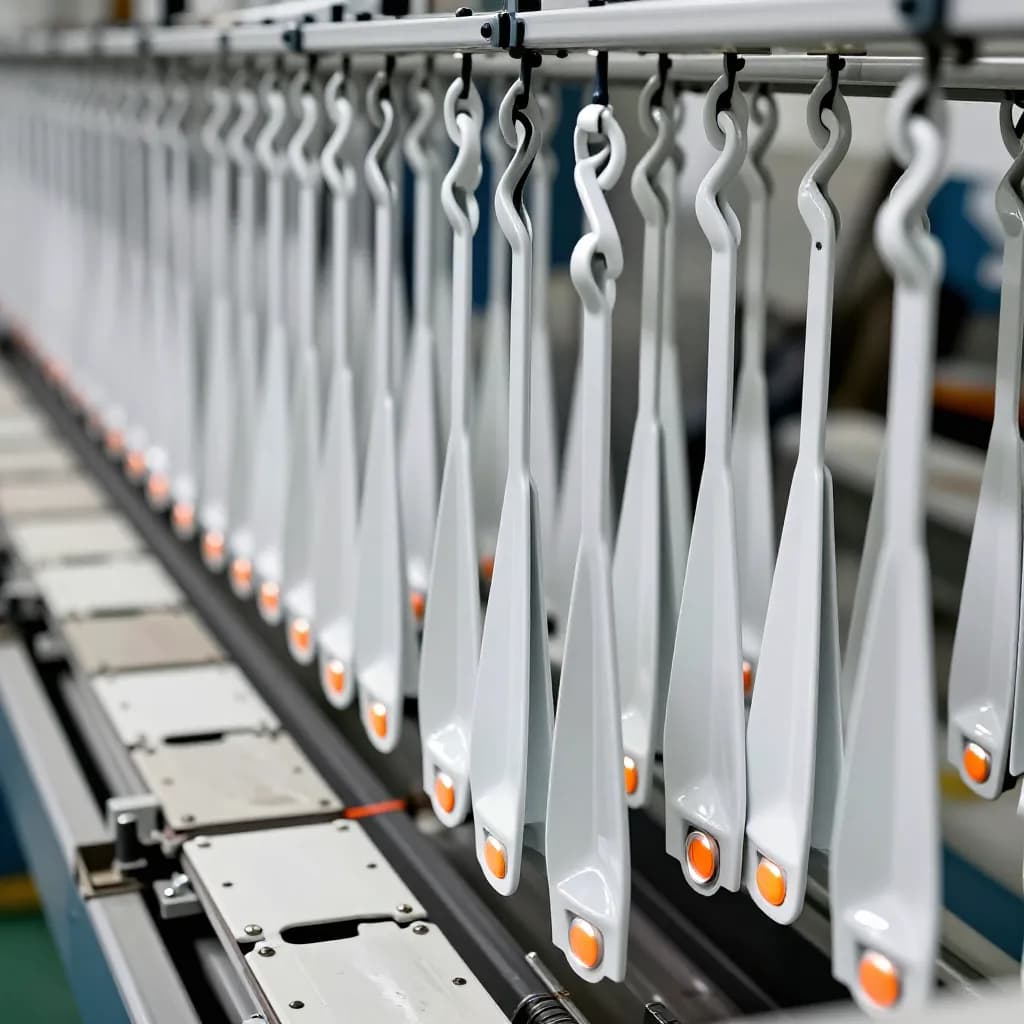
Powder coating has become the dominant finishing technology for stamped and pressed metal parts, driven by its environmental advantages, production efficiency, and superior coating performance compared to liquid paint. The high-volume, repetitive nature of stamping operations aligns perfectly with the automated, continuous-flow powder coating lines that deliver consistent quality at production rates of hundreds or thousands of parts per hour.
Ready to Start Your Project?
From one-off customs to 15,000-part production runs — get precise pricing in 24 hours.
On This Page
Stampings and Pressings: The Backbone of High-Volume Manufacturing
However, stamped parts present specific coating challenges that must be addressed for reliable quality. The stamping process creates sharp edges, burrs, and thin-wall sections that are difficult to coat uniformly. Stamping lubricants — drawing oils, forming compounds, and rust preventatives — must be thoroughly removed before coating. And the dimensional precision of stamped parts means that coating thickness must be controlled within tight tolerances to maintain fit and function in assembled products.
This article examines the complete powder coating process for stamped and pressed metal parts, from lubricant removal and surface preparation through application, curing, and quality verification, with specific attention to the challenges unique to high-volume stamping operations.
Stamping Lubricant Removal: The Critical First Step
The single most important pretreatment step for stamped parts is the complete removal of stamping lubricants. These lubricants — which include mineral oils, synthetic esters, chlorinated paraffins, water-soluble coolants, and solid film lubricants — are essential for the stamping process but are the primary cause of coating defects if not thoroughly removed before powder application.
The type of lubricant used in the stamping operation determines the cleaning approach. Light mineral oil-based stamping fluids are relatively easy to remove with standard alkaline cleaners at 50-65°C. Heavy-duty drawing compounds containing chlorinated paraffins, sulfurized fats, or extreme-pressure additives require more aggressive cleaning — higher temperatures (65-80°C), stronger alkaline concentrations, and longer immersion times.
Water-soluble stamping fluids, while easier to clean than oil-based compounds, present a different challenge: they can leave dried residues in recessed areas and on vertical surfaces that are difficult to detect visually but cause adhesion failures and fisheye defects in the coating. Thorough rinsing with clean water after alkaline cleaning is essential for water-soluble lubricant removal.
The cleaning process must reach all surfaces of the stamped part, including the interior of drawn cups, the back side of flanged edges, and the recesses of embossed features. Spray cleaning is generally more effective than immersion cleaning for complex stamped geometries because the mechanical action of the spray jets dislodges lubricant from recessed areas. Multi-stage spray wash systems with separate cleaning, rinsing, and conversion coating stages provide the most reliable results.
For high-volume automotive and appliance stamping operations, the cleaning system must handle the continuous flow of parts from the stamping press to the coating line. In-line cleaning systems integrated with the powder coating conveyor provide seamless processing, while batch cleaning in immersion tanks is used for lower-volume or mixed-part operations.
Verification of cleaning effectiveness is critical. Water-break testing — observing whether rinse water sheets uniformly across the part surface or breaks into droplets indicating residual contamination — is a simple but effective in-process check. More quantitative methods include surface tension measurement (contact angle goniometry) and residual carbon analysis for critical applications.
Sharp Edge Coverage: The Persistent Challenge
Sharp edges are the Achilles' heel of powder coating on stamped parts. The stamping process creates sheared edges, punched holes, and trimmed flanges with edge radii approaching zero — and powder coating naturally thins at sharp edges due to the electrostatic and surface tension effects that govern powder deposition and flow.
During electrostatic application, the electric field concentrates at sharp edges and points (the lightning rod effect), initially attracting excessive powder to these areas. However, as the powder melts and flows during curing, surface tension causes the molten coating to pull away from sharp edges, thinning the film at the edge while building up on adjacent flat surfaces. The result is a coating that may be 80-120 microns on flat areas but only 20-40 microns at sheared edges — a reduction of 50-75% that can leave edges inadequately protected against corrosion.
Several strategies address the sharp edge coverage problem. Edge radiusing — mechanically rounding the sharp edges before coating — is the most effective solution. A minimum edge radius of 0.5 mm significantly improves coating coverage, and 1.0 mm or greater provides near-uniform coverage. Tumble deburring, vibratory finishing, or dedicated edge-breaking operations can achieve the required radius on stamped parts, though they add a processing step and cost.
Powder formulation plays a significant role in edge coverage. Powders with higher melt viscosity resist the surface tension-driven flow away from edges, maintaining better coverage. Some powder manufacturers offer specific edge-coverage formulations with modified rheology that provides improved edge protection. Textured and wrinkle-finish powders also provide better edge coverage than smooth gloss finishes because their higher viscosity during cure limits flow.
Application technique can improve edge coverage. Applying a slightly thicker overall film ensures that even the thinnest areas at edges meet minimum protection requirements, though this increases powder consumption and may affect dimensional tolerances. Pre-heating the part to 40-60°C before powder application causes the powder to partially melt on contact, reducing the tendency for edge thinning during the subsequent oven cure.
For the most critical applications, edge coverage is verified by measuring film thickness directly on sheared edges using specialized small-area probes or by cross-sectional microscopy of coated edge samples.
High-Volume Coating Line Design and Automation
Powder coating lines for stamped parts are designed for high throughput, consistent quality, and minimal manual intervention. A modern automotive or appliance stamping coating line may process 500-2000 parts per hour, with every step from loading to unloading automated or semi-automated.
The conveyor system is the backbone of the coating line. Overhead conveyors with power-and-free capability allow parts to accumulate at loading and unloading stations without stopping the main line. Conveyor speed is matched to the slowest process step — typically the curing oven — and all upstream processes (cleaning, pretreatment, drying, application) are designed to operate within the available line time.
Part hanging and fixturing directly affect coating quality and line efficiency. Each stamped part must be hung in an orientation that allows complete powder coverage, adequate drainage during pretreatment, and proper airflow during curing. Custom hanging fixtures designed for specific part geometries ensure consistent orientation and minimize contact marks. The fixture design must also provide a reliable electrical ground path for electrostatic powder deposition.
Automatic powder application systems use reciprocating or robotic spray guns programmed to follow the part contour as it passes through the spray booth. Gun-to-part distance, traverse speed, powder flow rate, and electrostatic voltage are optimized for each part geometry and stored as recipes that can be recalled instantly when changing between part types. Multi-gun configurations with guns positioned on both sides and above the conveyor ensure complete coverage on complex three-dimensional stampings.
Powder reclaim systems are essential for the economics of high-volume stamping operations. Cyclone separators and cartridge filter collectors capture overspray powder for reuse, achieving material utilization rates of 95-98%. The reclaimed powder is blended with virgin powder at controlled ratios (typically 20-30% reclaim) to maintain consistent coating properties. Automatic color change systems that purge the booth, guns, and reclaim system between colors enable rapid changeover for mixed-production operations.
In-line quality monitoring systems provide real-time verification of coating thickness, cure, and appearance. Non-contact film thickness measurement using eddy-current or thermal sensors, combined with automated visual inspection using camera systems, identifies defective parts before they leave the coating line.
Automotive Stamping Applications and Specifications
The automotive industry drives the most demanding specifications for powder-coated stampings, with requirements that encompass corrosion resistance, appearance, mechanical durability, and process capability at volumes of millions of parts per year.
Structural stampings — floor pans, cross members, reinforcement brackets, and suspension mounting plates — require coatings that provide long-term corrosion protection in the harsh underbody environment. These components are exposed to road salt, gravel impacts, water spray, and temperature cycling from -40°C to +80°C. Epoxy and epoxy-polyester powder coatings at 60-100 microns, applied over zinc phosphate pretreatment, provide the corrosion resistance needed to meet automotive warranty requirements of 12-15 years perforation corrosion protection.
Visible stampings — appliance panels, decorative trim, and interior components — must meet stringent appearance requirements in addition to corrosion protection. Surface defects such as orange peel, inclusions, color variation, and gloss inconsistency are cause for rejection. Polyester and polyester-TGIC-free powder coatings provide the color range, gloss control, and weathering resistance needed for visible applications.
The automotive industry's quality management framework — based on IATF 16949 quality management system requirements — imposes rigorous process control and documentation requirements on powder coating operations. Process capability studies (Cpk analysis) must demonstrate that the coating process consistently produces parts within specification limits. Typical Cpk requirements of 1.33 or higher for critical characteristics (film thickness, adhesion, corrosion resistance) demand tight process control and continuous monitoring.
Failure Mode and Effects Analysis (FMEA) is required for automotive coating processes, identifying potential failure modes (inadequate cleaning, incorrect cure temperature, contaminated powder) and implementing controls to prevent them. Control plans define the inspection frequency, measurement methods, and reaction plans for each critical process parameter.
Automotive OEMs conduct regular audits of coating suppliers to verify compliance with specifications and quality system requirements. These audits evaluate the entire coating process from incoming material control through final inspection, and non-conformances must be addressed with corrective actions within specified timeframes.
Appliance Industry Stamping Applications
The appliance industry is the second-largest consumer of powder-coated stampings after automotive, with applications including refrigerator shelves and panels, washing machine drums and housings, oven cavities and panels, dishwasher racks and tubs, and HVAC equipment housings.
Appliance coatings must meet a unique combination of requirements: attractive appearance for consumer-facing surfaces, chemical resistance to cleaning agents and food acids, heat resistance for oven and dryer components, and humidity resistance for laundry and dishwasher applications. The diversity of requirements within a single appliance often means that different components receive different coating systems optimized for their specific exposure conditions.
Refrigerator and freezer components operate in cold, humid environments where condensation is a constant concern. The coating must resist moisture-induced adhesion loss and blistering at temperatures from -25°C to ambient. Epoxy-polyester hybrid coatings provide excellent moisture resistance for refrigeration applications, with the epoxy component contributing chemical resistance and the polyester component providing flexibility and appearance.
Oven cavity coatings must withstand continuous temperatures of 250-300°C during self-cleaning cycles and resist food spills, grease, and cleaning chemicals. Silicone-modified polyester or pure silicone powder coatings are used for oven interiors, with specialized formulations that maintain their appearance and cleanability after hundreds of thermal cycles. These high-temperature coatings are typically applied at 40-60 microns to maintain the smooth, easy-clean surface that consumers expect.
Dishwasher racks and tub components face perhaps the most aggressive chemical environment in appliance applications — hot alkaline detergent solutions, rinse aids, and water temperatures of 60-75°C in every wash cycle. Nylon powder coatings applied by fluidized bed at 300-500 microns have traditionally been used for dishwasher racks, providing the thick, flexible, chemical-resistant coating needed for this demanding application. Epoxy powder coatings are increasingly used as a thinner, lighter alternative for dishwasher tub interiors.
The appliance industry's trend toward premium finishes — stainless steel appearance, matte textures, and custom colors — has expanded the range of powder coating effects used on stamped appliance panels. Metallic powder coatings, bonded metallic formulations, and super-matte finishes provide the design differentiation that appliance manufacturers seek in competitive consumer markets.
Quality Control for High-Volume Stamping Operations
Quality control in high-volume stamping coating operations must balance thorough verification with the production pace demanded by automotive and appliance manufacturing schedules. Statistical sampling, automated inspection, and real-time process monitoring replace the 100% manual inspection that is practical only for low-volume operations.
Film thickness is the most frequently measured quality parameter. In-line non-contact measurement systems can check every part, while manual gauge measurements on sampled parts provide calibration verification. Typical sampling rates for manual measurement are 3-5 parts per hour per coating line, with measurements at 5-10 specified locations on each part. Statistical process control charts track thickness trends and trigger corrective action before parts drift out of specification.
Adhesion testing per ASTM D3359 (cross-cut tape test) is performed on sampled parts at the start of each shift, after any process change, and at regular intervals during production. For automotive applications, the more demanding steam jet adhesion test (DIN 55662) or high-pressure water jet test may be specified, simulating the aggressive conditions that coatings face in automotive service.
Cure verification ensures that the powder coating has achieved full crosslinking during the oven cycle. Methods include solvent rub testing (MEK or acetone rub for a specified number of double rubs), differential scanning calorimetry (DSC) measuring residual cure enthalpy, and hardness testing (pencil hardness or Buchholz indentation). Undercured coatings exhibit reduced chemical resistance, adhesion, and mechanical properties that may not become apparent until the product is in service.
Appearance inspection for visible parts includes gloss measurement (per ASTM D523), color measurement (per ASTM D2244 using spectrophotometry), orange peel evaluation (using wavescan instruments or visual standards), and defect detection (visual inspection or automated camera systems). Appearance specifications define acceptable ranges for each parameter, and parts outside these ranges are rejected or reworked.
Corrosion testing is performed on a periodic basis — typically weekly or monthly — using accelerated test methods. Salt spray testing per ASTM B117, cyclic corrosion testing per SAE J2334 or GMW 14872, and humidity testing per ASTM D2247 provide ongoing verification that the coating system is performing to specification. Test panels coated alongside production parts provide representative samples without consuming production parts.
Frequently Asked Questions
Why does powder coating thin out at stamped edges?
During curing, surface tension causes molten powder to pull away from sharp edges, reducing film thickness by 50-75% compared to flat areas. Solutions include edge radiusing (minimum 0.5 mm radius), using high-viscosity powder formulations, applying textured finishes, or pre-heating parts to 40-60°C before application.
How are stamping oils removed before powder coating?
Alkaline spray cleaning at 50-80°C is the standard method, with temperature and concentration adjusted for the lubricant type. Multi-stage spray wash systems with separate cleaning, rinsing, and conversion coating stages provide the most reliable results. Water-break testing verifies complete oil removal before coating.
What production rates can powder coating lines achieve for stampings?
Modern automated powder coating lines for stamped parts process 500-2000 parts per hour, depending on part size and complexity. Automatic gun systems, powder reclaim, and in-line quality monitoring enable consistent quality at these production rates with material utilization of 95-98%.
What powder coating is used for oven cavity stampings?
Oven cavities use silicone-modified polyester or pure silicone powder coatings that withstand continuous temperatures of 250-300°C during self-cleaning cycles. These coatings are applied at 40-60 microns and maintain their smooth, easy-clean surface after hundreds of thermal cycles.
How is coating quality verified in high-volume stamping operations?
Quality control combines in-line automated measurement (non-contact thickness, camera inspection) with statistical sampling of manual tests (adhesion, cure verification, appearance measurement). Statistical process control charts track trends, and periodic accelerated corrosion testing verifies ongoing coating system performance.
Ready to Start Your Project?
From one-off customs to 15,000-part production runs — get precise pricing in 24 hours.