Solar panel mounting systems must deliver reliable structural performance for a minimum of 25 years — the standard warranty period for photovoltaic panels. This extraordinary service life requirement places the mounting system's corrosion protection among the most demanding specifications in the construction industry. The powder coating on solar mounting hardware must maintain its protective function through decades of UV exposure, temperature cycling, moisture, and in many installations, salt spray and industrial atmospheric pollution.
Industrial
Powder Coating for Solar Panel Mounting Systems: 25-Year Durability, UV, and Galvanic Isolation
Sundial Powder Coating·April 23, 2026·12 min
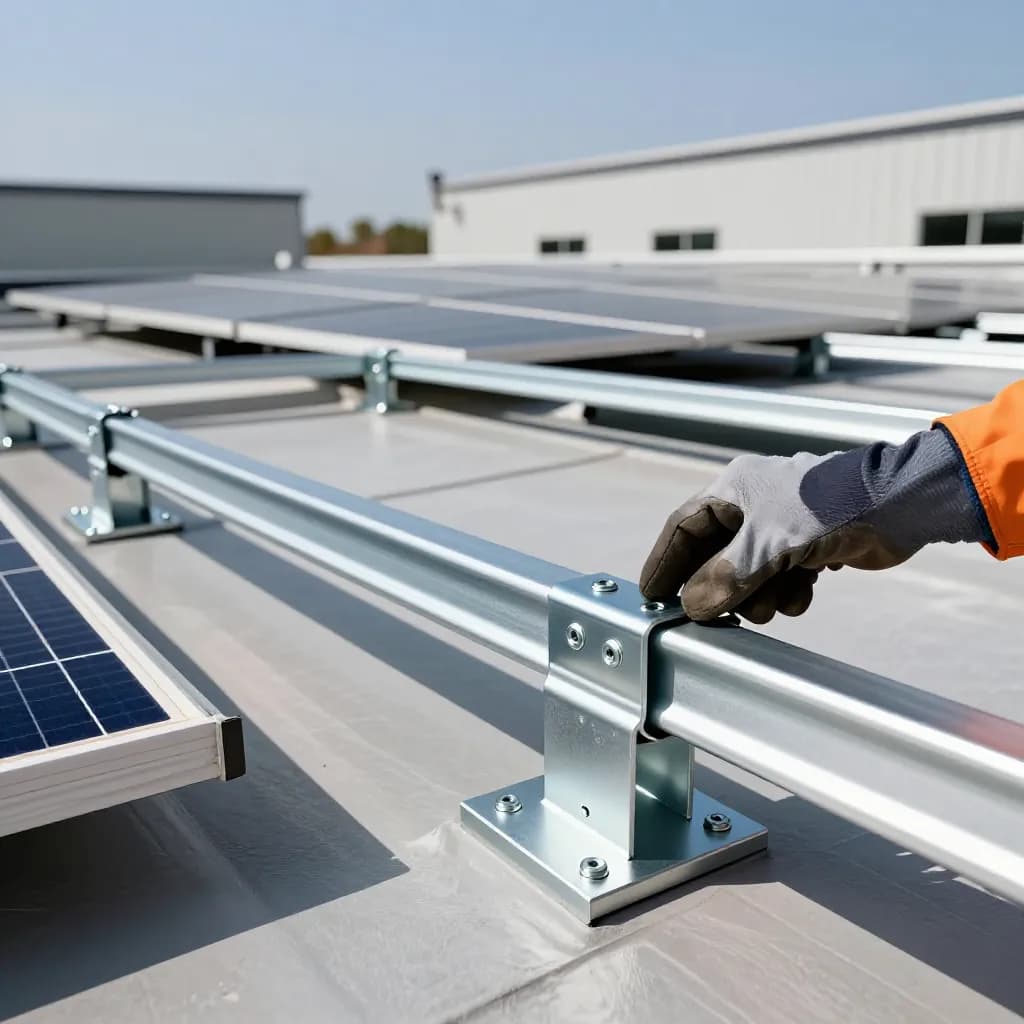
The solar mounting market has grown explosively alongside the photovoltaic industry, with millions of mounting systems installed annually on rooftops, ground-mount arrays, carports, and building-integrated applications. These systems use aluminum extrusions, galvanized steel sections, and stainless steel fasteners in various combinations, with powder coating applied to some or all components depending on the system design and the corrosion severity of the installation environment.
Ready to Start Your Project?
From one-off customs to 15,000-part production runs — get precise pricing in 24 hours.
On This Page
Solar Mounting Systems: A 25-Year Coating Challenge
The economic case for high-quality coating on solar mounting systems is straightforward. A mounting system failure due to corrosion can require panel removal, structural repair or replacement, and panel reinstallation — a disruptive and labor-intensive operation that negates years of energy production savings. The coating specification must be conservative enough to ensure that the mounting system outlasts the panels it supports, with a target service life of 30-35 years to provide margin beyond the 25-year panel warranty.
Powder coating competes with hot-dip galvanizing and anodizing as the primary corrosion protection technology for solar mounting systems. Each technology has advantages in specific applications, and many mounting systems use combinations — for example, galvanized steel rails with powder-coated aluminum clamps, or anodized aluminum rails with powder-coated steel ground mounts. Understanding the strengths and limitations of powder coating relative to these alternatives is essential for optimal specification.
UV Resistance for Multi-Decade Outdoor Exposure
Solar mounting systems face continuous, unshaded UV exposure for their entire service life — a more severe UV challenge than almost any other outdoor application. Unlike building facades that receive partial shading from overhangs, adjacent structures, and varying sun angles, solar mounting systems are deliberately oriented to maximize solar exposure, which also maximizes UV degradation of the coating.
The UV resistance hierarchy of powder coating chemistries determines which formulations are appropriate for solar mounting applications. Standard polyester powder coatings provide 3-5 years of acceptable UV performance — entirely inadequate for a 25-year application. Super-durable polyester formulations extend UV resistance to 7-10 years, which may be acceptable for components with limited UV exposure such as ground-mount foundations and concealed structural members. For fully exposed components, fluoropolymer-based powder coatings — either FEVE (fluoroethylene vinyl ether) or PVDF (polyvinylidene fluoride) formulations — provide 20-30 years of UV resistance, matching the service life requirement of the mounting system.
Accelerated weathering testing provides the primary means of predicting long-term UV performance. ASTM G154 using QUV-A lamps and ASTM G155 using xenon arc lamps simulate outdoor UV exposure in compressed timeframes. For solar mounting applications, a minimum of 3000 hours of QUV-A exposure or 5000 hours of xenon arc exposure is recommended, with acceptance criteria of less than 50 percent gloss retention loss and Delta E color change below 5.0. These extended test durations correlate approximately to 15-20 years of real-world exposure in temperate climates.
Real-world exposure testing in high-UV locations — South Florida, Arizona, or tropical sites — provides the most reliable long-term performance data but requires years of exposure time. Major powder coating manufacturers maintain outdoor exposure test sites and can provide 5-10 year real-world exposure data for their solar-grade formulations. This data, combined with accelerated testing, provides confidence in the coating's ability to meet the 25-year service life requirement.
Color selection affects UV durability. Light colors — white, light gray, and silver — show less visible UV degradation than dark colors because chalking and fading are less apparent. For solar mounting systems where appearance is secondary to function, light colors provide the most forgiving UV performance. However, some installations — particularly carports and building-integrated systems — have aesthetic requirements that may dictate specific colors.
Galvanic Isolation Between Dissimilar Metals
Solar mounting systems frequently combine dissimilar metals — aluminum rails with steel brackets, stainless steel fasteners in aluminum extrusions, and copper grounding conductors attached to aluminum or steel structures. These bimetallic junctions create galvanic corrosion cells that can cause accelerated degradation of the more active metal, and powder coating plays a critical role in preventing galvanic corrosion by electrically isolating the dissimilar metals.
Galvanic corrosion occurs when two metals with different electrochemical potentials are in electrical contact in the presence of an electrolyte — typically rainwater or condensation. In the galvanic series, aluminum is more active than steel, and both are more active than stainless steel and copper. At an unprotected aluminum-to-steel junction, the aluminum will corrode preferentially, potentially causing structural failure at the connection point.
Powder coating provides galvanic isolation by placing an electrically insulating polymer layer between the dissimilar metals. When an aluminum clamp is powder coated before assembly onto a steel rail, the coating prevents direct metal-to-metal contact and blocks the flow of galvanic current. The effectiveness of this isolation depends on the coating's integrity — any coating defect at the bimetallic interface creates a localized galvanic cell that concentrates corrosion at the defect.
For reliable galvanic isolation, the powder coating must maintain complete, defect-free coverage at all bimetallic interfaces throughout the system's service life. This requires adequate film thickness — a minimum of 60 microns at contact surfaces — and excellent adhesion that resists the compressive and shear forces at bolted connections. The coating must also resist the fretting wear that occurs at bolted joints as the structure flexes under wind and thermal loads, which can gradually wear through the coating and expose bare metal.
Supplementary isolation measures are recommended at critical bimetallic junctions. Nylon or EPDM isolation washers between bolt heads and coated surfaces distribute clamping force and provide a secondary isolation barrier. Stainless steel fasteners should use isolation bushings in aluminum holes to prevent galvanic attack on the hole bore. These mechanical isolation measures work in conjunction with the powder coating to provide redundant galvanic protection.
Electrical grounding requirements for solar mounting systems create a deliberate exception to galvanic isolation. The mounting structure must be electrically grounded for safety, which requires metal-to-metal contact at specific grounding points. These grounding connections should use compatible metals — aluminum grounding lugs on aluminum structures, for example — and should be protected with anti-oxidant compound to maintain conductivity while minimizing corrosion.
Aluminum vs. Steel Mounting Systems: Coating Approaches
The choice between aluminum and steel for solar mounting systems affects the coating specification significantly. Each material has different corrosion characteristics, pretreatment requirements, and coating performance expectations that must be understood for appropriate specification.
Aluminum mounting systems — the dominant choice for rooftop and residential ground-mount installations — offer inherent corrosion resistance from the stable aluminum oxide layer that forms naturally on the surface. In many benign environments, anodized or even bare aluminum provides adequate corrosion resistance without powder coating. However, powder coating is specified on aluminum mounting systems for several reasons: enhanced corrosion protection in aggressive environments, galvanic isolation at bimetallic junctions, color coding for product identification, and aesthetic requirements for visible installations.
Pretreatment for aluminum solar mounting components follows the standard sequence: alkaline cleaning, acid etch or deoxidize, and chromate-free conversion coating. The conversion coating — typically zirconium or titanium-based — must provide excellent adhesion that withstands decades of outdoor exposure. Conversion coating weight should be verified at 30-50 milligrams per square meter, with adhesion testing confirming 5B cross-hatch results on production parts.
Steel mounting systems — common for large ground-mount utility-scale installations — require more aggressive corrosion protection than aluminum. Hot-dip galvanized steel is the baseline corrosion protection for steel solar mounting, providing 25-50 years of protection depending on the zinc coating weight and the corrosion severity of the environment. Powder coating over galvanized steel provides a duplex system that extends the service life beyond what either protection method achieves alone.
The duplex galvanized-plus-powder-coating system is particularly effective because the two protection mechanisms are complementary. The zinc galvanizing provides sacrificial cathodic protection at any coating defect, preventing rust formation even where the powder coating is damaged. The powder coating protects the zinc layer from atmospheric attack, extending the life of the galvanizing. Together, the duplex system can provide 40-60 years of corrosion protection — well beyond the 25-year minimum requirement.
Pretreatment of galvanized steel for powder coating requires a modified process that addresses the zinc surface chemistry. The galvanized surface must be cleaned of zinc oxide and zinc carbonate films, lightly etched to create adhesion profile, and conversion coated with a chemistry compatible with zinc substrates. Over-etching must be avoided, as excessive removal of the zinc layer defeats the purpose of galvanizing.
Environmental Severity Classification and Coating Selection
The corrosion severity of the installation environment is the primary factor determining the coating specification for solar mounting systems. International standard ISO 9223 classifies atmospheric corrosivity into categories from C1 (very low) to CX (extreme), and the coating specification should be matched to the corrosivity category of the installation site.
C1-C2 environments — dry interiors and rural areas with low pollution — represent the least demanding conditions. Aluminum mounting systems in these environments may not require powder coating for corrosion protection, though coating may still be specified for aesthetic or identification purposes. If coated, standard polyester at 50-60 microns over basic conversion coating provides adequate protection.
C3 environments — urban and light industrial areas with moderate pollution — are the most common installation category for commercial and residential solar systems. Super-durable polyester at 60-80 microns over zirconium conversion coating on aluminum, or polyester over zinc phosphate on galvanized steel, provides reliable 25-year protection in C3 conditions. Salt spray resistance of 750-1000 hours is appropriate for this category.
C4 environments — industrial areas with moderate salinity and coastal areas with moderate salt spray — require enhanced coating specifications. Fluoropolymer-modified powder coatings or dual-coat systems at 80-120 microns total thickness are recommended, with salt spray resistance of 1500 hours or more. Galvanic isolation at all bimetallic junctions becomes critical in C4 environments where the electrolyte conductivity is higher.
C5 and CX environments — heavy industrial areas with high humidity and aggressive atmosphere, and offshore or direct coastal locations — represent the most demanding conditions for solar mounting systems. These environments may require the full duplex galvanized-plus-powder-coating system on steel components, with fluoropolymer topcoats for maximum UV and corrosion resistance. Salt spray resistance targets of 2000 hours or more are appropriate, and supplementary protection measures such as edge sealants and fastener encapsulation may be necessary.
Site-specific assessment is important because microclimate effects can create localized corrosion conditions that differ from the general area classification. A solar array near a cooling tower, adjacent to a highway where de-icing salt is used, or downwind of an industrial emission source may face more aggressive conditions than the general area classification suggests.
Fastener and Connection Point Protection
Fasteners and connection points are the most vulnerable locations in any solar mounting system because they concentrate mechanical stress, create bimetallic junctions, and are difficult to coat completely. The coating strategy for these critical locations requires specific attention beyond the general mounting system specification.
Bolted connections experience compressive stress under the bolt head and nut, shear stress at the joint interface, and cyclic loading from wind and thermal movement. The powder coating at these locations must withstand these mechanical forces without cracking, delaminating, or wearing through. Pre-coating the components before assembly ensures complete coverage of all surfaces, but the assembly process itself can damage the coating at contact points. Torque-controlled assembly with calibrated tools minimizes coating damage during installation.
Self-drilling and self-tapping fasteners used in some mounting systems penetrate the coating during installation, creating unprotected edges at the fastener hole. These exposed edges are corrosion initiation sites that can propagate under the surrounding coating. For critical applications, fastener holes should be pre-drilled and the hole edges coated before fastener installation. Where field-drilled holes are unavoidable, touch-up coating or corrosion-inhibiting sealant should be applied around the fastener after installation.
Clamp connections — used to attach panels to mounting rails — create high-contact-pressure zones where the clamp grips the rail. The powder coating at these contact zones must resist the compressive force without crushing or cold-flowing, which would reduce clamping force over time and potentially allow panel movement. Hard polyester coatings with pencil hardness of 3H or higher resist compression better than softer formulations. Some mounting system manufacturers specify uncoated contact zones on rails where clamps grip, relying on the clamp's coating and isolation washers for galvanic protection.
Grounding connections require special consideration. Electrical grounding of the mounting structure is a safety requirement, and the grounding connection must maintain low electrical resistance throughout the system's service life. Grounding lugs are typically installed with star washers or serrated flanges that penetrate the coating to make metal-to-metal contact. The exposed metal at the grounding connection should be protected with anti-oxidant compound and a weatherproof cover to prevent corrosion of the grounding interface.
Quality Assurance and Warranty Support
The 25-year service life requirement for solar mounting systems demands a quality assurance program that provides confidence in long-term coating performance. This program must encompass incoming material inspection, process control during coating application, finished product testing, and ongoing field performance monitoring.
Incoming powder inspection should verify that each powder batch meets the specification for chemistry, particle size distribution, gel time, and color. Certificate of analysis data from the powder manufacturer should be reviewed and retained as part of the batch traceability record. For critical solar applications, incoming powder should also be tested for accelerated weathering performance using retained samples from each batch.
Process control during coating application monitors the key parameters that affect coating quality: pretreatment chemical concentrations and temperatures, conversion coating weight, powder film thickness, cure oven temperature profile, and cure time. Statistical process control charting of these parameters identifies trends and drift before they produce out-of-specification product. Automated monitoring systems that log process data continuously provide the most reliable process control for high-volume solar mounting production.
Finished product testing should include film thickness measurement at multiple points per component, cross-hatch adhesion testing per ASTM D3359, and visual inspection for cosmetic defects. Periodic destructive testing — including salt spray, accelerated weathering, and mechanical property tests — on production samples verifies ongoing compliance with the coating specification.
Warranty documentation for solar mounting coatings should clearly define the warranted performance parameters, the environmental conditions covered, and the exclusions that void the warranty. Typical coating warranties for solar mounting systems guarantee against perforation corrosion, delamination, and excessive chalking or fading for 15-25 years, with specific performance thresholds defined for each parameter. The warranty should be backed by accelerated testing data and, ideally, real-world exposure data from the powder manufacturer's test sites.
Field performance monitoring through periodic inspection of installed systems provides the most valuable long-term quality data. Establishing a network of reference installations in different climate zones and inspecting them at regular intervals — annually for the first five years, then every two to three years thereafter — builds a performance database that validates the coating specification and supports warranty claims.
Frequently Asked Questions
Can powder coating last 25 years on solar mounting systems?
Yes, with appropriate specification. Fluoropolymer-based powder coatings (FEVE or PVDF) provide 20-30 years of UV resistance. Combined with proper pretreatment and adequate film thickness, these coatings maintain protective function for 25-35 years. Duplex systems combining galvanizing with powder coating on steel can achieve 40-60 years of corrosion protection.
How does powder coating prevent galvanic corrosion on solar mounts?
Powder coating electrically isolates dissimilar metals by placing an insulating polymer layer between them, blocking galvanic current flow. For reliable isolation, the coating must maintain defect-free coverage at all bimetallic interfaces with a minimum 60-micron film thickness. Supplementary isolation washers provide redundant protection at bolted connections.
Is powder coating better than anodizing for solar mounting?
Each has advantages. Anodizing provides excellent corrosion resistance on aluminum with no added thickness, but offers limited color options and no galvanic isolation. Powder coating provides galvanic isolation, unlimited colors, and can be applied to both aluminum and steel. Many systems use anodized rails with powder-coated clamps and brackets.
What coating is needed for coastal solar installations?
Coastal installations (ISO 9223 category C4-C5) require enhanced specifications: fluoropolymer-modified powder coatings or dual-coat systems at 80-120 microns, salt spray resistance of 1500-2000 hours, and careful galvanic isolation at all bimetallic junctions. Duplex galvanized-plus-powder-coating systems on steel provide maximum coastal corrosion protection.
Does powder coating affect solar mounting system grounding?
Powder coating is an electrical insulator, so grounding connections require metal-to-metal contact through the coating. Star washers or serrated flanges penetrate the coating at grounding points. These exposed connections should be protected with anti-oxidant compound and weatherproof covers to maintain low resistance throughout the system's service life.
Ready to Start Your Project?
From one-off customs to 15,000-part production runs — get precise pricing in 24 hours.