Shopping carts endure one of the most punishing service environments of any commercial product. A typical supermarket cart is used 5-8 times per day, spending hours in outdoor parking lots exposed to sun, rain, and temperature extremes, then rolling through refrigerated and ambient store environments. Carts collide with each other, with vehicles, with curbs, and with store fixtures. They carry corrosive items like leaking battery acid, bleach, and acidic foods. They are exposed to road salt in winter climates and coastal salt spray in seaside locations.
Commercial
Powder Coating for Shopping Carts and Trolleys: Corrosion-Resistant Finishes for Retail
Sundial Powder Coating·April 22, 2026·11 min
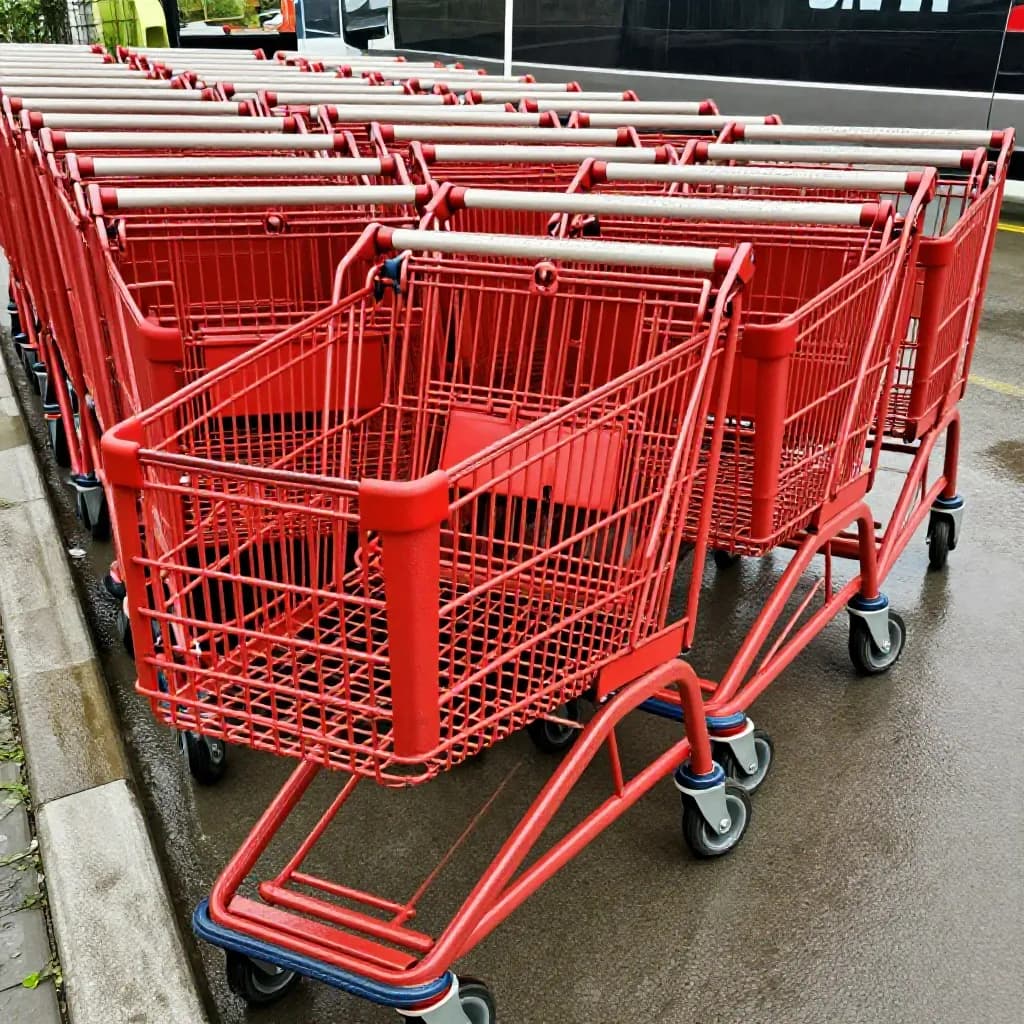
The average shopping cart has a service life of 3-7 years, and the coating is the primary factor determining whether a cart reaches the upper or lower end of that range. A cart with a failed coating develops rust that stains merchandise, creates sharp edges that injure customers, and projects a negative image of the retailer. Premature cart replacement due to coating failure represents a significant cost for retailers operating fleets of hundreds or thousands of carts.
Ready to Start Your Project?
From one-off customs to 15,000-part production runs — get precise pricing in 24 hours.
On This Page
The Demanding Life of a Shopping Cart Finish
Powder coating has become the preferred finishing technology for shopping cart manufacturers, displacing the chrome plating and zinc plating systems that dominated the market for decades. While chrome and zinc plating provide excellent corrosion protection when intact, they are vulnerable to chipping at impact points, and once breached, corrosion progresses rapidly beneath the plating. Powder coating provides a more forgiving system — minor chips and scratches can be tolerated without catastrophic corrosion spread, and the coating can be applied over zinc plating for a dual-protection system.
Wire Form Coating Challenges and Solutions
Shopping carts present unique powder coating challenges because they are fabricated primarily from wire — typically 5-8 mm diameter low-carbon steel wire formed into baskets, frames, and child seats. Wire forms have a very high surface-area-to-mass ratio and complex three-dimensional geometry with numerous wire intersections, bends, and weld points that are difficult to coat uniformly.
The Faraday cage effect is the primary challenge in powder coating wire forms. The electrostatic charge that drives powder deposition onto the workpiece is weakened in recessed areas between closely spaced wires, causing thin or absent coating in these critical zones. Wire intersections and the interior corners of the basket are particularly affected, and these are precisely the areas most vulnerable to corrosion because they trap moisture and debris.
Several techniques address the Faraday cage effect on shopping carts. Low-charging powder formulations with reduced electrostatic sensitivity penetrate recessed areas more effectively than standard formulations. Tribo-charging application guns, which charge powder through friction rather than corona discharge, produce a softer charge that wraps around wire forms more uniformly. Dense-phase powder delivery systems provide more consistent powder flow at lower velocities, improving deposition in hard-to-reach areas.
Multi-pass application strategies are common for shopping cart coating. The first pass applies powder to the exterior surfaces and accessible areas using standard corona guns. A second pass with tribo guns or low-kV corona settings targets the interior basket areas and wire intersections. Some manufacturers use a combination of automatic reciprocating guns for the first pass and manual touch-up guns for the second pass to ensure complete coverage.
Pre-heating the cart assembly to 80-120°C before powder application is another effective technique. The warm substrate causes powder particles to adhere on contact through thermal tack, independent of electrostatic charge. This eliminates the Faraday cage effect entirely, ensuring uniform coverage on all surfaces including recessed wire intersections.
Dual-Protection Systems: Zinc Plus Powder Coating
The most durable shopping cart coating systems combine zinc plating or galvanizing with powder coating to create a dual-layer protection system that dramatically extends cart service life. This approach leverages the cathodic protection of zinc with the barrier protection of powder coating for comprehensive corrosion resistance.
Electrogalvanized wire is the most common substrate for premium shopping carts. The zinc layer (typically 8-15 microns per ASTM B633) provides cathodic protection at any coating breach — the zinc sacrificially corrodes to protect the underlying steel, preventing rust formation even when the powder coating is chipped or scratched. This self-healing corrosion protection is the key advantage of the dual system over powder coating alone.
Hot-dip galvanized wire provides a thicker zinc layer (typically 40-80 microns per ASTM A153) and is used for carts destined for the most corrosive environments. However, the thicker, rougher zinc surface of hot-dip galvanizing requires more careful pretreatment and outgassing management before powder coating. A pre-bake at 200-230°C for 10-15 minutes is essential to prevent pinhole defects from zinc outgassing during powder cure.
The pretreatment process for zinc-plated cart wire must be compatible with both the zinc substrate and the powder coating. Chromate-free pretreatments based on zirconium or titanium chemistry provide adhesion promotion without attacking the zinc layer. Traditional iron phosphate pretreatment is not suitable for zinc substrates because the acidic bath dissolves the zinc coating. Zinc phosphate pretreatment is compatible but adds process complexity.
The powder coating over zinc is typically a hybrid epoxy-polyester or polyester formulation at 60-80 microns. The combination of zinc plating and powder coating routinely achieves 2000+ hours of salt spray resistance per ASTM B117, compared to 500-1000 hours for powder coating alone on bare steel. This exceptional corrosion resistance translates directly into extended cart service life, particularly in coastal and winter-salt environments.
Food Safety and Regulatory Compliance
Shopping carts directly contact food products, making food safety a critical consideration for the coating specification. Loose produce, bakery items, and deli products are placed directly on cart surfaces, and any coating degradation that could contaminate food is unacceptable from both safety and regulatory perspectives.
FDA 21 CFR 175.300 governs coatings intended for food contact surfaces and establishes extractive limits for coating components that could migrate into food. While shopping carts are not classified as food contact surfaces under FDA regulations (because food contact is incidental rather than intended), many retailers and cart manufacturers voluntarily specify FDA-compliant powder coatings as a precautionary measure and marketing advantage.
European food contact regulations under EU Framework Regulation (EC) No 1935/2004 and the specific measures for plastics (EU) No 10/2011 may apply to shopping cart coatings in the European market. These regulations establish overall migration limits and specific migration limits for individual substances, requiring testing under standardized conditions that simulate food contact.
NSF/ANSI 51 certification provides an independent verification that the powder coating is safe for food equipment use. NSF-certified powder coatings have been evaluated for extractables under conditions simulating food contact and found to meet safety requirements. Specifying NSF/ANSI 51-certified powder coatings for shopping carts provides retailers with documented food safety compliance.
Beyond chemical safety, the physical integrity of the coating is a food safety consideration. Coating chips or flakes that detach from the cart surface could contaminate food products. Powder coating's superior adhesion and chip resistance compared to chrome plating reduces this risk significantly. Adhesion testing per ASTM D3359 with a minimum rating of 4B ensures that the coating remains firmly bonded to the substrate throughout the cart's service life.
Color, Branding, and Retail Identity
Shopping cart color has evolved from a purely functional choice to a strategic branding decision. Retailers increasingly use cart color to reinforce brand identity, differentiate from competitors, and create a cohesive visual experience from the parking lot through the store.
Traditional cart colors — chrome silver, dark grey, and black — remain popular for their neutral appearance and ability to hide soiling. However, branded colors are growing rapidly as retailers recognize the marketing value of a fleet of carts in their signature color. A parking lot full of distinctively colored carts creates brand visibility from the road and reinforces brand identity with every shopping trip.
Powder coating enables this branding strategy with virtually unlimited color options. Custom color matching to any Pantone, RAL, or proprietary brand reference is standard practice for cart manufacturers. The challenge is maintaining color consistency across production runs that may span months or years, as a retailer's cart fleet is typically replaced gradually rather than all at once. Spectrophotometric color control with Delta E tolerances of ≤1.5 ensures that new carts are visually compatible with existing fleet carts.
Dual-color cart designs are achievable through selective masking during powder application. The basket may be one color while the frame and handle are another, creating a two-tone appearance that adds visual interest and can incorporate both primary and secondary brand colors. This approach requires additional production steps but is increasingly requested by brand-conscious retailers.
Gloss level selection affects both aesthetics and maintenance. Semi-gloss finishes (30-50 GU at 60°) are the most popular choice because they provide an attractive appearance while hiding fingerprints, water spots, and minor surface soiling better than high-gloss finishes. Matte finishes (5-15 GU) are gaining popularity for their contemporary aesthetic but may show scuff marks more readily than semi-gloss.
Production Processes for High-Volume Cart Coating
Shopping cart manufacturing is a high-volume operation, with major manufacturers producing thousands of carts per day. The powder coating process must deliver consistent quality at production speeds that support this throughput while managing the unique challenges of wire form geometry.
Conveyor systems for shopping cart coating use overhead monorail or power-and-free designs that transport assembled cart bodies through the pretreatment, dry-off, powder application, and cure stages. Cart bodies are hung from the conveyor using custom fixtures that provide electrical ground contact for electrostatic powder application while minimizing fixture marks on the finished product. Fixture design is critical — poor grounding causes inconsistent powder deposition, while excessive fixture contact creates uncoated areas that require touch-up.
Automatic powder application booths for shopping carts typically use 8-16 guns arranged in a configuration optimized for the cart's three-dimensional geometry. Guns are positioned to coat the basket interior, basket exterior, frame, handle, and child seat area in a single pass through the booth. Reciprocating gun movers adjust gun position and angle as the cart moves through the booth to maintain optimal spray distance and angle for each surface area.
Cure ovens for shopping cart coating must accommodate the large physical size of assembled carts while providing uniform heat distribution. Convection ovens with multiple heating zones and high air circulation rates ensure that all wire surfaces reach the specified cure temperature (typically 180-200°C metal temperature) within the required time window. The high surface-area-to-mass ratio of wire forms means they heat quickly, but the complex geometry can create air flow shadows that result in uneven heating without proper oven design.
Quality control for shopping cart coating focuses on film thickness at critical points (wire intersections, basket corners, handle grip area), adhesion, cure verification, and visual appearance. Film thickness measurement on wire forms requires specialized techniques — magnetic gauges designed for curved surfaces or cross-section microscopy for precise measurement at wire intersections.
Maintenance, Refurbishment, and Fleet Management
Shopping cart fleet management is a significant operational concern for retailers, and the powder coating condition is the primary factor in cart appearance and serviceability decisions. A structured maintenance and refurbishment program extends fleet life and reduces total cost of ownership.
Routine cart maintenance includes regular washing to remove food residue, dirt, and road salt that can accelerate coating degradation. Automated cart wash systems using mild alkaline detergent and low-pressure spray are the most effective and efficient cleaning method. High-pressure washing should be avoided because it can force water beneath coating chips and accelerate corrosion at damaged areas. Cart washing frequency varies by climate and location — weekly in winter-salt environments, bi-weekly in temperate climates, and monthly in dry, mild climates.
Coating damage assessment should be performed during routine maintenance. Carts with minor coating chips (less than 5% surface area affected) can be touched up with spray-applied liquid epoxy or polyurethane paint matched to the original powder coating color. Carts with moderate damage (5-20% surface area) are candidates for refurbishment — stripping the existing coating, re-pretreating, and re-powder coating the entire cart. Carts with severe damage (over 20% surface area) or structural corrosion are typically retired from service.
Cart refurbishment services are offered by specialized companies that strip, repair, and recoat shopping carts at a fraction of the cost of new cart purchase. The refurbishment process includes chemical or media blasting to remove the old coating, welding repair of damaged wire joints, straightening of bent components, zinc plating if specified, pretreatment, and powder coating application. A properly refurbished cart is functionally equivalent to a new cart and can provide another 3-5 years of service.
Fleet lifecycle analysis helps retailers optimize the balance between new cart purchases, refurbishment, and retirement. Tracking coating condition by cart age, deployment location, and environmental exposure identifies patterns that inform specification decisions for future purchases and refurbishment scheduling.
Frequently Asked Questions
How long does powder coating last on shopping carts?
Powder coating on shopping carts typically lasts 3-7 years depending on the environment and coating system. Carts with zinc plating plus powder coating achieve the longest service life, with 2000+ hours of salt spray resistance. Coastal and winter-salt environments reduce service life compared to mild, dry climates.
Is powder coating on shopping carts food-safe?
Powder coatings certified to NSF/ANSI 51 are verified safe for food equipment use. Many cart manufacturers specify FDA 21 CFR 175.300-compliant or NSF-certified powder coatings as a precautionary measure, even though shopping carts are not formally classified as food contact surfaces.
Why is powder coating better than chrome plating for shopping carts?
Powder coating provides more forgiving corrosion protection than chrome plating. When chrome plating chips, corrosion spreads rapidly beneath the plating. Powder coating chips remain localized, especially when applied over zinc plating. Powder coating also offers unlimited color options for brand identity, which chrome plating cannot provide.
Can shopping carts be recoated with powder coating?
Yes. Shopping cart refurbishment services strip the old coating, repair structural damage, re-pretreat, and re-powder coat carts at a fraction of new cart cost. A properly refurbished cart provides another 3-5 years of service and is functionally equivalent to a new cart.
What causes powder coating to fail on shopping carts?
The most common failure points are wire intersections where the Faraday cage effect causes thin coating, impact damage from cart collisions, and edge corrosion at sheared wire ends. Proper application techniques including pre-heating, tribo-charging, and multi-pass application minimize these vulnerabilities.
Ready to Start Your Project?
From one-off customs to 15,000-part production runs — get precise pricing in 24 hours.