ATM machines and self-service kiosks operate at the intersection of security, durability, and brand presentation. These enclosures must withstand attempted break-ins, environmental exposure, constant public interaction, and aggressive cleaning while maintaining the professional appearance that inspires user confidence. The powder coating on an ATM or kiosk is far more than cosmetic — it is an integral part of the security and durability system.
Commercial
Powder Coating for ATM and Kiosk Enclosures: Secure, Weather-Resistant Finishes
Sundial Powder Coating·April 22, 2026·11 min
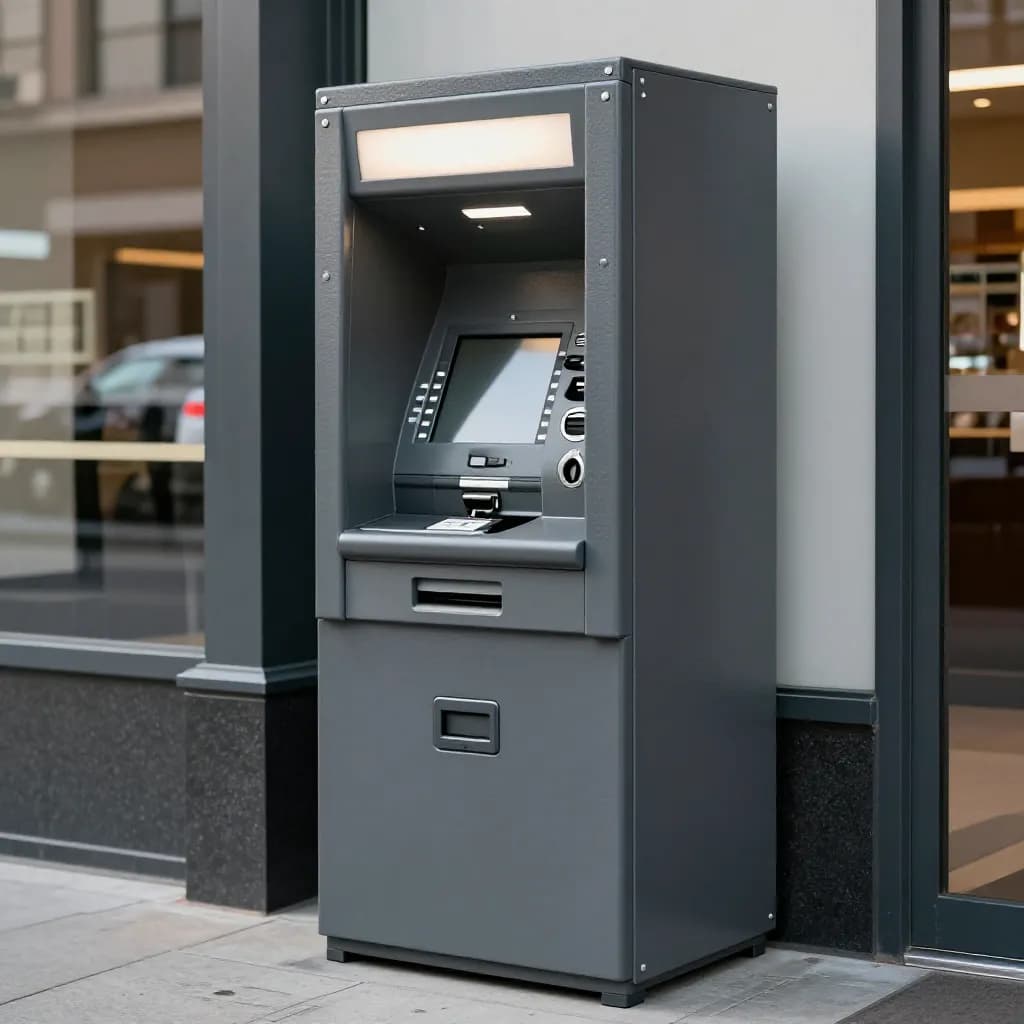
The global ATM market includes through-the-wall (TTW) units integrated into building facades, lobby-mounted machines in bank branches, and freestanding units in retail locations, airports, and convenience stores. Each deployment type presents different coating challenges. TTW units have exterior-exposed front panels that must resist weathering and vandalism while interior components remain in controlled environments. Freestanding outdoor ATMs require full-enclosure weather protection. Lobby units prioritize appearance and cleaning resistance.
Ready to Start Your Project?
From one-off customs to 15,000-part production runs — get precise pricing in 24 hours.
On This Page
Coating Requirements for ATM and Kiosk Enclosures
Self-service kiosks encompass an even broader range of applications: ticketing machines, check-in terminals, wayfinding displays, parking payment stations, and retail ordering systems. These devices share the ATM's need for durable, attractive finishes but may face additional challenges such as food service environments, outdoor transit locations, or high-humidity pool and spa areas. Major ATM manufacturers including NCR, Diebold Nixdorf, and Hyosung, along with kiosk manufacturers like KIOSK Information Systems and Olea Kiosks, specify powder coating as their primary enclosure finish.
Security-Grade Substrate and Pretreatment Systems
ATM enclosures are fabricated from heavier gauge steel than typical commercial equipment, reflecting their security function. Safe-grade enclosures use 6-10 mm steel plate for cash dispensing areas, while outer cabinets typically use 1.5-3 mm cold-rolled or galvanized steel. Some high-security models incorporate composite armor panels combining steel with concrete or ceramic layers. Each substrate type requires specific pretreatment for reliable powder coating adhesion.
Heavy-gauge steel plate used in ATM safes presents unique pretreatment challenges. The thick material retains more heat during welding, creating larger heat-affected zones with heavier mill scale. Abrasive blasting to Sa 2.5 (near-white metal) per ISO 8501-1 is typically required to remove mill scale and create an adequate surface profile for coating adhesion. The surface profile should target 40-75 micrometers for optimal mechanical anchoring of the powder coating.
After blasting, a zinc phosphate conversion coating is applied to provide corrosion protection and adhesion promotion. The zinc phosphate process for ATM enclosures follows the same chemistry as other steel applications but requires careful attention to rinse water quality and bath maintenance to ensure consistent coating weight on the heavy-gauge substrates. Deionized water final rinse with conductivity below 30 microsiemens/cm prevents water spot formation that could cause adhesion defects.
Galvanized steel components require outgassing management as described in standard galvanized steel powder coating protocols. A pre-bake at 200-230°C for 10-15 minutes before powder application is essential to prevent pinhole defects in the cured coating. Some ATM manufacturers specify electrogalvanized steel instead of hot-dip galvanized to minimize outgassing risk, as the thinner, more uniform zinc layer of electrogalvanizing produces fewer volatile compounds during cure.
Tamper-Evident and Security Coating Technologies
ATM and kiosk enclosures benefit from specialized powder coating technologies that enhance physical security beyond the structural strength of the steel enclosure itself.
High-hardness powder coatings with pencil hardness ratings of 4H-6H make it significantly more difficult to drill, grind, or cut through the enclosure. These ultra-hard formulations incorporate ceramic microspheres, silicon carbide, or aluminum oxide particles at 5-15% loading by weight. The abrasive particles dull cutting tools and drill bits, increasing the time and noise required for a physical attack — both of which are deterrents. While no coating can prevent a determined attack with power tools, high-hardness coatings add valuable minutes to the attack timeline, increasing the probability of detection.
Tamper-evident coatings change appearance when the surface is disturbed, providing visual indication of attempted break-in. These coatings use thermochromic or mechanochromic pigments that permanently change color when subjected to heat (from cutting or grinding) or mechanical stress (from prying or drilling). A coating that turns from grey to bright red at the site of an attack provides immediate visual evidence for security personnel and investigators.
Anti-skimming coatings for the card reader area use specialized formulations that interfere with the adhesion of skimming devices. Low surface energy coatings in the card slot area prevent double-sided tape and adhesive from bonding effectively, making it difficult for criminals to attach overlay skimmers. Some manufacturers also specify EMI-shielding powder coatings containing conductive fillers that attenuate electromagnetic signals, preventing wireless skimming devices from transmitting stolen card data through the enclosure.
These security coating technologies are typically applied selectively to specific areas of the ATM enclosure rather than the entire unit, allowing standard aesthetic coatings on visible surfaces while concentrating security features where they provide the most benefit.
Weatherproofing for Outdoor ATM and Kiosk Installations
Outdoor ATMs and kiosks face the complete range of environmental challenges, from desert heat to arctic cold, coastal salt spray to urban pollution. The powder coating system must provide comprehensive weather protection while maintaining appearance standards that reflect the deploying institution's brand quality.
For outdoor installations, a two-coat powder coating system is the standard specification. An epoxy primer at 25-40 microns provides maximum corrosion protection and adhesion to the pretreated steel substrate. A superdurable polyester topcoat at 60-80 microns provides UV resistance, color retention, and the aesthetic finish quality required for customer-facing equipment. The total system thickness of 85-120 microns provides a robust barrier against moisture, UV radiation, and atmospheric pollutants.
Thermal cycling is a significant concern for outdoor ATMs. In continental climates, surface temperatures can range from -40°C in winter to +70°C on sun-exposed dark surfaces in summer. This 110°C temperature range generates substantial thermal stress in the coating film as the steel substrate expands and contracts. Flexible polyester topcoat formulations with elongation at break exceeding 3% accommodate this thermal movement without cracking or delaminating.
Rain, snow, and condensation create persistent moisture exposure, particularly at horizontal surfaces, joints, and the base of the enclosure. Powder coating specifications for outdoor ATMs require minimum 1000-hour salt spray resistance per ASTM B117 and 1000-hour humidity resistance per ASTM D2247. Edge coverage is critical — the powder coating must achieve minimum 40-micron thickness on all edges, corners, and weld seams to prevent corrosion initiation at these vulnerable points.
UV exposure varies dramatically by deployment location. ATMs in equatorial regions receive 2-3 times the annual UV dose of units in northern Europe. Superdurable polyester formulations with high HALS and UVA loading are specified for high-UV locations, while standard polyester may be adequate for sheltered or high-latitude installations. Accelerated weathering testing per ASTM G154 provides comparative data, but deployment-specific exposure analysis should inform the coating specification.
Brand Identity and Aesthetic Requirements
ATMs and kiosks are high-visibility brand touchpoints, and the powder coating finish must accurately represent the deploying institution's visual identity. Banks, retailers, and service providers invest heavily in brand consistency, and any deviation in color, gloss, or texture across their equipment fleet is unacceptable.
Color matching for ATM and kiosk enclosures follows the same rigorous process used in other brand-critical applications. The brand owner provides a physical color standard, and the powder supplier develops a formulation match verified by spectrophotometric measurement. Delta E tolerances for banking equipment are typically ≤0.8 for primary brand colors, tighter than the ≤1.0 standard for general commercial equipment. This reflects the high visibility of ATMs and the brand sensitivity of financial institutions.
Metallic and special-effect finishes are increasingly popular for premium ATM and kiosk installations. Bonded metallic powder coatings, where aluminum or mica flake is thermally bonded to the powder particle surface, provide consistent metallic appearance without the separation and inconsistency issues of dry-blended metallics. These finishes add visual sophistication but require careful application parameter control to achieve uniform metallic effect across large flat panels.
Texture specifications for ATMs balance aesthetics with functionality. Smooth semi-gloss finishes (40-60 GU at 60°) are standard for customer-facing panels, providing a premium appearance while showing fingerprints less than high-gloss finishes. Fine texture finishes are sometimes specified for side panels and less visible surfaces to hide minor handling damage during installation and servicing.
Gloss consistency across panels is verified using a 60° gloss meter per ASTM D523, with tolerances typically ±5 GU from the specified target. For multi-panel assemblies where adjacent panels are visible simultaneously, tighter tolerances of ±3 GU may be specified to prevent visible gloss variation at panel joints.
EMI Shielding and Functional Coating Properties
ATMs and kiosks contain sensitive electronic systems — card readers, PIN pads, cash dispensers, touchscreens, and communication modules — that require electromagnetic interference (EMI) shielding to ensure reliable operation and data security. While the steel enclosure itself provides significant EMI shielding, powder coating can either enhance or compromise this shielding depending on the formulation.
Standard powder coatings are electrically insulating, which means they interrupt the electrical continuity of the steel enclosure at panel joints and fastener connections. This can create gaps in the EMI shield that allow electromagnetic energy to enter or exit the enclosure. To maintain EMI shielding integrity, ATM manufacturers specify bare metal contact areas at panel joints and grounding points, masking these areas during powder coating application.
Conductive powder coatings offer an alternative approach, maintaining electrical continuity across the entire coated surface. These formulations contain conductive fillers — typically nickel-coated graphite, silver-coated copper, or carbon nanotube additives — that provide surface resistivity below 10³ ohms per square. Conductive coatings allow the entire enclosure to function as a Faraday cage without requiring bare metal contact areas, simplifying assembly and improving EMI shielding effectiveness.
Thermal management is another functional consideration. ATMs generate significant heat from internal electronics, and the powder coating affects heat dissipation from the enclosure surface. Dark-colored coatings with high emissivity (>0.9) radiate heat more effectively than light-colored or metallic coatings with lower emissivity (0.3-0.6). For outdoor ATMs in hot climates, light-colored coatings are preferred to minimize solar heat gain, while high-emissivity coatings help dissipate internally generated heat.
Anti-fingerprint coatings are specified for touchscreen surrounds and frequently touched surfaces. These coatings incorporate oleophobic additives that reduce the visibility of fingerprints and make them easier to clean. The oleophobic treatment can be integrated into the powder coating formulation or applied as a post-cure surface treatment.
Quality Assurance and Compliance Standards
ATM and kiosk manufacturers operate under quality management systems that impose rigorous coating quality requirements. The financial services industry's emphasis on reliability and security extends to every component, including the enclosure finish.
ISO 9001 quality management system certification is a baseline requirement for powder coating suppliers to the ATM industry. Many manufacturers additionally require IATF 16949 (automotive quality) or equivalent process control capabilities, reflecting the high-volume, zero-defect production expectations of the industry. Statistical process control (SPC) of critical coating parameters — film thickness, adhesion, cure, color, and gloss — is mandatory, with process capability indices (Cpk) of 1.33 or higher required for key characteristics.
UL 291 is the primary safety standard for ATM enclosures in North America, covering physical security, environmental protection, and electrical safety. While UL 291 does not specify coating requirements directly, the coating must not compromise the enclosure's ability to meet UL 291 requirements for weather resistance, corrosion protection, and fire safety. Powder coatings used on ATM enclosures should be tested for flame spread and smoke generation per UL 94, with V-0 or V-1 ratings preferred.
PCI DSS (Payment Card Industry Data Security Standard) compliance influences coating specifications indirectly. The physical security requirements of PCI DSS mandate tamper-evident enclosures, which may include tamper-evident coating technologies as described earlier. The coating specification must support the overall physical security design without creating vulnerabilities.
Environmental compliance requirements include RoHS and REACH for equipment sold in the European Union, and various state and federal regulations in other markets. Powder coating's zero-VOC profile simplifies environmental compliance, but the coating materials themselves must be free of restricted substances including lead, cadmium, hexavalent chromium, and certain phthalates.
Frequently Asked Questions
What type of powder coating is used on outdoor ATMs?
Outdoor ATMs typically use a two-coat system: an epoxy primer at 25-40 microns for corrosion protection and a superdurable polyester topcoat at 60-80 microns for UV resistance and color retention. This system provides 1000+ hours of salt spray resistance and withstands temperature cycling from -40°C to +70°C.
Can powder coating help prevent ATM skimming attacks?
Yes. Low surface energy anti-skimming coatings in the card reader area prevent adhesive-mounted skimming devices from bonding effectively. EMI-shielding powder coatings with conductive fillers can also attenuate wireless signals, preventing skimming devices from transmitting stolen data through the enclosure.
How does powder coating enhance ATM physical security?
High-hardness powder coatings with ceramic or silicon carbide additives achieve 4H-6H pencil hardness, dulling cutting tools and increasing attack time. Tamper-evident coatings with thermochromic pigments permanently change color when subjected to heat or mechanical stress, providing visual evidence of break-in attempts.
How long does powder coating last on ATM enclosures?
Powder coating on ATM enclosures typically lasts 7-12 years depending on the deployment environment. Indoor lobby ATMs achieve the longest service life, while outdoor units in coastal or high-UV locations may require touch-up sooner. Two-coat systems with epoxy primer provide the best long-term protection.
What color tolerances are required for ATM powder coating?
Banking equipment typically requires Delta E tolerances of 0.8 or less for primary brand colors, tighter than the 1.0 standard for general commercial equipment. Gloss consistency is maintained within ±5 GU at 60°, with tighter ±3 GU tolerances for adjacent panels visible simultaneously.
Ready to Start Your Project?
From one-off customs to 15,000-part production runs — get precise pricing in 24 hours.