Rooftop bars occupy some of the most desirable real estate in urban hospitality, offering panoramic views and open-air ambiance that command premium positioning. But the same elevation that provides stunning views also exposes every surface to the full force of weather — unfiltered UV radiation, driving rain, sustained wind loads, and temperature extremes that ground-level venues rarely experience. Furniture and fixtures on rooftop bars must withstand this relentless environmental assault while maintaining the polished appearance that justifies premium drink and food pricing.
Hospitality
Powder Coating for Rooftop Bar Furniture: UV, Rain, Wind Resistance, and Brand Identity
Sundial Powder Coating·April 22, 2026·11 min
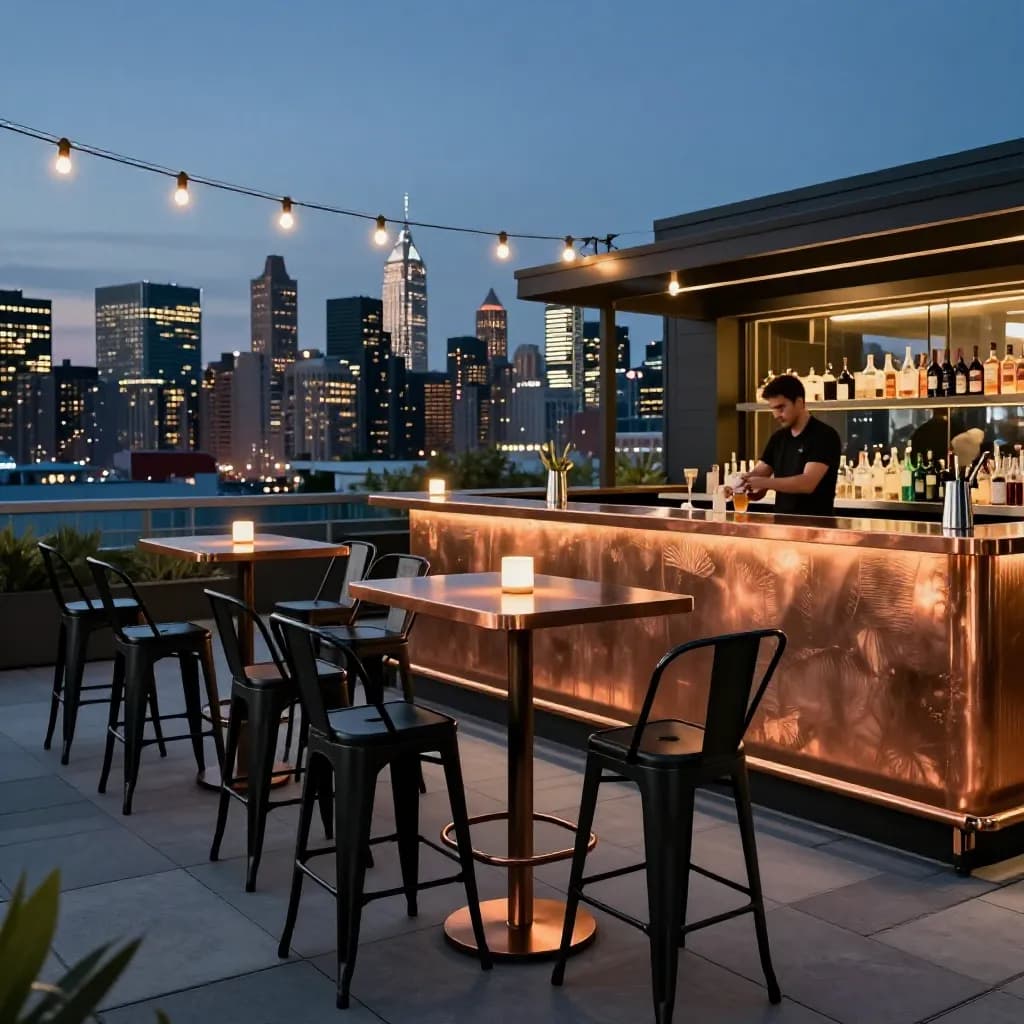
The UV exposure on rooftops is significantly more intense than at ground level. Without the shade provided by surrounding buildings, trees, or awnings that protect ground-level patios, rooftop furniture receives direct solar radiation for the entire daylight period. This sustained UV exposure accelerates the fading, chalking, and degradation of conventional paint finishes, often reducing their useful life to just 1-2 seasons. Powder coating with super-durable polyester chemistry provides the UV resistance needed to maintain color and gloss through multiple seasons of rooftop exposure.
Ready to Start Your Project?
From one-off customs to 15,000-part production runs — get precise pricing in 24 hours.
On This Page
The Rooftop Bar Environment: Extreme Exposure Demands
Wind is a constant factor on rooftops, creating both structural and finishing challenges. Sustained winds accelerate moisture evaporation from wet surfaces, which can actually benefit corrosion resistance, but wind-driven rain and airborne debris create impact and erosion forces that wear coating surfaces over time. Wind also creates practical furniture management challenges — lightweight furniture can become projectiles in strong gusts, creating safety hazards and damage risks that influence both furniture design and coating specification.
The combination of these environmental factors makes rooftop bar furniture one of the most demanding outdoor powder coating applications in the hospitality sector. Success requires careful attention to coating chemistry, substrate preparation, design details, and maintenance protocols that account for the elevated exposure conditions.
UV Resistance and Color Retention
Color retention is the most visible performance metric for rooftop bar furniture, and the one that most directly affects the venue's brand presentation. Faded, chalky furniture communicates neglect and undermines the premium positioning that rooftop bars cultivate. Powder coating chemistry selection is the primary determinant of UV performance, and the difference between standard and super-durable formulations is dramatic in rooftop applications.
Super-durable polyester powder coatings are formulated with UV-stabilized resin systems and lightfast pigments that resist the photochemical degradation caused by ultraviolet radiation. These formulations maintain their color and gloss for 10-15 years in standard outdoor exposure, compared to 3-5 years for standard polyester powders. On rooftops with intensified UV exposure, super-durable formulations typically deliver 7-10 years of acceptable appearance, while standard formulations may show visible fading within 2-3 seasons.
Fluoropolymer powder coatings — including PVDF-based formulations — provide the ultimate UV resistance for the most demanding rooftop applications. These coatings meet AAMA 2605 specifications requiring 10 years of South Florida exposure testing, the most stringent weathering standard in the coatings industry. While more expensive than polyester formulations, fluoropolymer coatings are justified for permanent rooftop installations where recoating is difficult or disruptive.
Color selection affects UV performance because different pigments have different lightfastness ratings. Organic pigments used in bright reds, oranges, and yellows are generally less UV-stable than inorganic pigments used in earth tones, blues, and greens. When specifying bright brand colors for rooftop furniture, verify that the powder manufacturer uses high-lightfastness pigments rated for exterior exposure, and request accelerated weathering test data specific to the chosen color.
Gloss retention is closely linked to UV resistance. As UV radiation degrades the coating surface, gloss decreases and the surface develops a chalky appearance. Super-durable formulations maintain gloss levels above 50% of initial values after 10 years of exposure, while standard formulations may drop below 50% within 3-5 years. For rooftop applications where appearance is paramount, specifying minimum gloss retention requirements ensures that the furniture maintains its visual impact throughout its intended service life.
Rain, Moisture, and Corrosion Protection
Rooftop furniture is fully exposed to rainfall without the partial protection that building overhangs, trees, and surrounding structures provide at ground level. Every rain event saturates the furniture completely, and the elevated position means that furniture dries more slowly on calm days when air circulation is limited. This repeated wet-dry cycling is the primary driver of corrosion on rooftop metal furniture, and the coating system must provide a reliable moisture barrier through thousands of these cycles.
Substrate preparation is the foundation of corrosion protection for rooftop furniture. Steel substrates should receive blast cleaning to SA 2.5 minimum followed by zinc phosphate or zirconium-based conversion coating. Aluminum substrates require chromate-free pretreatment that provides both corrosion inhibition and adhesion promotion. The pretreatment quality directly determines the coating system's resistance to underfilm corrosion — the most common failure mode for outdoor powder coating where moisture penetrates through coating defects and spreads beneath the intact film.
Dual-coat systems with zinc-rich epoxy primer under a super-durable polyester topcoat provide the highest level of corrosion protection for steel rooftop furniture. The zinc-rich primer provides cathodic protection at any coating breach, sacrificially corroding to protect the steel substrate. The polyester topcoat provides UV resistance and aesthetic appearance. This dual-coat system is standard practice for architectural steel exposed to severe weather and is equally appropriate for premium rooftop furniture.
Drainage design is critical for rooftop furniture where standing water accelerates corrosion. Tubular furniture frames should have drain holes at low points to prevent water accumulation inside hollow sections. Flat surfaces should be slightly angled to shed water rather than pooling. Weld seams should be continuous and sealed to prevent moisture ingress at joints. These design details are as important as the coating specification in determining the furniture's corrosion resistance.
Saltwater exposure affects rooftop bars in coastal locations, where salt-laden air and occasional salt spray create a significantly more corrosive environment than inland locations. Coastal rooftop furniture should be specified with marine-grade pretreatment and coating systems, with consideration of Qualicoat Seaside certification for the most demanding coastal environments.
Wind Resistance and Furniture Weight Management
Wind management is a unique challenge for rooftop bar operations that directly influences furniture design, material selection, and coating specification. Furniture must be heavy enough to resist wind displacement during normal operations yet light enough for staff to move and reconfigure for different events and group sizes. Powder coating contributes to this balance by enabling the use of lighter substrates — aluminum instead of steel — while providing the protection needed for outdoor durability.
Aluminum furniture frames offer a 60-65% weight reduction compared to equivalent steel frames, making them easier for staff to handle while still providing adequate wind resistance when occupied by guests. Powder coating on aluminum provides the corrosion protection and aesthetic finish that aluminum's natural oxide layer cannot deliver alone, particularly in the aggressive rooftop environment where UV, moisture, and airborne contaminants combine to attack unprotected surfaces.
Stackable furniture designs are essential for rooftop bars that must clear the deck for weather events, private functions, or seasonal closure. Powder coating on stackable furniture must withstand the metal-on-metal contact that occurs during stacking and unstacking. Nesting contact points should be designed with protective bumpers or reinforced coating thickness to prevent the scratching and chipping that repeated stacking causes on standard-thickness coatings.
Bolted-down furniture eliminates wind displacement concerns but requires coating details that protect the bolt penetrations from moisture ingress. Stainless steel fasteners with nylon isolation washers prevent galvanic corrosion between the fastener and the furniture frame. Sealant application around bolt heads and base plate edges prevents water from reaching the substrate through the fastener holes.
Windscreen and barrier systems that define the rooftop perimeter and create wind-sheltered zones are typically constructed from powder-coated steel or aluminum frames with glass, mesh, or perforated metal infill panels. These permanent installations require the same super-durable coating specifications as the furniture, with particular attention to the frame-to-glass or frame-to-panel connections where moisture can become trapped and initiate corrosion.
Brand Identity and Design Cohesion
Rooftop bars compete in a market where visual identity and Instagram-worthy aesthetics drive customer acquisition. The furniture, fixtures, and finishes must create a cohesive visual environment that photographs well, reinforces the brand, and differentiates the venue from competitors. Powder coating is the primary tool for achieving this visual cohesion across the diverse metal elements that furnish a rooftop bar.
Brand color application across all metal surfaces — furniture frames, planters, railing systems, bar equipment, signage, and decorative elements — creates the immersive branded environment that drives social media sharing and repeat visits. Powder coating enables this comprehensive color application because the same color reference can be formulated for different coating chemistries suited to each element's specific performance requirements, ensuring visual consistency across the entire rooftop.
Metallic and specialty finishes add visual sophistication that elevates the rooftop bar above venues with basic solid-color furniture. Copper metallic, brushed gold, and aged bronze effects create a premium aesthetic that complements the upscale positioning of most rooftop bars. These metallic finishes are particularly effective in the golden-hour lighting that rooftop bars are designed to showcase, catching and reflecting warm sunlight in ways that solid colors cannot.
Seasonal color updates allow rooftop bars to refresh their visual identity without replacing furniture. Removable accessories — cushion covers, table runners, planters — can be changed seasonally, but the permanent powder-coated furniture provides the consistent base palette that anchors the design through all seasonal variations. Selecting a neutral or versatile base color for furniture frames maximizes the flexibility for seasonal accessory changes.
Lighting integration with powder-coated fixtures creates dramatic evening atmospheres that transform the rooftop from a daytime terrace to a nighttime destination. Powder-coated light pole bases, fixture housings, and decorative lighting structures should coordinate with the furniture palette while accommodating the heat generated by lighting elements. LED lighting has reduced thermal concerns significantly, but fixture housings still benefit from heat-resistant powder coating formulations.
Stackable and Modular Furniture Systems
Operational flexibility is essential for rooftop bars that host diverse events — from casual afternoon service to formal evening functions to private parties. Stackable and modular furniture systems enable rapid reconfiguration of the space, and powder coating must support this flexibility by withstanding the handling, stacking, and reconfiguration that occurs multiple times per week.
Stackable chair designs for rooftop bars must balance aesthetic appeal with practical stacking efficiency. The powder coating on stacking contact points — typically the seat edge and the leg top — experiences concentrated wear from repeated stacking cycles. Reinforcing these contact points with additional coating thickness (125-150 microns versus 75-100 microns on general surfaces) extends the time before visible wear develops at stacking interfaces.
Modular table systems that can be configured as individual two-tops, combined into banquet tables, or arranged in lounge groupings require consistent powder coating across all module sizes and configurations. Color consistency is critical because modules from different production batches may be combined in a single configuration, and any color variation between modules would be immediately visible. Specifying tight color tolerances (Delta E less than 1.0) and sourcing all modules from the same powder coating batch when possible ensures seamless visual integration.
Lounge furniture including sofas, daybeds, and low tables with powder-coated metal frames creates the relaxed atmosphere that rooftop bars cultivate for evening service. These larger pieces are typically not stackable and remain in position throughout the season, requiring coating systems that withstand continuous outdoor exposure without the periodic indoor storage that stackable pieces may receive.
Storage solutions for stackable furniture during off-season or weather events should protect the powder coating from damage. Stack furniture on clean, dry surfaces with protective pads between stacked pieces. Cover stored furniture with breathable covers that prevent moisture accumulation while protecting against dust and debris. Avoid plastic tarps that trap condensation against the coating surface, potentially causing water spotting or mildew growth on the finish.
Bar Equipment and Service Fixtures
The rooftop bar itself — including the bar counter structure, back bar shelving, speed rails, and service equipment — requires powder coating that withstands the combined challenges of outdoor weather exposure and the aggressive chemical environment of bar operations. This dual exposure profile makes rooftop bar equipment one of the most demanding powder coating applications in hospitality.
Bar counter structures on rooftops are typically constructed from steel or aluminum frames clad with decorative materials. The structural frame requires the same weather-resistant coating system as the furniture — super-durable polyester over appropriate pretreatment — while the visible portions of the frame that are exposed at the bar front and ends require the aesthetic quality of the furniture finish. Coordinating the structural and aesthetic coating requirements ensures both durability and visual appeal.
Back bar shelving and bottle display systems face direct sun exposure that can heat dark-colored bottles and degrade label adhesives. Powder-coated shelving in light colors reflects rather than absorbs solar radiation, reducing heat buildup on displayed bottles. The coating must also resist the constant contact with wet bottles, spilled beverages, and cleaning chemicals that characterize bar operations.
Ice wells, sink surrounds, and glass washing station housings exist in a perpetually wet environment where standing water, beverage residue, and cleaning chemicals create aggressive corrosion conditions. Epoxy primer under the topcoat provides the enhanced moisture barrier needed for these constantly wet components. Drainage design that prevents standing water in and around these fixtures is equally important for coating longevity.
Service stations for food runners and servers require powder-coated surfaces that withstand the placement and removal of plates, glasses, and trays throughout service. These surfaces experience concentrated wear at specific points and benefit from reinforced coating thickness and high-hardness formulations that resist the scratching and marking from dishware contact.
Refrigeration equipment housings on rooftop bars face direct sun exposure that increases the thermal load on the refrigeration system and heats the equipment housing. Light-colored powder coating on refrigeration housings reflects solar radiation, reducing the additional cooling load and the surface temperature of the housing. This practical consideration can reduce energy consumption while maintaining the equipment's appearance.
Seasonal Maintenance and Long-Term Care
Rooftop bar furniture requires a structured maintenance program that accounts for the intensified environmental exposure and the seasonal operating pattern typical of most rooftop venues. A well-executed maintenance program extends coating life, maintains brand appearance, and reduces the total cost of furniture ownership over the venue's operating life.
Pre-season preparation should include thorough cleaning of all furniture and fixtures, inspection for coating damage, and repair of any chips, scratches, or corrosion spots before the operating season begins. Cleaning with a mild detergent solution removes the accumulated grime, pollen, and environmental deposits from the off-season. Inspection should focus on high-wear areas including stacking contact points, leg bottoms, and fastener locations where coating damage is most likely.
In-season maintenance should include weekly cleaning of all furniture surfaces and monthly inspection of high-wear areas. Prompt repair of coating damage prevents corrosion from developing during the operating season when the furniture is continuously exposed to weather. Touch-up paint matched to the original powder coating color provides adequate protection for small damaged areas until professional repair can be scheduled.
End-of-season procedures should include thorough cleaning, complete inspection, and professional repair of any significant coating damage before storage. Furniture that will remain on the rooftop through the off-season should receive a protective wax application that provides an additional barrier against winter weather. Furniture that will be stored should be cleaned, dried completely, and stored in a dry, ventilated space with protective padding between stacked pieces.
Recoating schedules for rooftop furniture depend on the coating chemistry, exposure conditions, and appearance standards of the venue. Super-durable polyester coatings on well-maintained furniture typically require recoating every 7-10 years in moderate climates and every 5-7 years in severe UV or coastal environments. Fluoropolymer coatings extend these intervals by 3-5 years. Planning for recoating as a scheduled maintenance expense rather than an emergency response ensures that the furniture never reaches the point of visible degradation that affects guest perception.
Replacement planning should account for the expected service life of both the coating and the substrate. Well-maintained powder-coated aluminum furniture can last 15-20 years with one or two recoating cycles, while steel furniture may require substrate repair or replacement after 10-15 years depending on corrosion conditions. Budgeting for phased replacement of the oldest furniture each year maintains a consistently fresh appearance without the capital expense of replacing the entire furniture inventory at once.
Frequently Asked Questions
How long does powder coating last on rooftop bar furniture?
Super-durable polyester powder coatings maintain acceptable appearance for 7-10 years on rooftops in moderate climates, while fluoropolymer coatings last 10-15 years. Standard polyester formulations may show visible fading within 2-3 seasons due to intensified UV exposure at rooftop elevation. Always specify super-durable or fluoropolymer chemistry for rooftop applications.
What prevents rooftop furniture powder coating from fading in the sun?
Super-durable polyester formulations use UV-stabilized resins and high-lightfastness pigments that resist photochemical degradation. Fluoropolymer (PVDF) coatings provide the ultimate UV resistance, meeting AAMA 2605 standards. Color selection also matters — inorganic pigments in earth tones and blues are more UV-stable than organic pigments in bright reds and oranges.
How should stackable rooftop furniture be powder coated for durability?
Stacking contact points should receive reinforced coating thickness of 125-150 microns versus 75-100 microns on general surfaces. Design stacking interfaces with protective bumpers where possible. Specify high-hardness formulations that resist the scratching from repeated metal-on-metal contact during stacking and unstacking cycles.
Is aluminum or steel better for powder-coated rooftop furniture?
Aluminum offers 60-65% weight reduction for easier handling and inherent corrosion resistance, making it ideal for stackable pieces. Steel provides greater weight for wind resistance on fixed installations. Both substrates perform well with appropriate powder coating systems — the choice depends on whether weight savings or wind stability is the priority.
How do you protect powder coating at bolt-down points on rooftop furniture?
Use stainless steel fasteners with nylon isolation washers to prevent galvanic corrosion. Apply sealant around bolt heads and base plate edges to prevent moisture ingress through fastener holes. Ensure the coating system extends fully to the edge of all bolt holes with no bare metal exposed to moisture.
Ready to Start Your Project?
From one-off customs to 15,000-part production runs — get precise pricing in 24 hours.