Bakery environments combine intense heat from ovens and proofers with flour dust, sugar residue, humidity from steam injection, and the constant cleaning required by food safety regulations. This combination creates finishing challenges that generic coatings cannot address. Powder coating engineered for bakery applications provides the heat resistance, food safety compliance, cleanability, and durability that bakery equipment demands across its full operational lifecycle.
Hospitality
Powder Coating for Bakery Equipment: Oven Exteriors, Display Cases, Racks, and Food Safety
Sundial Powder Coating·April 22, 2026·11 min
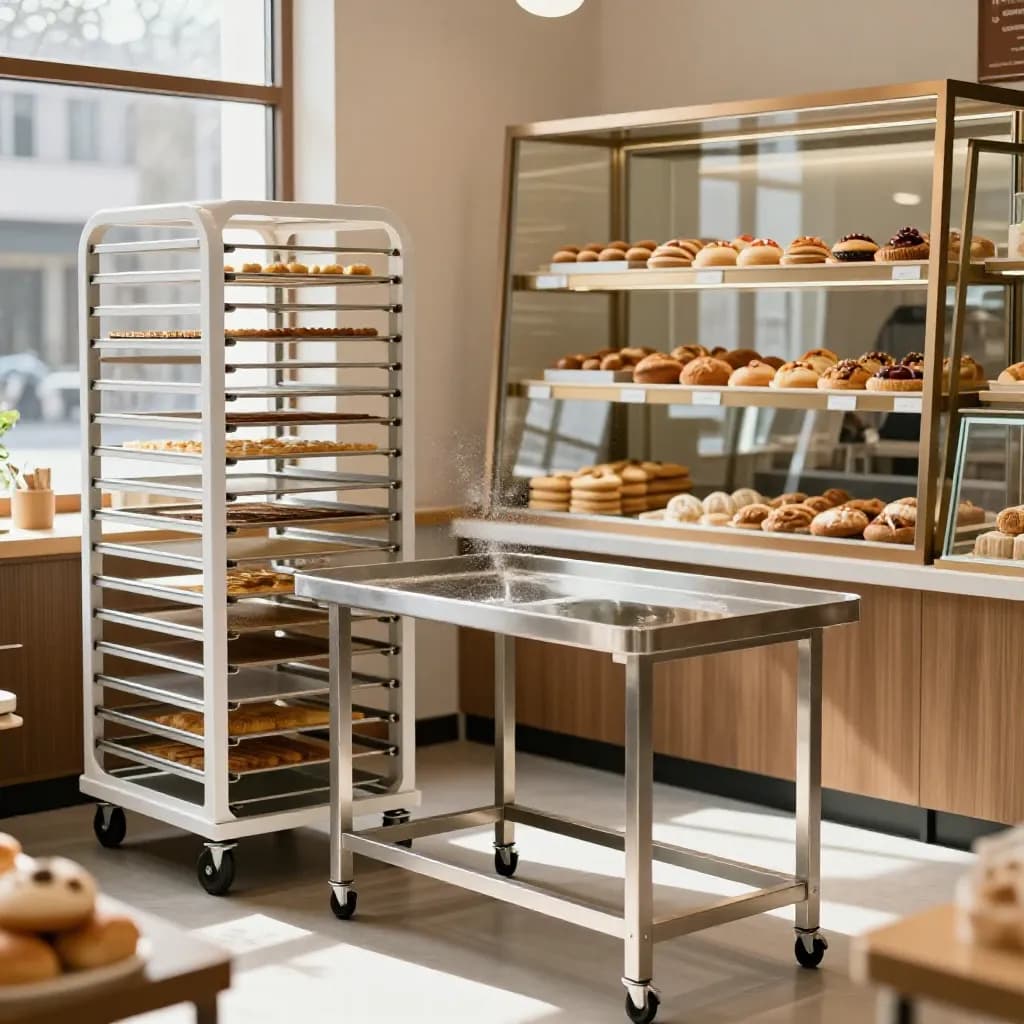
The bakery equipment spectrum ranges from massive deck ovens and rack ovens that generate sustained temperatures above 250°C to delicate display cases that must maintain precise refrigerated temperatures while presenting products attractively to customers. Between these extremes sit proofing cabinets, cooling racks, sheet pan storage, ingredient bins, and work tables — each with distinct finishing requirements driven by their specific operating conditions and regulatory classification.
Ready to Start Your Project?
From one-off customs to 15,000-part production runs — get precise pricing in 24 hours.
On This Page
Why Bakeries Need Specialized Powder Coating Solutions
Flour dust is a pervasive environmental factor unique to bakeries. Fine flour particles settle on every surface and, when combined with humidity, create a paste that adheres tenaciously to rough or porous finishes. Powder coating's smooth, non-porous surface resists flour adhesion and allows accumulated dust to be wiped or blown away easily, maintaining both equipment appearance and the housekeeping standards required to manage combustible dust hazards in bakery environments.
The visual presentation of bakery equipment has become increasingly important as open bakery concepts and bakery-cafe hybrids put production equipment in view of customers. Powder coating enables bakery equipment to be finished in colors and textures that complement the retail environment while meeting the performance requirements of a production bakery. This dual-purpose capability makes powder coating the natural choice for bakeries that combine production and retail functions.
Oven Exteriors and High-Temperature Applications
Commercial bakery ovens represent the most thermally demanding application for powder coating in the food service sector. Deck ovens, convection ovens, and rack ovens generate internal temperatures of 200-300°C during baking cycles, with exterior surface temperatures reaching 100-200°C depending on insulation quality and oven design. The powder coating on oven exteriors must withstand these temperatures continuously during production shifts that may run 12-16 hours per day.
Silicone-modified polyester powder coatings rated for 200-350°C continuous exposure are the standard choice for bakery oven exteriors. These formulations maintain their color, gloss, and adhesion at temperatures that would destroy standard polyester or epoxy powder coatings within hours. The silicone modification provides thermal stability while the polyester component contributes mechanical properties including flexibility and impact resistance.
Proofer and retarder cabinets present a different thermal challenge — they operate at controlled temperatures of 25-40°C with very high humidity levels of 75-85% relative humidity. The combination of warmth and moisture creates ideal conditions for corrosion of unprotected steel and for microbial growth on surfaces. Powder coating on proofer exteriors and structural components must resist this sustained humidity exposure without blistering, while the smooth surface discourages microbial colonization.
Steam injection systems used in artisan bread baking create localized bursts of high-temperature steam that contact oven door frames, control panels, and surrounding surfaces. These steam events combine thermal shock with moisture exposure, testing both the heat resistance and moisture barrier properties of the coating system. Epoxy primer under a high-temperature polyester topcoat provides the dual protection needed for surfaces in the steam zone.
Thermal cycling fatigue is a critical consideration for bakery oven coatings. Ovens heat up at the start of each production shift and cool down at the end, creating daily expansion and contraction cycles that stress the coating film. Over months and years, this cycling can cause micro-cracking in rigid coatings, eventually leading to visible cracking and delamination. High-temperature powder coatings formulated with controlled flexibility accommodate this cycling without film failure.
Display Cases and Customer-Facing Equipment
Bakery display cases are the primary sales tool for any retail bakery, and their appearance directly influences customer purchasing decisions. The metal frames, shelving supports, and structural components of display cases benefit from powder coating that provides both aesthetic appeal and resistance to the refrigerated, humid environment inside the case.
Refrigerated display cases maintain internal temperatures of 2-7°C with relative humidity levels that prevent product drying. The temperature differential between the cold case interior and the warm bakery environment creates condensation on metal surfaces, particularly during door openings and high-traffic periods. Powder coating with epoxy primer provides the moisture barrier needed to prevent corrosion on display case frames and shelving supports in this perpetually damp environment.
The color and finish of display case components influence how products are perceived by customers. Matte black frames create a sophisticated backdrop that makes colorful pastries and breads pop visually. White or cream finishes evoke cleanliness and freshness. Warm metallic tones in bronze or copper complement artisan bakery aesthetics. The powder coating finish should be selected not just for durability but for its contribution to product presentation and sales appeal.
Lighting integration in display cases requires powder coating that does not interfere with light distribution. Matte and satin finishes minimize unwanted reflections that can create glare and obscure product visibility. Interior surfaces of display cases may benefit from light-colored powder coating that reflects illumination evenly across displayed products, enhancing their visual appeal without hot spots or shadows.
Service counters and point-of-sale areas in retail bakeries experience constant customer interaction. Powder-coated counter fronts, tray rails, and sneeze guard frames must resist fingerprints, cleaning chemicals, and the mechanical wear of daily customer traffic. High-hardness polyester formulations with fingerprint-resistant properties maintain a clean appearance between cleaning cycles, reducing the labor needed to keep customer-facing surfaces presentable.
Cooling Racks, Sheet Pan Storage, and Production Hardware
Cooling racks are essential bakery equipment that must allow air circulation around freshly baked products while supporting significant weight loads. Wire cooling racks and sheet pan racks are typically constructed from welded steel wire and benefit from powder coating that provides food-safe surface protection, corrosion resistance, and the smooth surface needed to prevent product damage during handling.
The powder coating on cooling racks must meet food contact requirements because baked goods rest directly on the rack surface during cooling. NSF-listed powder coatings compliant with FDA 21 CFR 175.300 are required for racks used in direct food contact applications. The coating must also withstand the thermal shock of receiving products at 90-100°C directly from the oven, requiring heat resistance above the product temperature to prevent coating softening or transfer to food products.
Sheet pan storage racks endure constant impact from aluminum sheet pans being loaded and removed throughout the production day. The rack guides and support rails experience concentrated wear at contact points where pans slide in and out. Powder coating on these high-wear surfaces should be specified at 100-125 microns minimum thickness with high impact resistance to extend the service life of the coating at these critical contact points.
Ingredient bins, flour storage containers, and dry goods shelving require powder coating that resists the abrasion of granular materials and the moisture from hygroscopic ingredients like sugar and salt. The smooth powder coating surface prevents ingredient particles from embedding in the finish and simplifies the cleaning needed to prevent cross-contamination between ingredients.
Work table frames and legs operate in the splash zone where flour, water, eggs, and other ingredients contact surfaces during mixing and preparation. Powder coating on work table components must resist these food products as well as the cleaning chemicals used to sanitize work surfaces between production batches. Epoxy-polyester hybrid formulations provide excellent chemical resistance for splash zone applications while maintaining the mechanical toughness needed for heavy-duty production furniture.
Bread slicers, dough dividers, and other mechanical equipment have housings and frames that benefit from powder coating for both protection and hygiene. The smooth, sealed surface of powder coating prevents flour and dough residue from accumulating in surface irregularities, simplifying the cleaning required to maintain food safety standards on production equipment.
Food Safety Compliance in Bakery Environments
Food safety regulations governing bakery operations require that all surfaces in food production areas be smooth, non-absorbent, easily cleanable, and free from toxic substances. Powder coating meets these requirements when appropriate formulations are selected and properly applied, but compliance depends on matching the correct coating specification to each surface's regulatory classification.
Food zone surfaces that directly contact food products — including cooling rack wires, sheet pan rack guides, and display case shelving — require NSF-listed powder coatings that comply with FDA 21 CFR 175.300. These formulations have been tested for extractable substances and certified safe for repeated food contact. The coating applicator must use the specific NSF-listed product and maintain documentation of the formulation used on food contact components.
Splash zone surfaces that may be contacted by food splashes but do not directly contact food products — including work table legs, equipment housings, and wall-mounted shelving — require coatings that are cleanable and non-absorbent but do not need to meet the full food contact extraction testing requirements. Standard polyester powder coatings with smooth finishes generally satisfy splash zone requirements, though NSF-listed formulations provide additional assurance.
Non-food zone surfaces including structural framing, utility brackets, and equipment bases below the splash zone have the least stringent coating requirements but still benefit from powder coating for corrosion protection and cleanability. These surfaces must be maintainable in a clean condition to satisfy general food facility hygiene requirements.
Allergen management is an emerging concern in bakery food safety that has implications for surface finishes. Bakeries handling multiple allergens — wheat, nuts, dairy, eggs, soy — must prevent cross-contamination between products. Smooth, non-porous powder coating surfaces are easier to clean to allergen-free standards than rough or textured surfaces where allergen residues can become trapped. For bakeries with allergen management programs, specifying smooth powder coating finishes on all production area surfaces supports effective allergen cleaning protocols.
Flour Dust Management and Combustible Dust Safety
Flour dust is classified as a combustible dust by OSHA and NFPA, and bakeries must manage dust accumulation to prevent explosion hazards. Surface finishes play a role in dust management because smooth surfaces shed dust more readily than rough surfaces, reducing the accumulation that creates hazardous conditions. Powder coating's smooth, non-porous surface is inherently advantageous for combustible dust management in bakery environments.
NFPA 652, the Standard on the Fundamentals of Combustible Dust, requires facilities handling combustible dusts to implement housekeeping programs that prevent dust accumulation on surfaces. Equipment and structural surfaces finished with smooth powder coating are easier to clean to the standards required by NFPA 652, reducing the labor and frequency needed for dust management housekeeping.
Horizontal surfaces are the primary concern for dust accumulation, and equipment design should minimize horizontal ledges and flat surfaces where dust can settle. When horizontal surfaces are unavoidable — such as equipment tops, shelf surfaces, and structural beam flanges — smooth powder coating ensures that these surfaces can be wiped or vacuumed clean efficiently during routine housekeeping rounds.
Electrical enclosures and control panels in bakery environments accumulate flour dust that can interfere with electrical components and create ignition hazards. Powder-coated enclosures with proper sealing prevent dust ingress while the smooth exterior surface allows easy cleaning. The electrical insulation properties of powder coating provide an additional safety benefit for electrical enclosures in dusty environments.
Dust collection system ductwork and components benefit from interior powder coating that provides a smooth surface for efficient dust transport. Rough interior surfaces in ductwork create turbulence and accumulation points where dust can settle and potentially ignite. Smooth powder-coated duct interiors maintain laminar flow characteristics that keep dust moving toward the collection system rather than settling in the ductwork.
Color coding of equipment and zones using powder coating supports bakery safety programs by visually identifying different production areas, allergen zones, and safety equipment. Consistent color coding across all powder-coated surfaces creates an intuitive visual language that helps staff navigate safety requirements without relying solely on signage.
Aesthetic Integration of Production and Retail Spaces
The bakery-cafe concept has blurred the line between production and retail, placing ovens, mixers, and production equipment in full view of customers. This transparency creates a marketing advantage — customers see the craftsmanship behind the products — but it also means that production equipment must meet retail aesthetic standards. Powder coating enables production equipment to be finished in colors and textures that complement the retail environment without compromising functional performance.
Color coordination between production equipment and retail fixtures creates visual continuity that makes the combined space feel intentional rather than improvised. A unified color palette applied across oven exteriors, display cases, shelving, furniture, and signage communicates professionalism and attention to detail. Powder coating makes this coordination practical because the same color reference can be formulated for different coating chemistries suited to each application's performance requirements.
The industrial aesthetic that many artisan bakeries cultivate benefits from powder coating finishes that reference industrial materials. Matte black evokes cast iron and wrought steel. Textured dark gray suggests raw concrete. Metallic bronze and copper tones reference traditional baking equipment. These finishes transform standard commercial equipment into design elements that contribute to the bakery's brand narrative.
Open kitchen layouts require that the backs and sides of equipment — surfaces that are typically hidden in enclosed kitchens — be finished to the same standard as front-facing surfaces. Powder coating all visible surfaces of production equipment ensures a consistent appearance from every customer viewing angle, eliminating the visual disconnect that occurs when customers can see unfinished equipment backs through the open kitchen layout.
Lighting design in combined production-retail spaces must account for the different visual requirements of each zone. Production areas need bright, even illumination for food safety and quality control, while retail areas benefit from warmer, more atmospheric lighting. Powder coating colors should be evaluated under both lighting conditions to ensure they appear as intended in each zone, as the same color can look significantly different under cool fluorescent production lighting versus warm retail lighting.
Maintenance Protocols and Long-Term Care
Maintaining powder-coated bakery equipment requires cleaning protocols that address the specific contaminants found in bakery environments — flour dust, sugar residue, grease, egg wash, and baking chemical residues — without damaging the coating surface. Establishing proper maintenance procedures from the outset extends coating life and maintains both the appearance and food safety compliance of coated surfaces.
Daily cleaning should remove flour dust and food residue from all coated surfaces using soft cloths or brushes and mild detergent solutions. Avoid abrasive cleaning pads or powdered cleansers that can scratch the powder coating surface, creating micro-scratches that harbor bacteria and accumulate flour dust. For stubborn residues, allow the detergent solution to soak on the surface for several minutes before wiping rather than scrubbing aggressively.
Weekly deep cleaning should address areas where residue accumulates despite daily cleaning, including equipment bases, shelving undersides, and the gaps between equipment and walls. These areas are common points of food safety citation during health inspections and benefit from the smooth powder coating surface that facilitates thorough cleaning.
High-temperature surfaces including oven exteriors should be cleaned only when cool to avoid thermal shock to the cleaning solution and to prevent burns. Specialized oven cleaners formulated for coated surfaces should be used rather than aggressive caustic oven cleaners designed for bare stainless steel, which can damage powder coating finishes.
Inspection for coating damage should be incorporated into the bakery's preventive maintenance schedule. Check high-wear areas including rack guides, door edges, and equipment contact points for chips, scratches, or coating loss. Prompt repair of coating damage prevents corrosion development and maintains food safety compliance. Touch-up with color-matched liquid repair paint provides adequate protection for small damaged areas, while larger damage may require professional repair or component replacement.
Documentation of coating maintenance and inspection should be maintained as part of the bakery's food safety management system. This documentation demonstrates due diligence in maintaining food contact and splash zone surfaces and provides evidence of compliance during regulatory inspections and third-party food safety audits.
Frequently Asked Questions
Can powder coating withstand commercial bakery oven temperatures?
Yes, silicone-modified polyester powder coatings rated for 200-350°C continuous exposure are designed for bakery oven exteriors. These formulations maintain color, gloss, and adhesion through daily thermal cycling of 12-16 hour production shifts. Standard decorative powder coatings are not suitable — always specify high-temperature formulations for oven applications.
Is powder coating on cooling racks food-safe?
Powder coating on cooling racks that directly contact food must use NSF-listed formulations compliant with FDA 21 CFR 175.300. These coatings have been tested for extractable substances and certified safe for repeated food contact. Standard decorative powder coatings are not food-safe for direct contact applications.
How does powder coating help with flour dust management?
Powder coating's smooth, non-porous surface sheds flour dust more readily than rough or textured surfaces, reducing accumulation that creates combustible dust hazards. Smooth coated surfaces are easier to clean to NFPA 652 standards, supporting the housekeeping programs required for facilities handling combustible dusts like flour.
What powder coating finish works best for bakery display cases?
Matte black frames create sophisticated backdrops for colorful pastries, while white or cream finishes evoke cleanliness. Warm metallic tones complement artisan aesthetics. Use epoxy primer under the topcoat for moisture resistance in refrigerated cases, and specify fingerprint-resistant formulations for customer-facing surfaces.
How often should powder-coated bakery equipment be inspected?
Incorporate coating inspection into your preventive maintenance schedule — weekly for high-wear areas like rack guides and door edges, monthly for general equipment surfaces. Prompt repair of chips and scratches prevents corrosion and maintains food safety compliance. Document all inspections as part of your food safety management system.
Ready to Start Your Project?
From one-off customs to 15,000-part production runs — get precise pricing in 24 hours.