Roll cages are the last line of defense between a driver and catastrophic injury during a rollover or collision. Whether installed in a dedicated race car, a weekend track-day vehicle, or a trail rig built for rock crawling, the cage must maintain its structural integrity under extreme loads. Powder coating is the preferred finish for roll cages because it provides durable corrosion protection without compromising the metallurgical properties of the tubing or welds.
Automotive
Powder Coating Roll Cages: Protection and Finish for Motorsport Safety Equipment
Sundial Powder Coating·April 23, 2026·10 min
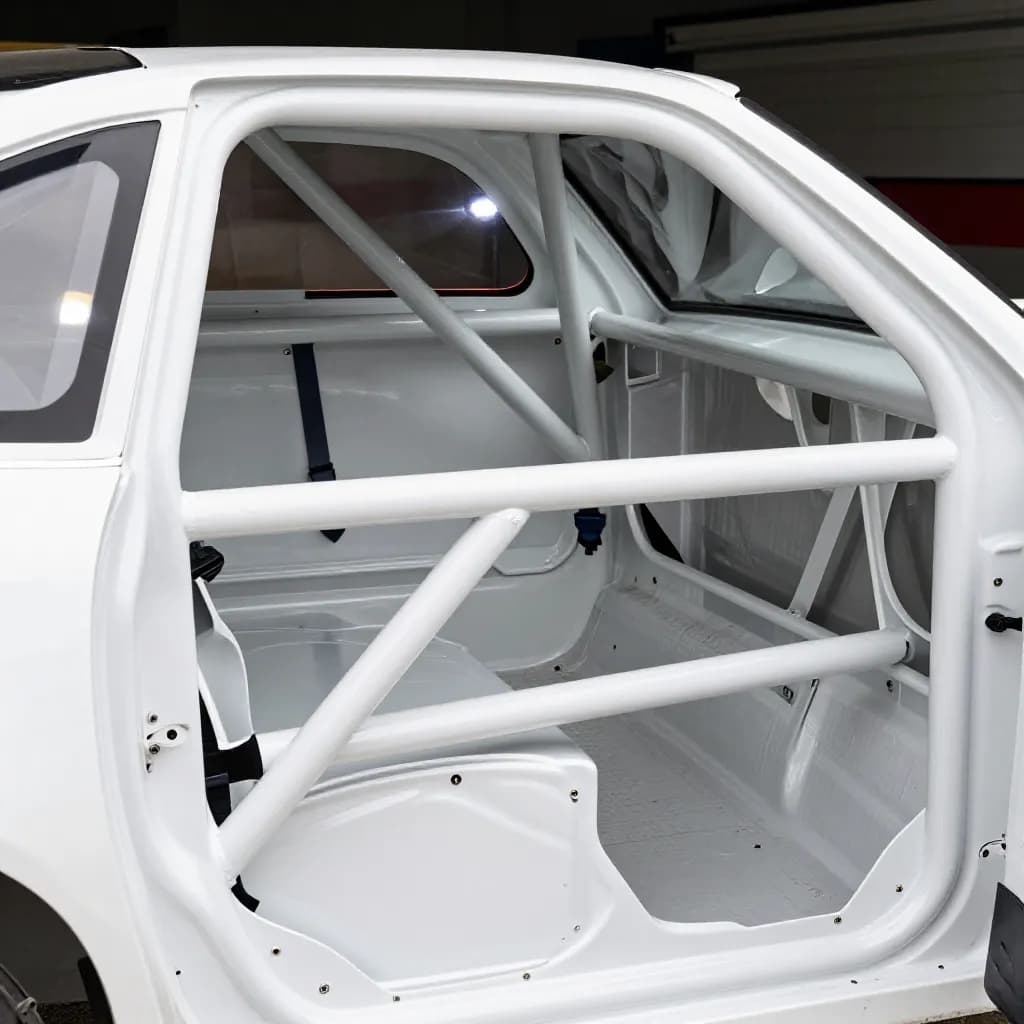
Unlike decorative automotive parts where appearance is the primary concern, roll cage coating must prioritize function. The finish needs to resist chipping from helmet contact, harness hardware abrasion, and the general wear that comes from climbing in and out of a caged vehicle. It must also withstand the thermal environment inside a competition vehicle, where interior temperatures can climb significantly during long sessions on track or trail.
Ready to Start Your Project?
From one-off customs to 15,000-part production runs — get precise pricing in 24 hours.
On This Page
Why Roll Cages Need Specialized Coating
Powder coating achieves all of this while also providing a clean, professional appearance. A well-coated cage signals that the builder took the same care with finishing as they did with fabrication. For vehicles that undergo technical inspection at sanctioned events, a quality finish also makes it easier for inspectors to examine weld quality and tube condition, since the coating conforms tightly to the surface without obscuring details the way thick brush-on paint can.
Tube Material and Preparation Considerations
Roll cages are typically fabricated from DOM (drawn over mandrel) mild steel tubing, ERW (electric resistance welded) tubing, or chromoly (4130 steel) depending on the application and sanctioning body requirements. Each material responds differently to preparation and coating, and understanding these differences is essential for a successful finish.
DOM and ERW mild steel tubes are straightforward to prepare. They respond well to abrasive blasting with aluminum oxide or steel grit at 40-80 mesh, which removes mill scale, surface rust, and any oils left from the bending process. The blasted surface provides an excellent mechanical profile for powder adhesion. A phosphate or iron phosphate pretreatment after blasting further improves corrosion resistance and coating adhesion.
Chromoly tubing requires more careful handling. The alloy is sensitive to hydrogen embrittlement if exposed to aggressive acid pickling or improper plating processes. For powder coating, the safest approach is mechanical preparation through blasting at moderate pressure, followed by a non-acid-based pretreatment. Some fabricators and sanctioning bodies advise against any coating process that involves prolonged heat exposure on chromoly, so it is critical to verify that the cure temperature and duration of the chosen powder are compatible with the tubing specification. Most standard polyester powders cure at 190-200 degrees Celsius for 10-15 minutes at metal temperature, which is well within the safe range for 4130 steel.
Handling Weld Areas and Joints
Weld areas are the most critical zones on any roll cage, and they demand special attention during the coating process. A properly welded cage joint will have full-penetration welds with smooth, consistent beads and no porosity, undercut, or cold lap. The coating process should preserve the ability to inspect these welds visually, which means the finish must be thin enough and conforming enough to reveal the weld profile underneath.
Before coating, all weld spatter must be removed by grinding or wire brushing. Spatter trapped under a powder coat creates stress risers and potential corrosion initiation points. Weld slag, flux residue, and any discoloration from the heat-affected zone should also be cleaned away. If the cage was TIG welded, the welds are typically cleaner and require less post-weld cleanup than MIG welds.
One common issue with powder coating welded assemblies is outgassing from the weld zone. Porosity in welds can trap air and contaminants that expand during the curing process, creating pinholes or bubbles in the finished coating directly over the weld. To mitigate this, many experienced coaters apply a pre-bake cycle, heating the entire cage to cure temperature before applying powder. This drives out trapped gases so they do not disrupt the final finish. The pre-bake also serves as a stress-relief cycle for the welds, which can be beneficial for the overall structural integrity of the cage.
Textured and Wrinkle Finishes for Cages
Textured powder coat finishes are the most popular choice for roll cages, and for good reason. A textured or wrinkle finish hides minor surface imperfections in the tubing and welds, provides a non-reflective surface that reduces glare inside the cockpit, and offers better grip for hands and harness mounting hardware than a smooth gloss finish.
Wrinkle black is the classic roll cage finish. This texture is achieved through specific powder chemistry and cure conditions that cause the coating to contract and form a tight, uniform wrinkle pattern during curing. The resulting surface is tough, hides scratches well, and gives the cage a purposeful, industrial look that suits competition vehicles. Wrinkle finishes are available in black, grey, red, blue, and other colors, though black remains dominant in motorsport applications.
Sandtex and fine texture finishes offer a subtler alternative. These provide a slightly rough, matte surface without the pronounced wrinkle pattern. They are popular for street-driven vehicles where the cage needs to look finished without drawing excessive attention. Fine textures also work well when the cage will be partially covered by interior panels or upholstery, as the texture helps prevent squeaks and rattles where panels contact the tubing.
Smooth gloss and satin finishes are less common on cages but are sometimes chosen for show cars or high-end builds where the cage is a visual centerpiece. These finishes demand more thorough surface preparation since every imperfection in the tubing and welds will be visible. The trade-off is a striking, mirror-like appearance that showcases the fabrication quality.
Sanctioning Body Rules and Inspection Requirements
Before coating a roll cage, check the rules of any sanctioning body under which the vehicle will compete. Organizations like the FIA, NHRA, SCCA, NASA, and various off-road sanctioning bodies have specific requirements regarding roll cage construction, and some of these rules affect coating decisions.
Many sanctioning bodies require that welds be visible for inspection. This does not prohibit powder coating, but it does mean the coating must be thin enough and conforming enough that inspectors can evaluate weld quality through the finish. A standard 50-80 micron powder coat meets this requirement easily, as it follows the contour of the weld bead without filling or obscuring it. Excessively thick coatings or heavy texture finishes over weld areas may draw scrutiny during tech inspection.
Some organizations require specific markings or stamps on the cage tubing to verify material grade and wall thickness. These markings must remain legible after coating. If the tubing stamps are on the interior of the tube where they will not be coated, this is not an issue. If they are on the exterior, the coater should mask these areas or apply a thin enough coat that the stamps remain readable.
For FIA-homologated cages, any modification to the cage after homologation, including coating, must comply with the homologation documentation. In practice, powder coating is universally accepted, but it is worth confirming with the relevant authority if the cage carries a specific homologation number. Documentation of the coating process, including cure temperatures and duration, may be requested during scrutineering for international competition.
Coating Large Cage Assemblies: Logistics and Fixturing
Roll cages present a significant logistical challenge for powder coating shops due to their size and geometry. A full cage for a sedan or coupe can measure 1.5 meters wide, 1.2 meters tall, and 2 meters long, requiring a large blast booth, spray booth, and curing oven to process. Not all powder coating shops have equipment large enough to handle a complete cage assembly.
When selecting a coater, confirm that their oven can accommodate the fully assembled cage. If the cage must be coated in sections and assembled afterward, the uncoated joint areas will need touch-up protection, which is never as durable as a continuous powder coat. Coating the complete welded assembly in one piece is always the preferred approach for both corrosion protection and appearance.
Fixturing and hanging the cage in the oven requires careful planning. The cage must be supported at points that will not be visible or that can be touched up after curing. Ground points for the electrostatic charge must make good contact with bare metal, which means the hanging points will have small uncoated spots. These are typically located on mounting feet or hidden surfaces where they can be addressed with a zinc-rich touch-up paint after coating.
For cages that are too large for available ovens, some shops offer infrared curing as an alternative. Portable infrared panels can be positioned around the cage to achieve cure temperature without requiring the entire assembly to fit inside a conventional box oven. This approach requires careful temperature monitoring to ensure uniform cure across all surfaces.
Padding, Harness, and Hardware Compatibility
After powder coating, the cage must be fitted with SFI or FIA-rated padding at all driver contact points. The coating surface affects how padding is attached. Smooth finishes allow adhesive-backed padding to bond directly, while textured or wrinkle finishes may require mechanical fastening with hose clamps or cable ties because adhesive does not grip the irregular surface as reliably.
Harness mounting tabs, gussets, and hardware attachment points should be masked during coating if they require bare metal contact for proper torque values or electrical grounding. Alternatively, these areas can be coated and then lightly sanded at the contact surface during hardware installation. For harness eye bolts and shoulder harness bars, the coating thickness is negligible relative to the hardware tolerances, so coating these areas is generally acceptable.
Electrical grounding is another consideration. If the cage serves as a grounding point for the vehicle's electrical system, kill switches, or fire suppression systems, at least one mounting point must have a clean metal-to-metal contact. Powder coating is an electrical insulator, so grounding connections must either be masked during coating or scraped clean during installation. A star washer or toothed lock washer at the grounding point will bite through thin powder coat to establish contact, but this should be verified with a continuity test.
Window nets, door bars, and removable sections also interact with the coated surface. Latch pins and quick-release mechanisms should operate smoothly against the coating without binding. A light application of dry lubricant at pivot and latch points prevents wear and ensures reliable operation during competition.
Maintaining a Powder-Coated Roll Cage
A powder-coated roll cage requires minimal maintenance compared to a painted or bare metal cage. The cured powder film resists oils, brake fluid, coolant, and the general grime that accumulates inside a competition vehicle. Routine cleaning with a mild detergent and water is sufficient to keep the cage looking fresh between events.
Chips and scratches are inevitable, especially in areas where the driver's helmet, HANS device, or harness hardware contacts the cage. Small chips can be touched up with a matching spray paint or brush-on enamel to prevent corrosion from starting at the exposed metal. For vehicles that see regular competition use, an annual inspection of the coating condition is good practice. Pay particular attention to the lower mounting points where the cage bolts or welds to the floor, as these areas are most exposed to moisture and road debris.
If the cage is in a vehicle that sees wet-weather competition or is trailered in open conditions, moisture can collect inside the tubing through open tube ends or drain holes. This internal corrosion is invisible from the outside and can weaken the cage over time. Sealing open tube ends with welded caps or silicone plugs prevents moisture ingress. Some builders also treat the tube interiors with a rust-inhibiting oil or wax before the ends are sealed.
For show vehicles where the cage is a visual feature, a periodic application of automotive detailing spray or light wax will enhance the appearance of smooth finishes and help repel dust. Textured finishes benefit from occasional scrubbing with a soft brush to clean dirt from the texture valleys. Avoid abrasive cleaners or solvents that could dull or damage the powder coat surface.
Frequently Asked Questions
Can you powder coat a chromoly roll cage?
Yes, chromoly (4130 steel) roll cages can be powder coated safely. The standard cure temperature of 190-200 degrees Celsius for 10-15 minutes does not affect the mechanical properties of 4130 steel. Avoid aggressive acid-based pretreatments that could cause hydrogen embrittlement, and use mechanical blasting for surface preparation instead.
Will powder coating hide weld defects on a roll cage?
A standard 50-80 micron powder coat conforms closely to the weld profile and does not hide defects. Porosity, undercut, cold lap, and incomplete fusion will still be visible through the coating. This is important for safety inspections, as sanctioning bodies require welds to be visually inspectable after finishing.
What is the best finish for a roll cage?
Wrinkle black is the most popular and practical finish for competition roll cages. It hides minor imperfections, reduces cockpit glare, provides grip, and resists showing scratches. For street or show vehicles, satin black or fine texture finishes offer a cleaner look while still being practical for daily use.
Do I need to remove the roll cage from the car before powder coating?
If the cage is bolt-in, it should be removed for coating. Weld-in cages are ideally coated before installation in the vehicle. If a weld-in cage is already installed, it cannot be oven-cured in place. In that case, some shops offer infrared curing or the cage must be cut out, coated, and re-welded, which is not recommended.
Does powder coating add significant weight to a roll cage?
No. A standard powder coat adds approximately 100-150 grams to a typical roll cage assembly. At 50-80 microns thickness, the coating weight is negligible compared to the mass of the steel tubing itself. Weight-conscious builders can use thin-film powders to reduce this further.
Ready to Start Your Project?
From one-off customs to 15,000-part production runs — get precise pricing in 24 hours.