The global renewable energy sector is deploying solar and wind generation capacity at unprecedented scale. The International Energy Agency projects that renewable energy capacity will exceed 4,500 GW by 2027, with solar PV and onshore wind accounting for the majority of new installations. This massive infrastructure deployment creates enormous demand for protective coatings that can match the 25-30 year design life of renewable energy equipment while operating in diverse and often remote environments.
Industrial
Powder Coating for Renewable Energy Farms: Solar, Wind, 25-Year Durability, and Remote Maintenance
Sundial Powder Coating·April 22, 2026·12 min
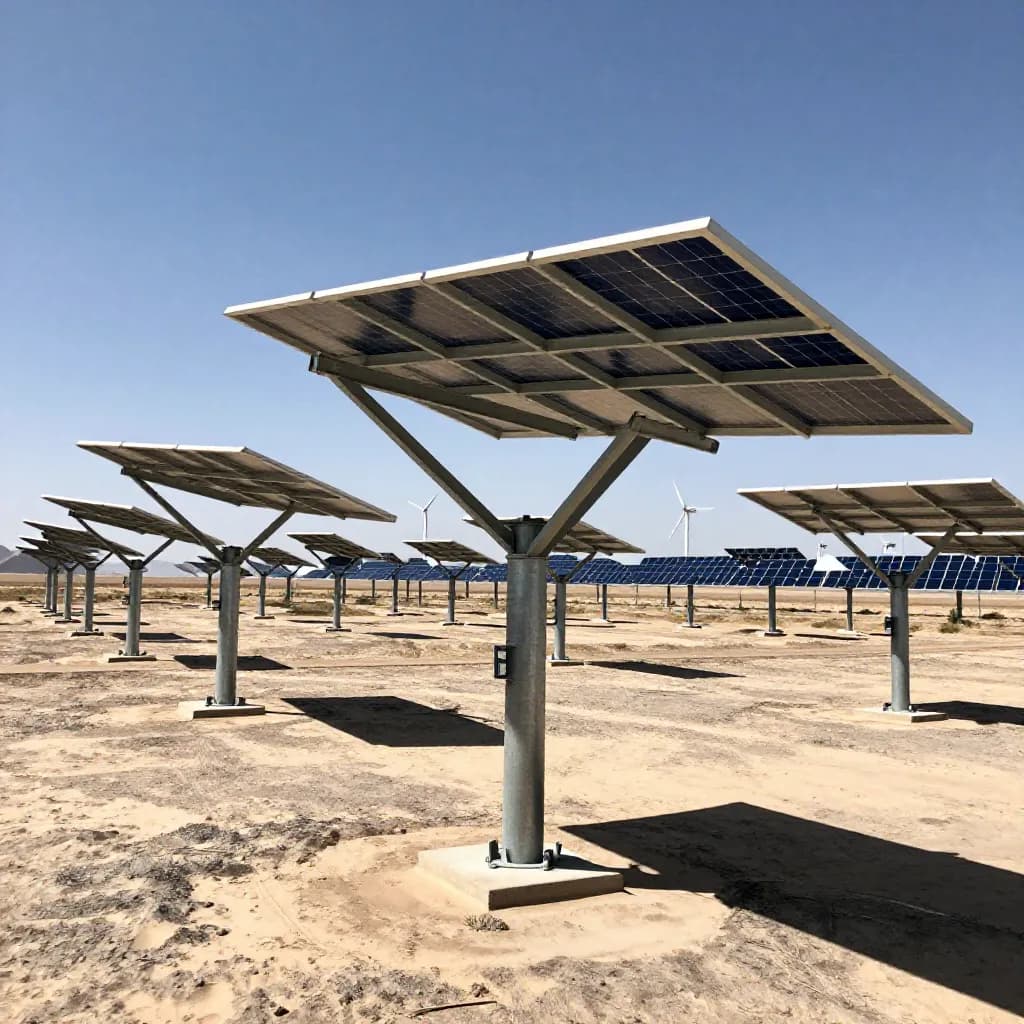
Renewable energy installations are located wherever the resource is strongest — solar farms in deserts and arid regions, wind farms on exposed hilltops, coastal plains, and offshore locations. These sites are selected for maximum energy production, not for ease of maintenance, meaning that the coating systems protecting this infrastructure must deliver decades of reliable performance with minimal maintenance intervention.
Ready to Start Your Project?
From one-off customs to 15,000-part production runs — get precise pricing in 24 hours.
On This Page
Renewable Energy Infrastructure and Coating Requirements
The coating requirements for renewable energy infrastructure differ from conventional building applications in several important ways. The design life expectation of 25-30 years (matching the warranted life of solar panels and wind turbines) exceeds the typical 15-20 year specification for architectural coatings. The remote locations often involve aggressive environmental conditions — desert UV, coastal salt, high altitude, or extreme temperatures — that accelerate coating degradation. And the economic model of renewable energy projects demands minimal ongoing maintenance costs to maintain the financial viability of the installation.
Powder coating is increasingly the preferred finishing technology for renewable energy infrastructure due to its combination of durability, environmental credentials, and lifecycle economics. The zero-VOC application process aligns with the sustainability mission of renewable energy, while the long service life and low maintenance requirements support the economic model of these capital-intensive projects.
Solar Farm Structural Components
Utility-scale solar farms use thousands of tons of steel and aluminum structural components — mounting frames, tracker systems, cable trays, inverter enclosures, and perimeter fencing — all of which require corrosion protection for the 25-30 year project life. The coating system for these components must withstand the specific environmental conditions of the solar farm location while remaining cost-effective at the massive scale of modern solar installations.
Solar farm mounting structures are typically fabricated from hot-dip galvanized steel or aluminum, with powder coating applied as a topcoat for UV protection, aesthetic appearance, and enhanced corrosion resistance. For galvanized steel structures, the powder coating extends the galvanizing life by a factor of 2-3, ensuring that the corrosion protection system matches the 25-30 year design life of the solar panels.
The environmental conditions at solar farm sites are often extreme. Desert solar farms in the Middle East, North Africa, and the American Southwest experience intense UV (UV index 12-14), surface temperatures exceeding 80°C, and sand abrasion. Coastal solar farms face salt spray corrosion. High-altitude solar installations in the Andes or Tibetan Plateau encounter amplified UV and extreme temperature cycling. The coating specification must be tailored to the specific site conditions rather than using a generic one-size-fits-all approach.
For desert solar farms, super-durable polyester powder coatings with IR-reflective pigments are recommended. The IR-reflective pigments reduce surface temperatures on structural members, minimizing thermal expansion that can stress panel mounting points. Film thickness of 80-100 microns provides adequate UV and abrasion resistance for 25+ year desert service.
For coastal solar farms, Qualicoat Seaside-equivalent specifications with enhanced salt spray resistance (minimum 1,500 hours per ISO 9227) are necessary. Duplex galvanizing-plus-powder-coating systems on steel structures provide the cathodic protection needed for reliable 25-year coastal performance.
Tracker systems — motorized mounting structures that follow the sun's path to maximize energy production — present additional coating challenges. The moving joints and pivot points of tracker systems experience mechanical wear that can damage the coating, creating corrosion initiation points. Specifying polyurethane powder coatings with enhanced abrasion resistance at wear points, combined with periodic lubrication of moving joints, maintains coating integrity on tracker components.
Wind Farm Tower and Component Coatings
Wind turbine towers — typically 80-120 meters tall for onshore installations and up to 150+ meters for offshore — are among the largest powder-coated structures in industrial service. Each tower requires coating of 500-1,500 m² of internal and external surface area, with the coating system designed to provide 25+ year protection in exposed, high-wind locations that are often difficult to access for maintenance.
External tower coatings must withstand the combined effects of UV radiation, wind-driven rain, temperature cycling, and in coastal and offshore locations, salt spray corrosion. The coating specification typically follows ISO 12944 for the site-specific corrosivity category: C3 (Medium) for inland locations, C4 (High) for coastal sites, and C5-M (Very High, Marine) or CX (Extreme) for offshore installations.
For onshore wind towers in C3-C4 environments, a typical powder coating system comprises zinc-rich epoxy primer (60-80 microns), epoxy intermediate coat (60-80 microns), and polyurethane or super-durable polyester topcoat (60-80 microns), with total dry film thickness of 200-280 microns. This system provides ISO 12944 durability class High (15-25 years) or Very High (>25 years) depending on the specific formulation and site conditions.
Internal tower coatings protect against condensation corrosion — the moisture that forms on the cold internal steel surfaces when warm, humid air enters the tower through ventilation openings. A single coat of epoxy powder coating at 80-120 microns provides adequate internal protection for most onshore installations. For offshore towers, where internal humidity is consistently high, enhanced internal coating systems with zinc-rich primers are specified.
Wind turbine nacelle components — the housing, generator frame, and mechanical components at the top of the tower — require coatings that resist vibration fatigue, oil and grease exposure, and the extreme temperature cycling experienced at hub height. Polyurethane powder coatings with enhanced chemical resistance and flexibility are preferred for nacelle components.
Blade root connections and tower flange surfaces require specialized coating considerations. These high-stress bolted connections must maintain precise friction coefficients for structural integrity, and the coating at these interfaces must be specified to provide the required slip resistance while maintaining corrosion protection. Zinc silicate or zinc-rich epoxy coatings at controlled thicknesses are typically specified for friction-critical connections.
25-Year Lifecycle Matching and Warranty Alignment
The economic model of renewable energy projects is built on 25-30 year financial projections that assume minimal maintenance and replacement costs. Solar panel manufacturers warrant power output for 25-30 years, and wind turbine manufacturers warrant mechanical performance for 20-25 years. The coating systems protecting the structural infrastructure must match these warranty periods to avoid the cost and disruption of mid-life recoating.
Achieving 25+ year coating performance requires a systems approach that addresses every factor affecting coating longevity: resin chemistry selection, pigment stability, pretreatment quality, application control, and maintenance planning. No single factor can compensate for deficiencies in others — a premium powder coating applied over inadequate pretreatment will fail just as surely as a budget coating applied over perfect pretreatment.
Accelerated weathering testing provides the primary basis for predicting long-term coating performance. For 25-year service life predictions, accelerated weathering exposure of 4,000-6,000 hours (xenon arc per ISO 16474-2 or fluorescent UV per ASTM G154) is typically required, depending on the correlation factor for the specific site conditions. Natural weathering exposure data from sites representative of the installation environment — South Florida for humid subtropical, Arizona for desert, Bohus-Malmön for marine — provides validation of accelerated test predictions.
Warranty structures for renewable energy coating systems should align with the project's financial model. Typical warranty terms include maximum color change (Delta E ≤ 5 after 25 years), minimum gloss retention (50% of initial after 25 years), no cracking, peeling, or blistering, and maximum corrosion at scribe marks (2 mm creep after 25 years of exposure). These warranty terms should be backed by the coating manufacturer's performance data and, ideally, by third-party certification (Qualicoat, GSB, or equivalent).
Lifecycle cost analysis for renewable energy coating systems should compare the total cost of ownership — including initial coating cost, maintenance costs, and any mid-life recoating — across different specification options. A higher-specification coating system that eliminates mid-life recoating typically delivers lower total lifecycle cost than a budget system that requires recoating at year 12-15, even before accounting for the logistical difficulty and production loss associated with recoating operational renewable energy infrastructure.
Remote Location Challenges and Maintenance Access
Renewable energy installations are frequently located in remote areas with limited infrastructure, difficult access, and extreme environmental conditions. Desert solar farms may be hours from the nearest town. Offshore wind farms require vessel or helicopter access. Mountain wind installations may be accessible only during summer months. These logistical constraints fundamentally affect coating specification and maintenance planning.
The primary implication of remote location is that coating maintenance must be minimized. Every maintenance intervention requires mobilization of personnel, equipment, and materials to the remote site — a costly and time-consuming process that reduces the energy production of the installation during maintenance periods. Coating systems that require maintenance every 5-10 years are economically unacceptable for remote renewable energy installations; the specification must target 20-25 years of maintenance-free performance.
When maintenance is required, it must be executable under field conditions with portable equipment and materials that can be transported to the site. Field repair of powder coatings on renewable energy infrastructure typically uses two-component liquid coating systems (epoxy primers and polyurethane topcoats) that can be applied by brush or portable spray equipment. These repair materials must be compatible with the original powder coating system and provide performance approaching the original specification.
Environmental constraints at remote sites affect both the timing and methods of coating maintenance. Desert sites may be too hot for coating application during summer months (surface temperatures exceeding the maximum application temperature of repair coatings). Offshore sites have limited weather windows for coating work. Mountain sites may be inaccessible during winter. Maintenance planning must account for these seasonal constraints and schedule work during appropriate weather windows.
Automated inspection technologies — including drone-based visual inspection, thermal imaging, and robotic coating thickness measurement — are increasingly used for remote renewable energy installations. These technologies enable coating condition assessment without the cost and risk of manual inspection at height or in remote locations, supporting condition-based maintenance planning that optimizes the timing of maintenance interventions.
Environmental and Sustainability Considerations
The environmental credentials of the coating system are particularly important for renewable energy infrastructure, where the entire project is predicated on environmental benefit. Using coating technologies with high environmental impact would undermine the sustainability narrative of the renewable energy installation.
Powder coating's zero-VOC application process eliminates solvent emissions that would otherwise contribute to air pollution and ground-level ozone formation. For a large solar farm with 10,000+ m² of coated structural steel, the VOC savings compared to liquid painting can amount to several tons of solvent emissions avoided — a meaningful environmental benefit that aligns with the project's sustainability mission.
The 95-98% material utilization rate of powder coating minimizes waste generation. Overspray powder is collected and recycled, and the small fraction of waste powder that cannot be recycled is disposed of as non-hazardous solid waste. This contrasts with liquid painting, where 30-50% of the paint may be lost as overspray requiring hazardous waste disposal.
End-of-life considerations for renewable energy infrastructure are increasingly important as first-generation installations approach decommissioning. Steel and aluminum structural components can be recycled regardless of the powder coating, which is removed during the melting process. The powder coating does not contaminate the recycled metal or reduce its value, supporting the circular economy principles that underpin sustainable infrastructure development.
Environmental Product Declarations (EPDs) for powder-coated structural steel and aluminum components provide quantified lifecycle environmental impact data that can be incorporated into the overall environmental assessment of the renewable energy project. These EPDs, prepared according to EN 15804 or ISO 14025, document the global warming potential, energy consumption, and resource depletion associated with the coating system across its lifecycle.
The carbon footprint of the coating system — including raw material production, powder manufacture, application energy, and end-of-life processing — is typically a small fraction of the total carbon footprint of the renewable energy installation. However, minimizing this contribution through efficient coating processes, renewable energy-powered coating facilities, and optimized logistics demonstrates commitment to comprehensive sustainability.
Emerging Technologies for Renewable Energy Coatings
The renewable energy sector's scale and growth rate are driving innovation in powder coating technology, with several emerging developments specifically targeting the unique requirements of solar and wind farm infrastructure.
Anti-soiling powder coatings for solar farm structures reduce dust accumulation on mounting frames and tracker systems, minimizing the transfer of dust to solar panel surfaces. While the primary anti-soiling effort focuses on the glass surface of solar panels, reducing dust on surrounding structural surfaces contributes to overall site cleanliness and reduces the frequency of panel cleaning operations.
Self-healing powder coatings containing micro-encapsulated corrosion inhibitors are being developed for wind turbine towers and solar farm structures. When the coating is damaged — by impact, abrasion, or fatigue cracking — the capsules rupture and release corrosion inhibitors that protect the exposed steel surface until permanent repair can be scheduled. This technology is particularly valuable for remote installations where prompt repair of coating damage is not feasible.
Conductive powder coatings for lightning protection integration are being developed for wind turbine components. These coatings provide corrosion protection while maintaining electrical conductivity for lightning current dissipation, eliminating the need for separate lightning protection conductors on coated surfaces. This dual-function approach simplifies tower design and reduces installation costs.
Bio-based powder coatings derived from renewable raw materials — plant oils, bio-succinic acid, and other bio-sourced monomers — are in development for renewable energy applications. These coatings reduce the fossil fuel content of the coating system, further improving the lifecycle environmental profile of the renewable energy installation. Current bio-based powder coatings achieve performance comparable to conventional formulations for many properties, though long-term weathering data is still being accumulated.
Digital twin technology — creating virtual models of coating condition across an entire renewable energy installation — enables predictive maintenance planning based on real-time environmental data and coating degradation models. By integrating weather data, coating specification data, and inspection results, digital twins can predict when and where coating maintenance will be needed, optimizing maintenance scheduling and resource allocation across large renewable energy portfolios.
Frequently Asked Questions
How long must powder coatings last on renewable energy infrastructure?
Coating systems must match the 25-30 year design life of solar panels and wind turbines. This requires super-durable polyester or fluoropolymer formulations, enhanced pretreatment, and site-specific specification. Accelerated weathering testing of 4,000-6,000 hours validates long-term performance predictions.
What coating system is used for wind turbine towers?
Typically zinc-rich epoxy primer (60-80µm), epoxy intermediate coat (60-80µm), and polyurethane topcoat (60-80µm), totaling 200-280 microns. The system is specified per ISO 12944 for the site corrosivity category: C3-C4 for onshore, C5-M or CX for offshore. Internal surfaces receive epoxy at 80-120 microns for condensation protection.
How are powder coatings maintained on remote solar farms?
The specification targets 20-25 years of maintenance-free performance to minimize costly site mobilization. When repair is needed, two-component liquid epoxy primers and polyurethane topcoats are applied with portable equipment. Drone-based inspection and thermal imaging enable condition assessment without manual access.
What environmental benefits does powder coating offer for renewable energy?
Zero VOC emissions (saving tons of solvent per large installation), 95-98% material utilization minimizing waste, non-hazardous waste disposal, and compatibility with steel/aluminum recycling at end of life. Environmental Product Declarations per EN 15804 quantify lifecycle impacts for project sustainability reporting.
How does the coating specification differ for desert vs. coastal solar farms?
Desert farms need super-durable polyester with IR-reflective pigments, 80-100µm thickness, and sand abrasion resistance. Coastal farms require Qualicoat Seaside-equivalent specification with 1,500+ hours salt spray resistance and duplex galvanizing-plus-powder systems on steel. Site-specific specification is essential — generic approaches lead to premature failure.
Ready to Start Your Project?
From one-off customs to 15,000-part production runs — get precise pricing in 24 hours.