Powder coating is one of the most versatile and durable finishing options available to product designers, but its success depends heavily on decisions made at the design stage — long before the part reaches the coating line. Designers who understand how powder coating works and what it requires from a part geometry can create products that coat beautifully, perform reliably, and avoid the costly rework that results from design-for-coating oversights.
Design
Powder Coating for Product Designers: Design for Coating Success
Sundial Powder Coating·April 22, 2026·12 min
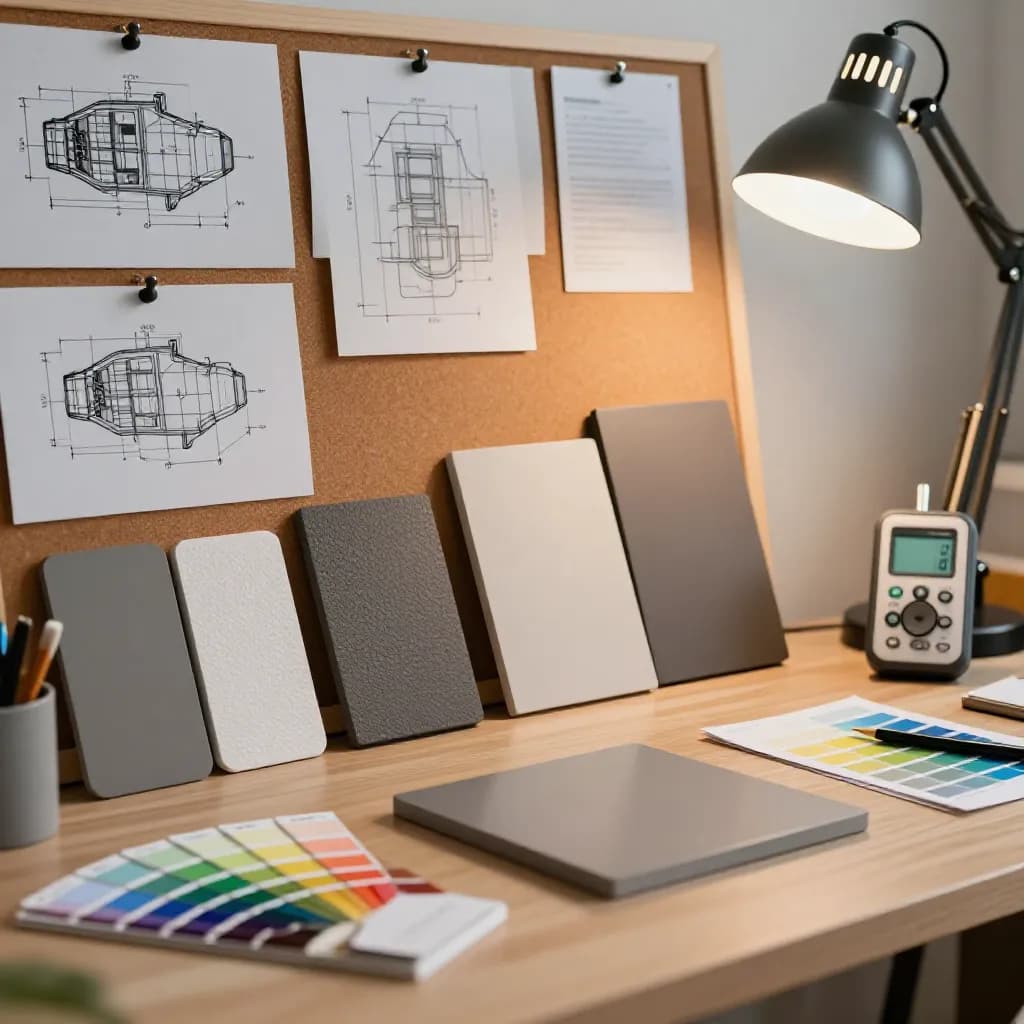
The fundamental challenge is that powder coating is an electrostatic process — charged powder particles are attracted to a grounded metal substrate and must flow, level, and cure into a uniform film. Part geometry directly affects how powder deposits on surfaces, edges, recesses, and internal features. Sharp edges attract excess powder and create thick, brittle ridges. Deep recesses and internal corners resist powder penetration due to the Faraday cage effect. Large flat surfaces can show orange peel or inconsistent texture if powder flow is not optimized.
Ready to Start Your Project?
From one-off customs to 15,000-part production runs — get precise pricing in 24 hours.
On This Page
Why Product Designers Need to Think About Coating Early
By considering these factors during the design phase, product designers can eliminate coating problems before they occur, reduce coating costs by simplifying the application process, and expand their design palette by understanding what finishes and effects are achievable. This guide covers the key design-for-coating principles that every product designer should know, from basic geometry rules to advanced considerations for color, texture, and multi-component assemblies.
Edge Radii and Corner Design
Edge treatment is the single most important design-for-coating consideration. Powder coating naturally thins on sharp external edges because electrostatic forces cause powder to wrap around the edge, resulting in reduced film thickness at the apex. On a perfectly sharp edge, the coating may be only 20-30% of the nominal film thickness, creating a weak point that is vulnerable to chipping, corrosion, and premature failure.
The solution is to radius all external edges. A minimum radius of 0.5mm is necessary for acceptable coating coverage, but 1.0mm or greater is recommended for optimal results. For products that will be exposed to outdoor environments or mechanical handling, a 1.5-2.0mm radius provides the best balance of coating performance and visual appearance. Specify edge radii on your engineering drawings and communicate the coating requirement to your fabrication supplier to ensure edges are properly prepared.
Internal corners present the opposite problem — the Faraday cage effect causes powder to be repelled from deep internal corners, resulting in thin or absent coating in these areas. Where possible, design internal corners with generous radii (3mm or more) and avoid deep, narrow channels or slots that powder cannot penetrate. If sharp internal corners are unavoidable for functional reasons, discuss the coating implications with your coating supplier and consider whether reduced film thickness in these areas is acceptable for the intended application.
Hole Placement, Slots, and Recessed Features
Holes, slots, and recessed features require careful consideration in design for powder coating. Small holes (under 3mm diameter) can become partially or fully blocked by powder during application, which may be acceptable for decorative holes but is problematic for functional holes that must remain clear for fasteners, airflow, or drainage. If holes must remain clear, they will need to be masked before coating — adding cost and complexity to the coating process — or drilled after coating, which damages the coating film around the hole perimeter.
Design strategies to minimize hole-related coating issues include using larger holes where possible (6mm or greater coat more cleanly), locating holes away from edges and corners where powder buildup is already problematic, and grouping holes to simplify masking operations. For threaded holes, consider whether the threads should be coated (which may affect thread engagement) or masked (which adds process steps). Specify masking requirements clearly on the engineering drawing.
Slots and elongated openings coat more reliably than small round holes because the powder can flow through the opening more easily. However, very narrow slots (under 2mm wide) may still bridge with powder. Recessed features such as countersinks, counterbores, and pockets should be designed with adequate depth-to-width ratios to allow powder penetration — a general guideline is that the depth should not exceed the width for reliable coating coverage. Embossed or debossed text and logos should use bold, open fonts with adequate line width (minimum 1mm) to ensure the coating follows the detail without filling in fine features.
Assembly Considerations and Hanging Points
Products that are assembled from multiple coated components require careful planning to ensure that the coating does not interfere with assembly and that assembly operations do not damage the coating. Mating surfaces that require precise fit — such as tongue-and-groove joints, press fits, or sliding interfaces — must account for the coating thickness (typically 60-120 microns per surface) in their dimensional tolerances. A press fit designed for bare metal dimensions may become an interference fit after coating, or a sliding joint may become too tight.
Fastener locations need particular attention. If screws or bolts will be driven through coated surfaces, the coating will be damaged at the fastener point, potentially creating a corrosion initiation site. Design solutions include masking fastener areas before coating, using captive fasteners installed before coating, or applying touch-up coating after assembly. For welded assemblies, decide whether to coat before or after welding — coating before welding damages the coating in the weld zone and can contaminate the weld, while coating after welding requires the entire assembly to fit in the coating booth and oven.
Every part that is powder coated must be hung or racked in the coating booth, and the hanging point will have a small uncoated area where the hook or fixture contacts the part. Design your parts with designated hanging points in non-critical locations — areas that will be hidden in the final assembly, covered by other components, or located on non-visible surfaces. If no suitable hanging point exists, discuss fixturing options with your coating supplier early in the design process.
Color and Texture Selection for Products
Powder coating offers product designers an extensive palette of colors, textures, and special effects that can define a product's visual identity and brand recognition. Standard color systems like RAL Classic provide over 200 colors available off the shelf from all major powder manufacturers, while custom color matching can reproduce virtually any color reference. Metallic, pearlescent, and color-shifting effects add visual depth and premium appeal.
Texture selection affects both aesthetics and functionality. Smooth finishes provide a clean, contemporary look but show fingerprints, scratches, and surface imperfections more readily. Fine textures (sometimes called 'sand' or 'leather' textures) hide minor surface defects and handling marks while maintaining a refined appearance. Medium and coarse textures provide maximum defect hiding and improved grip but can be more difficult to clean and may not suit all design aesthetics.
When selecting colors and textures, consider the product's use environment and handling conditions. Products that will be frequently touched benefit from textures that resist fingerprint visibility. Products exposed to outdoor environments should use UV-stable polyester chemistries in colors that are less susceptible to visible fading — lighter colors and earth tones generally show less perceptible color change than deep, saturated colors like bright reds and blues. Always evaluate physical samples on the actual substrate material rather than relying on color charts or digital representations, as the substrate surface, alloy composition, and coating thickness all influence the final appearance.
Substrate Material Selection and Preparation
The choice of substrate material affects coating adhesion, appearance, and long-term performance. Aluminum, mild steel, galvanized steel, stainless steel, and zinc die-castings are all commonly powder coated, but each requires different pretreatment processes and may present unique challenges.
Aluminum is the most coating-friendly substrate for most product applications. It is lightweight, corrosion-resistant, and accepts powder coating readily after appropriate chemical pretreatment (typically chromate or chrome-free conversion coating). Different aluminum alloys have different surface characteristics — 6000-series extrusion alloys coat very well, while high-silicon casting alloys may require additional surface preparation to achieve good adhesion.
Mild steel is widely used for structural and industrial products. It requires thorough degreasing and either mechanical preparation (blasting) or chemical pretreatment (iron phosphate or zinc phosphate) before coating. The pretreatment quality directly affects corrosion resistance — zinc phosphate provides significantly better corrosion protection than iron phosphate for products exposed to moisture or outdoor environments. Galvanized steel combines the corrosion resistance of the zinc layer with the aesthetic and additional protection of powder coating, but the galvanized surface must be properly prepared to ensure coating adhesion. Outgassing from zinc die-castings can cause coating defects (pinholes and bubbles) if not managed through appropriate degassing pretreatment or specialized low-cure powder formulations.
Prototyping and Design Validation with Powder Coating
Incorporating powder coating into the prototyping process helps designers validate both the aesthetic and functional aspects of the coating specification before committing to production tooling and volumes. Request coated prototype parts from your coating supplier to evaluate color accuracy, texture appearance, gloss level, and overall visual impact in the context of the complete product assembly.
Prototype evaluation should include assessment under the lighting conditions in which the product will be displayed or used — retail lighting, office environments, outdoor daylight, or industrial settings. Color appearance changes significantly under different light sources due to metamerism, and a color that looks perfect under the designer's studio lighting may appear quite different in the end-use environment. Evaluate prototypes at the actual viewing distance and angle to assess how the finish reads at scale.
Functional testing of coated prototypes is equally important. Verify that coating thickness does not interfere with assembly operations, that mating surfaces align correctly, that moving parts operate freely, and that the coating withstands the mechanical stresses of the product's intended use. Conduct adhesion testing, impact testing, and scratch resistance testing on prototype parts to confirm that the coating specification meets the product's durability requirements. If the prototype reveals design-for-coating issues — such as poor coverage on sharp edges, powder buildup in recesses, or interference with assembly — address these in the design before production begins.
Frequently Asked Questions
What minimum edge radius should I design for powder coating?
A minimum radius of 0.5mm is necessary, but 1.0mm or greater is recommended for reliable coating coverage. For products exposed to outdoor environments or mechanical handling, 1.5-2.0mm provides optimal coating performance. Sharp edges result in thin, vulnerable coating that is prone to chipping and corrosion.
How does powder coating thickness affect part dimensions?
Powder coating adds 60-120 microns (0.06-0.12mm) per coated surface. For mating surfaces, press fits, and precision assemblies, this thickness must be accounted for in dimensional tolerances. Either adjust the bare metal dimensions to compensate or specify masking of critical dimensional surfaces.
Can I powder coat plastic or non-metal parts?
Standard powder coating requires an electrically conductive, heat-resistant substrate because it uses electrostatic application and oven curing at 160-200°C. Some specialized processes exist for coating certain plastics and composites using UV-cure or low-temperature powders, but these are not widely available and have limitations compared to standard metal coating.
How do I specify a hanging point for powder coating?
Identify a non-critical area on the part where a small uncoated contact mark is acceptable — typically a hidden surface, an area covered by another component, or a non-visible face. Mark the designated hanging point on the engineering drawing and discuss fixturing options with your coating supplier during the design phase.
What causes orange peel in powder coating and how can design help?
Orange peel is a textured surface appearance caused by incomplete powder flow during curing. While primarily a process issue, design can contribute — very large flat surfaces are more prone to visible orange peel than curved or textured surfaces. Specifying a light texture finish rather than high gloss on large flat panels can effectively mask minor orange peel.
Ready to Start Your Project?
From one-off customs to 15,000-part production runs — get precise pricing in 24 hours.