Porsche wheels represent some of the most demanding applications in automotive powder coating. The combination of high-performance driving, aggressive brake systems that generate significant brake dust, and the exacting aesthetic standards of Porsche owners creates requirements that push powder coating technology to its limits. Understanding these requirements is essential for achieving results that meet Porsche owners' expectations.
Automotive
Powder Coating for Porsche Wheels: OEM Color Matching, Track Use, Concours, and Clear Coat Systems
Sundial Powder Coating·April 22, 2026·14 min
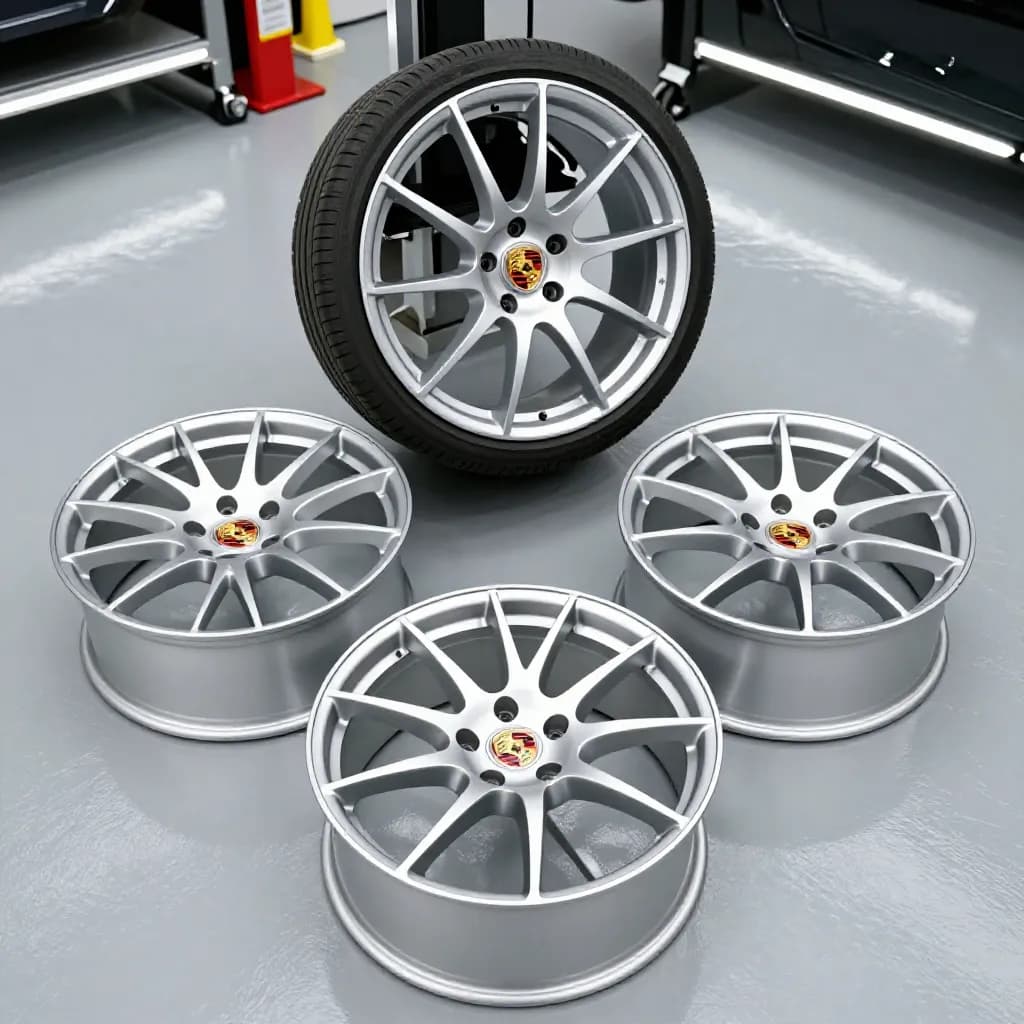
Porsche's high-performance brake systems — particularly the Porsche Ceramic Composite Brakes (PCCB) and the cast-iron brakes on non-ceramic models — generate substantial brake dust that deposits on wheel surfaces. This brake dust contains metallic particles that can etch into wheel finishes if not cleaned regularly. Powder coating provides a harder, more chemical-resistant surface than factory wheel paint, offering better protection against brake dust etching and making cleaning easier.
Ready to Start Your Project?
From one-off customs to 15,000-part production runs — get precise pricing in 24 hours.
On This Page
Porsche Wheels and the Case for Powder Coating
Track use adds another dimension to the powder coating requirement. Porsche owners who participate in track days, time trials, or club racing subject their wheels to extreme thermal cycling, high-speed stone impacts, and aggressive brake dust exposure. The powder coating must withstand these conditions without cracking, peeling, or discoloring. Track-use wheels may also require more frequent refinishing than street-only wheels, making the economics of powder coating versus other finishing methods an important consideration.
The concours and collector car community adds yet another set of requirements. Porsche concours judges evaluate wheel finish quality with extreme scrutiny, and any coating defects — orange peel, runs, inclusions, or color inconsistency — will be penalized. Achieving concours-quality powder coating requires the highest level of preparation, application skill, and quality control.
Porsche's wheel designs — from the classic Fuchs to modern Turbo S and GT3 designs — feature complex geometries with deep dishes, intricate spoke patterns, and tight recesses that challenge spray technique. Achieving uniform coverage and consistent finish quality across these complex surfaces requires experienced applicators with specific Porsche wheel experience.
OEM Porsche Wheel Colors and Matching
Porsche offers its wheels in a range of factory colors that vary by model, trim level, and option package. Matching these factory colors in powder coating format requires understanding the specific color codes and the characteristics of each finish.
The most common Porsche factory wheel colors include Silver (standard on most models), Platinum Satin (a warm grey-silver with satin finish), Satin Black, Gloss Black, Satin Platinum, and various model-specific colors. GT models often feature Satin Aurum (gold), Satin Neodyme (bronze), and White Gold Metallic options. The 911 Turbo S exclusive wheels are available in Turbonite (a dark bronze-gold metallic).
Porsche wheel color codes are typically found in the vehicle's option code sticker or can be identified through the Porsche parts catalog using the wheel part number. Common wheel color codes include C9Z (Platinum Satin), C9X (Satin Black), and various model-specific designations. Providing the exact option code to the powder coating manufacturer ensures the most accurate color match.
Matching Porsche's satin metallic wheel finishes requires careful attention to both color and gloss level. Satin finishes (typically 20-40 gloss units at 60 degrees) are more challenging to match than gloss finishes because the satin effect interacts with the metallic pigment to create a specific visual character. A metallic powder that looks correct at high gloss may appear quite different at satin gloss levels.
Porsche's Platinum Satin finish is one of the most frequently requested color matches. This warm grey-silver with fine metallic flake and satin sheen requires a bonded metallic powder formulation with precisely matched flake size and density. The satin gloss level must be carefully controlled during application and curing to achieve the characteristic Porsche Platinum appearance.
For restoration projects involving classic Porsche models, the original Fuchs wheel finish — a machined aluminum face with painted black or silver recesses — requires a different approach. The machined face is typically left uncoated or clear-coated, while the recesses are powder coated in the appropriate color. This two-tone process requires precise masking to maintain the clean line between machined and coated surfaces.
Track Use: Thermal and Mechanical Demands
Porsche wheels used on track experience thermal and mechanical stresses that significantly exceed normal street driving conditions. The powder coating must be selected and applied with these extreme conditions in mind to prevent premature failure.
During track driving, brake temperatures can reach 600-800 degrees Celsius on the disc surface, with significant heat transfer to the wheel hub and inner barrel. While the wheel itself does not reach these temperatures, the inner barrel area near the brake hat can experience sustained temperatures of 150-250 degrees Celsius during extended track sessions. Standard powder coatings are rated for continuous service at 120-150 degrees Celsius, which means the inner barrel area may exceed the coating's thermal limits during aggressive track use.
For track-use wheels, consider specifying a high-temperature resistant powder coating for the inner barrel area, with standard automotive-grade powder on the visible outer face. This dual-coating approach addresses the thermal demands of the inner barrel while maintaining the aesthetic quality expected on the visible surfaces. Alternatively, some owners leave the inner barrel uncoated or apply a ceramic thermal barrier coating.
Stone chip resistance is critical for track wheels. High-speed driving on track surfaces generates stone impacts that can chip powder coating, particularly on the outer lip and spoke leading edges. Selecting a powder coating with high impact resistance — typically measured by reverse impact testing — helps minimize chipping. Thicker film builds (80-100 microns) also provide more material to absorb impacts.
Brake dust exposure is more intense during track use than street driving. The higher brake temperatures and more aggressive pad compounds used for track driving generate more brake dust with higher metallic content. This dust is more corrosive than street brake dust and can etch into wheel finishes more aggressively. A high-quality clear coat over the base color provides an additional barrier against brake dust etching.
Track wheels may need refinishing more frequently than street wheels — every two to five years depending on usage intensity. When selecting a powder coating shop for track wheels, consider the shop's turnaround time and whether they can accommodate the periodic refinishing schedule that track use demands.
Clear Coat Systems for Maximum Protection
Two-coat powder coating systems — a colored base coat followed by a transparent clear coat — provide the highest level of protection and finish quality for Porsche wheels. The clear coat adds a sacrificial protective layer that shields the base color from brake dust, stone chips, UV exposure, and chemical attack.
The clear coat in a two-coat system serves multiple functions. It provides a high-gloss, high-clarity surface that enhances the depth and richness of the base color, particularly for metallic finishes where the clear coat adds visual depth. It creates a barrier between the colored base coat and environmental contaminants, preventing brake dust and road chemicals from reaching the pigmented layer. And it provides a renewable protective surface — if the clear coat becomes damaged or dulled, it can be sanded and recoated without disturbing the base color.
Powder coating clear coats are available in several formulations. Standard polyester clear coats provide good UV resistance and chemical protection for street use. Super-durable polyester clear coats offer enhanced UV resistance for vehicles stored outdoors. Acrylic clear coats provide the highest clarity and gloss, approaching the appearance of automotive liquid clear coat, but may have slightly lower chemical resistance than polyester formulations.
The application of a two-coat system requires curing the base coat before applying the clear coat, which means the wheel passes through the curing oven twice. This adds time and cost to the process but delivers a significantly superior result. The base coat must be fully cured and cooled before the clear coat is applied to prevent inter-coat adhesion issues.
For Porsche wheels with machined or polished faces, a clear coat applied over the bare aluminum protects the machined surface from oxidation and corrosion while maintaining the bright metallic appearance. The clear coat must be formulated for adhesion to bare aluminum, which requires appropriate pretreatment of the machined surface. Some clear coat formulations include UV absorbers that help prevent the yellowing that can occur on clear-coated aluminum over time.
Gloss level selection for the clear coat should match the intended overall finish. High-gloss clear coats (90+ gloss units) provide maximum depth and reflectivity. Satin clear coats (30-50 gloss units) create a more subdued, contemporary appearance. Matte clear coats (below 20 gloss units) provide a flat finish that is increasingly popular for modern Porsche wheel applications.
Concours Standards and Show-Quality Finishing
Achieving concours-quality powder coating on Porsche wheels requires attention to detail that goes well beyond standard automotive wheel coating. Concours judges evaluate wheel finish quality under close inspection, and any defects that might be acceptable on a daily driver will be penalized in competition.
Surface preparation for concours-quality work must be meticulous. Every scratch, pit, and imperfection in the wheel surface will be visible through the powder coating and must be addressed before coating begins. Wheels should be inspected under strong directional lighting to reveal surface defects that might not be visible under ambient lighting. Minor imperfections can be filled and sanded, while more significant damage may require professional wheel repair before coating.
Application technique for concours work demands consistent film thickness across all surfaces, with no orange peel, sags, runs, or dry spots. The powder should be applied in a controlled environment with minimal air movement and consistent temperature and humidity. Multiple light coats may be preferred over a single heavy coat to achieve the smoothest possible surface.
Curing must be precisely controlled to achieve optimal flow and leveling without over-curing, which can cause yellowing or gloss reduction. Oven temperature profiling should be conducted to verify that the wheel reaches the specified object temperature for the specified duration. Under-curing results in poor surface quality and reduced durability, while over-curing degrades the finish.
For concours Porsche restorations, the wheel finish must be period-correct. This means matching not only the color but also the finish type, gloss level, and any specific characteristics of the original factory finish. Early Porsche wheels were often painted rather than powder coated, so the powder coating must replicate the appearance of the original paint finish. Research the specific wheel finish for your model year using factory documentation, Porsche registry resources, and reference photographs of known-correct examples.
Post-coating inspection should be conducted under the same conditions that concours judges will use — strong directional lighting, close viewing distance, and comparison against reference standards. Any defects identified during inspection should be corrected before the wheel is considered complete. This may require stripping and recoating if the defect cannot be corrected in place.
Porsche-Specific Preparation and Masking
Porsche wheels have specific preparation and masking requirements that differ from generic automotive wheel coating. Understanding these requirements prevents fitment issues, maintains wheel balance, and ensures the coating does not interfere with the vehicle's brake system or tire pressure monitoring system.
Porsche center-lock wheels — used on GT3, GT3 RS, and some 911 Turbo models — have a single large center nut rather than conventional lug bolts. The center-lock hub interface is a precision-machined surface that must be completely masked during powder coating. Any coating buildup on this surface will prevent proper seating of the center lock mechanism and can cause wheel loosening during driving — a serious safety concern.
Conventional five-lug Porsche wheels require masking of the lug bolt seats, hub center bore, and valve stem hole. The lug bolt seats are conical (60-degree taper on most Porsche models) and must remain uncoated to ensure proper bolt seating and torque retention. Powder coating on lug seats can compress under bolt torque, causing the bolts to loosen over time.
Tire pressure monitoring system (TPMS) sensor mounting areas must be masked to ensure the sensor seats properly and maintains its seal. Powder coating buildup on the TPMS mounting surface can prevent proper sensor installation and may cause air leaks.
Wheel weight mounting surfaces — both the outer lip for clip-on weights and the inner barrel for adhesive weights — should be considered during the coating process. Clip-on weight mounting surfaces on the outer lip should be masked if clip-on weights will be used, as powder coating can prevent proper weight clip engagement. Adhesive weights adhere well to powder-coated surfaces and do not require masking.
For Porsche wheels with machined faces (common on Carrera S, Turbo, and GT models), the machined surface must be protected during the blasting and coating of the painted areas. Precision masking with flexible tape that follows the contour between machined and painted surfaces is essential for achieving the clean transition line that characterizes factory Porsche wheel finishes.
After coating, wheels should be checked for balance. The powder coating adds a small amount of weight that is generally uniform and does not significantly affect balance. However, any masking errors or uneven coating can create imbalance that requires correction with wheel weights.
Maintenance and Care of Powder-Coated Porsche Wheels
Maintaining powder-coated Porsche wheels requires a care regimen that preserves the coating's appearance and protective properties while addressing the specific challenges of brake dust, road contamination, and the cleaning products used on high-performance vehicles.
Regular cleaning is the most important maintenance practice. Brake dust should be removed at least weekly for street-driven Porsches and after every track session for track-use vehicles. Allowing brake dust to accumulate and bake onto the wheel surface in sunlight can cause permanent staining that penetrates the clear coat or base color. Prompt cleaning prevents this damage.
pH-neutral wheel cleaners are recommended for powder-coated wheels. Acidic wheel cleaners — commonly marketed as brake dust removers — can attack the powder coating surface over time, causing dulling, discoloration, and eventual coating degradation. While powder coating is more chemical-resistant than factory wheel paint, repeated exposure to acidic cleaners will eventually compromise the finish.
Avoid automatic car washes with aggressive wheel cleaning chemicals. The combination of strong chemicals and abrasive brushes can damage powder-coated wheel surfaces. Hand washing with a soft brush and pH-neutral soap is the safest cleaning method for maintaining powder coating quality.
For track-use wheels, a dedicated wheel sealant or ceramic coating applied over the powder coating provides additional protection against brake dust adhesion and makes cleaning easier. These protective products create a hydrophobic barrier that prevents brake dust from bonding to the wheel surface, allowing it to be rinsed off with water rather than requiring chemical cleaning.
Inspect powder-coated wheels periodically for chips, scratches, and areas where the coating has been damaged. Small chips can be touched up with matching touch-up paint to prevent corrosion from initiating at the damage site. Larger areas of damage may require professional repair or recoating.
When storing Porsche vehicles for extended periods — common for track cars and seasonal vehicles — clean the wheels thoroughly before storage to remove all brake dust and road contamination. Store the vehicle in a dry environment to prevent moisture-related corrosion under the powder coating. Applying a wheel sealant before storage provides additional protection during the storage period.
Frequently Asked Questions
Can powder coating match Porsche Platinum Satin wheel color?
Yes. Porsche Platinum Satin can be matched using bonded metallic powder with precisely matched flake size and density at satin gloss levels (20-40 gloss units). Provide the Porsche option code (C9Z) and ideally a physical sample for the most accurate match. The satin gloss level must be carefully controlled during application.
Is powder coating suitable for Porsche track wheels?
Yes, with considerations. The inner barrel near the brake hat can reach 150-250 degrees Celsius during track sessions, potentially exceeding standard powder coating limits. Consider high-temperature coating for the inner barrel and standard automotive powder for visible surfaces. Expect more frequent refinishing than street-only wheels.
Should I use a clear coat on powder-coated Porsche wheels?
A two-coat system with clear coat is recommended for Porsche wheels. The clear coat provides a sacrificial barrier against brake dust etching, enhances color depth for metallic finishes, and can be renewed without disturbing the base color. It adds cost but significantly improves protection and finish quality.
How do I mask Porsche center-lock wheels for powder coating?
The center-lock hub interface is a precision-machined surface that must be completely masked. Any coating buildup prevents proper center-lock seating and can cause wheel loosening — a serious safety concern. Only shops experienced with center-lock wheels should handle this work.
What wheel cleaner is safe for powder-coated Porsche wheels?
Use pH-neutral wheel cleaners only. Acidic brake dust removers can attack powder coating over time, causing dulling and discoloration. Hand wash with soft brushes and pH-neutral soap. Applying a wheel sealant or ceramic coating over the powder coat makes cleaning easier and provides additional protection.
Can classic Porsche Fuchs wheels be powder coated?
Yes. The machined aluminum face is typically left uncoated or clear-coated, while the recesses are powder coated in black or silver. Precise masking maintains the clean line between machined and coated surfaces. For concours restorations, the finish must match the period-correct factory appearance.
Ready to Start Your Project?
From one-off customs to 15,000-part production runs — get precise pricing in 24 hours.