Pipe fittings and flanges are the critical connection points in every piping system, and they face some of the harshest service conditions in industrial infrastructure. Whether joining sections of an offshore oil pipeline, connecting water mains beneath city streets, or linking HVAC ductwork in a commercial building, these components must resist corrosion for decades while maintaining structural integrity and seal performance.
Industrial
Powder Coating for Pipe Fittings and Flanges: Corrosion Protection Across Industries
Sundial Powder Coating·April 23, 2026·12 min
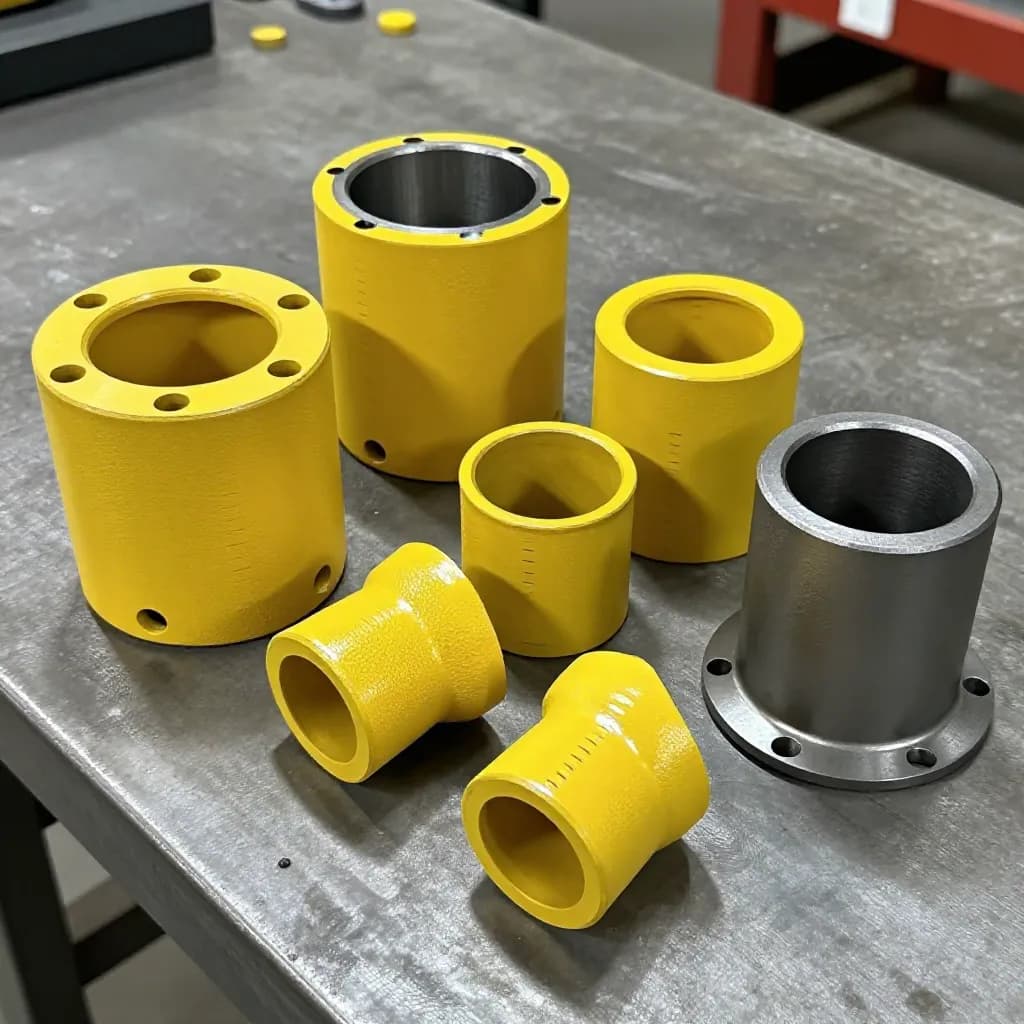
The geometry of fittings and flanges creates particular corrosion challenges. Threaded connections, bolt holes, gasket faces, and internal bores all present recessed areas where moisture and contaminants can accumulate. Crevice corrosion — one of the most aggressive forms of localized attack — thrives in exactly these geometries. Traditional liquid paint systems struggle to provide consistent film build in threads and recesses, leaving vulnerable areas with inadequate protection.
Ready to Start Your Project?
From one-off customs to 15,000-part production runs — get precise pricing in 24 hours.
On This Page
Why Pipe Fittings and Flanges Demand Superior Corrosion Protection
Powder coating addresses these challenges through its ability to build thick, uniform films that penetrate into recesses during the electrostatic application process. Fusion-bonded epoxy (FBE) powder coatings have become the industry standard for pipeline components, while polyester and hybrid formulations serve above-ground applications in HVAC and architectural piping. The thermoset nature of cured powder coatings provides chemical resistance and mechanical toughness that liquid alternatives cannot match at equivalent film thicknesses.
This article examines the specific requirements, standards, and application techniques for powder coating pipe fittings and flanges across the oil and gas, water, HVAC, and general industrial sectors.
Oil and Gas Pipeline Fittings: FBE and Dual-Layer Systems
The oil and gas industry was among the earliest adopters of powder coating technology for pipeline protection, and fusion-bonded epoxy remains the dominant coating system for buried and submerged pipeline fittings and flanges. FBE coatings are applied at 300-500 microns to provide a dense, impermeable barrier against soil moisture, groundwater, crude oil, natural gas condensates, and the cathodic protection currents that supplement the coating system.
For pipeline fittings operating in particularly aggressive environments — deepwater subsea installations, sour gas service, or high-temperature applications — dual-layer and three-layer polyethylene (3LPE) or polypropylene (3LPP) systems build on an FBE primer. The FBE provides adhesion and corrosion protection, an adhesive copolymer layer bonds the FBE to the outer polyolefin layer, and the thick polyolefin topcoat provides mechanical protection against handling damage, rock impingement, and soil stress.
Application of FBE to fittings requires careful temperature control. The steel substrate is heated to 220-245°C before powder application, and the powder must gel and cure within a precise temperature window to achieve optimal crosslink density. Fittings with complex geometries — tees, reducers, and wye branches — require skilled operators or automated systems to ensure consistent coverage on both interior and exterior surfaces. Post-application inspection using holiday detection at 5 volts per micron of coating thickness verifies the absence of pinholes or voids that could initiate corrosion.
Key standards governing FBE coating of pipeline fittings include CSA Z245.20 for external FBE, CSA Z245.21 for internal FBE, and ISO 21809-2 for fusion-bonded epoxy coatings on pipeline components.
Water and Wastewater System Fittings
Powder coating plays a vital role in protecting pipe fittings and flanges used in potable water distribution, wastewater collection, and water treatment infrastructure. The requirements differ significantly from oil and gas applications — coatings must not only resist corrosion but also comply with strict drinking water safety regulations that limit the leaching of contaminants into the water supply.
Fusion-bonded epoxy coatings meeting AWWA C213 (for steel water pipe) and AWWA C116 (for protective fusion-bonded epoxy coatings for the interior and exterior surfaces of ductile-iron and gray-iron fittings) are widely specified for municipal water systems. These coatings must pass NSF/ANSI 61 certification, which evaluates the potential for coatings to leach harmful substances into drinking water. The certification process involves extensive extraction testing under conditions that simulate decades of water contact.
For wastewater applications, the chemical environment is more aggressive. Hydrogen sulfide gas generated by anaerobic bacteria in sewer systems creates sulfuric acid that attacks unprotected metal and concrete surfaces. Epoxy powder coatings with enhanced chemical resistance are specified for fittings in these environments, with film thicknesses of 400-600 microns providing the barrier properties needed to resist acid attack.
Ductile iron fittings — the workhorses of municipal water distribution — are particularly well-suited to powder coating. The preheated casting accepts FBE powder readily, and the coating bridges the surface irregularities inherent in cast iron without the pinholing and bubbling that can affect liquid coatings on rough substrates. Internal coating of fittings ensures smooth flow characteristics and prevents tuberculation — the buildup of iron oxide nodules that restricts flow and harbors bacteria in uncoated iron pipe systems.
HVAC Piping and Ductwork Connections
Heating, ventilation, and air conditioning systems present a different set of requirements for powder-coated fittings and flanges. While the chemical environment is less aggressive than oil and gas or wastewater applications, HVAC fittings must resist condensation-induced corrosion, withstand thermal cycling, and often meet aesthetic requirements when installed in exposed ceiling or mechanical room configurations.
Powder-coated HVAC flanges and fittings typically use polyester or TGIC-free polyester formulations that provide excellent color retention and UV resistance for exposed installations. Standard film thicknesses of 60-80 microns are sufficient for indoor HVAC applications, while outdoor units and rooftop equipment may require 80-120 microns with enhanced weathering resistance.
Condensation management is a primary concern for HVAC fittings. When chilled water or refrigerant lines operate below the dew point, moisture condenses on external surfaces and can initiate corrosion at connection points. Powder coating provides a continuous, pinhole-free barrier that prevents moisture from reaching the metal substrate, eliminating the drip staining and surface corrosion that plague uncoated or poorly coated HVAC connections.
For commercial and institutional buildings where mechanical systems are architecturally exposed, powder-coated fittings and flanges offer a clean, professional appearance that raw or galvanized steel cannot match. Color-coded piping systems — using ANSI/ASME A13.1 color standards to identify pipe contents — are easily achieved with powder coating, providing both safety compliance and visual organization in complex mechanical rooms. The durability of the powder finish ensures that color coding remains legible throughout the system's service life, unlike adhesive labels or liquid paint that can peel, fade, or become obscured by dirt and grease.
Surface Preparation and Pretreatment for Fittings
The performance of any powder coating system on pipe fittings and flanges depends fundamentally on surface preparation. The complex geometries of these components — internal threads, bolt holes, gasket faces, and weld zones — make thorough preparation both critical and challenging.
For carbon steel fittings destined for high-performance service, abrasive blast cleaning to SSPC-SP 10 / NACE No. 2 (Near-White Blast Cleaning) or SSPC-SP 5 / NACE No. 1 (White Metal Blast Cleaning) is the standard requirement. The blast profile should be 50-100 microns for FBE applications, providing mechanical anchoring for the coating. Angular steel grit or aluminum oxide abrasives are preferred over round shot, as they produce the sharp anchor profile that maximizes coating adhesion.
Threaded fittings require special attention during blasting. Threads must be protected with plugs or caps to prevent profile damage that could compromise seal integrity, while the areas immediately adjacent to threads must still receive adequate preparation. After blasting, any residual abrasive must be removed from threads and internal passages using compressed air or vacuum cleaning.
Chemical pretreatment follows blast cleaning for many applications. Iron phosphate conversion coatings are standard for general industrial fittings, while zinc phosphate provides enhanced corrosion protection for demanding environments. For FBE pipeline applications, chromate or chromate-free conversion coatings may be specified to maximize adhesion and underfilm corrosion resistance.
The time between surface preparation and coating application is critical. For FBE pipeline fittings, coating must occur within four hours of blast cleaning to prevent flash rusting. In humid environments, this window may be even shorter. Automated production lines that integrate blasting, pretreatment, and coating application minimize this risk by maintaining process continuity.
Application Challenges Unique to Fittings and Flanges
Powder coating pipe fittings and flanges presents application challenges that differ significantly from flat or simple-geometry parts. The combination of internal and external surfaces, varying wall thicknesses, threaded connections, and bolt-hole patterns requires careful process engineering to achieve consistent coating quality.
The Faraday cage effect is a primary concern when coating the internal bores of fittings. Electrostatic powder guns struggle to deposit powder inside recessed areas because the electric field lines concentrate on external edges and corners rather than penetrating into cavities. For small-bore fittings, this can result in inadequate internal coverage. Solutions include using tribo-charging guns (which are less affected by Faraday cage geometry), reducing gun voltage to allow deeper penetration, or applying powder to internal surfaces before external surfaces using specialized lance-type guns.
Flange faces present the opposite problem — the flat, exposed gasket seating surface attracts excessive powder buildup that can interfere with gasket sealing. Raised-face flanges are particularly susceptible, as powder accumulates on the raised seating area and in the bolt holes. Masking of gasket faces and bolt holes is standard practice for flanges that must maintain precise dimensional tolerances for sealing. Silicone plugs, high-temperature masking tape, and custom masking fixtures are used depending on production volume and flange size.
Heavy-wall fittings and large flanges present thermal mass challenges during curing. A 24-inch, 300-pound class flange may weigh several hundred kilograms, requiring extended oven dwell times to bring the entire mass to curing temperature. The risk of undercure in thick sections and overcure on thinner edges must be managed through careful oven profiling and temperature monitoring using contact thermocouples or data loggers.
Standards and Specifications for Coated Fittings
A comprehensive framework of international standards governs the powder coating of pipe fittings and flanges, reflecting the critical nature of these components in infrastructure systems. Understanding and specifying the correct standards is essential for engineers, procurement teams, and coating applicators.
For oil and gas pipeline fittings, the primary standards include ISO 21809-2 (Petroleum and natural gas industries — External coatings for buried or submerged pipelines — Fusion-bonded epoxy coatings), CSA Z245.20 (Plant-applied external fusion bond epoxy coating for steel pipe), and NACE SP0394 (Application, performance, and quality control of plant-applied fusion-bonded epoxy external pipe coating). These standards define requirements for powder properties, application parameters, film thickness, adhesion, flexibility, cathodic disbondment resistance, and hot-water soak performance.
Water industry standards include AWWA C213, AWWA C116, and NSF/ANSI 61 for potable water contact. EN 14901 covers ductile iron fittings with polyurethane or epoxy internal lining for water and gas applications in Europe.
General industrial coating standards such as ISO 12944 (Corrosion protection of steel structures by protective paint systems) provide a framework for specifying coating systems based on environmental corrosivity categories ranging from C1 (very low) to CX (extreme). Fittings in offshore or chemical plant environments typically require C5 or CX classification, demanding coating systems with proven performance in salt spray, cyclic corrosion, and chemical immersion testing.
Quality control during production typically follows ISO 19840 for dry film thickness measurement, ISO 4624 or ASTM D4541 for adhesion testing, and ASTM G62 or NACE TM0186 for holiday detection on pipeline coatings.
Inspection, Quality Control, and Field Repair
Rigorous inspection and quality control are non-negotiable for powder-coated pipe fittings and flanges, particularly in safety-critical applications such as oil and gas pipelines and potable water systems. A comprehensive QC program spans incoming material verification, in-process monitoring, and final inspection before release.
Film thickness measurement is the most fundamental QC check. For FBE pipeline fittings, minimum and maximum thickness requirements are tightly specified — typically 300-500 microns for external coatings and 250-400 microns for internal linings. Measurements are taken using calibrated magnetic or eddy-current gauges at multiple points on each fitting, with particular attention to areas prone to thin coverage such as internal bores and thread run-outs.
Holiday detection — also called spark testing or continuity testing — is mandatory for pipeline fittings. A calibrated holiday detector applies a high-voltage spark across the coating surface, and any pinhole, void, or thin spot that allows current to pass through to the substrate is flagged for repair. Test voltages are calculated based on coating thickness, typically at 5 volts per micron for coatings up to 500 microns.
Adhesion testing using cross-cut (ISO 2409) or pull-off (ISO 4624) methods verifies that the coating is properly bonded to the substrate. For FBE coatings, a minimum pull-off adhesion of 5 MPa is typical, with cohesive failure within the coating preferred over adhesive failure at the coating-substrate interface.
Field repair of damaged coatings on installed fittings is an inevitable requirement. Two-component liquid epoxy repair materials, heat-shrink sleeves, and petrolatum tape wraps are used depending on the damage extent and accessibility. For critical pipeline applications, field repair procedures must comply with the original coating specification and are subject to the same holiday detection and adhesion testing requirements as the original factory-applied coating.
Frequently Asked Questions
What type of powder coating is used on oil and gas pipeline fittings?
Fusion-bonded epoxy (FBE) is the industry standard for oil and gas pipeline fittings. Applied at 300-500 microns to preheated steel substrates, FBE provides excellent corrosion resistance, cathodic disbondment resistance, and chemical resistance. For extreme environments, dual-layer or three-layer polyethylene systems build on an FBE primer for additional mechanical protection.
Can powder-coated fittings be used in drinking water systems?
Yes, provided the coating meets NSF/ANSI 61 certification for potable water contact. Fusion-bonded epoxy coatings meeting AWWA C213 and AWWA C116 are widely used in municipal water distribution systems. The certification process involves extraction testing to verify that no harmful substances leach into the water supply.
How are flange gasket faces protected during powder coating?
Flange gasket faces and bolt holes are masked before powder application using silicone plugs, high-temperature masking tape, or custom masking fixtures. This prevents powder buildup on sealing surfaces that could interfere with gasket compression and joint integrity. The masking is removed after curing.
What surface preparation is required before powder coating pipe fittings?
Carbon steel fittings typically require abrasive blast cleaning to SSPC-SP 10 (Near-White) or SSPC-SP 5 (White Metal) standards, achieving a 50-100 micron anchor profile. Chemical pretreatment with iron or zinc phosphate follows blasting. Coating must be applied within four hours of preparation to prevent flash rusting.
How is coating quality verified on pipe fittings?
Quality control includes film thickness measurement at multiple points, holiday detection using calibrated spark testing at 5 volts per micron, and adhesion testing via cross-cut or pull-off methods. Pipeline fittings must pass all tests before release, with particular attention to internal bores and threaded areas where coverage can be challenging.
Ready to Start Your Project?
From one-off customs to 15,000-part production runs — get precise pricing in 24 hours.