Perforated metal panels have become one of the most versatile elements in contemporary architecture, serving simultaneously as solar shading, privacy screening, ventilation, acoustic control, and decorative facade expression. From simple round-hole patterns to complex CNC-punched designs that create images and patterns when viewed from a distance, perforated metal transforms building envelopes into dynamic, functional surfaces.
Architecture
Powder Coating for Perforated Metal Panels: Facade Screens, Acoustic Panels, and Edge Coverage
Sundial Powder Coating·April 23, 2026·11 min
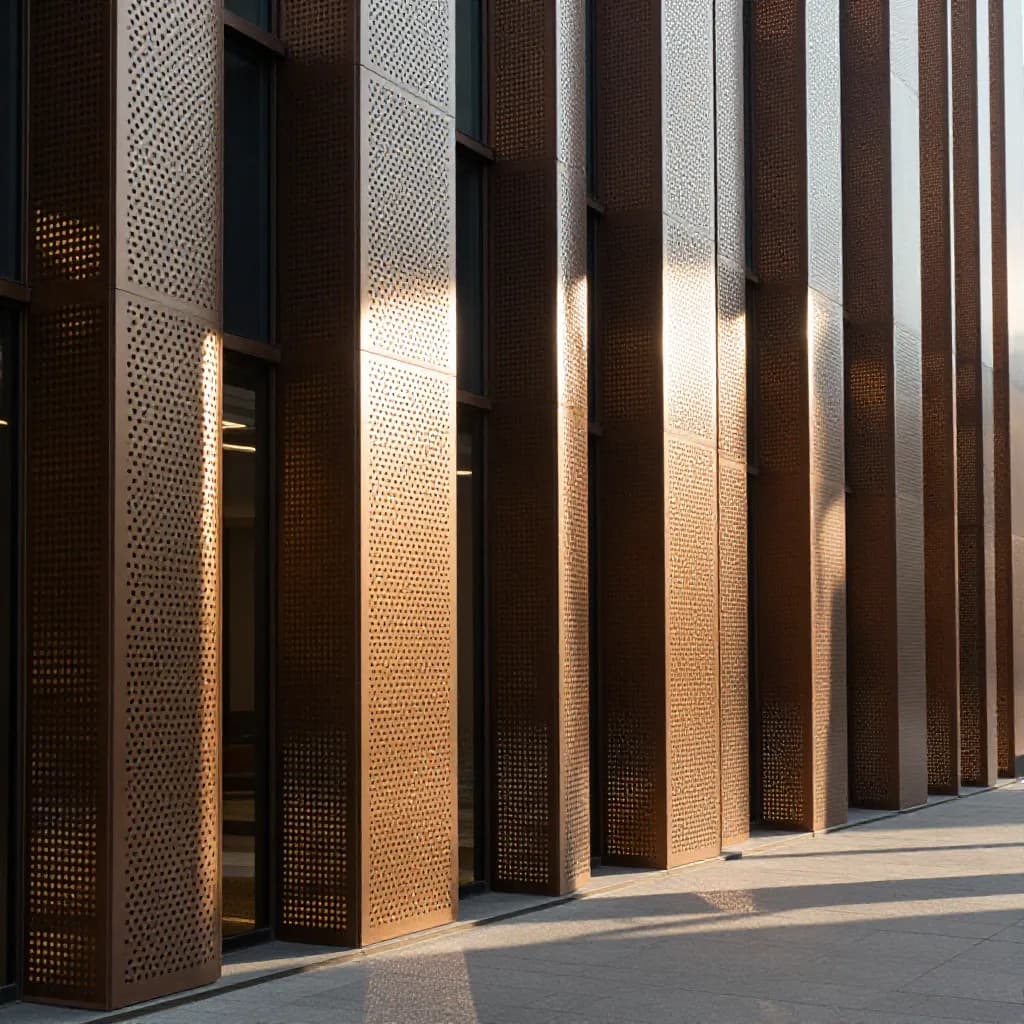
Powder coating is the dominant finishing technology for architectural perforated metal, providing the color, durability, and environmental performance that facade applications demand. However, the thousands of holes in a perforated panel create specific coating challenges that differ significantly from solid sheet metal finishing. Each hole is a miniature Faraday cage that resists electrostatic powder penetration, and each hole edge is a sharp transition that is prone to coating thinning.
Ready to Start Your Project?
From one-off customs to 15,000-part production runs — get precise pricing in 24 hours.
On This Page
Perforated Metal: Where Function Meets Architectural Expression
The scale of the challenge is significant. A typical perforated facade panel measuring 1000 × 2000 mm with 8 mm round holes at 40% open area contains approximately 15,900 holes — each with a circumferential edge that must be adequately coated for corrosion protection. The total edge length on this single panel exceeds 400 meters, representing an enormous amount of vulnerable edge area that must be protected.
This article examines the specific challenges of powder coating perforated metal panels, the application techniques that achieve reliable coverage, and the quality considerations for architectural facade and acoustic panel applications.
The Faraday Effect in Perforated Panels
The Faraday cage effect in perforated metal panels manifests differently than in wire mesh or enclosed structures. Each perforation acts as a small opening in a conductive sheet, and the electrostatic field lines that drive powder deposition are distorted around each hole in ways that affect coating uniformity on both the hole edges and the panel surface adjacent to the holes.
When an electrostatic powder gun is directed at a perforated panel, the electric field concentrates on the solid metal areas between holes and at the edges of each hole facing the gun. The interior surfaces of the holes (the hole walls) and the edges on the back side of the panel receive significantly less powder deposition because the field lines do not penetrate effectively through the holes.
The severity of the Faraday effect depends on the perforation pattern and open area percentage. Panels with small holes (less than 3 mm diameter) and high open area (greater than 50%) present the strongest Faraday effect because the closely spaced holes create an almost continuous electromagnetic shield. Panels with larger holes (8-15 mm) and lower open area (20-40%) are less affected because the larger openings allow more field penetration.
Hole shape also influences the Faraday effect. Round holes create a symmetrical field distortion, while elongated slots, square holes, and irregular shapes create asymmetric effects that can result in uneven coating distribution around the hole perimeter. Slots oriented perpendicular to the gun traverse direction may receive better edge coverage than slots oriented parallel to the traverse.
The panel thickness relative to hole diameter affects hole wall coverage. For thin panels (1-2 mm) with large holes, the hole wall is essentially an edge that receives the same treatment as any sharp edge. For thicker panels (3-6 mm) with smaller holes, the hole wall becomes a recessed surface that is more difficult to coat, similar to a small-diameter bore.
Practical solutions for the Faraday effect on perforated panels include reducing gun voltage to 30-50 kV (allowing powder to penetrate into holes rather than being deflected), using tribo-charging guns (which are less affected by the Faraday geometry), spraying from both sides of the panel, and applying powder at higher-than-normal film thickness on the gun side to ensure that even the thinnest areas on hole edges meet minimum protection requirements.
Edge Coverage on Thousands of Hole Perimeters
The edge coverage challenge on perforated panels is a scaled-up version of the sharp edge problem that affects all powder-coated parts. Each hole in the panel has a sheared or punched edge with a radius approaching zero, and the surface tension of the molten powder during curing causes the coating to thin at these edges — potentially leaving thousands of inadequately protected edge points on a single panel.
The punching or laser cutting process that creates the perforations determines the initial edge condition. Punched holes have a characteristic profile: a slight rollover on the punch entry side, a clean sheared zone through the middle of the material thickness, and a burr or breakout zone on the die side. The burr side presents the sharpest edge and the greatest challenge for coating coverage.
Deburring perforated panels is standard practice for architectural applications. Tumble deburring, vibratory finishing, or wide-belt sanding removes the burr and slightly rounds the hole edges, improving both coating coverage and safe handling. The degree of edge rounding achievable depends on the panel thickness and hole pattern — thin panels with closely spaced holes are more fragile and cannot withstand aggressive deburring without distortion.
For laser-cut perforated panels, the edge condition depends on the assist gas (as discussed in the laser cutting article). Nitrogen-cut holes have clean, oxide-free edges that are more compatible with powder coating than oxygen-cut holes with their adherent oxide layer. For architectural perforated panels that will be powder coated, nitrogen-assist cutting is strongly recommended.
Powder formulation significantly affects edge coverage on perforated panels. High-viscosity powder formulations that resist flow during curing maintain better coverage on hole edges than low-viscosity formulations that flow readily. Textured and matte finishes provide inherently better edge coverage than high-gloss smooth finishes because their higher melt viscosity limits the surface tension-driven flow away from edges.
Some powder manufacturers offer specific formulations optimized for perforated metal, with modified rheology that provides improved edge coverage without sacrificing appearance on flat areas. These formulations typically have a slightly higher gel time, allowing the powder to flow and level on flat surfaces while maintaining sufficient viscosity to resist edge thinning.
Film thickness strategy for perforated panels often involves applying a slightly thicker overall film (80-100 microns on flat areas) to ensure that even the thinnest areas on hole edges meet the minimum protection requirement (typically 40-50 microns). This approach increases powder consumption but provides a safety margin for edge coverage.
Facade Screen and Rainscreen Applications
Perforated metal facade screens are one of the fastest-growing applications in architectural powder coating, driven by the increasing use of double-skin facades, solar shading systems, and decorative screening in contemporary building design.
Solar shading screens use perforated metal to reduce solar heat gain on building facades while maintaining outward visibility and natural daylight. The perforation pattern, open area percentage, and panel orientation are engineered to optimize the balance between solar control and visual transparency. Powder coating these screens in light colors with high solar reflectance maximizes the shading effectiveness by reflecting solar radiation rather than absorbing it.
Rainscreen cladding systems use perforated metal as the outer skin of a ventilated facade assembly. The perforations allow air circulation behind the panel, promoting drainage and drying of the cavity while providing weather protection and aesthetic expression. The coating on rainscreen panels must withstand direct weather exposure — UV radiation, rain, wind-driven dust, and temperature cycling — for the building's design life, typically 25-40 years.
Super-durable polyester powder coatings meeting Qualicoat Class 2 or AAMA 2604 specifications are the standard choice for perforated facade screens. These formulations provide the UV resistance and color retention needed for long-term outdoor exposure, with gloss retention of 50% or better after 10 years of South Florida weathering (the benchmark for architectural coating durability).
For projects in aggressive coastal or industrial environments, AAMA 2605 or Qualicoat Class 3 specifications may be required. These premium specifications demand fluoropolymer-based coatings (PVDF/Kynar) that provide superior weathering resistance, though PVDF powder coatings are less widely available than liquid PVDF systems. High-performance polyester formulations that approach PVDF weathering performance are increasingly available as powder coatings and may satisfy the intent of these specifications.
The visual impact of perforated facade screens depends on the interplay between the perforation pattern, the coating color, and the viewing angle. Dark colors on the panel surface with a lighter color visible through the perforations (from the building wall behind) create a strong visual contrast that emphasizes the perforation pattern. Lighter panel colors with dark backgrounds create a more subtle, veiled effect. Architects should evaluate color samples on actual perforated panels at the intended viewing distance to assess the visual effect before finalizing the specification.
Acoustic Panel Applications
Perforated metal acoustic panels use the perforations to allow sound energy to pass through the metal face and be absorbed by acoustic insulation material behind the panel. These panels are used in concert halls, auditoriums, offices, transportation terminals, and industrial facilities to control reverberation and reduce noise levels.
The acoustic performance of perforated metal panels depends on the open area percentage, hole size, and panel thickness — and the powder coating can affect all three parameters. Coating buildup on hole edges effectively reduces the hole diameter, which reduces the open area and can alter the acoustic absorption characteristics of the panel. For a panel with 3 mm holes and 60 microns of coating on each edge, the effective hole diameter is reduced to approximately 2.88 mm — a 4% reduction in diameter that translates to an 8% reduction in open area.
For acoustically critical applications, the coating thickness on hole edges must be accounted for in the acoustic design. Either the perforation pattern is designed with slightly larger holes to compensate for coating buildup, or the coating thickness is controlled to minimize the impact on acoustic performance. Communication between the acoustic engineer, the panel manufacturer, and the coating applicator is essential to ensure that the finished panel meets both acoustic and coating specifications.
The coating surface texture can also affect acoustic performance. Smooth, glossy coatings reflect sound energy more effectively than matte or textured coatings, which scatter sound. For panels where the metal face is intended to be acoustically reflective (directing sound toward the absorptive backing), a smooth coating is preferred. For panels where the metal face should contribute to sound diffusion, a textured coating provides additional scattering.
In environments where acoustic panels are exposed to moisture — swimming pools, food processing facilities, outdoor canopies — the coating must provide corrosion protection in addition to acoustic function. Epoxy or epoxy-polyester powder coatings provide the moisture resistance needed for these environments, while polyester coatings are used for dry interior applications where UV resistance and color options are priorities.
Cleanability is an important consideration for acoustic panels in commercial and institutional settings. Perforated panels accumulate dust and debris in the perforations and on the panel surface, and the coating must withstand regular cleaning without degradation. Smooth, hard powder coatings resist dirt adhesion and are easier to clean than textured finishes, though textured finishes better hide minor soiling between cleaning cycles.
Application Techniques for Perforated Panels
Achieving consistent coating quality on perforated metal panels requires application techniques specifically adapted for the unique challenges of this substrate. The combination of Faraday cage effects, edge coverage requirements, and the need for uniform appearance across large panel areas demands careful process optimization.
Dual-side coating is the most reliable method for achieving complete coverage on perforated panels. The panel is coated from the front (show side) first, then rotated or flipped and coated from the back. This ensures that both the front and back surfaces, as well as the hole walls, receive direct powder deposition rather than relying on electrostatic wrap-around. For production efficiency, some coating lines use opposing gun banks that coat both sides simultaneously.
Gun voltage optimization is critical for perforated panels. Standard corona gun voltages of 60-80 kV create strong field lines that concentrate on the solid metal areas and deflect around holes, resulting in poor hole edge coverage. Reducing voltage to 30-50 kV allows powder to penetrate into and through the holes more effectively. The trade-off is reduced transfer efficiency on solid areas, requiring more powder and longer spray times.
Tribo-charging guns offer significant advantages for perforated panel coating. Because tribo guns charge powder through friction rather than corona discharge, they do not create the strong directional field lines that cause the Faraday effect. Powder from tribo guns deposits more uniformly across the panel surface, including hole edges and walls, producing better overall coverage with less thickness variation between solid areas and hole edges.
Conveyor speed and gun traverse rate must be matched to the panel's perforation density. Panels with high open area (50%+) require slower conveyor speeds or multiple spray passes to build adequate film thickness, because a significant portion of the sprayed powder passes through the perforations rather than depositing on the panel surface. Powder reclaim systems must account for the higher overspray rates associated with perforated panel coating.
Panel orientation during coating affects drainage and appearance. Horizontal orientation allows powder to settle into holes by gravity, potentially improving hole wall coverage but risking powder accumulation on horizontal surfaces. Vertical orientation provides more uniform coverage but may result in thin spots at the top of the panel due to gravity-assisted powder flow during curing. Most production lines coat perforated panels in a vertical orientation, matching the standard conveyor configuration.
For large architectural panels (2000 × 4000 mm or larger), maintaining uniform film thickness across the entire panel area requires careful gun programming. Reciprocating guns must maintain consistent gun-to-panel distance and traverse speed across the full panel width, and edge effects at the panel perimeter must be managed to prevent excessive buildup at panel edges.
Quality Control and Specification for Architectural Perforated Panels
Quality control for powder-coated perforated metal panels must address both the standard coating quality parameters (thickness, adhesion, appearance) and the specific challenges of verifying coating performance on a substrate with thousands of holes.
Film thickness measurement on perforated panels is performed on the solid areas between holes using standard magnetic or eddy-current gauges. The measurement locations should be representative of the panel area, including the center, edges, and corners. Thickness on hole edges is more difficult to measure directly — cross-sectional microscopy of sample holes provides the most accurate edge thickness data, while small-area probes can measure thickness on the hole wall of larger perforations.
Appearance evaluation for architectural panels includes color measurement (spectrophotometry per ASTM D2244), gloss measurement (per ASTM D523), and visual assessment of uniformity, orange peel, and defects. The visual assessment should be performed at the intended viewing distance — facade panels viewed from 10-20 meters do not require the same close-up perfection as interior panels viewed from 1-2 meters.
The specification for architectural perforated panels should define the coating requirements in the context of the panel's function. For facade screens, the specification should reference Qualicoat, AAMA, or equivalent standards for weathering performance. For acoustic panels, the specification should include the acoustic performance requirements and the allowable coating impact on perforation dimensions. For interior decorative panels, appearance requirements may take precedence over weathering performance.
Sample panel approval is standard practice for architectural perforated panel projects. The coating applicator produces sample panels using the production powder, pretreatment, and application parameters, and these samples are evaluated by the architect and project team before production coating begins. The approved sample becomes the reference standard for production quality, and production panels are compared to the approved sample for color, gloss, texture, and overall appearance.
Accelerated weathering testing per ASTM G154 or G155 provides performance data for facade applications. Test panels should be perforated panels (not solid panels) to ensure that the test results reflect the actual coating performance on the perforated substrate, including any edge-related degradation that may not appear on solid test panels.
For projects requiring long-term performance guarantees, the powder manufacturer and coating applicator may provide a joint warranty covering color retention, gloss retention, and coating integrity for a specified period (typically 10-25 years depending on the specification tier). These warranties are contingent on proper pretreatment, application within specified parameters, and adherence to recommended maintenance procedures.
Frequently Asked Questions
Why is powder coating perforated metal more difficult than solid panels?
Each perforation creates a miniature Faraday cage that deflects electrostatic field lines, reducing powder deposition on hole edges and walls. A typical facade panel may contain 15,000+ holes, each with edges prone to coating thinning. The combined effect of Faraday cage and edge thinning requires specialized application techniques for reliable coverage.
Does powder coating affect the acoustic performance of perforated panels?
Yes. Coating buildup on hole edges reduces effective hole diameter and open area. For a panel with 3 mm holes and 60 microns of edge coating, the open area is reduced by approximately 8%. Acoustically critical applications must account for coating thickness in the perforation design or control coating thickness to minimize acoustic impact.
What application technique works best for perforated panels?
Dual-side coating with reduced gun voltage (30-50 kV) or tribo-charging guns provides the most reliable coverage. Tribo guns are particularly effective because they don't create the directional field lines that cause the Faraday effect. Coating both sides ensures hole walls and back-side edges receive adequate powder deposition.
What powder coating specification is used for perforated facade screens?
Super-durable polyester meeting Qualicoat Class 2 or AAMA 2604 is standard for most facade applications. For aggressive coastal or industrial environments, Qualicoat Class 3 or AAMA 2605 specifications may be required. High-performance polyester formulations increasingly approach fluoropolymer weathering performance in powder form.
How is coating quality verified on perforated panels?
Film thickness is measured on solid areas between holes with standard gauges. Hole edge thickness requires cross-sectional microscopy or small-area probes. Appearance is evaluated at the intended viewing distance. Sample panel approval before production ensures color, gloss, and texture meet architectural requirements.
Ready to Start Your Project?
From one-off customs to 15,000-part production runs — get precise pricing in 24 hours.